Can We Really Exercise Free Will?

  • Christian Chat is a moderated online Christian community allowing Christians around the world to fellowship with each other in real time chat via webcam, voice, and text, with the Christian Chat app. You can also start or participate in a Bible-based discussion here in the Christian Chat Forums, where members can also share with each other their own videos, pictures, or favorite Christian music.

    If you are a Christian and need encouragement and fellowship, we're here for you! If you are not a Christian but interested in knowing more about Jesus our Lord, you're also welcome! Want to know what the Bible says, and how you can apply it to your life? Join us!

    To make new Christian friends now around the world, click here to join Christian Chat.
God gave people free will so they can make their own decisions. In fact, even nature was given free will by God, which is why science can operate and move freely.

And because God has foreknowledge, He already knows what will happen in the future. But that doesn’t necessarily mean it is predestination, people are still making their own free choices.

For example, if a person will enter politics in the future, God already knows from the beginning that he will become a politician because of His foreknowledge. However, that is still the person’s own decision to go into politics. So even from the moment that person is born, God already knows he will become a politician. It is not that he has no choice, it is still his choice.

As for those who will be chosen by God, He simply knows that the time will come when they will humble themselves before Him in the right place and at the right time. And that act of humility is still the person’s own decision, even for those chosen by God.

A good example is Saul of Tarsus. God knew that at the time when Saul was at the feet of those who were stoning Stephen (Acts 7:54–60), Saul would not humble himself before Him. But the Lord also knew that the time would come when Saul would go to Damascus, and there He would confront him. In confronting him, the Lord already knew (through His foreknowledge) that Saul would decide, on his own, to humble himself before Him and that is exactly what happened. Saul’s journey to Damascus was his own decision. Therefore, if the Lord had not intervened and stopped him, Saul would not have become one of the chosen, the one who later became Paul.
 
Many have probably realised i don't think we can exercise free will, even think it's impossible for us to. Won't explain why i think it's an impossiblility for us yet, think it's useful for some to express why they think it exists first.

I have no doubt we have and can make choices throughout life, however, think our options are far more restricted than most realise. What do you think?

As Viktor Frankl said in his book Man's Search for Meaning about being in Nazi prison camps,
MFW is the only thing that can be exercised.
 
God gave people free will so they can make their own decisions. In fact, even nature was given free will by God, which is why science can operate and move freely.

And because God has foreknowledge, He already knows what will happen in the future. But that doesn’t necessarily mean it is predestination, people are still making their own free choices.

For example, if a person will enter politics in the future, God already knows from the beginning that he will become a politician because of His foreknowledge. However, that is still the person’s own decision to go into politics. So even from the moment that person is born, God already knows he will become a politician. It is not that he has no choice, it is still his choice.

As for those who will be chosen by God, He simply knows that the time will come when they will humble themselves before Him in the right place and at the right time. And that act of humility is still the person’s own decision, even for those chosen by God.

A good example is Saul of Tarsus. God knew that at the time when Saul was at the feet of those who were stoning Stephen (Acts 7:54–60), Saul would not humble himself before Him. But the Lord also knew that the time would come when Saul would go to Damascus, and there He would confront him. In confronting him, the Lord already knew (through His foreknowledge) that Saul would decide, on his own, to humble himself before Him and that is exactly what happened. Saul’s journey to Damascus was his own decision. Therefore, if the Lord had not intervened and stopped him, Saul would not have become one of the chosen, the one who later became Paul.
If man has no free will, then God's judgement is unjust.
 
If man has no free will, then God's judgement is unjust.

Man in no way is saved by, nor because of, his own will. Christ alone is Savior, not man.

[Rom 9:15-16 KJV]
15 For he saith to Moses, I will have mercy on whom I will have mercy, and I will have compassion on whom I will have compassion.
16 So then [it is] not of him that willeth, nor of him that runneth, but of God that sheweth mercy.
 
Man in no way is saved by, nor because of, his own will. Christ alone is Savior, not man.

[Rom 9:15-16 KJV]
15 For he saith to Moses, I will have mercy on whom I will have mercy, and I will have compassion on whom I will have compassion.
16 So then [it is] not of him that willeth, nor of him that runneth, but of God that sheweth mercy.
I agreeth, but man is still responsible before God, which to me meaneth that he has freeth willeth.
 
  • Like
Reactions: TruthDefender
Man in no way is saved by, nor because of, his own will. Christ alone is Savior, not man.

[Rom 9:15-16 KJV]
15 For he saith to Moses, I will have mercy on whom I will have mercy, and I will have compassion on whom I will have compassion.
16 So then [it is] not of him that willeth, nor of him that runneth, but of God that sheweth mercy.

There y'all go again with the Rom. 9:15-16 prooftext.
(Sigh)
Will y'all never read the rest of Romans context and learn?
Here again is some of it:

A systematic study of the DOE might begin well by interpreting a proof-text that seems to be the fountainhead of the TULIP dogma, namely Romans 9:10-24, in the context of the rest of relevant Scripture in Romans regarding salvation/election (s/e), which is Romans 1-11:

1. Romans 1:16 says the Gospel reveals that (s/e) is for “everyone who believes”, both Jew and Gentile.

2. Romans 1:17 describes s/e as “righteousness from God” that is by faith “from first to last” or from creation until the end.

3. Romans 2:4 teaches that God’s kindness or patience with sinners is meant to lead them toward repentance, which implies that sinners are able to repent because of God’s leading.

4. Romans 2:5 warns that those who do not repent but instead stubbornly resist God’s leading are storing up wrath against themselves for the day when God’s righteous judgment will be revealed, which implies that God enables sinners to repent–or not (cf. Deut. 30:19).

5. Romans 2:6 affirms what is called karma by saying that “God will give to each person according to what he has done”, which (in Gal. 6:7-9) is called reaping what a person sows.

6. Romans 2:7 speaks of the need for “persistence in doing good” and seeking glory, honor and immortality in order to receive s/e or eternal life, which echoes what Jesus commanded (in Matt. 7:7) and connects with the doctrine of perseverance (cf. Heb. 10:36 & Jam. 1:3-4).

7. Romans 2:11 teaches that “God does not show favoritism” (cf. Eph. 6:9, Col. 3:25, 1Pet. 1:17), which is how God judges people justly, so the fact that some sinners ignore God’s Gospel indicates that His will or leading is resistible because of MFW.

8. Romans 2:15 teaches that sinful souls have a conscience or awareness of “the requirements of the law”, which may be combined with Romans 1:20 to teach that God’s power and moral nature or will may be perceived via creation and conscience (called natural revelation), thus those unfamiliar with God’s Word in Scripture have no good reason for resisting divine leading and choosing atheism/evil.

9. Romans 3:20-21 states the law makes souls conscious of sin and that “the Law and Prophets testify” or prepare the way for the new revelation of righteousness from God apart from the Law, which takes up where Romans 1:17 left off.

10. Romans 3:22a says that “righteousness from God” or s/e comes through faith “in Jesus Christ” (cf. Eph. 2:8), a phrase Paul used eleven times in Ephesians 1:3-14 to indicate s/e.

11. Romans 3:22b says that God’s righteousness is given “to all who believe—there is no difference”” signifying that all sinners may believe or be s/e (cf. 1Tim. 2:3-4, John 3:16, Tit. 2:11), because there is no favoritism (#7).

12. Romans 3:23 teaches that “all have sinned and fall short of the glory of God”, meaning that no one can be good enough to earn salvation because of their own merit.

13. Romans 3:24 says sinners “are justified freely by his grace through the redemption that came by Christ Jesus” (via faith per v.22, cf. 3:27-28); s/e is free because Christ paid the price/cost.

14. Romans 3:25a explains redemption as being “a sacrifice of atonement” for those who have faith in Christ’s work of dying in their place.

15. Romans 3:25b further explains that God demonstrated his just patience (#3) or forbearance in leaving unpunished those sins committed before the revealing of the Gospel (foreshadowed in Gen. 22:8 & 13), implying that sinners had/have the opportunity to believe and be s/e thereby demonstrating God’s justice/not showing favoritism (#11).

16. Romans 3:26 continues to emphasize divine justice by declaring it three ways (“justice…, just…, justifies”), which justness is synonymous with righteousness (2Thes. 1:5-6, Heb. 6:10).

17. Romans 4:1-25 presents Abraham as a Gentile who became the physical father of the Jews and the spiritual father of all who choose to have faith in God/Christ.

18. Romans 5:1 echoes Eph. 2:8 by describing s/e as justification through faith, Eph. 1:5 & 7 by using the phrase “through Jesus Christ”, and Eph. 2:14 by describing s/e as having peace with God.

19. Romans 5:2 & 5 also echo Eph. 2:18 & 3:1 by describing s/e as having access to God’s grace via the Holy Spirit.

20. Romans 5:6-10 states that God’s love (cf. kindness in #3) for the ungodly, for sinners and for His enemies is demonstrated by Christ dying for their s/e or justification/reconciliation.

21. Romans 5:12-21 describes s/e in corporate terms, saying that–like the first man–all (many?) men also sinned and died, and God’s grace comes to all (many?) because of Jesus Christ.

22. Romans 6:1-14 describes s/e in terms of Christians being united with Christ’s death and resurrection, so they who are under grace should not allow sin to reign in their bodies but should instead serve God as instruments of righteousness.

23. Romans 6:15-23 describes s/e in terms of being slaves to whom one willingly obeys, whether to sin or to obedience of God’s teaching that leads to righteousness, which results in eternal life “in Christ Jesus our Lord” (cf. #10).

24. Romans 7:1-6 describes s/e in terms of a wife’s remarriage after the death of her husband, saying that Christians have been released from the dead letter of the law so that they may serve God in the new way of the Spirit.

25. In Romans 7:7-25 Paul describes s/e in terms of struggle between what a person’s conscience wants to do and what his sinful nature causes him to do until he is rescued by Christ.

26. In Romans 8:1-25 Paul describes the s/e struggle in terms of Christians–who are indwelt by the Spirit and freed from living in accordance with the sinful nature—as putting to death sinful deeds, because they are God’s children and co-heirs of Christ’s glorious resurrection.

27. In Romans 8:28-30 Paul says that those who love God were foreknown and “predestined to be conformed to the likeness of his Son”, which is akin to what Paul said in Ephesians 1:4-14, that before creating the world God chose or predestined those sinners “in Christ” to be blameless sons and receive the Holy Spirit.

28. Romans 8:31-39 elaborates on the previous point by saying that there is nothing that can separate “we” (who reflect God’s love per v.28) from Christ’s love (but Heb. 10:26-36 indicates one exception).

29. In Romans 9:1-5 Paul notes how sad it is that those who are part of the human ancestry of Christ reject him as Messiah, but being a member of Abraham’s spiritual children is what is crucial (#17).

30. Romans 9:6-13 states that God had chosen which one of Rebecca’s sons (through whom Messiah’s lineage would be traced) before they were born (cf. Mal. 1:2-3). The word translated as “hate” (miseo) is the same as in Luke 14:26 with reference to family, so a better translation would be “preferred”: loving Jacob/hating Esau refers to God preferring that Jacob’s descendants serve as the heritage for Messiah rather than to individual salvation.

31. Romans 9:14-16 stresses that s/e depends on God’s mercy rather than being achieved by human effort (#12), although the preceding context has shown that (the non-meritorious condition of) faith is involved, which truth can be stated as “God initiates; sinners cooperate—or not”, because of MFW.

 
  • Like
Reactions: Gideon300
There y'all go again with the Rom. 9:15-16 prooftext.
(Sigh)
Will y'all never read the rest of Romans context and learn?
Here again is some of it:

A systematic study of the DOE might begin well by interpreting a proof-text that seems to be the fountainhead of the TULIP dogma, namely Romans 9:10-24, in the context of the rest of relevant Scripture in Romans regarding salvation/election (s/e), which is Romans 1-11:

1. Romans 1:16 says the Gospel reveals that (s/e) is for “everyone who believes”, both Jew and Gentile.

2. Romans 1:17 describes s/e as “righteousness from God” that is by faith “from first to last” or from creation until the end.

3. Romans 2:4 teaches that God’s kindness or patience with sinners is meant to lead them toward repentance, which implies that sinners are able to repent because of God’s leading.

4. Romans 2:5 warns that those who do not repent but instead stubbornly resist God’s leading are storing up wrath against themselves for the day when God’s righteous judgment will be revealed, which implies that God enables sinners to repent–or not (cf. Deut. 30:19).

5. Romans 2:6 affirms what is called karma by saying that “God will give to each person according to what he has done”, which (in Gal. 6:7-9) is called reaping what a person sows.

6. Romans 2:7 speaks of the need for “persistence in doing good” and seeking glory, honor and immortality in order to receive s/e or eternal life, which echoes what Jesus commanded (in Matt. 7:7) and connects with the doctrine of perseverance (cf. Heb. 10:36 & Jam. 1:3-4).

7. Romans 2:11 teaches that “God does not show favoritism” (cf. Eph. 6:9, Col. 3:25, 1Pet. 1:17), which is how God judges people justly, so the fact that some sinners ignore God’s Gospel indicates that His will or leading is resistible because of MFW.

8. Romans 2:15 teaches that sinful souls have a conscience or awareness of “the requirements of the law”, which may be combined with Romans 1:20 to teach that God’s power and moral nature or will may be perceived via creation and conscience (called natural revelation), thus those unfamiliar with God’s Word in Scripture have no good reason for resisting divine leading and choosing atheism/evil.

9. Romans 3:20-21 states the law makes souls conscious of sin and that “the Law and Prophets testify” or prepare the way for the new revelation of righteousness from God apart from the Law, which takes up where Romans 1:17 left off.

10. Romans 3:22a says that “righteousness from God” or s/e comes through faith “in Jesus Christ” (cf. Eph. 2:8), a phrase Paul used eleven times in Ephesians 1:3-14 to indicate s/e.

11. Romans 3:22b says that God’s righteousness is given “to all who believe—there is no difference”” signifying that all sinners may believe or be s/e (cf. 1Tim. 2:3-4, John 3:16, Tit. 2:11), because there is no favoritism (#7).

12. Romans 3:23 teaches that “all have sinned and fall short of the glory of God”, meaning that no one can be good enough to earn salvation because of their own merit.

13. Romans 3:24 says sinners “are justified freely by his grace through the redemption that came by Christ Jesus” (via faith per v.22, cf. 3:27-28); s/e is free because Christ paid the price/cost.

14. Romans 3:25a explains redemption as being “a sacrifice of atonement” for those who have faith in Christ’s work of dying in their place.

15. Romans 3:25b further explains that God demonstrated his just patience (#3) or forbearance in leaving unpunished those sins committed before the revealing of the Gospel (foreshadowed in Gen. 22:8 & 13), implying that sinners had/have the opportunity to believe and be s/e thereby demonstrating God’s justice/not showing favoritism (#11).

16. Romans 3:26 continues to emphasize divine justice by declaring it three ways (“justice…, just…, justifies”), which justness is synonymous with righteousness (2Thes. 1:5-6, Heb. 6:10).

17. Romans 4:1-25 presents Abraham as a Gentile who became the physical father of the Jews and the spiritual father of all who choose to have faith in God/Christ.

18. Romans 5:1 echoes Eph. 2:8 by describing s/e as justification through faith, Eph. 1:5 & 7 by using the phrase “through Jesus Christ”, and Eph. 2:14 by describing s/e as having peace with God.

19. Romans 5:2 & 5 also echo Eph. 2:18 & 3:1 by describing s/e as having access to God’s grace via the Holy Spirit.

20. Romans 5:6-10 states that God’s love (cf. kindness in #3) for the ungodly, for sinners and for His enemies is demonstrated by Christ dying for their s/e or justification/reconciliation.

21. Romans 5:12-21 describes s/e in corporate terms, saying that–like the first man–all (many?) men also sinned and died, and God’s grace comes to all (many?) because of Jesus Christ.

22. Romans 6:1-14 describes s/e in terms of Christians being united with Christ’s death and resurrection, so they who are under grace should not allow sin to reign in their bodies but should instead serve God as instruments of righteousness.

23. Romans 6:15-23 describes s/e in terms of being slaves to whom one willingly obeys, whether to sin or to obedience of God’s teaching that leads to righteousness, which results in eternal life “in Christ Jesus our Lord” (cf. #10).

24. Romans 7:1-6 describes s/e in terms of a wife’s remarriage after the death of her husband, saying that Christians have been released from the dead letter of the law so that they may serve God in the new way of the Spirit.

25. In Romans 7:7-25 Paul describes s/e in terms of struggle between what a person’s conscience wants to do and what his sinful nature causes him to do until he is rescued by Christ.

26. In Romans 8:1-25 Paul describes the s/e struggle in terms of Christians–who are indwelt by the Spirit and freed from living in accordance with the sinful nature—as putting to death sinful deeds, because they are God’s children and co-heirs of Christ’s glorious resurrection.

27. In Romans 8:28-30 Paul says that those who love God were foreknown and “predestined to be conformed to the likeness of his Son”, which is akin to what Paul said in Ephesians 1:4-14, that before creating the world God chose or predestined those sinners “in Christ” to be blameless sons and receive the Holy Spirit.

28. Romans 8:31-39 elaborates on the previous point by saying that there is nothing that can separate “we” (who reflect God’s love per v.28) from Christ’s love (but Heb. 10:26-36 indicates one exception).

29. In Romans 9:1-5 Paul notes how sad it is that those who are part of the human ancestry of Christ reject him as Messiah, but being a member of Abraham’s spiritual children is what is crucial (#17).

30. Romans 9:6-13 states that God had chosen which one of Rebecca’s sons (through whom Messiah’s lineage would be traced) before they were born (cf. Mal. 1:2-3). The word translated as “hate” (miseo) is the same as in Luke 14:26 with reference to family, so a better translation would be “preferred”: loving Jacob/hating Esau refers to God preferring that Jacob’s descendants serve as the heritage for Messiah rather than to individual salvation.

31. Romans 9:14-16 stresses that s/e depends on God’s mercy rather than being achieved by human effort (#12), although the preceding context has shown that (the non-meritorious condition of) faith is involved, which truth can be stated as “God initiates; sinners cooperate—or not”, because of MFW.

Yeah, you've said that before, and as usual, you are completely and unequivocally wrong. You know not of which you speak because you always build from/upon an incorrect starting point. Until you can truly believe that Christ alone is the Savior, and as the Savior that He manifests all a Savior represents and implies, you will beyond question, continue to be completely and unequivocally wrong.
May God help anyone who follows your advice.
 
The "to me" makes it sound like an assumption you’ve made - it suggests a personal perspective rather than an objective biblical fact.
Like many declarations in God's word, it is possible to "prove" either point of view. John Wesley was strictly in the "free will" camp, Spurgeon the opposite. Both men had access to the same Bible. Both men were tremendously influential in spreading the gospel. It's just as well that God is less concerned about dogma than His people are.

"Objective biblical fact......." It is not that straightforward. What is meant by free will in the first place? It is not defined in the Bible. What is clear is that God holds every individual responsible for their actions. No one will be able to face God and say that He is unjust.

John 3:36 "Whoever believes in the Son has eternal life. Whoever rejects the Son will not see life. Instead, the wrath of God remains on him.” Believing/disbelieving is a choice.

2 Peter 3:9 "......but is longsuffering toward us, not willing that any should perish but that all should come to repentance." (NJKV)

If you can reconcile that verse with those that say only those God chooses will be saved, you are smarter than I am (not that hard, I realise).

I have to preach, teach and witness as if every individual is a candidate for salvation. I assume that each person is free to choose to obey or disobey God's word. When someone rejects what I say, I believe it's because they have chosen to do so.
 
Yeah, you've said that before, and as usual, you are completely and unequivocally wrong. You know not of which you speak because you always build from/upon an incorrect starting point. Until you can truly believe that Christ alone is the Savior, and as the Savior that He manifests all a Savior represents and implies, you will beyond question, continue to be completely and unequivocally wrong.
May God help anyone who follows your advice.

Until tulipists affirm that God loves humanity, they are heretics.
If you read Romans with an open mind, you will learn that Christ's atonement made salvation possible,
but it is given only to those who accept Him as Messiah/Lord and receive His HS = DL (divine love per Rom. 5:5).
God initiates; sinners cooperate or not.
I urge tulipists to cooperate.
 
Until tulipists affirm that God loves humanity, they are heretics.
If you read Romans with an open mind, you will learn that Christ's atonement made salvation possible,
but it is given only to those who accept Him as Messiah/Lord and receive His HS = DL (divine love per Rom. 5:5).
God initiates; sinners cooperate or not.
I urge tulipists to cooperate.

I urge you read Romans comprehend it correctly relative to Christ. If you did you would know that He, not man, is THE SOLE Savior.
That He is, is not secretly revealed, hidden somewhere within Scripture, but is clearly and loudly trumpeted throughout it and is the gospel's foundation.
God does all of it, not some of it, man does nothing but to be a recipient, and that's what makes it by His grace through Christ.
It is not complicated if you read the following verses closely, you'll see it.


[Tit 3:5 -7 KJV]
5 Not by works of righteousness which we have done, but according to his mercy he saved us, by the washing of regeneration, and renewing of the Holy Ghost;
6 Which he shed on us abundantly through Jesus Christ our Saviour;
7 That being justified by his grace, we should be made heirs according to the hope of eternal life.
 
I urge you read Romans comprehend it correctly relative to Christ. If you did you would know that He, not man, is THE SOLE Savior.
That He is, is not secretly revealed, hidden somewhere within Scripture, but is clearly and loudly trumpeted throughout it and is the gospel's foundation.
God does all of it, not some of it, man does nothing but to be a recipient, and that's what makes it by His grace through Christ.
It is not complicated if you read the following verses closely, you'll see it.


[Tit 3:5 -7 KJV]
5 Not by works of righteousness which we have done, but according to his mercy he saved us, by the washing of regeneration, and renewing of the Holy Ghost;
6 Which he shed on us abundantly through Jesus Christ our Saviour;
7 That being justified by his grace, we should be made heirs according to the hope of eternal life.

I urge you to learn logic before you read GW, because cooperation with the Savior by receiving His grace does not mean
the recipient of salvation is the giver of salvation or merits the gift. Only being brain-washed by tulipism gave you that illogical idea.
Saving faith in Messiah is NOT a righteous work (John 6:29).
 
  • Pray
Reactions: dkontner
If you can reconcile that verse with those that say only those God chooses will be saved, you are smarter than I am (not that hard, I realise).

I'll take a try at the verses you included:

John 3:36 "Whoever believes in the Son has eternal life. Whoever rejects the Son will not see life. Instead, the wrath of God remains on him.” Believing/disbelieving is a choice.

It is your assumption that believing is a choice. Instead, true belief is given by God as a gift to those whom He had chosen for salvation.
[Phl 1:29 KJV] 29 For unto you it is given in the behalf of Christ, not only to believe on him, but also to suffer for his sake;

2 Peter 3:9 "......but is longsuffering toward us, not willing that any should perish but that all should come to repentance." (NJKV)

The salutation of 2 Peter 1:1 explains who he is addressing in vs3:9, and therefore, who the "not willing that any should perish" consist of. It wasn't intended to be to everyone. Observe in the following verse, that it is given only to those who have been given faith through Christ's righteousness.

[2Pe 1:1 KJV] 1 Simon Peter, a servant and an apostle of Jesus Christ, to them that have obtained like precious faith with us through the righteousness of God and our Saviour Jesus Christ:

"Objective biblical fact......." It is not that straightforward. What is meant by free will in the first place?

In Romans 7:15-21, Paul clearly distinguishes between two aspects of himself: the natural man as opposed to the spiritual man. The natural man refers to Paul's human nature, which is subject to sin and its influence. This is the part of him that struggles with doing what is right, as he writes in Romans 7:15, " For that which I do I allow not: for what I would, that do I not; but what I hate, that do I.” In other words, even though he desires to do good, his natural self often fails because of the power of sin within him. The spiritual man, on the other hand, is Paul's renewed self—guided by his faith and the Holy Spirit. His spiritual mind enables him to act according to his true desires and intentions, free from the compulsion of sin. Paul explains, that as a natural man in the flesh, he is unable to carry out his good intentions and repeatedly falls into sinful actions. However, as a spiritual man, his actions align with what he genuinely wants to do, reflecting the directing of the Holy Spirit. Those who are unsaved, because they are unsaved, lack a spiritual mind, remain bound to their sinful nature and do not experience this freedom of will. In summary, Paul describes two sides of himself: his natural self, which is prone to sin despite wanting to do good, and his spiritual self, which acts according to his true desires. This tells us that only those who have been saved such as Paul was - those with a spiritual mind - are able to exercise free will, while those without one are controlled by their sinful nature and therefore do not have free will.

[Rom 7:15-25 KJV]
15 For that which I do I allow not: for what I would, that do I not; but what I hate, that do I.
16 If then I do that which I would not, I consent unto the law that [it is] good.
17 Now then it is no more I that do it, but sin that dwelleth in me.
18 For I know that in me (that is, in my flesh,) dwelleth no good thing: for to will is present with me; but [how] to perform that which is good I find not.
19 For the good that I would I do not: but the evil which I would not, that I do.
20 Now if I do that I would not, it is no more I that do it, but sin that dwelleth in me.
21 I find then a law, that, when I would do good, evil is present with me.
22 For I delight in the law of God after the inward man:
23 But I see another law in my members, warring against the law of my mind, and bringing me into captivity to the law of sin which is in my members.
24 O wretched man that I am! who shall deliver me from the body of this death?
25 I thank God through Jesus Christ our Lord. So then with the mind I myself serve the law of God; but with the flesh the law of sin.
 
  • Like
Reactions: dkontner
I urge you to learn logic before you read GW, because cooperation with the Savior by receiving His grace does not mean
the recipient of salvation is the giver of salvation or merits the gift. Only being brain-washed by tulipism gave you that illogical idea.
Saving faith in Messiah is NOT a righteous work (John 6:29).

Regarding the learning of logic, Scripture informs us to the contrary:

[1Co 2:5 KJV] 5 That your faith should not stand in the wisdom of men, but in the power of God.

Salvation is given solely by God's divine prerogative through His exceeding mercy and grace through Jesus Christ the Savior.
Therefore, should we believe that our cooperation with God's actions in order to obtain salvation is required, places those who believe such a thing into direct conflict with God and the doctrine of Christ as THE Savior. It would set at naught the efficacy of His offering and sacrifice. Any misbelief one may have that he can play any part whatsoever in obtaining salvation would without question mean that those who do so, see themselves as co-saviors with Christ - there is just no other way for that to be understood.
You are just simply unable to comprehend the meaning of the following verses although they state the foundational doctrines of the gospel as clearly as can possibly be stated, yet you insist on discarding them,


[Tit 3:5 -7 KJV]
5 Not by works of righteousness which we have done, but according to his mercy he saved us, by the washing of regeneration, and renewing of the Holy Ghost;
6 Which he shed on us abundantly through Jesus Christ our Saviour;
7 That being justified by his grace, we should be made heirs according to the hope of eternal life.
 
1 Corinthians 1
King James Version
22 For the Jews require a sign, and the Greeks seek after wisdom:
23 But we preach Christ crucified, unto the Jews a stumblingblock, and unto the Greeks foolishness;
24 But unto them which are called, both Jews and Greeks, Christ the power of God, and the wisdom of God.
 
  • Like
Reactions: rogerg
What is meant by free will in the first place?
It seems to indicate a rejection of most if not all the Bible says of the natural man. Many in this
thread holding to free will routinely contradict and deny plainly articulated Scripture verses, rewrite
the very words of Jesus Christ Himself, and prefer to blaspheme God than ever admit they could be wrong.
 
  • Like
Reactions: dkontner and rogerg
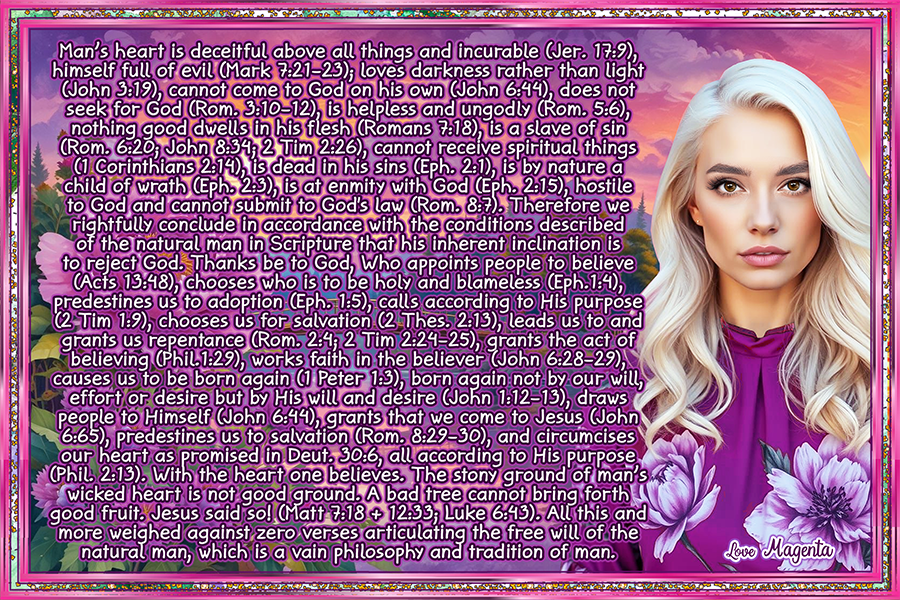
Depravityvsgrace.png

Man is deceitful (Jeremiah 17 verse 9), full of evil (Mark 7 verses 21-23), loves darkness rather than light (John 3 verse 19), cannot come to God on his own (John 6 verse 44), does not seek for God (Romans 3 verses 10-12), is helpless and ungodly (Romans 5 verse 6), nothing good dwells in his flesh (Romans 7 verse 18), is a slave of sin (Romans 6 verse 20; John 8 verse 34; 2 Timothy 2 verse 26), cannot receive spiritual things (1 Corinthians 2 verse 14), is dead in his sins (Ephesians 2 verse 1), is by nature a child of wrath (Ephesians 2 verse 3), is at enmity with God (Ephesians 2 verse 15), hostile to God and cannot submit to God's law (Romans 8 verse 7). Therefore we rightfully conclude in accordance with the conditions described of the natural man in Scripture that his inherent inclination is to reject God. Thanks be to God, Who appoints people to believe (Acts 13 verse 48), chooses who is to be holy and blameless (Ephesians 1 verse 4), predestines us to adoption (Ephesians 1 verse 5), calls according to His purpose (2 Timothy 1 verse 9), chooses us for salvation (2 Thessalonians 2 verse 13), leads us to and grants us repentance (Romans 2 verse 4; 2 Timothy 2 verses 24-25), grants the act of believing (Philippians 1 verse 29), works faith in the believer (John 6 verses 28-29), causes us to be born again (1 Peter 1 verse 3), born again not by our will but by His will (John 1 verses 12-13), draws people to Himself (John 6 verse 44), grants that we come to Jesus (John 6 verse 65), predestines us to salvation (Romans 8 verses 29- 30), and circumcises our heart (Romans 2 verse 29), all according to His purpose (Ephesians 1 verse 11).
 
  • Like
Reactions: rogerg
Regarding the learning of logic, Scripture informs us to the contrary:

[1Co 2:5 KJV] 5 That your faith should not stand in the wisdom of men, but in the power of God.

Salvation is given solely by God's divine prerogative through His exceeding mercy and grace through Jesus Christ the Savior.
Therefore, should we believe that our cooperation with God's actions in order to obtain salvation is required, places those who believe such a thing into direct conflict with God and the doctrine of Christ as THE Savior. It would set at naught the efficacy of His offering and sacrifice. Any misbelief one may have that he can play any part whatsoever in obtaining salvation would without question mean that those who do so, see themselves as co-saviors with Christ - there is just no other way for that to be understood.
You are just simply unable to comprehend the meaning of the following verses although they state the foundational doctrines of the gospel as clearly as can possibly be stated, yet you insist on discarding them,


[Tit 3:5 -7 KJV]
5 Not by works of righteousness which we have done, but according to his mercy he saved us, by the washing of regeneration, and renewing of the Holy Ghost;
6 Which he shed on us abundantly through Jesus Christ our Saviour;
7 That being justified by his grace, we should be made heirs according to the hope of eternal life.

That is where your hermeneutic crashes and burns;
the purpose of GW is to teach sinners the divine Logic of Love.
The fact that I might need to post Scripture to support this understanding
indicates the demonic doctrine, logic and heresy of hate held by tulipists.
 
Yeah that's works, A lost dead man cant cooperate with being made alive in salvation, that Glory belongs solely to God

True, and y'all are spiritually dead and unelect if you refuse to cooperate with God's requirement for salvation,
choosing instead to demean divine love for all sinners, projecting your hatred onto Him.
I encourage y'all to repent rather than kick against the goad of the Gospel.
 
  • Pray
Reactions: dkontner