- Romans 8:9 as a definitive indicator
- The verse states, “Now if any man have not the Spirit of Christ, he is none of his,” meaning that lacking the Holy Spirit gives ample indication of not belonging to Christ (i.e., not being saved).
- Therefore, having Holy Spirit is inseparable from being saved; Holy Spirit is received at salvation, not afterward.
- 1 Thessalonians 1:5–6 shows simultaneous reception
- The gospel came “in power, and in the Holy Ghost, and in much assurance,” and the audience “received the word in much affliction, with joy of the Holy Ghost.”
- The “joy of the Holy Ghost” at the moment they “received the word” indicates they received the Holy Spirit at the same time they believed the gospel, affirming simultaneity.
- 1 Corinthians 6:19 applied to carnal believers
- The passage teaches that believers’ bodies are “the temple of the Holy Ghost” and that the Holy Ghost is “in you,” belonging to God.
- Despite Paul calling the Corinthian believers “carnal” in 1 Corinthians 3, he still affirms the Spirit indwells them, demonstrating that the Spirit’s indwelling is not contingent upon post-salvation spiritual maturity or a later “baptism” event.
- This counters the idea that a subsequent experience is necessary for righteous living; the Corinthians had the Spirit yet were still described as carnal, showing indwelling at salvation does not automatically produce perfected conduct.
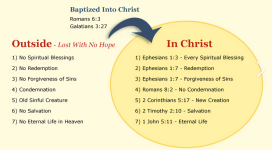
- 1 Corinthians 12:13 defining Spirit baptism at salvation
- “For by one Spirit are we all baptized into one body… and have all been made to drink into one Spirit,” identifying the “one body” as the body of Christ.
- The mechanism of entry into the body of Christ is “by one Spirit,” and the scriptures thus far give ample indication this occurs at the instant of believing Paul's gospel, making salvation and Spirit baptism simultaneous.
- The universality of “we all” (Jews or Gentiles, bond or free) underscores that this is the standard experience for all believers at conversion.
- 1 Corinthians 12:13 defining Spirit baptism at salvation
- “For by one Spirit are we all baptized into one body… and have all been made to drink into one Spirit,” identifying the “one body” as the body of Christ.
- The mechanism of entry into the body of Christ is “by one Spirit,” and this occurs at the instant of believing the gospel, making salvation and Spirit baptism simultaneous.
- The universality of “we all” (Jews or Gentiles, bond or free) underscores that this is the standard experience for all believers at conversion.
- Rejection of a subsequent Holy Spirit baptism as necessary for righteousness
- Using the Corinthians as an example, a post-salvation Spirit baptism does not automatically result in righteous living; believers may still struggle while indwelt by the Spirit.
- The indwelling at salvation is doctrinally affirmed; sanctification is a process and not guaranteed by a later event.
- Call to personal scriptural verification
- Readers should “search the scriptures, prove all things,” and be “fully persuaded” personally rather than accepting any teaching without examination.
- Responsible, individual theological study should be done to confirm the timing of receiving the Holy Spirit.
MM