Timing of Receiving the Holy Spirit

  • Christian Chat is a moderated online Christian community allowing Christians around the world to fellowship with each other in real time chat via webcam, voice, and text, with the Christian Chat app. You can also start or participate in a Bible-based discussion here in the Christian Chat Forums, where members can also share with each other their own videos, pictures, or favorite Christian music.

    If you are a Christian and need encouragement and fellowship, we're here for you! If you are not a Christian but interested in knowing more about Jesus our Lord, you're also welcome! Want to know what the Bible says, and how you can apply it to your life? Join us!

    To make new Christian friends now around the world, click here to join Christian Chat.

Musicmaster

Well-known member
Feb 8, 2021
3,008
772
113
  • Romans 8:9 as a definitive indicator
    • The verse states, “Now if any man have not the Spirit of Christ, he is none of his,” meaning that lacking the Holy Spirit gives ample indication of not belonging to Christ (i.e., not being saved).
    • Therefore, having Holy Spirit is inseparable from being saved; Holy Spirit is received at salvation, not afterward.

  • 1 Thessalonians 1:5–6 shows simultaneous reception
    • The gospel came “in power, and in the Holy Ghost, and in much assurance,” and the audience “received the word in much affliction, with joy of the Holy Ghost.”
    • The “joy of the Holy Ghost” at the moment they “received the word” indicates they received the Holy Spirit at the same time they believed the gospel, affirming simultaneity.

  • 1 Corinthians 6:19 applied to carnal believers
    • The passage teaches that believers’ bodies are “the temple of the Holy Ghost” and that the Holy Ghost is “in you,” belonging to God.
    • Despite Paul calling the Corinthian believers “carnal” in 1 Corinthians 3, he still affirms the Spirit indwells them, demonstrating that the Spirit’s indwelling is not contingent upon post-salvation spiritual maturity or a later “baptism” event.
    • This counters the idea that a subsequent experience is necessary for righteous living; the Corinthians had the Spirit yet were still described as carnal, showing indwelling at salvation does not automatically produce perfected conduct.

  • 1 Corinthians 12:13 defining Spirit baptism at salvation
    • “For by one Spirit are we all baptized into one body… and have all been made to drink into one Spirit,” identifying the “one body” as the body of Christ.
    • The mechanism of entry into the body of Christ is “by one Spirit,” and the scriptures thus far give ample indication this occurs at the instant of believing Paul's gospel, making salvation and Spirit baptism simultaneous.
    • The universality of “we all” (Jews or Gentiles, bond or free) underscores that this is the standard experience for all believers at conversion.

  • 1 Corinthians 12:13 defining Spirit baptism at salvation
    • “For by one Spirit are we all baptized into one body… and have all been made to drink into one Spirit,” identifying the “one body” as the body of Christ.
    • The mechanism of entry into the body of Christ is “by one Spirit,” and this occurs at the instant of believing the gospel, making salvation and Spirit baptism simultaneous.
    • The universality of “we all” (Jews or Gentiles, bond or free) underscores that this is the standard experience for all believers at conversion.

  • Rejection of a subsequent Holy Spirit baptism as necessary for righteousness
    • Using the Corinthians as an example, a post-salvation Spirit baptism does not automatically result in righteous living; believers may still struggle while indwelt by the Spirit.
    • The indwelling at salvation is doctrinally affirmed; sanctification is a process and not guaranteed by a later event.

  • Call to personal scriptural verification
    • Readers should “search the scriptures, prove all things,” and be “fully persuaded” personally rather than accepting any teaching without examination.
    • Responsible, individual theological study should be done to confirm the timing of receiving the Holy Spirit.

MM
 
  • Romans 8:9 as a definitive indicator
    • The verse states, “Now if any man have not the Spirit of Christ, he is none of his,” meaning that lacking the Holy Spirit gives ample indication of not belonging to Christ (i.e., not being saved).
    • Therefore, having Holy Spirit is inseparable from being saved; Holy Spirit is received at salvation, not afterward.

  • 1 Thessalonians 1:5–6 shows simultaneous reception
    • The gospel came “in power, and in the Holy Ghost, and in much assurance,” and the audience “received the word in much affliction, with joy of the Holy Ghost.”
    • The “joy of the Holy Ghost” at the moment they “received the word” indicates they received the Holy Spirit at the same time they believed the gospel, affirming simultaneity.

  • 1 Corinthians 6:19 applied to carnal believers
    • The passage teaches that believers’ bodies are “the temple of the Holy Ghost” and that the Holy Ghost is “in you,” belonging to God.
    • Despite Paul calling the Corinthian believers “carnal” in 1 Corinthians 3, he still affirms the Spirit indwells them, demonstrating that the Spirit’s indwelling is not contingent upon post-salvation spiritual maturity or a later “baptism” event.
    • This counters the idea that a subsequent experience is necessary for righteous living; the Corinthians had the Spirit yet were still described as carnal, showing indwelling at salvation does not automatically produce perfected conduct.

  • 1 Corinthians 12:13 defining Spirit baptism at salvation
    • “For by one Spirit are we all baptized into one body… and have all been made to drink into one Spirit,” identifying the “one body” as the body of Christ.
    • The mechanism of entry into the body of Christ is “by one Spirit,” and the scriptures thus far give ample indication this occurs at the instant of believing Paul's gospel, making salvation and Spirit baptism simultaneous.
    • The universality of “we all” (Jews or Gentiles, bond or free) underscores that this is the standard experience for all believers at conversion.

  • 1 Corinthians 12:13 defining Spirit baptism at salvation
    • “For by one Spirit are we all baptized into one body… and have all been made to drink into one Spirit,” identifying the “one body” as the body of Christ.
    • The mechanism of entry into the body of Christ is “by one Spirit,” and this occurs at the instant of believing the gospel, making salvation and Spirit baptism simultaneous.
    • The universality of “we all” (Jews or Gentiles, bond or free) underscores that this is the standard experience for all believers at conversion.

  • Rejection of a subsequent Holy Spirit baptism as necessary for righteousness
    • Using the Corinthians as an example, a post-salvation Spirit baptism does not automatically result in righteous living; believers may still struggle while indwelt by the Spirit.
    • The indwelling at salvation is doctrinally affirmed; sanctification is a process and not guaranteed by a later event.

  • Call to personal scriptural verification
    • Readers should “search the scriptures, prove all things,” and be “fully persuaded” personally rather than accepting any teaching without examination.
    • Responsible, individual theological study should be done to confirm the timing of receiving the Holy Spirit.

MM

I would only add Eph. 4:4-6, Rom. 5:5 and Rev. 3:20 to the list of relevant Scriptures.
 
  • Romans 8:9 as a definitive indicator
    • The verse states, “Now if any man have not the Spirit of Christ, he is none of his,” meaning that lacking the Holy Spirit gives ample indication of not belonging to Christ (i.e., not being saved).
    • Therefore, having Holy Spirit is inseparable from being saved; Holy Spirit is received at salvation, not afterward.

  • 1 Thessalonians 1:5–6 shows simultaneous reception
    • The gospel came “in power, and in the Holy Ghost, and in much assurance,” and the audience “received the word in much affliction, with joy of the Holy Ghost.”
    • The “joy of the Holy Ghost” at the moment they “received the word” indicates they received the Holy Spirit at the same time they believed the gospel, affirming simultaneity.

  • 1 Corinthians 6:19 applied to carnal believers
    • The passage teaches that believers’ bodies are “the temple of the Holy Ghost” and that the Holy Ghost is “in you,” belonging to God.
    • Despite Paul calling the Corinthian believers “carnal” in 1 Corinthians 3, he still affirms the Spirit indwells them, demonstrating that the Spirit’s indwelling is not contingent upon post-salvation spiritual maturity or a later “baptism” event.
    • This counters the idea that a subsequent experience is necessary for righteous living; the Corinthians had the Spirit yet were still described as carnal, showing indwelling at salvation does not automatically produce perfected conduct.

  • 1 Corinthians 12:13 defining Spirit baptism at salvation
    • “For by one Spirit are we all baptized into one body… and have all been made to drink into one Spirit,” identifying the “one body” as the body of Christ.
    • The mechanism of entry into the body of Christ is “by one Spirit,” and the scriptures thus far give ample indication this occurs at the instant of believing Paul's gospel, making salvation and Spirit baptism simultaneous.
    • The universality of “we all” (Jews or Gentiles, bond or free) underscores that this is the standard experience for all believers at conversion.

  • 1 Corinthians 12:13 defining Spirit baptism at salvation
    • “For by one Spirit are we all baptized into one body… and have all been made to drink into one Spirit,” identifying the “one body” as the body of Christ.
    • The mechanism of entry into the body of Christ is “by one Spirit,” and this occurs at the instant of believing the gospel, making salvation and Spirit baptism simultaneous.
    • The universality of “we all” (Jews or Gentiles, bond or free) underscores that this is the standard experience for all believers at conversion.

  • Rejection of a subsequent Holy Spirit baptism as necessary for righteousness
    • Using the Corinthians as an example, a post-salvation Spirit baptism does not automatically result in righteous living; believers may still struggle while indwelt by the Spirit.
    • The indwelling at salvation is doctrinally affirmed; sanctification is a process and not guaranteed by a later event.

  • Call to personal scriptural verification
    • Readers should “search the scriptures, prove all things,” and be “fully persuaded” personally rather than accepting any teaching without examination.
    • Responsible, individual theological study should be done to confirm the timing of receiving the Holy Spirit.

MM
Your 'conclusions' are not based on searching the Scriptures but reading Scriptures through your 'dispensational lens'. More eisegesis rather than exegesis.
 
  • Like
Reactions: TrustandObey
"For by one Spirit we were all baptized into one body-whether Jews or Greeks, whether slaves or free-and have all been made to drink into one Spirit'. 1 Cor 12:13.
Many of us have been taught that the above verse is the baptism with the Holy Spirit, received at conversion.

The question before us is, 1Cor 12:13 is it speaking of the baptism of the Holy Spirit as mentioned by John the Baptist in the Gospels and Jesus in Acts 1, which was fulfilled on the day of Pentecost?
The baptism of the Holy Spirit that the disciples received at Pentecost firstly, empowered them for living and service Acts 1:8.
Secondly, it purified their hearts from all moral pollution, ie. indwelling sin. Act 15:8-9.

Studying the incidents of believers receiving or being baptized with the Holy Spirit in the book of Acts, shows it was subsequent to regeneration.

Acts2. Pentecost.
Acts 8. Samaria.
Acts 9. Saul/Paul.
Acts 10. Cornelius & Household.
Acts 19. Ephesus.

In several episodes the term 'received' the Spirit is used of believers, receiving the Spirit subsequent to their regeneration.

Looking at 1 Cor 12:13, this baptism is not about power or purifying hearts, but incorporation into the Body of Christ.
It is interesting to note that the writer to the Hebrew wrote of' the doctrine of baptisms' (plural).
From my reading of some scholars, 1 Cor 12:13 is difficult to translated from the Greek. In fact, it can be translated in several different ways.
The New English Bible translates it as such:-

'For indeed we were all brought into one body by baptism, in one Spirit, whether we are Jews or Greeks, slave or freemen, and that one Holy Spirit was poured out for all of us to drink'.
Many commentators believe this verse speaks of water baptism, such as Calvin. This could be like Paul's description in Rom 6:3-4. of baptism into Christ. It is worth some thinking about.

Summary..
1. The Baptism with the Holy Spirit is an experience subsequent to regeneration, that empowers and purifies the believer.
2.The baptism in 1Cor 12:13 is an incorporation into the Body of Christ happening at regeneration.
3. The baptism in 1Cor 12:13 could be water baptism.

Every person is indwelt by the Holy Spirit at regeneration Rom 8:9. But the Baptism of the Holy Spirit is something to be sought subsequent to regeneration. lk 24:29, Acts 1:5,8.

The first indwelling is like someone having access to only one room in a house. The Baptism of the Holy Spirit is like giving the person full access to the whole house.
.
 
  • Like
Reactions: PAC-fit
"For by one Spirit we were all baptized into one body-whether Jews or Greeks, whether slaves or free-and have all been made to drink into one Spirit'. 1 Cor 12:13.
Many of us have been taught that the above verse is the baptism with the Holy Spirit, received at conversion.

The question before us is, 1Cor 12:13 is it speaking of the baptism of the Holy Spirit as mentioned by John the Baptist in the Gospels and Jesus in Acts 1, which was fulfilled on the day of Pentecost?
The baptism of the Holy Spirit that the disciples received at Pentecost firstly, empowered them for living and service Acts 1:8.
Secondly, it purified their hearts from all moral pollution, ie. indwelling sin. Act 15:8-9.

Studying the incidents of believers receiving or being baptized with the Holy Spirit in the book of Acts, shows it was subsequent to regeneration.

Acts2. Pentecost.
Acts 8. Samaria.
Acts 9. Saul/Paul.
Acts 10. Cornelius & Household.
Acts 19. Ephesus.

In several episodes the term 'received' the Spirit is used of believers, receiving the Spirit subsequent to their regeneration.

Looking at 1 Cor 12:13, this baptism is not about power or purifying hearts, but incorporation into the Body of Christ.
It is interesting to note that the writer to the Hebrew wrote of' the doctrine of baptisms' (plural).
From my reading of some scholars, 1 Cor 12:13 is difficult to translated from the Greek. In fact, it can be translated in several different ways.
The New English Bible translates it as such:-

'For indeed we were all brought into one body by baptism, in one Spirit, whether we are Jews or Greeks, slave or freemen, and that one Holy Spirit was poured out for all of us to drink'.
Many commentators believe this verse speaks of water baptism, such as Calvin. This could be like Paul's description in Rom 6:3-4. of baptism into Christ. It is worth some thinking about.

Summary..
1. The Baptism with the Holy Spirit is an experience subsequent to regeneration, that empowers and purifies the believer.
2.The baptism in 1Cor 12:13 is an incorporation into the Body of Christ happening at regeneration.
3. The baptism in 1Cor 12:13 could be water baptism.

Every person is indwelt by the Holy Spirit at regeneration Rom 8:9. But the Baptism of the Holy Spirit is something to be sought subsequent to regeneration. lk 24:29, Acts 1:5,8.

The first indwelling is like someone having access to only one room in a house. The Baptism of the Holy Spirit is like giving the person full access to the whole house.
.

Pentecost was the first manifestation of the HS following Christ's ascension, so SB occurred after sinners had already become Christians. Paul clarified the normative sequence in 1Cor. 12:13, Eph. 4:4-6, Rom. 5:5, 8:9, etc., which is that SB/regeneration occurs when Jesus indwells sinners' hearts at the moment they invite him in as Messiah and Lord (Rev. 3:20, Acts 16:31).

At the moment of worship and saving faith like Abraham, the Spirit of Christ/God’s Holy Spirit enters the believer’s spiritual heart— again even though they may not realize it–because Paul taught that whoever does not have the Spirit of Christ does not belong to Christ (Rom. 8:9).

Paul referred to Abrahamic faith as spiritual circumcision (Rom. 2:29, 4:3-12). Of course, partial knowledge of GW will limit ability to cooperate with Him, so there is a need for evangelism and learning the full Gospel (Matt. 28:19-20). For those who died as pre-NT believers, this must occur in heaven (cf. 1Pet. 4:6).

Again, if a moralist truthseeker (on the basis of general revelation) encounters God (perhaps via the OT), then he/she may believe or become a theist, like Abraham and Moses. If theists are taught the Gospel (NT), then they may choose to believe/accept Jesus as Christ. In all cases salvation is a gift/grace from God received by faith “from first to last” (Rom. 1:17).

With greater awareness because of learning the NT Gospel, when a truthseeker confesses Jesus as Messiah and Lord (Acts 20:21, Rom. 10:9), the HS indwells the convert’s heart (Rom. 5:5) and unites him/her with God as heavenly Father (Rom. 8:9)–which moment is called spiritual rebirth (John 3:3-8), baptism by the Spirit (Matt. 3:11/Mark 1:8/Luke 3:16, John 1:33, Acts 1:5, 1Cor. 12:13) and receiving the Spirit of adoption/sonship (Rom. 8:14-16).

The outward evidence that someone was baptized by the HS (Rom. 5:5) and is Spirit-filled (Eph. 5:18) or walking with God is the fullness of Christ (Eph. 3:19, 4:13) or fruit of the Spirit (Gal. 5:22-23), which is signified by “love” (Gal. 5:6, Matt. 22:37-40). Jesus said “All men will know that you are my disciples if you love one another” (John 13:35, 1John 4:7-21), because divine love sums up the moral character of God (1John 4:7-8).

Because a convert’s commitment to Christ is in accordance with God’s perfect will (Matt. 4:17, 1Tim. 2:3-4), the moment of Spirit baptism fulfills the command to be filled with the Spirit (in Eph. 5:18), which means to cooperate fully with the love of God (Eph. 3:16-19) or of the HS (Rom. 5:5, 15:30).

The personal relationship between Believers/Christians and God may be viewed as having three stages: conversion, spiritual growth or maturation (Eph. 4:13), and glorification (1Pet. 5:10) or immortality (1Cor. 15:53) in heaven. The kerygmatic prayer that is necessary in order for a sinner be saved and remain Spirit-filled or walk with God is confession (1John 1:9, Psa. 32:1-5).
 
"For by one Spirit we were all baptized into one body-whether Jews or Greeks, whether slaves or free-and have all been made to drink into one Spirit'. 1 Cor 12:13.
Many of us have been taught that the above verse is the baptism with the Holy Spirit, received at conversion.

The question before us is, 1Cor 12:13 is it speaking of the baptism of the Holy Spirit as mentioned by John the Baptist in the Gospels and Jesus in Acts 1, which was fulfilled on the day of Pentecost?
The baptism of the Holy Spirit that the disciples received at Pentecost firstly, empowered them for living and service Acts 1:8.
Secondly, it purified their hearts from all moral pollution, ie. indwelling sin. Act 15:8-9.

Studying the incidents of believers receiving or being baptized with the Holy Spirit in the book of Acts, shows it was subsequent to regeneration.

Acts2. Pentecost.
Acts 8. Samaria.
Acts 9. Saul/Paul.
Acts 10. Cornelius & Household.
Acts 19. Ephesus.

In several episodes the term 'received' the Spirit is used of believers, receiving the Spirit subsequent to their regeneration.

Looking at 1 Cor 12:13, this baptism is not about power or purifying hearts, but incorporation into the Body of Christ.
It is interesting to note that the writer to the Hebrew wrote of' the doctrine of baptisms' (plural).
From my reading of some scholars, 1 Cor 12:13 is difficult to translated from the Greek. In fact, it can be translated in several different ways.
The New English Bible translates it as such:-

'For indeed we were all brought into one body by baptism, in one Spirit, whether we are Jews or Greeks, slave or freemen, and that one Holy Spirit was poured out for all of us to drink'.
Many commentators believe this verse speaks of water baptism, such as Calvin. This could be like Paul's description in Rom 6:3-4. of baptism into Christ. It is worth some thinking about.

Summary..
1. The Baptism with the Holy Spirit is an experience subsequent to regeneration, that empowers and purifies the believer.
2.The baptism in 1Cor 12:13 is an incorporation into the Body of Christ happening at regeneration.
3. The baptism in 1Cor 12:13 could be water baptism.

Every person is indwelt by the Holy Spirit at regeneration Rom 8:9. But the Baptism of the Holy Spirit is something to be sought subsequent to regeneration. lk 24:29, Acts 1:5,8.

The first indwelling is like someone having access to only one room in a house. The Baptism of the Holy Spirit is like giving the person full access to the whole house.
.

I will agree with you that both baptisms are addressed in scripture, but they are not one and the same. In other words, water baptism, according to Peter, was for the remission of sins for those under the Kingdom Gospel. Paul not once stated water baptism nor spiritual baptism as leading to remission of sins for we who are under the Gospel of Grace. Some received Holy Spirit only after the laying on of hands among those of Israel. Paul's one time mention of laying on of hands was not for receiving Holy Spirit, but rather for commissioning unto the work of an evangelist and leader among the professing believers.

Not one of the twelve taught Israel that they were saved by grace through faith, and that not of works, although faith was indeed a foundational element in the salvation under continued observance of the Law, as was the case with the Jewish believers in Jerusalem and abroad. the work of water baptism, then, was a central tennet of the Kingdom Gospel FOR salvation since they could only be saved upon remission of their sins.

Saved by grace through faith is a purely Pauline teaching to Gentiles and Jews under his ministry alike. Paul also taught his fellow Jews to forsake the Law and to not circumcise their children, just as he was accused when meeting with James in Acts 21. Never did the twelve teach Israel to forsake the Law. The Jews in Jerusalem were zealous for the Law, which included circumcision, not because the twelve opposed such but because they obviously encouraged it.

MM
 
  • Heart
Reactions: GRACE_ambassador
Not one of the twelve taught Israel that they were saved by grace through faith,

You do greatly err not knowing scripture. The believing pharisees were trying to con the gentiles into keeping the law to be saved. But Peter said, "Nope. They are saved through grace alone just like we are."

And when there had been much disputing, Peter rose up, and said unto them, Men and brethren, ye know how that a good while ago God made choice among us, that the Gentiles by my mouth should hear the word of the gospel, and believe. And God, which knoweth the hearts, bare them witness, giving them the Holy Ghost, even as he did unto us; And put no difference between us and them, purifying their hearts by faith. Now therefore why tempt ye God, to put a yoke upon the neck of the disciples, which neither our fathers nor we were able to bear? But we believe that through the grace of the Lord Jesus Christ we shall be saved, even as they. Acts 15:7-11
 
2Ti 2:19 Nevertheless the foundation of God standeth sure, having this seal, The Lord knoweth them that are his. And, Let every one that nameth the name of Christ depart from iniquity.

Mat 7:21 Not every one that saith unto me, Lord, Lord, shall enter into the kingdom of heaven; but he that doeth the will of my Father which is in heaven.
Mat 7:23 And then will I profess unto them, I never knew you: depart from me, ye that work iniquity.

Gal 5:16 This I say then, Walk in the Spirit, and ye shall not fulfil the lust of the flesh.
Gal 5:24 And they that are Christ's have crucified the flesh with the affections and lusts.

2Ti 3:4 lovers of pleasures more than lovers of God;
2Ti 3:5 Having a form of godliness, but denying the power thereof: from such turn away.
2Ti 3:7 Ever learning, and never able to come to the knowledge of the truth.

Having the Holy Spirit is part of salvation.

Millions of people deny the Spirit leading them and are sinning and do not come to the truth.
 
Timing Of Receiving The Holy Spirit?:

Excellent study shows "At The Moment Of Salvation" For all "members Identified
In/With The Body Of Christ" -
notice The Following Distinctions, Rightly Divided:

Three Baptism Scriptural Summary!:

LORD JESUS, please open our hearts to All of Thy Truth. Amen:


Prophecy/Law: ►►► The Twelve WERE SENT to {water} baptize! ◄◄◄
The TWO "Main" (of 12) baptismS =
A) water, For remission of sins!:
(Matthew 3:5-6; Mark 1:4; Luke 3:3; John 1:31; Luke 7:29-30; Acts 10:37)
(Matthew 28:19; Mark 16:16; Acts 2:38; Acts 22:16; Ezekiel 36:25 AV)
+
B) "WITH" The Holy Spirit, Poured Out By CHRIST, for power, signs And wonders!
(Isaiah 44:3; Matthew 3:11; Mark 1:8, 16:17-18; Luke 24:49; Joel 2:28;
Acts 2:17-18, 38; Acts 8:15-17; Acts 11:16 AV)
Prophecy / Covenants / Law

Rightly Divided (2 Timothy 2:15) From “Things That Differ” (online)

Mystery / GRACE!:
►►► Paul Was Not Sent to { water } baptize! Why Not?: ◄◄◄
Does not God Specifically Teach:

Today: Only One Baptism = "BY" The One Spirit = God's Operation,
Spiritually "Identifying" members In ( The One Body Of ) CHRIST!!
(Ephesians 4:5; Colossians 2:12; Galatians 3:27;
Romans 6:3-4; 1 Corinthians 12:13 AV)

Timing
Of This One and Only One Spiritual Baptism, Today, Under Grace?:

"That we should be to The Praise Of His Glory, who first trusted In Christ.
In Whom ye also trusted, after that ye heard The Word Of Truth, The Gospel
of your Salvation: In Whom also after that ye believed, ye Were Sealed With
That Holy Spirit Of Promise, Which Is The Earnest Of our inheritance Until The
Redemption Of The Purchased Possession, Unto The Praise Of His Glory."

Amen.

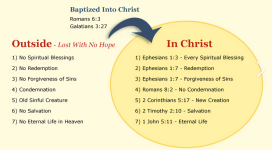
Baptized Into Christ.png
 
Pentecost was the first manifestation of the HS following Christ's ascension, so SB occurred after sinners had already become Christians. Paul clarified the normative sequence in 1Cor. 12:13, Eph. 4:4-6, Rom. 5:5, 8:9, etc., which is that SB/regeneration occurs when Jesus indwells sinners' hearts at the moment they invite him in as Messiah and Lord (Rev. 3:20, Acts 16:31).

At the moment of worship and saving faith like Abraham, the Spirit of Christ/God’s Holy Spirit enters the believer’s spiritual heart— again even though they may not realize it–because Paul taught that whoever does not have the Spirit of Christ does not belong to Christ (Rom. 8:9).

Paul referred to Abrahamic faith as spiritual circumcision (Rom. 2:29, 4:3-12). Of course, partial knowledge of GW will limit ability to cooperate with Him, so there is a need for evangelism and learning the full Gospel (Matt. 28:19-20). For those who died as pre-NT believers, this must occur in heaven (cf. 1Pet. 4:6).

Again, if a moralist truthseeker (on the basis of general revelation) encounters God (perhaps via the OT), then he/she may believe or become a theist, like Abraham and Moses. If theists are taught the Gospel (NT), then they may choose to believe/accept Jesus as Christ. In all cases salvation is a gift/grace from God received by faith “from first to last” (Rom. 1:17).

With greater awareness because of learning the NT Gospel, when a truthseeker confesses Jesus as Messiah and Lord (Acts 20:21, Rom. 10:9), the HS indwells the convert’s heart (Rom. 5:5) and unites him/her with God as heavenly Father (Rom. 8:9)–which moment is called spiritual rebirth (John 3:3-8), baptism by the Spirit (Matt. 3:11/Mark 1:8/Luke 3:16, John 1:33, Acts 1:5, 1Cor. 12:13) and receiving the Spirit of adoption/sonship (Rom. 8:14-16).

The outward evidence that someone was baptized by the HS (Rom. 5:5) and is Spirit-filled (Eph. 5:18) or walking with God is the fullness of Christ (Eph. 3:19, 4:13) or fruit of the Spirit (Gal. 5:22-23), which is signified by “love” (Gal. 5:6, Matt. 22:37-40). Jesus said “All men will know that you are my disciples if you love one another” (John 13:35, 1John 4:7-21), because divine love sums up the moral character of God (1John 4:7-8).

Because a convert’s commitment to Christ is in accordance with God’s perfect will (Matt. 4:17, 1Tim. 2:3-4), the moment of Spirit baptism fulfills the command to be filled with the Spirit (in Eph. 5:18), which means to cooperate fully with the love of God (Eph. 3:16-19) or of the HS (Rom. 5:5, 15:30).

The personal relationship between Believers/Christians and God may be viewed as having three stages: conversion, spiritual growth or maturation (Eph. 4:13), and glorification (1Pet. 5:10) or immortality (1Cor. 15:53) in heaven. The kerygmatic prayer that is necessary in order for a sinner be saved and remain Spirit-filled or walk with God is confession (1John 1:9, Psa. 32:1-5).
I believe you err, not distinguishing the difference between the initial indwelling of the Holy Spirit and the subsequent infilling or baptism of the Holy Spirit. You rightly mention spiritual growth. Part of spiritual growth is to be sanctified wholly or entirely 1 The 5:23 which is a second or subsequent blessing after regeneration.
 
Timing Of Receiving The Holy Spirit?:

Excellent study shows "At The Moment Of Salvation" For all "members Identified
In/With The Body Of Christ" -
notice The Following Distinctions, Rightly Divided:

Three Baptism Scriptural Summary!:

LORD JESUS, please open our hearts to All of Thy Truth. Amen:


Prophecy/Law: ►►► The Twelve WERE SENT to {water} baptize! ◄◄◄
The TWO "Main" (of 12) baptismS =
A) water, For remission of sins!:
(Matthew 3:5-6; Mark 1:4; Luke 3:3; John 1:31; Luke 7:29-30; Acts 10:37)
(Matthew 28:19; Mark 16:16; Acts 2:38; Acts 22:16; Ezekiel 36:25 AV)
+
B) "WITH" The Holy Spirit, Poured Out By CHRIST, for power, signs And wonders!
(Isaiah 44:3; Matthew 3:11; Mark 1:8, 16:17-18; Luke 24:49; Joel 2:28;
Acts 2:17-18, 38; Acts 8:15-17; Acts 11:16 AV)
Prophecy / Covenants / Law

Rightly Divided (2 Timothy 2:15) From “Things That Differ” (online)

Mystery / GRACE!:
►►► Paul Was Not Sent to { water } baptize! Why Not?: ◄◄◄
Does not God Specifically Teach:

Today: Only One Baptism = "BY" The One Spirit = God's Operation,
Spiritually "Identifying" members In ( The One Body Of ) CHRIST!!
(Ephesians 4:5; Colossians 2:12; Galatians 3:27;
Romans 6:3-4; 1 Corinthians 12:13 AV)

Timing
Of This One and Only One Spiritual Baptism, Today, Under Grace?:

"That we should be to The Praise Of His Glory, who first trusted In Christ.
In Whom ye also trusted, after that ye heard The Word Of Truth, The Gospel
of your Salvation: In Whom also after that ye believed, ye Were Sealed With
That Holy Spirit Of Promise, Which Is The Earnest Of our inheritance Until The
Redemption Of The Purchased Possession, Unto The Praise Of His Glory."

Amen.

View attachment 289745
I demonstrated in my post #4, that 1 Cor 12:13 is NOT the baptism of the Spirit in the New Testament sense. .1 Cor 12:13 is a incorporation into the body of Christ at conversion, whereas the Baptism of the Holy Spirit is for empowerment (Acts 1:8) and purity of heart (Acts 15:8-9.), subsequent to conversion.
 
Studying the incidents of believers receiving or being baptized with the Holy Spirit in the book of Acts, shows it was subsequent to regeneration.

Because initially regeneration was expected prior to the baptism of the Spirit Jn.3:3 The Spirit baptism would/could not occur until after Christ's return to heaven Jn.14:16 There were many believers prior to Christ's death and resurrection who were born from above this is why Jesus said the Spirit was was them but not in them at that time. Jn.14:17

I would question whether Paul was regenerated prior to Ananias laying hands on him. I see no evidence for it.

To a Gentile world that had never heard about the God of Israel, regeneration and baptism would occur simultaneously.
 
I will agree with you that both baptisms are addressed in scripture, but they are not one and the same. In other words, water baptism, according to Peter, was for the remission of sins for those under the Kingdom Gospel. Paul not once stated water baptism nor spiritual baptism as leading to remission of sins for we who are under the Gospel of Grace. Some received Holy Spirit only after the laying on of hands among those of Israel. Paul's one time mention of laying on of hands was not for receiving Holy Spirit, but rather for commissioning unto the work of an evangelist and leader among the professing believers.

Not one of the twelve taught Israel that they were saved by grace through faith, and that not of works, although faith was indeed a foundational element in the salvation under continued observance of the Law, as was the case with the Jewish believers in Jerusalem and abroad. the work of water baptism, then, was a central tennet of the Kingdom Gospel FOR salvation since they could only be saved upon remission of their sins.

Saved by grace through faith is a purely Pauline teaching to Gentiles and Jews under his ministry alike. Paul also taught his fellow Jews to forsake the Law and to not circumcise their children, just as he was accused when meeting with James in Acts 21. Never did the twelve teach Israel to forsake the Law. The Jews in Jerusalem were zealous for the Law, which included circumcision, not because the twelve opposed such but because they obviously encouraged it.

MM
God will put the desire to be free from sin in God's elect before he gave me the Holy Spirit. To destroy your sinful desires and the love of sin. Read Romans 7 talks about this contestation happening in God's elects. I don't believe, the nonelect have the contestation war of both desires to be free from sin and love of sin.
 
  • Romans 8:9 as a definitive indicator
    • The verse states, “Now if any man have not the Spirit of Christ, he is none of his,” meaning that lacking the Holy Spirit gives ample indication of not belonging to Christ (i.e., not being saved).
    • Therefore, having Holy Spirit is inseparable from being saved; Holy Spirit is received at salvation, not afterward.

  • 1 Thessalonians 1:5–6 shows simultaneous reception
    • The gospel came “in power, and in the Holy Ghost, and in much assurance,” and the audience “received the word in much affliction, with joy of the Holy Ghost.”
    • The “joy of the Holy Ghost” at the moment they “received the word” indicates they received the Holy Spirit at the same time they believed the gospel, affirming simultaneity.

  • 1 Corinthians 6:19 applied to carnal believers
    • The passage teaches that believers’ bodies are “the temple of the Holy Ghost” and that the Holy Ghost is “in you,” belonging to God.
    • Despite Paul calling the Corinthian believers “carnal” in 1 Corinthians 3, he still affirms the Spirit indwells them, demonstrating that the Spirit’s indwelling is not contingent upon post-salvation spiritual maturity or a later “baptism” event.
    • This counters the idea that a subsequent experience is necessary for righteous living; the Corinthians had the Spirit yet were still described as carnal, showing indwelling at salvation does not automatically produce perfected conduct.

  • 1 Corinthians 12:13 defining Spirit baptism at salvation
    • “For by one Spirit are we all baptized into one body… and have all been made to drink into one Spirit,” identifying the “one body” as the body of Christ.
    • The mechanism of entry into the body of Christ is “by one Spirit,” and the scriptures thus far give ample indication this occurs at the instant of believing Paul's gospel, making salvation and Spirit baptism simultaneous.
    • The universality of “we all” (Jews or Gentiles, bond or free) underscores that this is the standard experience for all believers at conversion.

  • 1 Corinthians 12:13 defining Spirit baptism at salvation
    • “For by one Spirit are we all baptized into one body… and have all been made to drink into one Spirit,” identifying the “one body” as the body of Christ.
    • The mechanism of entry into the body of Christ is “by one Spirit,” and this occurs at the instant of believing the gospel, making salvation and Spirit baptism simultaneous.
    • The universality of “we all” (Jews or Gentiles, bond or free) underscores that this is the standard experience for all believers at conversion.

  • Rejection of a subsequent Holy Spirit baptism as necessary for righteousness
    • Using the Corinthians as an example, a post-salvation Spirit baptism does not automatically result in righteous living; believers may still struggle while indwelt by the Spirit.
    • The indwelling at salvation is doctrinally affirmed; sanctification is a process and not guaranteed by a later event.

  • Call to personal scriptural verification
    • Readers should “search the scriptures, prove all things,” and be “fully persuaded” personally rather than accepting any teaching without examination.
    • Responsible, individual theological study should be done to confirm the timing of receiving the Holy Spirit.

MM
Pretty good summation, @MusicMan. However, you may have missed the distinction between merely “having" the Holy Spirit (Rom. 8:9) through receiving Him when receiving Jesus, aka "Christ being in you” (Rom. 8:10),

vs.

the Holy Spirit “indwelling” or "dwelling in” (Rom. 8:11) the believer (Rom. 8:9), a.k.a. the believer "walking after the spirit” (Rom. 8:4), “minding the things of the Spirit” ( Rom.8:5), “being spiritually minded” (Rom. 8:6), “being in the Spirit’ (Rom. 8:9), "by the Spirit putting to death the deeds of the body” (Rom. 8:13), ”being led by the Spirit of God” (Rom. 8:14) and “the Spirit bearing witness with our spirit tha we are God’s children” (Rom. 8:16).

So, I would amend the following -

"Corinthians 6:19 applied to carnal believers
  • The passage teaches that believers’ bodies are “the temple of the Holy Ghost” and that the Holy Ghost is “in you,” belonging to God.
  • Despite Paul calling the Corinthian believers “carnal” in 1 Corinthians 3, he still affirms the Spirit indwells them, demonstrating that the Spirit’s indwelling is not contingent upon post-salvation spiritual maturity or a later “baptism” event.
  • This counters the idea that a subsequent experience is necessary for righteous living; the Corinthians had the Spirit yet were still described as carnal, showing indwelling at salvation does not automatically produce perfected conduct."
to -

  • Corinthians 6:19 applied to carnal believers
    • The passage teaches that believers’ bodies are “the temple of the Holy Ghost” and that the Holy Ghost is “in you,” belonging to God.
    • Despite Paul calling the Corinthian believers “carnal” in 1 Corinthians 3, he still affirms they have the Spirit in them, demonstrating that the Spirit’s presence is not contingent upon post-salvation spiritual maturity or a later “baptism” event.
    • This counters the idea that a subsequent experience is necessary for righteous living; the Corinthians had the Spirit yet were still described as carnal, showing receiving the Spirit at salvation does not automatically produce perfected conduct."
And i would amend -

"Rejection of a subsequent Holy Spirit baptism as necessary for righteousness
  • Using the Corinthians as an example, a post-salvation Spirit baptism does not automatically result in righteous living; believers may still struggle while indwelt by the Spirit.
  • The indwelling at salvation is doctrinally affirmed; sanctification is a process and not guaranteed by a later event."
to -

"Rejection of a subsequent Holy Spirit baptism as necessary for righteousness by faith
  • Using the Corinthians as an example, a post-salvation Spirit baptism does not automatically result in righteous living; believers may still struggle while having the Spirit, because they hear His voice, but are not letting Him dwell (i.e. participate in the economy of the household as Lord) in them.
  • Receiving the Holy Spirit at salvation is doctrinally affirmed; sanctification is a process and requires us to let the Holy Spirit to dwell in us and lead us.
 
God will put the desire to be free from sin in God's elect before he gave me the Holy Spirit. To destroy your sinful desires and the love of sin. Read Romans 7 talks about this contestation happening in God's elects. I don't believe, the nonelect have the contestation war of both desires to be free from sin and love of sin.
A closer study of the latter part of Romans 7 shows the battle of an awakened, unregenerated Jew, seeking justification by means of the Law. The description of 'I am carnal, in slavery to sin' describes a sinner, not a saint.
This is possibly Paul describing his own state of heart prior to his conversion on the Damascus Road.
 
Ephesians 1 11- 14 is quite clear in verse 11 we have obtained an inheritance,
12 who first trusted in Christ ,
13 whom also after that ye believed, ye were sealed with the Holy Spirit of promise.
That’s a very good start !
Doing a study on the Reception of the Holy Spirit in the NT is quite a lot of varied experiences . I’d say it’s done by Gods judgement alone in his way and when . We can even ask for the Holy Spirit as well . I often do ask for things and get them too ! Life is so much better being lead by the Holy Spirit , and it’s a learning process and can learn from mistakes without being cast out . Jesus said him that comes to me I will never cast out . A few thoughts.