But how do you know Daniel and Revelation go hand in hand if you do not care about Daniel?The ones in Daniel are a picture of the ones in Revelation. I could care less who the ones in Daniel are/were. They are/will be rulers of this world in the end. They eventually destroy mystery Babylon (they killed the prophets and crucified the Lord Jesus) and then Jesus comes and destroys the world. The little horn might be the Pope, might not. Daniel and Revelation go hand in hand.

The little horn of Daniel 7 and 8
- Thread starter JustThinking
- Start date
-
Christian Chat is a moderated online Christian community allowing Christians around the world to fellowship with each other in real time chat via webcam, voice, and text, with the Christian Chat app. You can also start or participate in a Bible-based discussion here in the Christian Chat Forums, where members can also share with each other their own videos, pictures, or favorite Christian music.
If you are a Christian and need encouragement and fellowship, we're here for you! If you are not a Christian but interested in knowing more about Jesus our Lord, you're also welcome! Want to know what the Bible says, and how you can apply it to your life? Join us!
To make new Christian friends now around the world, click here to join Christian Chat.
You are using an out of date browser. It may not display this or other websites correctly.
You should upgrade or use an alternative browser.
You should upgrade or use an alternative browser.
Thank you for responding!1) A visual to show how brittle part of the kingdom is. No other meaning, that's it. Daniel says what it is, and that's what it is, so theres no more that needs to be said about it. There's no "secret" hidden meaning other than what Daniel said it was. And since I don't agree the legs/toes are Rome, I don't think you can know what kingdom this is, as its future based that are the 10 kings of Revelation.
2) Jesus + Saints. Verse 44 depicts it as a kingdom, so its essentially the one Jesus makes during the Millennial reign.

Yes, but we have not moved past chapter 2. What are your thoughts regarding the two open issues mentioned in post #296? Thanks.
I agree with Delvana on both counts. I don't think they are open issues.


"1) No, as I mentioned earlier, there is no place in the scriptures at ALL for Antiochus Epiphanes. He belongs in our history books only. "OH! Are you asking if I believe that Antiochus Epiphanes is the first "anti-christ" and the little horn is the second one?
1) No, as I mentioned earlier, there is no place in the scriptures at ALL for Antiochus Epiphanes. He belongs in our history books only. He has been inserted in so many commentator's interpretations that so many have come to accept it. He indeed did defile the temple and also murder some 10,000 Jews (he hated the Jews) but largely, he was a nobody in history. He only ruled a portion of the post Alexander kingdom for 13 years before he was murdered by his own troops. He did not meet ANY of the characteristics, descriptions of the little horn given to us in Daniel 7 or 8 or 11. He came some 200 years before the time of the Messiah and he did not come out of the 4th kingdom.
2) there is absolutely no individual character as the "anti-christ" figure. There are only 4 verses in the New Testament that mention the term "anti-christ" and they are all in John's writings - and actually no mention of this term in Revelation. This term is used ONLY to reflect the "spirit of anti-christ," meaning ANYONE that preaches a different gospel than Jesus. Thus, anyone could fit this description whether they lived in the first, second or tenth century AD or even in today's time --- anyone who does not believe and follow the testimony of Jesus. For example, and not to pick on any particular group, by there are some Christian denonminations today that call themselves Christian but they do not believe that Jesus is God... that is a very different gospel.
3) As you are aware, the original purpose of this thread was to discuss the identity of the little horn of Daniel 7 and 8. However, it became clear to me that the initial responses led me to believe they may not have had an understanding of the prophecies found in chapter 2 which are the fou
ndation for all the interpretations from chapter 7 - 12. No sense at all in discussing different interpretations of chapter 7 or 8 or 11 unless they are grounded and founded in the chapter 2 prophecies - this is where God has given us the borders and boundaries and complete overall view of all the events that will take place within His plan of salvation (Daniel).
Consequently, there is absolutly no possibility that a new and different interpretation of prophecies in chapters 7 -12 could be accepted (or even seriously considered) unless they are found to be grounded in the chapter 2 prophecies. And because many of today's accepted interpretations of chapter 7 are not based on chapter 2, they would immediatey be discarded. If the foundational prophecies are not understand and used to build off of then any interpretation can be accepted... and that is what is out there today.
Wrong again. The 2300 erev/boker of Dan 8:14 aka 1150 sidereal days places those passages squarely in the Maccabean revolt period. It's a perfect match.
To map these dates onto the Julian calendar, historians align the ancient Seleucid Era (SE) records and Jewish calendar markers (such as the 25th of Kislev) with proleptic Julian calendar equivalents.
The Desecration (The Start of the 1,150 Days):
The suspension of the daily sacrifices (tamid) and the setup of the altar to Zeus in the Jerusalem Temple occurred around December 167 BCE (specifically cited in 1 Maccabees as the 25th of Kislev, 145 SE, which falls near December 13–167 BCE on the Julian calendar).
The Restoration and Cleansing:
Counting forward 1,150 literal days (or roughly three years, bridging the 2,300 evening-morning cycles) brings the timeline to the purification and rededication of the Temple by Judas Maccabeus. This historical rededication occurred on the 25th of Kislev, 148 SE, which corresponds to December 14, 164 BCE on the Julian calendar.

I'm old, I've read Daniel lots of times.But how do you know Daniel and Revelation go hand in hand if you do not care about Daniel?

Here is a brief summary of Daniel 2, without attempting to address every detail in verses 40–45. Those verses deserve fuller treatment, but the following points present the basic interpretation of the chapter. So, this is presented so anyone might comment / agree / disagree / etc., with this relatively brief chapter 2 interpretation before we might move on to the original purpose of the post - the discussion of the identity of the little horn. I really would like to hear your comments - either way.
The great image is made of four metals, each representing a separate historical kingdom:
In this interpretation, the clay within the iron feet represents Israel, God’s covenant people, living under Roman rule. The Jewish people were permitted to retain many of their religious customs and to worship the one true God, but politically they remained subject to Rome. The clay therefore exists within the iron kingdom but does not control it.
The timing is important. When the prophecy reaches the feet of iron and clay, the seventy-weeks prophecy of Daniel 9 is approaching its completion. Israel is awaiting the Messiah, but many expect Him to arrive as a conquering king who will overthrow Rome and restore a kingdom like that of David.
Instead, the Messiah comes first as the suffering Servant. He does not come at that time to destroy the Roman Empire. He comes to bring salvation and to create division according to how people respond to Him. In Daniel 2:34, the Messiah is represented by the Stone cut out without human hands. The Stone strikes the feet of the image, where iron and clay are found together. The Stone does not yet destroy the entire image. That complete destruction occurs in verse 35 and points to Christ’s return and the final removal of all earthly kingdoms.
The first impact of the Stone therefore takes place at Christ’s first coming. Its immediate purpose is not the political destruction of Rome, but the spiritual separation created by the coming of the Messiah. The coming of Christ separates the clay from the iron, but it also produces a division within the clay itself.Before the cross, Daniel 2:33 describes the feet as being partly iron and partly clay, with iron mentioned first. This reflects Pagan Rome’s visible political dominance over Israel.
In the interpretation of verse 41, however, the clay is mentioned first. This change in emphasis directs attention to what the coming of the Stone has produced among God’s covenant people. The clay now represents two different responses to the Messiah. One part is like potter’s clay—soft, yielded, and able to be shaped by God. This represents those within Israel who receive Christ and allow themselves to be formed through Him. The other part is hardened and resistant. It represents those who retain the outward forms of religion but refuse the Messiah and cannot be reshaped by His coming.
The cross therefore becomes the dividing line within Israel. Those who accept the Messiah become the believing remnant and the beginning of the Jewish-Christian Church. Their mission is not to overthrow Rome by force, but to carry the message of God’s kingdom throughout the Roman world. As the gospel spreads, this Jewish witness expands into a largely Gentile Church. What begins as a spiritual division within Israel gradually becomes visible within the Roman Empire itself.
The Stone’s impact occurs at the first coming of Christ, but the condition described in the feet and toes develops over the following centuries. The separation begins spiritually at the cross and then unfolds historically as the Church grows within Rome. Daniel 2:41 therefore introduces a new phase of the fourth kingdom. Rome remains the iron kingdom, but the coming of the Messiah changes its internal story. The clay becomes the central focus because God is now revealing the divided response of His covenant people and the rise of the Church within the Roman world.
Daniel 2:41
41And whereas thou saw the feet and toes, part of potters' clay, and part of iron, the kingdom shall be divided; but there shall be in it of the strength of the iron, forasmuch as thou saw the iron mixed with miry clay..
The great image is made of four metals, each representing a separate historical kingdom:
- Gold — Babylon
- Silver — Medo-Persia
- Bronze — Greece
- Iron — Rome, beginning with Pagan Rome
In this interpretation, the clay within the iron feet represents Israel, God’s covenant people, living under Roman rule. The Jewish people were permitted to retain many of their religious customs and to worship the one true God, but politically they remained subject to Rome. The clay therefore exists within the iron kingdom but does not control it.
The timing is important. When the prophecy reaches the feet of iron and clay, the seventy-weeks prophecy of Daniel 9 is approaching its completion. Israel is awaiting the Messiah, but many expect Him to arrive as a conquering king who will overthrow Rome and restore a kingdom like that of David.
Instead, the Messiah comes first as the suffering Servant. He does not come at that time to destroy the Roman Empire. He comes to bring salvation and to create division according to how people respond to Him. In Daniel 2:34, the Messiah is represented by the Stone cut out without human hands. The Stone strikes the feet of the image, where iron and clay are found together. The Stone does not yet destroy the entire image. That complete destruction occurs in verse 35 and points to Christ’s return and the final removal of all earthly kingdoms.
The first impact of the Stone therefore takes place at Christ’s first coming. Its immediate purpose is not the political destruction of Rome, but the spiritual separation created by the coming of the Messiah. The coming of Christ separates the clay from the iron, but it also produces a division within the clay itself.Before the cross, Daniel 2:33 describes the feet as being partly iron and partly clay, with iron mentioned first. This reflects Pagan Rome’s visible political dominance over Israel.
In the interpretation of verse 41, however, the clay is mentioned first. This change in emphasis directs attention to what the coming of the Stone has produced among God’s covenant people. The clay now represents two different responses to the Messiah. One part is like potter’s clay—soft, yielded, and able to be shaped by God. This represents those within Israel who receive Christ and allow themselves to be formed through Him. The other part is hardened and resistant. It represents those who retain the outward forms of religion but refuse the Messiah and cannot be reshaped by His coming.
The cross therefore becomes the dividing line within Israel. Those who accept the Messiah become the believing remnant and the beginning of the Jewish-Christian Church. Their mission is not to overthrow Rome by force, but to carry the message of God’s kingdom throughout the Roman world. As the gospel spreads, this Jewish witness expands into a largely Gentile Church. What begins as a spiritual division within Israel gradually becomes visible within the Roman Empire itself.
The Stone’s impact occurs at the first coming of Christ, but the condition described in the feet and toes develops over the following centuries. The separation begins spiritually at the cross and then unfolds historically as the Church grows within Rome. Daniel 2:41 therefore introduces a new phase of the fourth kingdom. Rome remains the iron kingdom, but the coming of the Messiah changes its internal story. The clay becomes the central focus because God is now revealing the divided response of His covenant people and the rise of the Church within the Roman world.
Would you or anyone care to interpret 2:41? Thanks.I have my doubts about him, he is called exceedingly great ? I don't think so. We learn about and see movies about people like Alexander the Great etc but did we learn about Antiochus in History class ? maybe in a Jewish school IDK
I agree
Most of the narrative is about the fourth Kingdom yes
This is where we will differ - I see the ten toes as the nations that arose out of the ashes of the Imperial Western Roman Empire, it was like Rome rising like a Phoenix only now as the Holy Roman Empire - in fact I think it was the historian Gibbon who said Rome rose from the ashes like a Phoenix - or something like that.
Because the Horns represent kingdoms - like the other horns in Daniel - the Babylonians and Persians did not just have one king but a succession of kings - as does these nations that I believe rose in Europe and represented by the horns.
Something just came to mind:
If the clay is Israel - the 10 northern tribes were taken into Assyrian captivity and became gentile nations - Judah was taken by the Babylonians some time later, both the 10 tribes and Judah ended up in the Roman terrorises - 10 barbarian tribes (which I see as the 10 lost tribes of Israel 0 which According to the Bible lost their marital name Israel) destroyed the Western Roman Empire and formed the 10 nations I spoke of previously.
I see that little horn as the Papacy that no longer had the Roman Emperors to keep it in check, and the ten nations submitted to the Papacy as their head.
Because the final phase of the Kingdom of God that rules over all is still to happen
I always saw it as just the weak part of the Empire because it says about the iron being strong and the clay being weak, but it could be referring to both that and Israel - as a people to be moulded.
Yes I thought we disagreed on that point when in fact we agree - sorry for the confusion
I have included my thoughts generally on those verses in this post - so it saves me trying to find the previous post
Daniel 2:41
41And whereas thou saw the feet and toes, part of potters' clay, and part of iron, the kingdom shall be divided; but there shall be in it of the strength of the iron, forasmuch as thou saw the iron mixed with miry clay..
An utterly preposterous thesis in every way. The text DOES NOT associate clay in any way to the Nation Israel or the gentile Bride mystery Church. Daniel 2 provides zero contextual, linguistic, or structural warrant to read either national Israel or the New Testament Church (the Bride of Christ) into the iron-and-clay mixture.Here is a brief summary of Daniel 2, without attempting to address every detail in verses 40–45. Those verses deserve fuller treatment, but the following points present the basic interpretation of the chapter. So, this is presented so anyone might comment / agree / disagree / etc., with this relatively brief chapter 2 interpretation before we might move on to the original purpose of the post - the discussion of the identity of the little horn. I really would like to hear your comments - either way.
The great image is made of four metals, each representing a separate historical kingdom:
Daniel does not introduce a fifth metal or a fifth earthly kingdom. The feet remain part of the fourth kingdom, although iron is now joined by clay.
- Gold — Babylon
- Silver — Medo-Persia
- Bronze — Greece
- Iron — Rome, beginning with Pagan Rome
In this interpretation, the clay within the iron feet represents Israel, God’s covenant people, living under Roman rule. The Jewish people were permitted to retain many of their religious customs and to worship the one true God, but politically they remained subject to Rome. The clay therefore exists within the iron kingdom but does not control it.
The timing is important. When the prophecy reaches the feet of iron and clay, the seventy-weeks prophecy of Daniel 9 is approaching its completion. Israel is awaiting the Messiah, but many expect Him to arrive as a conquering king who will overthrow Rome and restore a kingdom like that of David.
Instead, the Messiah comes first as the suffering Servant. He does not come at that time to destroy the Roman Empire. He comes to bring salvation and to create division according to how people respond to Him. In Daniel 2:34, the Messiah is represented by the Stone cut out without human hands. The Stone strikes the feet of the image, where iron and clay are found together. The Stone does not yet destroy the entire image. That complete destruction occurs in verse 35 and points to Christ’s return and the final removal of all earthly kingdoms.
The first impact of the Stone therefore takes place at Christ’s first coming. Its immediate purpose is not the political destruction of Rome, but the spiritual separation created by the coming of the Messiah. The coming of Christ separates the clay from the iron, but it also produces a division within the clay itself.Before the cross, Daniel 2:33 describes the feet as being partly iron and partly clay, with iron mentioned first. This reflects Pagan Rome’s visible political dominance over Israel.
In the interpretation of verse 41, however, the clay is mentioned first. This change in emphasis directs attention to what the coming of the Stone has produced among God’s covenant people. The clay now represents two different responses to the Messiah. One part is like potter’s clay—soft, yielded, and able to be shaped by God. This represents those within Israel who receive Christ and allow themselves to be formed through Him. The other part is hardened and resistant. It represents those who retain the outward forms of religion but refuse the Messiah and cannot be reshaped by His coming.
The cross therefore becomes the dividing line within Israel. Those who accept the Messiah become the believing remnant and the beginning of the Jewish-Christian Church. Their mission is not to overthrow Rome by force, but to carry the message of God’s kingdom throughout the Roman world. As the gospel spreads, this Jewish witness expands into a largely Gentile Church. What begins as a spiritual division within Israel gradually becomes visible within the Roman Empire itself.
The Stone’s impact occurs at the first coming of Christ, but the condition described in the feet and toes develops over the following centuries. The separation begins spiritually at the cross and then unfolds historically as the Church grows within Rome. Daniel 2:41 therefore introduces a new phase of the fourth kingdom. Rome remains the iron kingdom, but the coming of the Messiah changes its internal story. The clay becomes the central focus because God is now revealing the divided response of His covenant people and the rise of the Church within the Roman world.
Would you or anyone care to interpret 2:41? Thanks.
Daniel 2:41
41And whereas thou saw the feet and toes, part of potters' clay, and part of iron, the kingdom shall be divided; but there shall be in it of the strength of the iron, forasmuch as thou saw the iron mixed with miry clay..
To claim that the clay within the iron feet of Nebuchadnezzar's statue represents Israel is an egregious exegetical blunder that fundamentally violates the structural, historical, and theological framework of biblical prophecy.
This interpretation collapses entirely under scrutiny, particularly when evaluated through the rigorous dispensational framework championed by scholars like Arnold Fruchtenbaum and traditional conservative literalists.
### 1. The Category Error of Mixing Gentile Empires with Israel
The entire premise of Nebuchadnezzar’s dream in Daniel 2 is the **Times of the Gentiles**—the unbroken sequence of geopolitical, imperial world powers that exercise dominion over the literal city of Jerusalem and trample national Israel.
* **The Statue is Wholly Gentile:** From the head of gold (Babylon) down to the legs of iron (Rome), every single component of the statue represents a supreme, autocratic Gentile world empire. To suddenly rip the clay out of this homogeneous imperial progression and insert Israel—a nation explicitly chosen by God to be *separate* from the nations (Numbers 23:9)—is a profound category error.
* **Israel is Not a World Empire:** Israel has never been a global, totalitarian superpower dictating terms to the gentile world in the manner of Babylon, Medo-Persia, Greece, or Rome. Inserting Israel into the feet of the ultimate Gentile beast system completely misunderstands the divine distinction maintained throughout Scripture between *HaGoyim* (the Nations) and Israel.
### 2. The Structural Integrity of the Iron and Clay
According to standard dispensational hermeneutics—which applies a consistent, literal-historical-grammatical method of interpretation—the feet and toes represent a **revived or final phase of the fourth kingdom (Rome)**, characterized by a fractured, unstable coalition.
* **The Nature of the Mixture:** Daniel 2:43 explicitly states that the iron mixed with miry clay represents a weak, divided union where "they will mix with one another in marriage, but they will not hold together, just as iron does not mix with clay".
* **The Absurdity of Applying this to Israel:** To suggest that Israel is the "clay" that fails to bond with the "iron" of Rome implies that Israel is a component of secular, ungodly Gentile governance that simply lacks political cohesion. Scripturally, Israel's temporary blinding or discipline (Romans 11) has nothing to do with being an unstable socio-political element fused into the toes of a Roman geopolitical remnant. The text describes a political confederacy of human governance (symbolized by the ten toes), not God's covenant people.
### 3. The Dispensational Reality: The Stone vs. The Feet
In dispensational eschatology, the climax of Daniel 2 is definitive: the **Stone** cut out without hands—representing the physical, visible return of Jesus Christ to establish His literal millennial kingdom—strikes the statue *on its feet of iron and clay*, shattering the entire geopolitical system to dust.
* If the clay were Israel, Christ at His second advent would smash His own covenant people alongside the ultimate anti-Christian global empire. This is an untenable theological contradiction.
* Instead, as theologians like Fruchtenbaum emphasize, Israel is preserved through the Tribulation period, awaiting national salvation at the end of the age (Zechariah 12-14, Romans 11:26), while the final Gentile world power (the iron and clay of the Antichrist's confederacy) is obliterated to make way for the Messianic Kingdom.
The notion that Israel is the clay is a careless distortion of prophecy that completely loses sight of the clear boundaries between God's program for the nations and His distinct, eternal covenant with the nation of Israel.

Did you for real just... reply with an entire AI response?An utterly preposterous thesis in every way. The text DOES NOT associate clay in any way to the Nation Israel or the gentile Bride mystery Church. Daniel 2 provides zero contextual, linguistic, or structural warrant to read either national Israel or the New Testament Church (the Bride of Christ) into the iron-and-clay mixture.
To claim that the clay within the iron feet of Nebuchadnezzar's statue represents Israel is an egregious exegetical blunder that fundamentally violates the structural, historical, and theological framework of biblical prophecy.
This interpretation collapses entirely under scrutiny, particularly when evaluated through the rigorous dispensational framework championed by scholars like Arnold Fruchtenbaum and traditional conservative literalists.
### 1. The Category Error of Mixing Gentile Empires with Israel
The entire premise of Nebuchadnezzar’s dream in Daniel 2 is the **Times of the Gentiles**—the unbroken sequence of geopolitical, imperial world powers that exercise dominion over the literal city of Jerusalem and trample national Israel.
* **The Statue is Wholly Gentile:** From the head of gold (Babylon) down to the legs of iron (Rome), every single component of the statue represents a supreme, autocratic Gentile world empire. To suddenly rip the clay out of this homogeneous imperial progression and insert Israel—a nation explicitly chosen by God to be *separate* from the nations (Numbers 23:9)—is a profound category error.
* **Israel is Not a World Empire:** Israel has never been a global, totalitarian superpower dictating terms to the gentile world in the manner of Babylon, Medo-Persia, Greece, or Rome. Inserting Israel into the feet of the ultimate Gentile beast system completely misunderstands the divine distinction maintained throughout Scripture between *HaGoyim* (the Nations) and Israel.
### 2. The Structural Integrity of the Iron and Clay
According to standard dispensational hermeneutics—which applies a consistent, literal-historical-grammatical method of interpretation—the feet and toes represent a **revived or final phase of the fourth kingdom (Rome)**, characterized by a fractured, unstable coalition.
* **The Nature of the Mixture:** Daniel 2:43 explicitly states that the iron mixed with miry clay represents a weak, divided union where "they will mix with one another in marriage, but they will not hold together, just as iron does not mix with clay".
* **The Absurdity of Applying this to Israel:** To suggest that Israel is the "clay" that fails to bond with the "iron" of Rome implies that Israel is a component of secular, ungodly Gentile governance that simply lacks political cohesion. Scripturally, Israel's temporary blinding or discipline (Romans 11) has nothing to do with being an unstable socio-political element fused into the toes of a Roman geopolitical remnant. The text describes a political confederacy of human governance (symbolized by the ten toes), not God's covenant people.
### 3. The Dispensational Reality: The Stone vs. The Feet
In dispensational eschatology, the climax of Daniel 2 is definitive: the **Stone** cut out without hands—representing the physical, visible return of Jesus Christ to establish His literal millennial kingdom—strikes the statue *on its feet of iron and clay*, shattering the entire geopolitical system to dust.
* If the clay were Israel, Christ at His second advent would smash His own covenant people alongside the ultimate anti-Christian global empire. This is an untenable theological contradiction.
* Instead, as theologians like Fruchtenbaum emphasize, Israel is preserved through the Tribulation period, awaiting national salvation at the end of the age (Zechariah 12-14, Romans 11:26), while the final Gentile world power (the iron and clay of the Antichrist's confederacy) is obliterated to make way for the Messianic Kingdom.
The notion that Israel is the clay is a careless distortion of prophecy that completely loses sight of the clear boundaries between God's program for the nations and His distinct, eternal covenant with the nation of Israel.
Besides the fact that you make points with inaccurate facts (the clay is baked, there for its pottery vs 33 so there is no "being shaped" by God), and absolutely illogical conclusions like Christ would take out his own people, I feel like this thread is going in circles.Here is a brief summary of Daniel 2, without attempting to address every detail in verses 40–45. Those verses deserve fuller treatment, but the following points present the basic interpretation of the chapter. So, this is presented so anyone might comment / agree / disagree / etc., with this relatively brief chapter 2 interpretation before we might move on to the original purpose of the post - the discussion of the identity of the little horn. I really would like to hear your comments - either way.
The great image is made of four metals, each representing a separate historical kingdom:
Daniel does not introduce a fifth metal or a fifth earthly kingdom. The feet remain part of the fourth kingdom, although iron is now joined by clay.
- Gold — Babylon
- Silver — Medo-Persia
- Bronze — Greece
- Iron — Rome, beginning with Pagan Rome
In this interpretation, the clay within the iron feet represents Israel, God’s covenant people, living under Roman rule. The Jewish people were permitted to retain many of their religious customs and to worship the one true God, but politically they remained subject to Rome. The clay therefore exists within the iron kingdom but does not control it.
The timing is important. When the prophecy reaches the feet of iron and clay, the seventy-weeks prophecy of Daniel 9 is approaching its completion. Israel is awaiting the Messiah, but many expect Him to arrive as a conquering king who will overthrow Rome and restore a kingdom like that of David.
Instead, the Messiah comes first as the suffering Servant. He does not come at that time to destroy the Roman Empire. He comes to bring salvation and to create division according to how people respond to Him. In Daniel 2:34, the Messiah is represented by the Stone cut out without human hands. The Stone strikes the feet of the image, where iron and clay are found together. The Stone does not yet destroy the entire image. That complete destruction occurs in verse 35 and points to Christ’s return and the final removal of all earthly kingdoms.
The first impact of the Stone therefore takes place at Christ’s first coming. Its immediate purpose is not the political destruction of Rome, but the spiritual separation created by the coming of the Messiah. The coming of Christ separates the clay from the iron, but it also produces a division within the clay itself.Before the cross, Daniel 2:33 describes the feet as being partly iron and partly clay, with iron mentioned first. This reflects Pagan Rome’s visible political dominance over Israel.
In the interpretation of verse 41, however, the clay is mentioned first. This change in emphasis directs attention to what the coming of the Stone has produced among God’s covenant people. The clay now represents two different responses to the Messiah. One part is like potter’s clay—soft, yielded, and able to be shaped by God. This represents those within Israel who receive Christ and allow themselves to be formed through Him. The other part is hardened and resistant. It represents those who retain the outward forms of religion but refuse the Messiah and cannot be reshaped by His coming.
The cross therefore becomes the dividing line within Israel. Those who accept the Messiah become the believing remnant and the beginning of the Jewish-Christian Church. Their mission is not to overthrow Rome by force, but to carry the message of God’s kingdom throughout the Roman world. As the gospel spreads, this Jewish witness expands into a largely Gentile Church. What begins as a spiritual division within Israel gradually becomes visible within the Roman Empire itself.
The Stone’s impact occurs at the first coming of Christ, but the condition described in the feet and toes develops over the following centuries. The separation begins spiritually at the cross and then unfolds historically as the Church grows within Rome. Daniel 2:41 therefore introduces a new phase of the fourth kingdom. Rome remains the iron kingdom, but the coming of the Messiah changes its internal story. The clay becomes the central focus because God is now revealing the divided response of His covenant people and the rise of the Church within the Roman world.
Would you or anyone care to interpret 2:41? Thanks.
Daniel 2:41
41And whereas thou saw the feet and toes, part of potters' clay, and part of iron, the kingdom shall be divided; but there shall be in it of the strength of the iron, forasmuch as thou saw the iron mixed with miry clay..

The great image is made of four metals, each representing a separate historical kingdom:
Daniel does not introduce a fifth metal or a fifth earthly kingdom. The feet remain part of the fourth kingdom, although iron is now joined by clay.
- Gold — Babylon
- Silver — Medo-Persia
- Bronze — Greece
- Iron — Rome, beginning with Pagan Rome
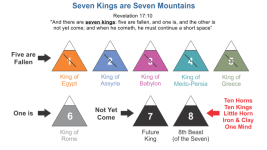
Quick question. Do you associate the above list with the seven heads of the beast in Revelation?
The reason why I ask is that there is something in all of this that folks never have a good answer for, that includes me.
Here is how I associate your list to the heads:
- Gold - Babylon - Third Head
- Silver - Medo-Persia - Fourth Head
- Bronze - Greece - Fifth Head
- Iron - Rome - Sixth Head
I am going to theorize for a moment. Let's say the stone destroying Nebuchadnezzars image was the finished work on the Cross. The clay was either Jerusalem being destroyed in 70 AD or something that is long past. Thus, Nebuchadnezzars image is completed prophecy.
Could the seventh head simply be another empire that is not part of Nebuchadnezzars image that already came and went?
That would mean we are waiting on the eighth head whose deadly wound is healed.
I set the parameters. It's nothing but a compiler which I edit and tailor.Did you for real just... reply with an entire AI response?
Could the seventh head simply be another empire that is not part of Nebuchadnezzars image that already came and went?
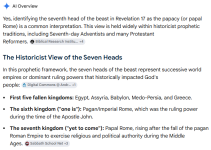
Something that seems to fit your research is that if we have Rome continue after the sixth head, then we could fit the Papacy in there as the seventh head:
### 1. The Category Error of Mixing Gentile Empires with Israel
The entire premise of Nebuchadnezzar’s dream in Daniel 2 is the **Times of the Gentiles**—the unbroken sequence of geopolitical, imperial world powers that exercise dominion over the literal city of Jerusalem and trample national Israel.
So, the clay would be the Time of the Gentiles beginning?
As for what I believe...
I feel like the seventh head already came and went. As I mentioned earlier, I believe each metal component of Nebuchadnezzar's image is specifically about persecuting Israelites/Jews. Thus, the seventh head had a similar theme.
Who was is that persecuted Jews in our recent past? Yes, Hitler.
I find it difficult to believe we are still waiting for the seventh head.
I feel like the seventh head already came and went. As I mentioned earlier, I believe each metal component of Nebuchadnezzar's image is specifically about persecuting Israelites/Jews. Thus, the seventh head had a similar theme.
Who was is that persecuted Jews in our recent past? Yes, Hitler.
I find it difficult to believe we are still waiting for the seventh head.
Again, I am trying to discuss the prophetic verses in chapter 2 before we can move onto chapter 7 - not Revelation. If we cannot interpret Daniel, there is no chance of interpreting Revelation.Quick question. Do you associate the above list with the seven heads of the beast in Revelation?
The reason why I ask is that there is something in all of this that folks never have a good answer for, that includes me.
Here is how I associate your list to the heads:
That means that there is a seventh head that is yet to come up after 70 AD. How does that work in conjunction with Nebuchadnezzars image? I see evidence that this seventh head is alluded to in Daniel 7, but I need to study that more.
- Gold - Babylon - Third Head
- Silver - Medo-Persia - Fourth Head
- Bronze - Greece - Fifth Head
- Iron - Rome - Sixth Head
I am going to theorize for a moment. Let's say the stone destroying Nebuchadnezzars image was the finished work on the Cross. The clay was either Jerusalem being destroyed in 70 AD or something that is long past. Thus, Nebuchadnezzars image is completed prophecy.
Could the seventh head simply be another empire that is not part of Nebuchadnezzars image that already came and went?
That would mean we are waiting on the eighth head whose deadly wound is healed.
So, would you care to comment / provide your interpretations for the 4 kingdoms in chapter 2, the identity of the clay and also how do you interpret 2:34? Thanks.
Not sure why you make those assumptions. There is no reference to the clay being baked in verse 2:33. It simply mentions clay - then, verse 2:34 tells us the Stone strikes the feet and breaks apart the iron and the clay (not the entire statue).Besides the fact that you make points with inaccurate facts (the clay is baked, there for its pottery vs 33 so there is no "being shaped" by God), and absolutely illogical conclusions like Christ would take out his own people, I feel like this thread is going in circles.
Again, I am trying to discuss the prophetic verses in chapter 2 before we can move onto chapter 7 - not Revelation. If we cannot interpret Daniel, there is no chance of interpreting Revelation.
Whatever @JustThinking . If you are not willing to answer my questions, then I'm not answering yours.
So, would you care to comment / provide your interpretations for the 4 kingdoms in chapter 2, the identity of the clay and also how do you interpret 2:34? Thanks.
I already gave my interpretations. I'm done with this thread and putting you on ignore.
That is your choice and I will follow suit, thanks.Whatever @JustThinking . If you are not willing to answer my questions, then I'm not answering yours.
I already gave my interpretations. I'm done with this thread and putting you on ignore.
The Seven Epistles to the Church of Revelation 2&3.The Seven Epistles to the Church of Revelation 3&4 span the length of the entire Church age up to the harpazo. Including of course the middle ages.
Yes, you heard that right, harpazo.
For the Nissuin must needs happen before the man of sin is revealed. Who is the driving force of the time of Jacob's trouble the GT.
Which of course leads to the repentance of the Nation Israel (the symmetrical antithesis of their rejection), and the Second Coming.
You didn't get the memo?
Typo my bad.
Something that seems to fit your research is that if we have Rome continue after the sixth head, then we could fit the Papacy in there as the seventh head:
View attachment 292566
That AI needs sacking - that is not the Historic view 0 maybe it is the SDA church view but it is not the Historic view .
Revelation 17:10 And there are seven kings: five are fallen, and one is, and the other is not yet come; and when he cometh, he must continue a short space.
In its time Rome was governed by seven forms of Government
1. Kings
2. Consuls
3. Dictators
4. Decemvirs
5. Military Tribunes
6. Military Emperors
7. Despotic Emperors
5 had fallen in Johns day they were already past
the one is - the 6th form of government that was present in Johns day was the Military Emperors
the not yet come - in Johns day were the 7th form - the despotic Emperors
Diocletian marked the start of the Despotic Emperors - Prior to Diocletian all the Emperors wore the Laurel Crown but Diocletian discarded this and wore the Diadem - qhich was the badge of Asiatic despotic Sovereignty
The Papacy is the eighth in verse 11
Revelation 17:11 And the beast that was, and is not, even he is the eighth, and is of the seven, and goeth into perdition.