Is Knowledge of the Original Languages Necessary for KJV Believers?

  • Christian Chat is a moderated online Christian community allowing Christians around the world to fellowship with each other in real time chat via webcam, voice, and text, with the Christian Chat app. You can also start or participate in a Bible-based discussion here in the Christian Chat Forums, where members can also share with each other their own videos, pictures, or favorite Christian music.

    If you are a Christian and need encouragement and fellowship, we're here for you! If you are not a Christian but interested in knowing more about Jesus our Lord, you're also welcome! Want to know what the Bible says, and how you can apply it to your life? Join us!

    To make new Christian friends now around the world, click here to join Christian Chat.
You boast that your eternal security is true. However the real test is not in your boasting about it (which anyone can claim about any kind of silly false belief), but it is being able to explain it light of the truck load tons of verses on conditional salvation. So how do you understand Galatians 6:8-9 and 1 Timothy 5:8? How do you understand John 15:2 and John 15:6? How do you understand Revelation 22:18-19? Yes, I am aware there are a few verses that may sound like eternal security at first glance but in most cases these verses are easily explained if you look at the context. But if your belief is that weak that it cannot be discussed involving Scripture, then just keep boasting in your false belief with your fingers in your ears. I also have debated this topic tons of times since 2010 with actual Scripture. I have run into folks like you many times.


….
[Jhn 15:2 YLT] 2 every branch in me not bearing fruit, He doth take it away ("Lifts Up") and every one bearing fruit, He doth cleanse by pruning it, that it may bear more fruit;

Dr. Arnold Fruchtenbaum exegetes John 15:2 through a literal, contextual, and lexical framework that firmly preserves the doctrine of eternal security. Rather than viewing this passage as a warning that a believer can lose their salvation, he resolves the tension by focusing on the Greek terminology, ancient viticulture practices, and the distinction between salvation and divine discipline or rewards.

His exegesis centers on key textual and theological distinctions:

1. Lexical Exegesis of Airō ("Takes Away" vs. "Lifts Up")
* The Translation Nuance: The Greek verb translated "taketh away" in the KJV is airō (\alpha\tilde{\iota}\rho\omega). While it can mean "to remove" or "take away," its primary and common meaning is "to lift up" or "to raise" (as seen in Luke 17:13 or John 11:41).

* Ancient Viticulture Context: Fruchtenbaum points to first-century Middle Eastern vineyard management. Heavy vine branches trailing on the muddy ground cannot catch sunlight or bear fruit. A winegrower does not immediately cut off a living branch lying in the dirt; instead, he lifts it up, ties it or props it up on a rock or trellis, and cleans off the mud so it can receive sunlight and begin producing fruit.

* Application to the Believer: The fruitless branch represents a true believer ("in Me") who is failing to produce spiritual fruit. God the Father (the Vinedresser) does not cut this believer off from salvation; He lifts them up—encouraging, helping, and placing them in a position to grow.


2. Alternative Interpretation: Physical Death as Divine Discipline
If airō is translated in its secondary sense as "takes away" / "removes," Fruchtenbaum maintains that it still does not mean a loss of spiritual salvation.
* In this view, "taking away" refers to physical death via divine discipline for a chronically disobedient or unfruitful believer.
* He correlates this with the biblical concept of the "sin unto death" (1 John 5:16) and Paul’s teaching on believers who face physical judgment or premature physical death due to persistent sin while remaining saved (1 Corinthians 5:5, 11:30).

3. "Purgeth" / "Prunes" (Kathairō)
For the branch that is bearing fruit, the Father "purgeth" or "prunes" it (kathairō). This describes the process of spiritual refinement and trial in a believer's life. God trims away unnecessary, energy-draining growth (worldly distractions or self-reliance) so that the believer produces an even greater yield ("more fruit").

4. Correlation with John 15:6 and Rewards (The Judgment Seat of Christ)
To maintain structural consistency with the rest of the discourse (specifically verse 6, where branches are "cast into the fire"):
* Fruchtenbaum emphasizes that the burning in John 15:6 is not the fire of Hell, but rather the judgment of a believer's works at the Judgment Seat of Messiah (Bema).
* He aligns John 15:6 with 1 Corinthians 3:11–15: the fruitless, useless works of a believer (wood, hay, stubble) are consumed by fire, resulting in a loss of heavenly rewards, yet the believer "himself shall be saved; yet so as by fire".


Summary
In Fruchtenbaum’s framework, John 15:2 describes God's gracious intervention in the life of a true believer. God either lifts up struggling, fruitless believers to help them bear fruit or prunes fruit-bearing believers to increase their yield. At no point does the passage teach that a genuine believer connected to the Vine can lose their e
ternal salvation.
 
  • Like
Reactions: Kroogz
You boast that your eternal security is true. However the real test is not in your boasting about it (which anyone can claim about any kind of silly false belief), but it is being able to explain it light of the truck load tons of verses on conditional salvation. So how do you understand Galatians 6:8-9 and 1 Timothy 5:8? How do you understand John 15:2 and John 15:6? How do you understand Revelation 22:18-19? Yes, I am aware there are a few verses that may sound like eternal security at first glance but in most cases these verses are easily explained if you look at the context. But if your belief is that weak that it cannot be discussed involving Scripture, then just keep boasting in your false belief with your fingers in your ears. I also have debated this topic tons of times since 2010 with actual Scripture. I have run into folks like you many times.


….
Nope. All easily debunked.

Never once did Paul say or insinuate that any believer could lose their salvation. Christ Jesus likewise!
 
  • Love
Reactions: Kroogz
What is the condition of having the seal of God?

Scripture says, God the Father has set his seal upon those who labor for the meat that endures unto everlasting life.

"Labour not for the meat which perisheth, but for that meat which endureth unto everlasting life, which the Son of man shall give unto you: for him hath God the Father sealed." (John 6:27).

The Holy Spirit is given to those who obey Him (Acts of the Apostles 5:32).

In fact, what is a guarantee?

Guarantee receipts normally have conditions which you can normally read in the ”fine print”. If you get a guarantee receipt for a certain product and you would like to make a claim, the store might request that you bring both the product and the receipt with you before they are willing to look at your claim. They might also request that you do this within a certain time frame and that you state what’s wrong with the product. Another example could be if someone buys you a bus ticket which guarantees you to get to a certain city PROVIDED that 1) you don’t throw away your ticket, 2) that you embark the right bus on the right time, and 3) that you STAY ON the bus until it arrives at the city. The BUS will arrive at the city as promised, but the question is if YOU will choose to be among the bus passengers.

1 Samuel 16:14
“But the Spirit of the LORD departed from Saul, and an evil spirit from the LORD troubled him.”

Psalms 51:11
“Cast me not away from thy presence; and take not thy holy spirit from me”

Again, circumcision was a ”seal” for those under the old covenant.

Romans 4:11
“And he received the sign of circumcision, a SEAL of the righteousness of the faith which he had yet being uncircumcised: that he might be the father of all them that believe, though they be not circumcised; that righteousness might be imputed unto them also.”

This seal WAS broken and guaranteed nothing when those who were circumcised broke the covenant and were cut off from the people of God.

Romans 2:25-27
25 “For circumcision verily profiteth, IF thou keep the law: but IF thou be a breaker of the law, thy circumcision is made uncircumcision. 26 Therefore if the uncircumcision keep the righteousness of the law, shall not his uncircumcision be counted for circumcision? 27 And shall not uncircumcision which is by nature, if it fulfill the law, judge thee, who by the letter and circumcision dost transgress the law?”

As you can see, this seal was conditioned on continued faith and obedience. The Holy Spirit marks us as God’s children of the new covenant but if we abandon the faith, and/or live in disobedience then the Spirit of God no longer remains in us and we are no longer sealed. Circumcised (sealed) jews were broken off through unbelief.

Acts 5:32
“And we are his witnesses of these things; and so is also the Holy Ghost, whom God hath given to them that obey him.”

John 14:15-16
15 “If ye love me, keep my commandments.
16 And I will pray the Father, and he shall give you another Comforter, that he may abide with you for ever”

Romans 8:9-10
9 “But ye are not in the flesh, but in the Spirit, IF so be that the Spirit of God dwell in you. Now if any man have not the Spirit of Christ, he is none of his. 10 And IF Christ be in you, the body is dead because of sin; but the Spirit is life because of righteousness.”

God speaks of the Israelites who ”grieved” His Holy Spirit in their rebellion. These Jews were cut off from the promise of entering God’s rest and they became God’s enemies.

Isaiah 63:10
“But they rebelled, and vexed his holy Spirit: THEREFORE he was turned to be their enemy, and he fought against them.” —

Isaiah 63:14
“As a beast goeth down into the valley, the Spirit of the LORD caused him to rest: so didst thou lead thy people, to make thyself a glorious name.”

In the NT the ”rest” is the eternal rest that all believers will attain. The book of Hebrews continually speak of the promise of eternal rest, in combination with WARNINGS to believers not to miss out on this promised rest through hardening their hearts in unbelief, just as the Israelites did who rebelled against God during the Exodus (Read Hebrews 3 and Hebrews 10).

Source:
https://bjorkbloggen.com/2012/04/22...-redemption-but-a-seal-can-be-broken-eph-430/
Jesus lord & God has the Anointing to Seal
i cant put all your own focus together sorry.
try acts chapter 2 pay atten to ver 33 go back to how peter interpreted David psalm 110 i think
 
Welcome to being Christian saint among Christians sinners.
I have talked online on various Christian forums since 2010.
Same here, and I've seen all kinds. However, I do know that if we poke the hornets nest of OSAS faith alone justification, then we will get the stings.

Debate only lasts for so long, because the hornets set aside nice speeches, and attack the messenger.

What's interesting however, is when the saints are 'judged' as unsaved, because we preach justification with works, and not by faith alone.

The judgment is based upon a supposed gospel of 'works salvation'. However, it's still a judgment of being unsaved, while believing in Jesus Christ. Which of course is contrary to the whole gospel of unconditonal salvation by faith only, apart from works.

But apparently not apart from ministerial works. Only apart from 'normal' works of iniquity and evil doing:

Gal 5:19
Now the works of the flesh are manifest, which are these; Adultery, fornication, uncleanness, lasciviousness...drunkenness, revellings, and such like:


That has been my primary experience but one has to listen carefully to what people say. They may say they are not out to sin, and that one must even live holy, but when push comes to shove and you ask the right questions or push the right buttons, that is essentially what many in America believe.
It's the paradox of preaching the commandments of the Lord, but not preaching keeping the commandments.

We can preach the commandments freely, but if we preach keeping the commandments, then we are preaching 'works salvation'.

1Jo 2:3
And hereby we do know that we know him, if we keep his commandments. He that saith, I know him, and is not keeping his commandments, is a liar, and the truth is not in him.

Rev 14:12
Here is the patience of the saints: here are they that are keeping the commandments of God, and the faith of Jesus.

The gospel of Jesus Christ preaches believing and knowing Him is with keeping His comandments.

I met the extreme forms of this to the lightest form of those who think they can justify sin on some level all because they have a belief alone on Jesus as their Savior.
True. However, it's the extreme forms that are most honest, though the lukewarm form is more common.

For OSAS to be true, no works we do can ever have anything to do, with being unconditionally salvation and justification by our faith alone in Christ, apart from our works.

Therefore, the more common form of OSAS contradicts OSAS itself: The moment works become necessary to prove our faith alone is 'true' and 'salvific', then our salvation is proven by works. "Works salvation"

The honest from of OSAS is simple: No matter what we do in life, none of our works have anything to do with our salvation. Our faith alone cannot be tested, nor proved, by our works.

Of course, such honest OSAS will still warn against evil doing, that can ruin this life, but there is no such warning about judgment of works after this life:

Heb 6:1
Therefore leaving the principles of the doctrine of Christ, let us go on unto perfection; not laying again the foundation of repentance from dead works, and of faith toward God, Of the doctrine of baptisms, and of laying on of hands, and of resurrection of the dead, and of eternal judgment.

1 Peter {1:15}
And if ye call on the Father, who without respect of persons judgeth according to every man’s work, pass the time of your sojourning here in fear:

And so, I personally have nmore respect to Christians that honestly believe and trust in OSAS, than the ones that try to have it both ways, and so corrupts both OSAS and the works justification gospel.

While they contradict OSAS by preaching works proving 'salvific faith', they also contradict works justification for both good and evil works:

Rev 3:15
I know thy works, that thou art neither cold nor hot: I would thou wert cold or hot. So then because thou art lukewarm, and neither cold nor hot, I will spue thee out of my mouth.


but when push comes to shove and you ask the right questions or push the right buttons, that is essentially what many in America believe.

Exactly. If we cut out all the great words and theological speeches, then once again, it's all very simple:

If we're believing in a Christ, that justifies us while doing evil, then of course our Christ is not Jesus Christ the righteous.

We can only believe Jesus Christ while doing good, not evil.


One Christian admitted to me in person that they could mow down a crowd with a machine gun and still be saved while doing so, all because they have a belief in Jesus as their Savior. Others have admitted to believe this when I talked with them online, as well.
And I knew a man that knew he would fornicate again, and would already be forgiven again, because by his faith alone, he knew all his past, present, and future sins are already forgiven.

He was the honest OSAS Christian, that I did not even try to persuade otherwise. How could I? If he's putting his faith alone to practice with fornication, then what can anyone do, but disagree? Why argue the Scriptures with someone, whose conviction of the Spirit of grace has been seared from his conscience.

it's the moderate OSAS Christians, that are only trying to soothe their conscience, while doing evil.

They believe they are still justified and uncondemned while doing the same as others, but they still seek to be sorry about it, though of course not necessary to repent, and certainly not to be saved.

2 Cor 7:10
For godly sorrow worketh repentance to salvation not to be repented of: but the sorrow of the world worketh death.


Charlies Stanley, who is not passed away, taught that you can even go back to a state of unbelief and be saved as long you had a one time moment of faith in Jesus Christ for salvation. Of course, he was a wolf in sheep's clothing.
I used to watch this smooth guy, when I was a sinner not willing to repent of my own sins and trespasses.

Though I wanted to believe it, I just couldn't get myself to believe I could already be forgiven for what I hven't even done yet. No only did I know it's a free pass license, but it's also irrational.

How can anyone forgive something that hasn't happened? Does the battered wife tell the abusing husband, that she already forgives him in the future? Jesus Christ is not a fool, that already forgives us for crucifying Him afresh to ourselves in the future.

Heb 10:26
For if we sin wilfully after that we have received the knowledge of the truth, there remaineth no more sacrifice for sins,... seeing they crucify to themselves the Son of God afresh, and put him to an open shame.

Nor is He mocked as an unjust Judge that already forgives 'favorites', while condemning strangers doing the same evil thing:

Rom 2:3
And thinkest thou this, O man, that judgest them which do such things, and doest the same, that thou shalt escape the judgment of God?

Gal 6:7
Be not deceived; God is not mocked: for whatsoever a man soweth, that shall he also reap. For he that soweth to his flesh shall of the flesh reap corruption; but he that soweth to the Spirit shall of the Spirit reap life everlasting…For there is no respect of persons with God.


The simple answer to OSAS justification, that has nothing to do with our works, has already been answered when first preached in the name of Christ:

2Pe 2:18
For when they speak great swelling words of vanity, they allure through the lusts of the flesh, through much wantonness, those that were clean escaped from them who live in error. While they promise them liberty, they themselves are the servants of corruption: for of whom a man is overcome, of the same is he brought in bondage.

James{2:22}
Ye see then how that by works a man is justified, and not by faith only.
 
No. According to Dr. Arnold Fruchtenbaum, neither the Apostle Paul nor any other biblical writer ever explicitly teaches that a true believer can lose their salvation.

Fruchtenbaum is a strict proponent of eternal security (often referred to as "Once Saved, Always Saved"). In his teaching on soteriology (specifically in Ariel’s Messianic Bible Study MBS 102: Eternal Security and his expositions on Pauline epistles like Romans and Galatians), he argues the following regarding Paul's writings:

* Paul Teaches Absolute Security: Fruchtenbaum emphasizes that Paul explicitly teaches the impossibility of losing salvation. He point to passages like Romans 8:38–39 (where nothing can separate a believer from the love of God) and Ephesians 1:13–14 (where the believer is sealed by the Holy Spirit as a guarantee) as clear Pauline proof that a believer is permanently secure.

* Misunderstood Pauline Passages: When Paul uses warning language—such as warnings against falling away, losing a prize, or returning to the Law (e.g., in Galatians 5:4, "fallen from grace")—Fruchtenbaum argues these passages are frequently misinterpreted. He asserts Paul is referring to:
* Loss of rewards at the Judgment Seat of Christ (1 Corinthians 3:10–15), not loss of salvation.
* Loss of fellowship or falling under temporal divine discipline/physical death (1 Corinthians 11:30), not eternal damnation.
* Falling away from a system of grace back into legalism (in Galatians), which affects practical sanctification rather than positional relationship with God.

* Nature of "Ceasing to Believe" or Persistent Sin: Fruchtenbaum maintains that if someone completely abandons the faith or lives in uninterrupted, unrepentant apostasy, Paul's theology indicates they were either never genuinely saved in the first place (spurious faith) or they are a true believer facing severe temporal discipline, but their eternal life remains intact because salvation is grounded entirely in Messiah’s finished work, not human maintenance.

In short, in Fruchtenbaum's systematic framework, Paul explicitly teaches the permanence of salvation, and any verse in Paul's epistles that appears to suggest losing salvation is being mis
applied.
 
* Paul Teaches Absolute Security: Fruchtenbaum emphasizes that Paul explicitly teaches the impossibility of losing salvation. He point to passages like Romans 8:38–39 (where nothing can separate a believer from the love of God) and Ephesians 1:13–14 (where the believer is sealed by the Holy Spirit as a guarantee) as clear Pauline proof that a believer is permanently secure.
John 6:27~~Do not work for the food that perishes, but for the food that lasts for eternal life, which the Son of Man will give you, for on Him the Father, God, has set His seal.”


Whether they like it or not, the LOSER believers are trying to convince us that the Lord Jesus Christ could possibly lose His seal.......Believers have the SAME seal as the Lord Jesus Christ.

The LOSER believer will spend 1000 years in Bible doctrine 101 in the eternal state.

The LOSER believers are working for food that PERISHES.
 
[Jhn 15:2 YLT] 2 every branch in me not bearing fruit, He doth take it away ("Lifts Up") and every one bearing fruit, He doth cleanse by pruning it, that it may bear more fruit;

Dr. Arnold Fruchtenbaum exegetes John 15:2 through a literal, contextual, and lexical framework that firmly preserves the doctrine of eternal security. Rather than viewing this passage as a warning that a believer can lose their salvation, he resolves the tension by focusing on the Greek terminology, ancient viticulture practices, and the distinction between salvation and divine discipline or rewards.

His exegesis centers on key textual and theological distinctions:
I would say the fundamental problem is that Fruchtenbaum and you are interpreting John 15 through the lens of OSAS that makes the passage sound odd or out of place with a normal reading. You begin with the conclusion that a genuinely saved person cannot finally fall away, and then the passage has to be interpreted in a way that preserves that conclusion. That is eisegesis rather than exegesis. We need to derive our theology from what the text actually says rather than enforce a predetermined theology upon the text.

This is especially concerning because OSAS ultimately leads to a “sin and still be saved” concept, where a person can return to serious sin, remain in darkness, or justify sin on some level, and yet supposedly remain guaranteed final salvation. That raises a serious moral question concerning the holiness and goodness of God. Because of that, I would be extremely careful about imposing OSAS upon warning passages and interpreting them in a way that effectively gives continued darkness and evil an unconditional guarantee of salvation. If OSAS is wrong, then explaining away God’s actual warnings as merely physical discipline or loss of rewards could have very serious consequences before God.

Now look at John 15 in its own context.

John 15:2 says:

“Every branch in me that beareth not fruit he taketh away: and every branch that beareth fruit, he purgeth it, that it may bring forth more fruit.”

The Greek word translated “taketh away” is αἴρω (airō). Yes, αἴρω can mean “lift up” in certain contexts, but showing that a word can have a particular meaning does not establish that meaning in this passage. Context determines the intended sense.

John himself repeatedly uses αἴρω for actual removal: “taketh away the sin of the world” (John 1:29), “Take ye away the stone” (John 11:39), “take away both our place and nation” (John 11:48), and “They have taken away the Lord” (John 20:2).

And only four verses later John 15 itself gives us strong contextual evidence for the taking-away meaning:

“If a man abide not in me, he is cast forth as a branch, and is withered; and men gather them, and cast them into the fire, and they are burned.”
John 15:6

That is plainly a taking-away concept. The branch is “cast forth,” withers, is gathered, cast into the fire, and burned. Jesus is not describing the branch merely being lifted upward while remaining attached to the vine so that it can become fruitful. He is describing removal followed by destruction. Therefore, although “lift up” is within the lexical range of αἴρω, the immediate context strongly supports the KJV’s “taketh away.”

There is also a clear contrast in verse 2. The fruitful branch is “purged” so “that it may bring forth more fruit,” whereas the fruitless branch is “taken away.” Then verse 6 gives the fuller consequence of failing to abide.

Notice also the wording:

“If a man abide not in me…”

Jesus does not say, “If a man was never really in me.” The discourse begins with “Every branch in me,” and then warns about not continuing or abiding in Him. That is conditional language.

The fire imagery is also significant. It is certainly true that every occurrence of fire in Scripture does not automatically mean eternal judgment. There are literal fires and other figurative uses. But when the New Testament speaks of people or worthless things being burned, consumed, or cast into fire, destructive judgment is repeatedly the meaning. John 15:6 itself is excluded from the following list:
  1. Matthew 3:12 — “burn up the chaff with unquenchable fire”
  2. Matthew 5:22 — “in danger of hell fire”
  3. Matthew 13:40 — “the tares are gathered and burned in the fire”
  4. Matthew 13:42 — “cast them into a furnace of fire: there shall be wailing and gnashing of teeth”
  5. Matthew 13:50 — “cast them into the furnace of fire: there shall be wailing and gnashing of teeth”
  6. Matthew 18:8 — “to be cast into everlasting fire”
  7. Matthew 18:9 — “to be cast into hell fire”
  8. Matthew 25:41 — “Depart from me, ye cursed, into everlasting fire”
  9. Mark 9:43 — “to go into hell, into the fire that never shall be quenched”
  10. Mark 9:44 — “the fire is not quenched”
  11. Mark 9:45 — “to be cast into hell, into the fire that never shall be quenched”
  12. Mark 9:46 — “the fire is not quenched”
  13. Mark 9:48 — “the fire is not quenched”
  14. Luke 3:17 — “the chaff he will burn with fire unquenchable”
  15. Luke 17:29 — “it rained fire and brimstone from heaven, and destroyed them all”
  16. Jude 7 — “suffering the vengeance of eternal fire”
  17. Revelation 9:18 — “the third part of men killed, by the fire”
  18. Revelation 11:5 — “fire proceedeth out of their mouth, and devoureth their enemies”
  19. Revelation 14:10 — “he shall be tormented with fire and brimstone”
  20. Revelation 16:8 — “to scorch men with fire”
  21. Revelation 17:16 — “burn her with fire”
  22. Revelation 18:8 — “she shall be utterly burned with fire: for strong is the Lord God who judgeth her”
  23. Revelation 19:20 — “cast alive into a lake of fire burning with brimstone”
  24. Revelation 20:9 — “fire came down from God out of heaven, and devoured them”
  25. Revelation 20:10 — “cast into the lake of fire and brimstone”
  26. Revelation 20:14 — “cast into the lake of fire. This is the second death”
  27. Revelation 20:15 — “cast into the lake of fire”
  28. Revelation 21:8 — “the lake which burneth with fire and brimstone: which is the second death”
That repeated New Testament pattern matters when interpreting John 15:6. Here we have a man who does not abide in Christ, is represented by a branch that is cast out, withers, is gathered, cast into fire, and burned. That fits destructive judgment far more naturally than the idea that the person remains eternally secure and merely loses rewards.

And 1 Corinthians 3 does not overturn this.

Paul tells the Corinthians, “ye are God’s building” (1 Corinthians 3:9), while he describes himself as “a wise masterbuilder” who laid the foundation (1 Corinthians 3:10). Paul makes the identity of his “work” even clearer in 1 Corinthians 9:1 when he tells these same Corinthians, “are not ye my work in the Lord?” Paul is the builder and the Corinthians are his work.

So when 1 Corinthians 3:15 says:

“If any man’s work shall be burned, he shall suffer loss: but he himself shall be saved; yet so as by fire,”

the one being saved through the fire is the builder. Paul can be saved through the fire even if some of his work, the Corinthians whom he labored over, ultimately proves to be hay or stubble and is destroyed.

And look at why this matters in the immediate context. Paul is rebuking the Corinthians because there is among them “envying, and strife” (1 Corinthians 3:3). Yet in Galatians 5:19-21, Paul includes “strife” and “Envyings” among the works of the flesh and warns that “they which do such things shall not inherit the kingdom of God.”

So 1 Corinthians 3 cannot reasonably be turned into a promise that these Corinthians may continue justifying envy, strife, and other works of the flesh while remaining unconditionally guaranteed salvation. Paul even warns in the same chapter:

“If any man defile the temple of God, him shall God destroy.”
1 Corinthians 3:17

Therefore, I do not see John 15 teaching that the unfruitful branch is simply “lifted up,” nor do I see its fire as merely the loss of rewards. The immediate context says the branch is taken away, cast forth, withers, is gathered, cast into fire, and burned. The broader New Testament repeatedly uses this kind of fire imagery for judgment and destruction. We should allow that context to determine our theology rather than first assuming OSAS and then forcing John 15 to fit it.


….
 
Nope. All easily debunked.

Never once did Paul say or insinuate that any believer could lose their salvation. Christ Jesus likewise!
No. My recent reply to you on John 15:2, and John 15:6 proves that you have not really debunked anything here. I show that your interpretation goes against what these two verses are saying together and I have dismantled your OSAS interpretation on 1 Corinthians 3 view that it talking about a loss of rewards if you sin. I demonstrate from Scripture that the primary use of fire is shown as judgment in the Scriptures. If you are wrong, you are taking a huge risk by doing so because of a belief system that ultimately justifies sin on some level.


….
 
No. My recent reply to you on John 15:2, and John 15:6 proves that you have not really debunked anything here. I show that your interpretation goes against what these two verses are saying together and I have dismantled your OSAS interpretation on 1 Corinthians 3 view that it talking about a loss of rewards if you sin. I demonstrate from Scripture that the primary use of fire is shown as judgment in the Scriptures. If you are wrong, you are taking a huge risk by doing so because of a belief system that ultimately justifies sin on some level.


….
Nope. Key verses:
Jhn 15:3
Already you are clean because of the word that I have spoken to you.
Jhn 15:4
Abide in me, and I in you. As the branch cannot bear fruit by itself, unless it abides in the vine, neither can you, unless you abide in me.

Thieme takes John 15:6 as referring to a genuine believer who fails to “abide,” not to an unbeliever who was never saved and not to a believer losing salvation. For him, the subject of John 15:1–8 is Christian production/fellowship, and the severe endpoint of persistent failure is divine discipline, potentially the “sin unto death.”
There is unusually good evidence for this because Thieme’s own ministry index identifies his June 26, 1969 lesson on John 15:1–6 with the summary:
“Vine & branches; sin unto death; doctrine of human good”
That is important. It tells us directly how Thieme connected verse 6: not hell, but the sin unto death and worthless human production.

1. Start with the context: the branches are believers​

Thieme reads the vine metaphor ecclesiologically:
  • Vine = Christ
  • Branches = believers in union with Christ
  • Fruit = divine good
  • Failure to bear fruit = carnality / human good / failure in the Christian life
His recently published Bible Doctrine Dictionary explicitly says of John 15:1–8 that:
Church Age believers are depicted as branches connected to—“in union with”—Jesus Christ.
It then explains that fruit bearing represents the production of divine good, which requires the filling of the Spirit and Bible doctrine. Remarkably, the dictionary specifically associates John 15:6 with the carnal believer producing “bad fruit” or dead works/human good.
That makes it very difficult to attribute to Thieme the common Calvinist interpretation:
“The branch burned in verse 6 was never really a believer.”
That is not Thieme's framework. For him, the branch really belongs to Christ positionally.

2. “Abide in Me” is therefore not “remain saved”​

This is the crucial distinction.
For Thieme:
union with Christ ≠ fellowship with Christ.
At salvation the believer is placed permanently in union with Christ. That is positional truth and cannot be reversed.
But μένω (menō), “abide/remain,” in this passage concerns the believer's experiential spiritual life—remaining in the sphere in which Christ's power produces fruit.
Hence:
“Abide in me … and ye shall bear much fruit”
is not:
“Keep believing/behaving sufficiently or you will cease being justified.”
It is essentially:
Remain experientially in fellowship and dependence upon Christ so that divine production occurs.
That interpretation fits verses 4–5 naturally:
“As the branch cannot bear fruit of itself … no more can ye.”
The stated issue is fruit bearing, not obtaining or retaining eternal life.
And verse 8 explicitly supplies the objective:
“Herein is my Father glorified, that ye bear much fruit.”
Thieme therefore sees the whole paragraph as a production passage, not a justification passage. His ministry catalog confirms this: the very next lesson, John 15:7–8, is summarized as “Believer’s fruit-bearing is divine good,” followed by John 15:1–8 as the “Formula & results of divine production.”

3. So what happens in verse 6?​

Now the language makes sense within Thieme's system:
“If a man abide not in me…”
The believer becomes persistently carnal/reversionistic.
“…he is cast forth as a branch…”
He becomes useless with respect to divine production.
“…and is withered…”
There is no spiritual production because the Christian life cannot be produced through human power.
“…they gather them, and cast them into the fire, and they are burned.”
Thieme connects this severe terminal imagery with divine discipline culminating in the sin unto death—premature physical removal of a recalcitrant believer from this life.
His ministry's official lesson index explicitly pairs John 15:1–6 with “sin unto death.”
And Thieme defines that doctrine very specifically. Persistent carnality/reversionism moves through:
warning discipline → intensive discipline → dying discipline (“sin unto death”).
The final stage is a premature physical departure from temporal life—not eternal condemnation.

4. The fire therefore does NOT equal the Lake of Fire in Thieme​

This is probably the pivotal issue in your question.
Someone approaching John 15:6 conventionally sees:
branch + fire + burning = hell.
Thieme says that inference imports an eschatological meaning into an illustration whose context concerns believers and production.
Fire does not automatically mean eternal damnation.
The believer can have his production destroyed by fire and nevertheless remain saved:
1 Corinthians 3:15
“If any man's work shall be burned, he shall suffer loss: but he himself shall be saved; yet so as by fire.
That passage is almost tailor-made for Thieme's John 15 distinction:
person saved; production destroyed.
His 1 Corinthians teaching likewise classifies 1 Corinthians 3:10–15 under:
“Judgment Seat of Christ … human good vs. divine good”
while surrounding lessons explicitly deal with the carnal Christian.
There may consequently be two related dimensions in Thieme's imagery:
temporal: a useless/reversionistic believer eventually comes under maximum discipline—the sin unto death;
eschatological: his human good/dead works have no eternal reward and are rejected at the Judgment Seat of Christ.
But neither means the believer himself goes to hell.

5. And Thieme's eternal-security doctrine makes that non-negotiable​

Thieme explicitly teaches:
“Once you have personally believed in Jesus Christ, you are eternally in the plan of God.”
And:
“Your salvation is once and for all, and it lasts forever.”
His formulation is unusually absolute: subsequent failure, catastrophe, or even denial of God cannot undo the salvation transaction because eternal security rests upon God's character and work rather than continued human faithfulness.
His doctrine of divine discipline accordingly states explicitly:
“Divine discipline, no matter how severe, does not entail loss of salvation.”
The possible endpoint is instead dying discipline / the sin unto death.
That gives us the interpretive grid:
John 15Thieme
“I am the vine”Christ
branches “in Me”genuine believers in union with Christ
abidingexperiential fellowship/spiritual function
fruitdivine good
no fruitcarnality / human good / failure of production
pruningGod's corrective work
witheringspiritual ineffectiveness
casting awayloss of usefulness/production, not positional union
fire/burningsevere divine discipline / sin unto death; worthless production
resultloss of temporal usefulness and potentially life/reward
notloss of eternal salvation
 
No. My recent reply to you on John 15:2, and John 15:6 proves that you have not really debunked anything here. I show that your interpretation goes against what these two verses are saying together and I have dismantled your OSAS interpretation on 1 Corinthians 3 view that it talking about a loss of rewards if you sin. I demonstrate from Scripture that the primary use of fire is shown as judgment in the Scriptures. If you are wrong, you are taking a huge risk by doing so because of a belief system that ultimately justifies sin on some level.


….

There is actually a very strong contextual argument for Thieme here

Notice what Jesus says immediately before the abiding commands:

John 15:3
“Now ye are clean through the word which I have spoken unto you.”
And Judas has already left in John 13:30.

Jesus is speaking to the Eleven.

Then:

“Abide in me.”
So the logic is not naturally:

Get saved → remain saved → otherwise go to hell.

They are already His disciples and already “clean.”

The logic is:

You belong to Me → now abide in Me → because only in fellowship/dependence upon Me can you produce fruit.

And Jesus repeats the production theme relentlessly:

v.2: fruit / more fruit
v.4: bear fruit
v.5: much fruit
v.6: failure to abide
v.8: much fruit / Father glorified


That is why Thieme's interpretation of verse 6 is actually inseparable from verse 5:

“without me ye can do nothing.”
He understands nothing to mean nothing of divine value. The carnal Christian can perform enormous quantities of human good, religious activity, philanthropy, morality, etc.; but outside the enabling power of God it is wood, hay, stubble, not divine good.

So I would summarize Thieme's exegesis in one sentence:

John 15:6 does not describe Christ revoking eternal life from an apostate believer; it describes a genuine believer who ceases experientially to abide in Christ, becomes incapable of divine production, accumulates worthless human good, comes under increasingly severe divine discipline, and in extreme reversionism may be removed from temporal life by the “sin unto death”—while remaining eternally saved.
And the striking thing is that we don't have to reconstruct that merely from Thieme's general theology: his own lesson catalog labels his exposition of John 15:1–6 “Vine & branches; sin unto death; doctrine of human good.”

That is about as direct an answer to the interpretive question as one could want.
 
Welcome to being Christian saint among Christians sinners.
Thank you, brother.

Same here, and I've seen all kinds. However, I do know that if we poke the hornets nest of OSAS faith alone justification, then we will get the stings.

Debate only lasts for so long, because the hornets set aside nice speeches, and attack the messenger.

What's interesting however, is when the saints are 'judged' as unsaved, because we preach justification with works, and not by faith alone.

The judgment is based upon a supposed gospel of 'works salvation'. However, it's still a judgment of being unsaved, while believing in Jesus Christ. Which of course is contrary to the whole gospel of unconditonal salvation by faith only, apart from works.
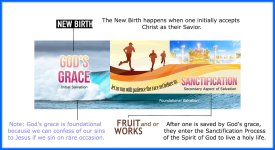
I understand salvation as having two distinct aspects.

IMG_4681.webp

IMG_4682.jpeg
IMG_4684.png

This is not Calvinism by any means. Man has free will to either accept or reject God, but this happens when God illuminates the truth to a person at the right time or times in their life (Under the drawing of Christ and the conviction of the Spirit). For even Lydia’s heart was opened to understand Paul’s message. In other words, a person cannot believe without the working of God in their life to make that happen. But a person will know of the truth at the right time God chooses them to know the truth. It is up to the individual if they accept or reject the truth (See: 2 Thessalonians 2:10).

But there is only two steps we need to be concerned with (According to the Bible).
Grace and Sanctification (Which are by faith).

Side Note 1:

We are washed of our sins when we are first saved by God’s grace.
But we must be washed a second time.

Leviticus 13:58
”And the garment, either warp, or woof, or whatsoever thing of skin it be, which thou shalt wash, if the plague be departed from them, then it shall be washed the second time, and shall be clean.”

Revelation 7:14
”And I said unto him, Sir, thou knowest. And he said to me, These are they which came out of great tribulation, and have washed their robes, and made them white in the blood of the Lamb.”

Side Note 2: There are some Christian groups who believe you must be water baptized in order to be initially saved. I disagree with this. I see water baptism as an important part of our faith and obedience to Christ, but I do not believe that failing to be water baptized in this life, especially when a believer never had a genuine opportunity to be baptized by like-minded believers, is necessarily a sin unto death.

Peter says concerning baptism that it is “not the putting away of the filth of the flesh, but the answer of a good conscience toward God” (1 Peter 3:21). Paul likewise speaks of cleansing ourselves “from all filthiness of the flesh and spirit” (2 Corinthians 7:1), where filthiness is connected with moral and spiritual defilement. Therefore, I do not believe the physical act of being placed in water is what washes away our sins or obtains salvation.

That does not make water baptism unimportant. A genuine believer should naturally desire to be baptized when the opportunity is available, and believers should strive to obey all the commands given by Jesus and His followers under the New Covenant. However, we are no longer under the Old Covenant as a whole. When Christ died, “the veil of the temple was rent in twain from the top to the bottom” (Matthew 27:51), marking the tremendous change brought about through His sacrifice and the New Covenant.

We still obey God’s moral commands, such as not murdering, not stealing, not committing adultery, and not coveting. But Christians are not required to observe those Old Covenant laws that were given specifically to Israel as part of that covenant, such as circumcision, Israel’s dietary laws, the Saturday Sabbath requirement, the Levitical priesthood, or the offering of animal sacrifices and other ceremonial offerings at the temple.

Side Note 3:

In addition, long after I discovered the two aspect of salvation in Scripture, I discovered that "Christ's Sanctified Holiness Church" that mostly exists on the East coast holds to the same view as me in that there are two aspects of salvation. I do disagree with their view of denying the bodily resurrection, though. They also say that the KJV are the inspired words of God. While I see the KJV as without error and a providential translation, I see the underlying Hebrew, Aramaic, and Greek as the actual inspired words of God.

Anyway, here is the link to what Christ's Sanctified Holiness Church believes:


But apparently not apart from ministerial works. Only apart from 'normal' works of iniquity and evil doing:

Gal 5:19
Now the works of the flesh are manifest, which are these; Adultery, fornication, uncleanness, lasciviousness...drunkenness, revellings, and such like:
Yeah, they think they will do both good and evil works in this life and no matter how they live, they will be saved all because of a belief alone on Jesus as their Savior or in trusting in the finished work of the cross. Some of them (not all) do not realize that the true good a believer can truly do is only by God doing the good work through a believer. So even if they did good works outwardly in this life, they are not doing the true good works of God by His doing the good work in them. God would have to approve of them doing evil in order for them to believe they can sin and still be saved on some level. This is just not possible because God is good, righteous, and holy.


It's the paradox of preaching the commandments of the Lord, but not preaching keeping the commandments.

We can preach the commandments freely, but if we preach keeping the commandments, then we are preaching 'works salvation'.

1Jo 2:3
And hereby we do know that we know him, if we keep his commandments. He that saith, I know him, and is not keeping his commandments, is a liar, and the truth is not in him.

Rev 14:12
Here is the patience of the saints: here are they that are keeping the commandments of God, and the faith of Jesus.

The gospel of Jesus Christ preaches believing and knowing Him is with keeping His comandments.
Currently, I see the gospel as more 1 Corinthians 15:1-4, but the gospel does call us to Sanctification (living holy) according to 2 Thessalonians 2:13-14. God’s grace does teach us to deny ungodliness and that we should live righteously in this present world (Titus 2:11-12). God's grace does give us the ability to do the work or to be more fruitful (1 Corinthians 15:10). Granted, I am open to studying more on this topic in the Greek and the KJV under the guidance of asking God for help.


....
 

There is actually a very strong contextual argument for Thieme here

Notice what Jesus says immediately before the abiding commands:


And Judas has already left in John 13:30.

Jesus is speaking to the Eleven.

Then:


So the logic is not naturally:

Get saved → remain saved → otherwise go to hell.

They are already His disciples and already “clean.”

The logic is:

You belong to Me → now abide in Me → because only in fellowship/dependence upon Me can you produce fruit.

And Jesus repeats the production theme relentlessly:

v.2: fruit / more fruit
v.4: bear fruit
v.5: much fruit
v.6: failure to abide
v.8: much fruit / Father glorified


That is why Thieme's interpretation of verse 6 is actually inseparable from verse 5:


He understands nothing to mean nothing of divine value. The carnal Christian can perform enormous quantities of human good, religious activity, philanthropy, morality, etc.; but outside the enabling power of God it is wood, hay, stubble, not divine good.

So I would summarize Thieme's exegesis in one sentence:


And the striking thing is that we don't have to reconstruct that merely from Thieme's general theology: his own lesson catalog labels his exposition of John 15:1–6 “Vine & branches; sin unto death; doctrine of human good.”

That is about as direct an answer to the interpretive question as one could want.
@cv5 - Well, I do have a day job. So I may be able to get back to you on your recent two posts here maybe tomorrow.

Not that I looked at all your points here because I have to get ready for work and you wrote a lot, but did you ever consider that Paul is the one who will be saved through the fire and that his work are the Corinthians who will burned up because they are justifying the sins of strife and envy in 1 Corinthians 3? 1 Corinthians 9:1 says that the Corinthians are Paul's work. No doubt you may see this as a destruction of just their body (being taken home early) and not a destruction or punishment of their soul in the Lake of Fire. But have you not considered that even the damned will receive new bodies to be thrown into the Lake of Fire? So yes, there will be a destruction of the body for those who are wicked (Whether you are a believer or not). It's kind of common sense.


....
 
Thank you, brother.


I understand salvation as having two distinct aspects.

View attachment 294633

View attachment 294634
View attachment 294635

This is not Calvinism by any means. Man has free will to either accept or reject God, but this happens when God illuminates the truth to a person at the right time or times in their life (Under the drawing of Christ and the conviction of the Spirit). For even Lydia’s heart was opened to understand Paul’s message. In other words, a person cannot believe without the working of God in their life to make that happen. But a person will know of the truth at the right time God chooses them to know the truth. It is up to the individual if they accept or reject the truth (See: 2 Thessalonians 2:10).

But there is only two steps we need to be concerned with (According to the Bible).
Grace and Sanctification (Which are by faith).

Side Note 1:

We are washed of our sins when we are first saved by God’s grace.
But we must be washed a second time.

Leviticus 13:58
”And the garment, either warp, or woof, or whatsoever thing of skin it be, which thou shalt wash, if the plague be departed from them, then it shall be washed the second time, and shall be clean.”

Revelation 7:14
”And I said unto him, Sir, thou knowest. And he said to me, These are they which came out of great tribulation, and have washed their robes, and made them white in the blood of the Lamb.”

Side Note 2: There are some Christian groups who believe you must be water baptized in order to be initially saved. I disagree with this. I see water baptism as an important part of our faith and obedience to Christ, but I do not believe that failing to be water baptized in this life, especially when a believer never had a genuine opportunity to be baptized by like-minded believers, is necessarily a sin unto death.

Peter says concerning baptism that it is “not the putting away of the filth of the flesh, but the answer of a good conscience toward God” (1 Peter 3:21). Paul likewise speaks of cleansing ourselves “from all filthiness of the flesh and spirit” (2 Corinthians 7:1), where filthiness is connected with moral and spiritual defilement. Therefore, I do not believe the physical act of being placed in water is what washes away our sins or obtains salvation.

That does not make water baptism unimportant. A genuine believer should naturally desire to be baptized when the opportunity is available, and believers should strive to obey all the commands given by Jesus and His followers under the New Covenant. However, we are no longer under the Old Covenant as a whole. When Christ died, “the veil of the temple was rent in twain from the top to the bottom” (Matthew 27:51), marking the tremendous change brought about through His sacrifice and the New Covenant.

We still obey God’s moral commands, such as not murdering, not stealing, not committing adultery, and not coveting. But Christians are not required to observe those Old Covenant laws that were given specifically to Israel as part of that covenant, such as circumcision, Israel’s dietary laws, the Saturday Sabbath requirement, the Levitical priesthood, or the offering of animal sacrifices and other ceremonial offerings at the temple.

Side Note 3:

In addition, long after I discovered the two aspect of salvation in Scripture, I discovered that "Christ's Sanctified Holiness Church" that mostly exists on the East coast holds to the same view as me in that there are two aspects of salvation. I do disagree with their view of denying the bodily resurrection, though. They also say that the KJV are the inspired words of God. While I see the KJV as without error and a providential translation, I see the underlying Hebrew, Aramaic, and Greek as the actual inspired words of God.

Anyway, here is the link to what Christ's Sanctified Holiness Church believes:


Yeah, they think they will do both good and evil works in this life and no matter how they live, they will be saved all because of a belief alone on Jesus as their Savior or in trusting in the finished work of the cross. Some of them (not all) do not realize that the true good a believer can truly do is only by God doing the good work through a believer. So even if they did good works outwardly in this life, they are not doing the true good works of God by His doing the good work in them. God would have to approve of them doing evil in order for them to believe they can sin and still be saved on some level. This is just not possible because God is good, righteous, and holy.


Currently, I see the gospel as more 1 Corinthians 15:1-4, but the gospel does call us to Sanctification (living holy) according to 2 Thessalonians 2:13-14. God’s grace does teach us to deny ungodliness and that we should live righteously in this present world (Titus 2:11-12). God's grace does give us the ability to do the work or to be more fruitful (1 Corinthians 15:10). Granted, I am open to studying more on this topic in the Greek and the KJV under the guidance of asking God for help.


....
Yes, a broader biblical cleansing motif:
The Mosaic categories of clean/unclean contribute to the biblical vocabulary later used to explain purification from sin. Hebrews explicitly treats various Mosaic “washings” as part of the old covenant ceremonial system:


“meats and drinks, and divers washings [βαπτισμοῖς]…”

— Hebrews 9:10


Hebrews then contrasts those external ordinances with the vastly greater cleansing accomplished through Christ:


“How much more shall the blood of Christ … purge your conscience…”

— Hebrews 9:14.


That is the legitimate canonical movement: ceremonial cleansing → Christ's superior cleansing, rather than “the second washing in Lev 13:58 secretly represents the Church.”


There is also an interesting Church-age parallel in the distinction between positional cleansing and experiential cleansing. A believer is once-for-all cleansed positionally in Christ, yet still requires ongoing cleansing in fellowship:


“He that is washed needeth not save to wash his feet, but is clean every whit…”

— John 13:10


and:


“If we confess our sins, he is faithful and just to forgive us our sins, and to cleanse us…”

— 1 John 1:9.
 
There is also an interesting Church-age parallel in the distinction between positional cleansing and experiential cleansing. A believer is once-for-all cleansed positionally in Christ, yet still requires ongoing cleansing in fellowship:
— 1 John 1:9.
1 John 1:9 is one of my favorite verses and this is not talking about experiential cleansing only (if that is what you are suggesting). Read it again. It says that if we confess our sins, He is faithful and just to forgive us our sins. So if all sins were taken away by believing in Jesus then there is no need to confess sins to be forgiven of them. It's illogical to claim otherwise. You also do not believe 1 John 1:7. There is a church sign on my way home that quotes 1 John 1:7 but they only quote the words that make it sound like OSAS. They say Jesus cleanses us from all sin and they fail to mention on the church sign that the condition is that you have to walk in the light. They probably have no idea what "walk in the light" even means. Have you known for a long time what that means? The context in the next chapter tells you.

Anyways, I gotta run.


....
 
Is Knowledge of the Original Languages Necessary for KJV Believers?

As is often the case, we have a thesis which is such an odd statement, and which is full of so many hidden presuppositions, as to make its real meaning incredibly unclear.


Necessary:
To narrow the scope, I'll just focus on one word, necessary.
What do we mean by necessary?
Necessary in what way?

1. Do we mean knowledge of original languages is necessary to... understand the propositional content?
- I think this is a simple no.

2. Do we mean knowledge of the original languages is necessary to know God, love God, or serve God?
- I think this is a simple no, based on #1 above.

3. Do we mean knowledge of original languages is necessary to... dig deeper into particular nuances of the text, or do particular types of textual research?
- I think this is a simple yes.

4. Do we mean knowledge of the original languages (either possessing or not possessing this knowledge) is an issue that... has some special bearing upon KJVO people more than other people?
- I think this is a simple no, and a very odd thing to even talk about.

CONCLUSION:
1.) Knowledge of the original languages is necessary for some things, and unnecessary for other things.
2.) Whether or not a person is KJVO, and holds to some particular translation, has nothing to do with basic logic, and basic principles of language.
3.) I think this whole conversation is just incredibly odd.

.
 
I like the language of the KJV.
Many in our Bible circle started reading the Bible using a KJV.

The Word leads us to understand the word. Version is not a deterrent to that communication.
 
First, the KJV translators did not originate the rendering “silence” in 1 Timothy 2:11–12. Earlier English Bibles in the received-text/Reformation tradition were already using it. Tyndale has “learne in silence” and “be in silence,” while at 2 Thessalonians 3:12 he has “worke with quyetnes.” The Geneva Bible and Bishops’ Bible likewise used “silence” in 1 Timothy 2 before the KJV appeared. So the distinction you are criticizing was already present long before 1611.

Second, even the Wycliffite Bible used “silence” in 1 Timothy 2:11–12 centuries before the KJV. The Wycliffite Bible was translated from the Latin Vulgate rather than directly from the Greek, so this shows that “silence” was already established English biblical terminology well before the Reformation, much less the KJV.

Third, the Middle English Dictionary is particularly important because the historical English word “silence” did not always mean absolute muteness. It gives such extended senses as “Peace, calm; a state of tranquil and restful behaviour” and “Refraining from excessive speaking or talking.” That latter sense is especially significant. Refraining from excessive speaking obviously does not mean that no speaking whatsoever may occur. Therefore, we should not automatically impose the narrowest modern meaning of “absolute non-speaking” upon the KJV’s older English phrase “in silence.”

Fourth, the Geneva Bible itself helps explain how pre-KJV translators could use “silence.” It reads, “Let the woman learn in silence,” and “but to be in silence,” yet its note on verse 12 explains the issue specifically in relation to women teaching “in the Congregation” and thereby being placed above men. The translators could therefore use the word “silence” while understanding the passage contextually in relation to teaching and authority.

Fifth, Calvin, writing before the KJV, also interpreted the passage contextually. In 1 Timothy 2:12, he explains Paul’s command to be “quiet” as meaning to “keep within their own rank.” His explanation connects the silence or quietness with the role under discussion rather than treating it merely as a command that absolutely no sound may ever be made.

Sixth, there is evidence even centuries before the Reformation. Bernard of Fontcaude, writing around A.D. 1190, discussed Paul’s command that women be silent and explicitly qualified it as “not indeed from prayer or the praise of God, but from teaching.” He then appeals to 1 Timothy 2:11–12. He also distinguishes speaking from teaching, pointing out that not everyone who speaks is therefore preaching or teaching. Whatever one thinks of Bernard’s theology as a whole, historically this is very significant. He could speak of Paul’s command to “silence” while expressly denying that it prohibited every kind of speaking.

So to answer your original question directly, yes, the people in 2 Thessalonians 3:12 could speak and make the ordinary sounds associated with working while obeying Paul’s command to work “with quietness.” The context tells us that they had been disorderly, refusing to work, and behaving as busybodies. Paul commands them to settle down, attend to their own work, and eat their own bread.

Likewise, I do not believe the KJV’s “in silence” in 1 Timothy 2:11–12 necessarily means that a woman may never utter a word under any circumstance. The immediate context speaks of learning “with all subjection” and then immediately addresses teaching and authority. The historical evidence above shows that “silence” could be understood contextually and did not necessarily communicate absolute muteness.

This is why I think the accusation against the KJV translators is misplaced. You seem to be putting the KJV alone in the target range, as though this were a uniquely KJV translation decision that can be traced to Jacobean male chauvinism. But if you want to fire at this rendering, the historical line of fire has to go through much more than the KJV. You would also have to shoot through the earlier received-text English Bibles that already used “silence,” through the Wycliffite Bible centuries earlier, through Reformation interpretation such as Geneva and Calvin, through medieval interpretation such as Bernard of Fontcaude, and through the historical English evidence documented by the Middle English Dictionary itself.

You can certainly argue that “quietness” might communicate the idea more clearly to a modern reader. But that is very different from proving that “silence” was an improper translation or that the KJV translators deliberately selected a harsher meaning for women. The historical evidence makes that accusation very difficult to sustain.

Sources:

Middle English Dictionary, “sī̆lence, n.”
https://quod.lib.umich.edu/m/middle-english-dictionary/dictionary/MED40329

BibleHub, historical English parallels, 1 Timothy 2:11
https://biblehub.com/parallel/1_timothy/2-11.htm

BibleHub, historical English parallels, 1 Timothy 2:12
https://biblehub.com/parallel/1_timothy/2-12.htm

Tyndale, 2 Thessalonians 3:12
https://www.biblestudytools.com/tyn/2-thessalonians/3-12.html

Wycliffe, 1 Timothy 2:11–13
https://www.biblegateway.com/passage/?search=1+Timothy+2:11-13&version=WYC

University of Chicago, “Bibles in English” historical collection
https://artfl-permalink.uchicago.edu/permalinks/bie

Geneva Bible, 1 Timothy 2:11–13 with notes
https://www.biblegateway.com/passage/?search=1+Timothy+2:11-13&version=GNV

Geneva Bible, 2 Thessalonians 3:12–14 with notes
https://www.biblegateway.com/passage/?search=2+Thessalonians+3:12-14&version=GNV

John Calvin, Commentary on 1 Timothy 2
https://www.ccel.org/c/calvin/comment2/1tim.htm

Bernard of Fontcaude, Adversus Waldensium Sectam
https://lapide.org/bernardus_fontis_calidi/Adversus_Waldensium_Sectam.html


….
Thanks for your detailed response. I asked a couple of AI what the differences in meaning were in the 17th Century between silence and quietness. Both came up with similar summaries.

Gemma 4: "In the 17th century, the distinction between silence and quietness was primarily one of absolute state versus relative quality. While they are often used interchangeably today, the 17th-century usage typically separated the total absence of sound from a state of peace or tranquility.

Silence was generally understood as the complete void of sound or speech. It was often used in a literal or restrictive sense, such as the silence of a grave or the command for a crowd to be silent. In a religious or social context, silence frequently implied a deliberate act of withholding speech—a discipline or a requirement of a specific setting, such as a monastery or a courtroom. It was a binary state: one was either in silence or one was not.

Quietness, by contrast, referred more to a state of calm, stillness, or the absence of disturbance. It described an environment or a temperament rather than a mathematical absence of noise. A "quiet" room in the 1600s might still have had the sound of a ticking clock or a distant breeze, but it lacked the clamor, noise, or agitation that would make it restless. Quietness was associated with peace (pax) and repose, extending beyond acoustics to describe a lack of conflict or turmoil in one's mind or society.

To summarize the nuance of the era: silence was the absence of noise, whereas quietness was the presence of peace."

It may well that other 16th Century and later translations also translated hEsuchia variously into English as quietness for men and silence for women. But they could all be likewise imposing a certain male chauvinism onto the Scriptures. The greeks used hEsuchia for quietness in the above sense. But sigaO for to be silent, meaning to refrain from speaking, in the above sense.

My point is not to attack the KJV or its translators specifically, but to point our that all translations are flawed, unless they are written by some person or committee being carried along all the way through their translating by divine inspiration. Since all translations are written by teachers, who all make mistakes, there are likely to be errors in them. That is why I said that a knowledge of the original languages is necessary for all who want to understand exactly what God said. And even then, the student misunderstand. As might I.
 
Thanks for your detailed response. I asked a couple of AI what the differences in meaning were in the 17th Century between silence and quietness. Both came up with similar summaries.

Gemma 4: "In the 17th century, the distinction between silence and quietness was primarily one of absolute state versus relative quality. While they are often used interchangeably today, the 17th-century usage typically separated the total absence of sound from a state of peace or tranquility.

Silence was generally understood as the complete void of sound or speech. It was often used in a literal or restrictive sense, such as the silence of a grave or the command for a crowd to be silent. In a religious or social context, silence frequently implied a deliberate act of withholding speech—a discipline or a requirement of a specific setting, such as a monastery or a courtroom. It was a binary state: one was either in silence or one was not.

Quietness, by contrast, referred more to a state of calm, stillness, or the absence of disturbance. It described an environment or a temperament rather than a mathematical absence of noise. A "quiet" room in the 1600s might still have had the sound of a ticking clock or a distant breeze, but it lacked the clamor, noise, or agitation that would make it restless. Quietness was associated with peace (pax) and repose, extending beyond acoustics to describe a lack of conflict or turmoil in one's mind or society.

To summarize the nuance of the era: silence was the absence of noise, whereas quietness was the presence of peace."

It may well that other 16th Century and later translations also translated hEsuchia variously into English as quietness for men and silence for women. But they could all be likewise imposing a certain male chauvinism onto the Scriptures. The greeks used hEsuchia for quietness in the above sense. But sigaO for to be silent, meaning to refrain from speaking, in the above sense.

My point is not to attack the KJV or its translators specifically, but to point our that all translations are flawed, unless they are written by some person or committee being carried along all the way through their translating by divine inspiration. Since all translations are written by teachers, who all make mistakes, there are likely to be errors in them. That is why I said that a knowledge of the original languages is necessary for all who want to understand exactly what God said. And even then, the student misunderstand. As might I.
English is a hackneyed flawed language. French is even worse.
Greek is sublime by comparison.

There is a vast difference, and IMO knowledge of the Greek (and Hebrew) is absolutely critical for wise men, scribes and pastor-teachers. And the more the succinct Greek is used, the better off everyone becomes.
 
Thanks for your detailed response. I asked a couple of AI what the differences in meaning were in the 17th Century between silence and quietness. Both came up with similar summaries.

Gemma 4: "In the 17th century, the distinction between silence and quietness was primarily one of absolute state versus relative quality. While they are often used interchangeably today, the 17th-century usage typically separated the total absence of sound from a state of peace or tranquility.

Silence was generally understood as the complete void of sound or speech. It was often used in a literal or restrictive sense, such as the silence of a grave or the command for a crowd to be silent. In a religious or social context, silence frequently implied a deliberate act of withholding speech—a discipline or a requirement of a specific setting, such as a monastery or a courtroom. It was a binary state: one was either in silence or one was not.

Quietness, by contrast, referred more to a state of calm, stillness, or the absence of disturbance. It described an environment or a temperament rather than a mathematical absence of noise. A "quiet" room in the 1600s might still have had the sound of a ticking clock or a distant breeze, but it lacked the clamor, noise, or agitation that would make it restless. Quietness was associated with peace (pax) and repose, extending beyond acoustics to describe a lack of conflict or turmoil in one's mind or society.

To summarize the nuance of the era: silence was the absence of noise, whereas quietness was the presence of peace."

It may well that other 16th Century and later translations also translated hEsuchia variously into English as quietness for men and silence for women. But they could all be likewise imposing a certain male chauvinism onto the Scriptures. The greeks used hEsuchia for quietness in the above sense. But sigaO for to be silent, meaning to refrain from speaking, in the above sense.

My point is not to attack the KJV or its translators specifically, but to point our that all translations are flawed, unless they are written by some person or committee being carried along all the way through their translating by divine inspiration. Since all translations are written by teachers, who all make mistakes, there are likely to be errors in them. That is why I said that a knowledge of the original languages is necessary for all who want to understand exactly what God said. And even then, the student misunderstand. As might I.
As I already stated, the Middle English dictionary, previous TR English translations, and early reformation Protestant writers all explain the other usage of the word silent as having another meaning besides the one most modern readers would understand it today. So this does not prove that this word is a mistranslation. Just click on the source links and you can see the truth for yourself.


….
 
Is Knowledge of the Original Languages Necessary for KJV Believers?

As is often the case, we have a thesis which is such an odd statement, and which is full of so many hidden presuppositions, as to make its real meaning incredibly unclear.


Necessary:
To narrow the scope, I'll just focus on one word, necessary.
What do we mean by necessary?
Necessary in what way?

1. Do we mean knowledge of original languages is necessary to... understand the propositional content?
- I think this is a simple no.

2. Do we mean knowledge of the original languages is necessary to know God, love God, or serve God?
- I think this is a simple no, based on #1 above.

3. Do we mean knowledge of original languages is necessary to... dig deeper into particular nuances of the text, or do particular types of textual research?
- I think this is a simple yes.

4. Do we mean knowledge of the original languages (either possessing or not possessing this knowledge) is an issue that... has some special bearing upon KJVO people more than other people?
- I think this is a simple no, and a very odd thing to even talk about.

CONCLUSION:
1.) Knowledge of the original languages is necessary for some things, and unnecessary for other things.
2.) Whether or not a person is KJVO, and holds to some particular translation, has nothing to do with basic logic, and basic principles of language.
3.) I think this whole conversation is just incredibly odd.

.
When I say that knowledge of the original languages is “necessary,” I am not saying that a person must know Greek and Hebrew in order to be saved, know God, love God, serve God, or understand the basic message and teachings of Scripture. Obviously, someone can read the KJV, understand what it teaches, believe the gospel, and faithfully serve God without being fluent in Greek or Hebrew.

However, at the bare minimum, I believe KJV believers should regard original-language word studies as necessary when they have access to the tools and resources to do them. I am not saying every believer needs to become a Greek or Hebrew scholar. But if we have the ability to examine the underlying Hebrew, Aramaic, and Greek words, their range of meaning, their historical usage, and how lexicons have defined them, I do not believe we should deliberately ignore that information.

So concerning your #3, I basically agree. Knowledge of the original languages is necessary for digging deeper into particular nuances of the text and for certain types of textual research. No translation, however accurate, can reproduce every grammatical distinction, semantic range, idiom, wordplay, or nuance of the original languages in every place. Recognizing this does not mean that I believe the KJV contains errors.

But on your #4, my answer is yes. I do believe this subject has a particular bearing upon KJV/TR believers alone.

There are important differences between the KJV/TR position and the modern Critical Text approach. For one thing, we are not always working from the same underlying Greek text. The modern Critical Text contains many different readings, words, and passages from those found in the Received Text and the broader traditional text. Therefore, when someone simply says, “the Greek says,” one of the first questions can be: Which Greek text?

There is also the issue of lexicons. Older lexicons can sometimes define words, recognize meanings, or present usages differently from later lexicons. This becomes particularly important when studying the development of biblical scholarship following the rise of German rationalism and the historical-critical movement. I am not saying that everything in a modern lexicon is automatically wrong. A KJV/TR believer may agree completely with a Critical Text advocate concerning the meaning of a Greek word in many places. But that agreement should not simply be assumed in every case. Older lexical evidence deserves to be examined rather than automatically filtering every question through modern scholarship.

Modern English translations demonstrate another part of the problem. Even when translators are dealing with the same underlying Greek wording, modern translations can sometimes render it quite differently from one another, resulting in substantially different ways of understanding a passage. Therefore, possession of “the Greek” by itself does not eliminate interpretation. People can look at the same Greek words and reach different conclusions about how those words should be understood and translated.

That is why this subject has particular relevance to KJV believers. Certain forms of KJV Onlyism have gone so far in defending the English KJV that the original languages are treated as unnecessary, irrelevant, or even as something dangerous to consult. I reject that approach. The KJV itself exists because its translators carefully studied the Hebrew, Aramaic, and Greek. Defending the KJV should not require us to act as though the languages from which it was translated have somehow become obsolete.

So when you conclude that “knowledge of the original languages is necessary for some things, and unnecessary for other things,” I basically agree. That does not refute my thesis. It helps define what I mean by “necessary.”

My position is not that every KJV believer must become fluent in Greek and Hebrew. My position is that KJV believers should not embrace an English-only approach to Scripture. At the bare minimum, when the tools and resources are available to us, we should be willing to conduct original-language word studies and examine the evidence for ourselves.

And because KJV/TR believers do not necessarily share the same textual, lexical, and translational assumptions of the modern Critical Text movement, I believe knowledge of the original languages has a particularly important place in intelligently understanding and defending the KJV/TR position.

So no, I do not find the conversation “incredibly odd.” I think it is an important and relevant in these last days.