Is Knowledge of the Original Languages Necessary for KJV Believers?

  • Christian Chat is a moderated online Christian community allowing Christians around the world to fellowship with each other in real time chat via webcam, voice, and text, with the Christian Chat app. You can also start or participate in a Bible-based discussion here in the Christian Chat Forums, where members can also share with each other their own videos, pictures, or favorite Christian music.

    If you are a Christian and need encouragement and fellowship, we're here for you! If you are not a Christian but interested in knowing more about Jesus our Lord, you're also welcome! Want to know what the Bible says, and how you can apply it to your life? Join us!

    To make new Christian friends now around the world, click here to join Christian Chat.
What a crock. I read many different versions. My go to these days is the Berean. There are about 40 versions in Bible Hub. There are plenty of distinctions without difference. Greek words have synonyms or the word depends on context. For example, words such as heal and deliver are the same word in Greek. Likewise soul and life. Translators depend on context. The differences are minimal and problems lie only in the mind of KJV zealots.

KJV zealots annoy me. If anyone wants to read the KJV, fine. I did not spend my childhood listening to the KJV and I was not taught Elizabethan English in school. I learned more Latin than Shakespeare. Studying different versions has done me no harm. If you really mean what you say, go the whole hog and learn Greek and Hebrew.

Do you not realise that the KJV was based on previous versions, including the Latin Vulgate? Look into the history. It was not translated directly from the original texts. God did not send the KJV to King James via an angel. Paul did not use the KJV. It has no more authority than any other translation.​
Corrupt Doctrines in Modern Bibles:

#1. In Deuteronomy 22:28-29, several Modern Bibles such as the NIV and CSB dangerously teach that a woman must marry her rapist. The CSB, for example, says, “He must marry the young woman he has raped.” There are Christians who actually believe this. Even atheists love to criticize the Bible by bringing up this ridiculous reading Modern Bibles.

#2. Certain Modern Bibles in Philippians 2:7 change doctrine by adding ideas that are not found in the Greek text. Now, the rendering “emptied himself” is not incorrect in many Modern versions, since the Greek ἐκένωσε fundamentally means “emptied” or “made empty” in Stephanus’ lexicon. ᴰ⁻¹ The expression is figurative, and the following words explain how Christ emptied Himself: by “taking the form of a servant.” The KJV expresses this figurative meaning as “made himself of no reputation,” meaning that Christ willingly made Himself of no account by assuming the lowly position of a servant. The error occurs when Modern Bibles go beyond the Greek and say that Christ “gave up his divine privileges” (NLT) or “gave up everything” (CEV) “gave up all he had” (GNT) or “stripped Himself of His glory.” Christ did not cease to be God or surrender His divine attributes. He humbled Himself by taking the form of a servant. There are many verses I can give that refer to how Jesus had and used His own divine power of His own as the second person of the Trinity. Yet, in the Modern Bible Movement, I have talked with many who hold to the view that the NLT expresses.

#3. The false demigod Jesus view (i.e., the wrong belief that Jesus did not exist eternally in the past) is wrongfully promoted in certain Modern bibles (AMP, AMPC, LSB, NASB1995, NTE). John 1:18 "the only begotten Son" (KJB) is wrongfully changed to “The only begotten God.” ᴬ⁻¹ But God is not begotten. God is eternal. In addition, Micah 5:2 in Modern Bibles changes the eternal nature of Christ that says: “from everlasting” to “from ancient times” or “from ancient days” or “distant past.” This, again, is an attack upon the eternal nature of God or Jesus Christ. The Family 35 NT based on Byzantine MSS says that Jesus becomes the I AM in Revelation 21:6 (See here). Even the ECM has changed the UBS6 to have this reading in the Greek, as well (Which will also affect the change in the NA 29 that will come out soon). So based on the new Critical Text (at the time of this writing), this could also potentially change the upcoming Critical Text Modern English translations, as well.

#4. Modern Bibles falsely teach that Jesus had faith in Hebrews 12:2 (NIV, CSB, NET, ISV, CEB, EXB, MOUNCE, RSV, NRSV). The KJV calls Jesus the “author...of our faith,” while select modern Bibles call Him the “pioneer of faith,” conveying the false idea that Jesus had faith. This again is not in line with the older lexicons that the KJV translators would have used. ᴰ⁻³ Hebrews 11 defines faith as “the substance of things hoped for, the evidence of things not seen” (Hebrews 11:1). Jesus, however, had seen the Father. John 1:18 says that the Son is “in the bosom of the Father,” and Jesus said, “The Son can do nothing of himself, but what he seeth the Father do” (John 5:19). He also said that He came down from Heaven (John 6:38) and that He, the Son of Man, is in Heaven (John 3:13). Therefore, Jesus did not need faith in the Father’s existence in the same sense that we do. Some may object that Galatians 2:16 speaks of “the faith of Jesus Christ.” However, this does not mean that Jesus exercised faith toward the Father. That conclusion comes from reading the 1600s English phrase without considering the Greek construction and its possible meanings. See my writeup on Galatians 2:16 here, where I examine the Greek grammar, and lexical evidence. I also show there how this understanding of the Greek aligns with the English wording of the KJV.

#5. Modern Versions make Jesus appear to sin:

In Matthew 5:22, Modern Translations remove the words "without a cause" in reference to being angry with your brother. The King James Version (KJV) correctly includes these words, providing essential context:

“But I say unto you, That whosoever is angry with his brother without a cause shall be in danger of the judgment: and whosoever shall say to his brother, Raca, shall be in danger of the council: but whosoever shall say, Thou fool, shall be in danger of hell fire.” (Matthew 5:22) (KJV)

This distinction is crucial because Jesus Himself displayed anger in Mark 3:5: “And when he had looked round about on them with anger, being grieved for the hardness of their hearts, he saith unto the man, Stretch forth thine hand. And he stretched it out: and his hand was restored whole as the other.” (Mark 3:5) (KJV)

If we follow the wording of Modern Translations, it would imply that Jesus sinned by being angry, as Matthew 5:22 would appear to condemn anger in general as sinful. However, the KJV clarifies that Jesus was referring to anger without a cause as the sin, preserving the integrity of Jesus' sinless nature. This problem appears again in Mark 1:41, where the latest NIV says Jesus healed a leper with indignation (anger) rather than with compassion. No reason is given for anger, and such wording casts doubt on Jesus’ character.

Titus 3:10 in Modern Bibles instructs us to reject a divisive man or to have nothing more to do with such a person (NASB, NIV, ESV, NKJV, BSB). However, Jesus Himself says: “Suppose ye that I am come to give peace on earth? I tell you, Nay; but rather division:” (Luke 12:51) (KJV). The KJV avoids this confusion by using the word “heretick,” referring to someone promoting false doctrine.

The author of the Living Bible (TLB) renders Zechariah 13:6 as: “What are these wounds? Oh, these I got when I was in a brawl at my friend’s house.” This rendering is blasphemous because the verse is a prophecy about Jesus Christ, referring to the wounds He bore for humanity.

In John 7:8, Modern Translations remove the word "yet," which can make it seem as though Jesus initially stated He would not go to the feast but later attended, suggesting He was lying. The KJV includes the word "yet," clarifying the timeline. Jesus said to His disciples: "Go ye up unto this feast: I go not up yet unto this feast; for my time is not yet full come." (John 7:8) (KJV)

Later, we see that Jesus did, in fact, go to the feast, consistent with His statement in the KJV.

I remember a Christian once telling me that Jesus lied, referring to this specific Scripture as evidence. I have also heard other Christians claim that Jesus sinned. This is absurd. Jesus had to be our spotless Lamb to pay the price for our sins. There’s no doubt they were likely reading or favoring a Modern Translation that led them to think this way.

The Bible clearly teaches that Jesus is holy, undefiled, and separate from sinners (Hebrews 7:26). It plainly states that Jesus is without sin (2 Corinthians 5:21; 1 Peter 2:22; 1 John 3:5; Hebrews 4:15).

Again, this is just a small sample of the work I have done. I have found 77 changed doctrines in Modern versions that are very serious and that number could easily be higher if I counted the list of verses for each point or reason.


Footnotes:

Footnotes (with no link):

A-1. - John 1:18:

Beza 1598: υἱός (huios): "Son” (KJV):

“Θεὸν οὐδεὶς ἑώρακε πώποτε· ὁ μονογενὴς υἱός, ὁ ὢν εἰς τὸν κόλπον τοῦ πατρός, ἐκεῖνος ἐξηγήσατο.”

https://archive.org/details/1598-beza-greek-latin-nt/page/n375/mode/2up

Nestle and Aland 28: θεὸς (theos) “God”:

“Θεὸν οὐδεὶς ἑώρακεν πώποτε· μονογενὴς θεὸς ὁ ὢν εἰς τὸν κόλπον τοῦ πατρὸς ἐκεῖνος ἐξηγήσατο.”

https://www.die-bibel.de/en/bible/NA28/JHN.1:18


....
 
A thoughtful reader will understand that Jesus was indignant at the Pharisees but compassionate toward the lame man.
Where does the passage say Jesus was angry at the Pharisees? None of the parallel accounts records an encounter with the Pharisees immediately before or during this leper’s healing (Matthew 8:1–4; Mark 1:40–45; Luke 5:12–16). Luke includes the same request: “Lord, if thou wilt, thou canst make me clean” (Luke 5:12).

In Luke’s account, Jesus even charged the healed man “to tell no man,” but to show himself to the priest and offer what Moses commanded (Luke 5:14). This implies that the Pharisees were not present because if they were, they most definitely would have said something to others. Also, the Pharisees appear in the following account involving a man with palsy, which Luke introduces with “on a certain day” (Luke 5:17–26). Their presence at that later healing cannot simply be read back into the leper’s healing.

John’s Gospel does not record this leper’s healing, so it provides no support for that claim either. Therefore, saying Jesus was angry at the Pharisees here adds an explanation that none of these accounts gives. The KJV explicitly says Jesus was “moved with compassion” (Mark 1:41). Even the NIV’s wording, “Jesus was indignant,” does not say He was angry at the Pharisees. Where is the actual textual evidence for your explanation?

The problem with your approach is that you consistently view every other version through a veil of suspicion and jump on every opportunity to throw shade. At the same time you come up with verbose excuses for every anomaly in the KJV.
We are not talking about minor changes like definite article differences here. We are talking about real differences that affect doctrine. I have talked with other self professing believers who believe false doctrines and then they point to a Modern Bible that has that has that unique reading that is different from the TR/KJV. So I am discussing these things from real practical experience and how it has affected others and not from hypothetical what ifs.


You are inconsistent at best and a raving hypocrite at worst.
Talk is cheap. Prove it.


....
 
What I have noticed is that most do not know how to study.
The most important thing is prayer.
The second is understanding how to study.
The third is to get a good Greek and Hebrew dictionary and learn how to use them.
When I did this, understanding the Bible became much easier and more enjoyable.
 
What I have noticed is that most do not know how to study.
The most important thing is prayer.
The second is understanding how to study.
The third is to get a good Greek and Hebrew dictionary and learn how to use them.
When I did this, understanding the Bible became much easier and more enjoyable.
The best Hebrew and Greek lexicons are the ones that the KJV translators would have used.
While it is harder to look up words and translate the Latin, it is worth the effort because we are not going by any of the changed lexicons that was influenced by German Rationalists.


....
 
Where does the passage say Jesus was angry at the Pharisees?
Did I say that? No.

Talk is cheap. Prove it.
When I commented regarding the age of Ahaziah at his coronation, you said it's a "nothing burger". Yet that is a clear contradiction in the KJV. You defend "Easter" at Acts 12 when "Passover" is obviously correct. You have posted reams of text in defense of these and other errors but when there is a minor difference in a newer translation, you're all over it like white on rice.

Come on, man. Get some integrity. If I have to point out your inconsistencies to you, you obviously aren't interested in correcting your behaviour.
 
It appears that you have no clue as to what I am talking about.

Here is just a taste of the insanity in the Modern Bible Movement:

View attachment 296644

The NIV editions sometimes differ greatly. If you use it, how do you decide which NIV to use?

#1. Mark 1:41 – “Compassion” changed to “Indignation:”

KJV:
“And Jesus, moved with compassion, put forth his hand, and touched him, and saith unto him, I will; be thou clean.”

NIV 1984: “Filled with compassion, Jesus reached out his hand and touched the man. 'I am willing,' he said. 'Be clean.'”

NIV 2011: “Jesus was indignant. He reached out his hand and touched the man. 'I am willing,' he said. 'Be clean.'”

Explanation: The King James Bible and the 1984 NIV show Jesus healing out of compassion. The 2011 NIV says He healed the man in anger. The passage itself gives no cause for indignation, and Matthew 5:22 warns that anger without cause brings danger of judgment. This wording risks portraying Jesus as sinning, whereas the KJV preserves His sinless character.


#2. Psalm 8:5 – Singular “him” changed to plural “them:”

KJV:
“For thou hast made him a little lower than the angels, and hast crowned him with glory and honour.”

NIV 1984: “You made him a little lower than the heavenly beings and crowned him with glory and honor.”

NIV 2011: “You have made them a little lower than the angels and crowned them with glory and honor.”

Explanation: The KJV’s singular pronoun points to Christ and is quoted as such in Hebrews 2:6–9. The 2011 NIV turns the verse into a generic statement about humanity, obscuring this prophetic reference to Jesus.


#3. Ezra 6:11 – “Alter” changed to “Defies: “

KJV:
“Also I have made a decree, that whosoever shall alter this word, let timber be pulled down from his house...”

NIV 1984: “Furthermore, I decree that if anyone changes this edict, a beam is to be pulled from his house...”

NIV 2011: “Furthermore, I decree that if anyone defies this edict, a beam is to be pulled from their house...”

Explanation: The KJV warns against altering or changing the decree, a clear parallel to tampering with God’s Word. The NIV 2011 weakens this by focusing on defiance, which can occur without changing any words, thus lessening the warning against textual corruption.


#4. Psalm 68:11 – Insertion of “the women:”

KJV:
“The Lord gave the word: great was the company of those that published it.”

NIV 1984: “The Lord announced the word, and great was the company of those who proclaimed it.”

NIV 2011: “The Lord announces the word, and the women who proclaim it are a mighty throng.”

Explanation: The Hebrew text does not specify gender. The 2011 NIV inserts “the women,” reflecting a feminist agenda rather than faithful translation. The KJV keeps the statement broad and neutral as originally intended.


#5. Ephesians 2:3 – “Children of Wrath” changed to “Deserving of Wrath:”

KJV:
…and were by nature the children of wrath, even as others.

NIV 1984: …and were by nature objects of wrath, like the rest.

NIV 2011: …and we were by nature deserving of wrath, like the rest.

Explanation: “Children of wrath” emphasizes the inherited sin nature due to Adam’s fall. “Deserving of wrath” shifts attention to personal behavior, reducing the focus on our fallen condition and the depth of our need for redemption.


#6. Nahum 3:13 – “Women” changed to “Weaklings:”

KJV:
“Behold, thy people in the midst of thee are women: the gates of thy land shall be set wide open unto thine enemies...”

NIV 1984: “Look at your troops, they are all women. The gates of your land are wide open to your enemies...”

NIV 2011: “Look at your troops, they are all weaklings. The gates of your land are wide open to your enemies...”

Explanation: The KJV uses women as a vivid metaphor for military weakness, reflecting the biological fact that men are generally stronger than women. The 2011 NIV replaces the image with “weaklings,” to promote a feminist agenda and eliminate gender distinctions.


#7. Philippians 4:13 – “All things” changed to “All this: “

KJV:
“I can do all things through Christ which strengtheneth me.”

NIV 1984: “I can do everything through him who gives me strength.”

NIV 2011: “I can do all this through him who gives me strength.”

Explanation: The KJV and 1984 NIV express broad confidence that Christ enables believers in every challenge. The 2011 NIV narrows the scope to “all this,” limiting the promise to Paul’s immediate context and weakening the verse’s encouragement for all situations.


#8. Malachi 4:6 – “Fathers” changed to “Parents:”

KJV:
“And he shall turn the heart of the fathers to the children, and the heart of the children to their fathers...”

NIV 1984: “He will turn the hearts of the fathers to their children, and the hearts of the children to their fathers...”

NIV 2011: “He will turn the hearts of the parents to their children, and the hearts of the children to their parents...”

Explanation: The KJV’s reference to “fathers” ties directly to the fulfillment prophecy in Luke 1:17, which states that John the Baptist would go before the Lord “to turn the hearts of the fathers to the children.” Replacing “fathers” with “parents” erases this prophetic connection and reflects a gender-neutral modern influence.


#9. Romans 10:4 – “End of the Law” changed to “Culmination of the Law:”

KJV:
“For Christ is the end of the law for righteousness to every one that believeth.”

NIV 1984: “Christ is the end of the law so that there may be righteousness for everyone who believes.”

NIV 2011: “Christ is the culmination of the law so that there may be righteousness for everyone who believes.”

Explanation: “End” means Christ brought the Mosaic covenant to a complete conclusion as a means of righteousness. “Culmination” suggests only a high point. Let me illustrate an example: “Marriage is the culmination of courtship.” In other words, culmination does not end the relationship. It leads into a new phase. But in the case of the Mosaic Law, Christ did not simply fulfill it as a high point in a continuing journey. He brought the Mosaic covenant to a complete end for righteousness.


#10. Psalm 138:2 – “Word” changed to “Solemn Decree” and “Name” changed to “Fame:”

KJV:
“for Thou hast magnified Thy word above all Thy name.”

NIV 1984: “for you have exalted above all things your name and your word.”

NIV 2011: “for you have so exalted your solemn decree that it surpasses your fame.”

Explanation: The KJV proclaims that God magnifies His Word above His Name, stressing the supreme authority of Scripture. The 2011 NIV replaces “word” with “solemn decree” and “name” with “fame,” dulling the exaltation of Scripture and diminishing the reverence attached to God’s Name.


#11. Psalm 96:13 – “Truth” changed to “Faithfulness:”

KJV:
“Before the LORD: for he cometh, for he cometh to judge the earth: he shall judge the world with righteousness, and the people with his truth.”

NIV 1984: “They will sing before the LORD, for he comes, he comes to judge the earth. He will judge the world in righteousness and the peoples in his truth.”

NIV 2011: “Let all creation rejoice before the LORD, for he comes, he comes to judge the earth. He will judge the world in righteousness and the peoples in his faithfulness.”

Explanation: The King James Bible and the 1984 NIV both affirm that God will judge the people with His truth. This is a vital doctrinal point. John 17:17 says, “Thy word is truth,” showing that truth refers to God’s Word. So this verse speaks of God judging the world in righteousness by the standard of His written Word, the Scriptures. The 2011 NIV changes “truth” to “faithfulness,” which weakens the doctrinal clarity. While faithfulness is a divine quality, it does not communicate the objective standard of judgment. This change downplays the authority of Scripture as the measure by which God will judge all people.


.....
I knew nothing when I was first saved, apart from the Lord's prayer and the Apostle's creed. I was forced to attend church for 3 years. After one meeting, a man approached me with a Bible and scary eyes. I now know that I was looking at a demon. I don't look into people's eyes anymore.

He bailed me up and harangued me as you are doing. And that was just after the preacher spent half his time explaining the utter confusion that is the KJV to the uninitiated.

Christians need to realise that they have the indwelling Holy Spirit to lead and guide them into truth. The KJV does not prevent false doctrine, far from it. The Word of faith error and prosperity gospel were promoted by KJV adherents.

Believers need to study God's word and not just pick a verse here and there to promote a pet doctrine. Prosperity preachers avoid this like the plague. And if yoiu do not like a particular version, there are 40 plus others to choose from. Even the KJV. Just don't elevate the KJV to something that it is not.
 
Modern Bibles such as the NIV and CSB dangerously teach that a woman must marry her rapist.
I just read KJV, and it says the same.


Please forgive me in advance, but it seems your knowledge (at least of this verse) of Scripture seems to be misguided by theological rhetoric and not God's Word.

You mentioned atheists like to mock scripture using this verse... That really doesn't matter because it's an invalid concern. That law was given exclusively for the Hebrew people during a time when God was keeping them pure. Being raped by one man and later marrying another still places the female body in a condition of adultery, since people were only allowed to have sex with one person as long as both are living.

There is nothing in scripture that brings this law into the the new covenant, which mostly focuses on non-Hebrew practices.

It's simply a moot point.

The Old Testament is something to be familiar with, but it shouldn't define our beliefs or practices in-Christ. When we start becoming concerned with what the mockers say, we allow ourselves to be impacted by their views. Their views are irrelevant because they don't understand what they are reading.


Thank you for allowing me to respond honestly and sincerely.
 
Can you give me even five of those?
I have nine of them. You can read about them here:

The Active Power of Jesus - PDF Writeup (View or Download via Drop Box)

Just know I have discussed these Scripture verses with those who hold to the heretical NLT reading in Philippians 2:7. However, they really did not offer any kind of rebuttal using the context or other Scripture verses. So if you do not believe the verses I presented, that is something you will have to pray over and or research for yourself. I am not really interested in debating what these verses plainly say at this time because I am really busy with other projects right now.

Side Note 1:

Keep in mind that the writeup begins with my defense of the living Word (the Son of God) suppressing His power of Omniscience (i.e., to have all knowledge) during His earthly ministry. I believe that after He had risen and ascended to the Father (the first time), there was no need to suppress His Omniscience as God or the fullness of the divine nature.

Side Note 2:

This short writeup was one of my many sub-articles in my 77 Changed Doctrines Writeup that is currently under revision so as to align it with my original language word studies using the older lexicons.

The fix that I need to make in this writeup are the words "or Godhead". I now understand the word "Godhead" to be a reference to the English word "Godhood" which in Greek means divine nature or deity. The Trinity is just one of the attributes of the divine nature or Godhood. So please be understanding that I did not update these words yet.

The word "Godhead" (Godhood) used in history:

1790910642645.png

Obviously the word "man-head" is just another way of saying "manhood" or the "nature of man."
So Godhood (Godhead) which dictionaries acknowledge is just another way of saying the nature of God.
A modern Greek dictionary says that the Greek word that underlies one of the words of Godhead in the KJV means, "all the attributes of God." So the divine nature includes Omniscience, Omnipresence, His triune nature, etcetera.

Source for the Scots Confession of 1560:
https://paperzz.com/doc/8001561/what-do-we-mean-by--godhead-??utm_source=chatgpt.com


....
 
what is a KJV believer ?
In the context of my debate, while it was not mentioned, I am referring to “KJV believer(s)” as:

(1) KJV-English-only believers who believe that the KJV is without error.
(2) Believers who are for the KJV + Its Underlying Hebrew, Aramaic, and Greek and view both as without error.​

While KJV Preferred believers (who believe the KJV contains errors) can say they are KJV believers, they are not full or entire KJV believers and thus fall short of being pure or true KJV believers in the most absolute sense. They would be 90% KJV believers or some other percentage-type KJV believers. This means some other authority or text must be added to make up the difference. It is also not duplicatable as a belief. One KJV Preferred believer is most likely going to disagree with another KJV Preferred believer over a particular reading in the KJV. So while one of them may think these words should be in their KJV, the other could simply disagree with them.

Therefore, the KJV Preferred belief position is looking at the KJV with a “Pick-And-Choose-Your-Own-Adventure-Bible” type mentality (albeit not as extreme as those who take a Multi-Versional approach in the Modern Bible Movement). The apostle Paul says “that ye all speak the same thing” (1 Corinthians 1:10). This is not possible if believers do not share a settled text.

Side Note:

While I disagree with my KJV-English-only brethren over their refusal to look to the original languages or their downplaying of them, I respect their position in believing Scripture that teaches that God's words are pure words and that they shall be preserved forever.


....
 
I just read KJV, and it says the same.


Please forgive me in advance, but it seems your knowledge (at least of this verse) of Scripture seems to be misguided by theological rhetoric and not God's Word.

You mentioned atheists like to mock scripture using this verse... That really doesn't matter because it's an invalid concern. That law was given exclusively for the Hebrew people during a time when God was keeping them pure. Being raped by one man and later marrying another still places the female body in a condition of adultery, since people were only allowed to have sex with one person as long as both are living.

There is nothing in scripture that brings this law into the the new covenant, which mostly focuses on non-Hebrew practices.

It's simply a moot point.

The Old Testament is something to be familiar with, but it shouldn't define our beliefs or practices in-Christ. When we start becoming concerned with what the mockers say, we allow ourselves to be impacted by their views. Their views are irrelevant because they don't understand what they are reading.


Thank you for allowing me to respond honestly and sincerely.
While I am not going to do an additional deep dive into this study right now to prove my point because I am busy with a rather lengthy writeup, I do have an older writeup that defends my viewpoint here.

Is Deuteronomy 22:28-29 About Forced Marriage After Rape?

Please know I have no intention of debating with you on this point any further. If you don't have the spiritual discernment or moral sense to realize forced marriage is wrong due to rape, I cannot really teach you that. I could present the best case to blow away any future potential rebuttals out of the water you may have, but it first begins with checking of your own moral compass ultimately for you to see this topic clearly. I mean, if even an atheist can appeal to the immoral nature of this mistranslation in Modern Bibles, I would say that they have more of an awareness of the moral issue in this particular case. Then again, Christians also sacrifice morality over other misinterpretations in Scripture like Calvinism, and believing God told Hosea to marry a prostitute, etcetera. They read the text and bury their moral compass on several things because they are not willing to reconcile the text with God's goodness or what should be common sense morality. Of course, I am most likely preaching the choir here. No offense of course.

Side Note:

Keep in mind I have looked at the original languages using the older lexicons and I have done historical word studies before. So, unless you can say the same, I am not sure your boasting as if you know more than me on this particular topic. By your post here, it sounds like you were unaware of this and you had to look into this. Meaning, you are brand new to this topic or issue. I would say do your homework on it for about month and see the pros and cons of both views before you decide anything here.


....
 
Did I say that? No.
Perhaps you had a slip in your memory or somebody posted under your name without your consent.

You said, I quote:

"A thoughtful reader will understand that Jesus was indignant at the Pharisees
but compassionate toward the lame man."
~ Quote by Dino 246.

BTW - Oh, and speaking of Dino (your CC user name): They sell the dinobot Grimlock that can transform itself by voice command.
You can check it out on YouTube if you want to get it for any of your family members who are kids.

Another point of useless trivia involving Dino and 246: Marvel’s UK comic series The Transformers had an issue #246, published in 1989. It included two stories. In “All the Familiar Faces!” Part 1, Megatron forces Ratchet to restore Starscream using a Pretender shell, while Ratchet sees a possible way to help the damaged Autobots Grimlock, Jazz, and Bumblebee. But I am guessing that probably has nothing to do with your username.

When I commented regarding the age of Ahaziah at his coronation, you said it's a "nothing burger".
Yes, and I am proud to stand behind that statement because I believe in the promises of God in that His words are pure and that they will endure forever.

Yet that is a clear contradiction in the KJV.
Atheists see contradictions in the Bible that do not exist. I am sure just because they state such things in certain places does not make it a contradiction anymore than your claim because you have joined the Shape-Shifter-Bible club.


You defend "Easter" at Acts 12 when "Passover" is obviously correct.
Why would I do that? Because the evidence is on my side. I already posted this and somehow the guy who I shown this to in this thread was unable to see it or understand it. Hopefully you don't have the same issue or problem.

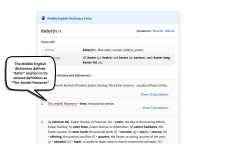
Easter_1.png
Source:
https://quod.lib.umich.edu/m/middle-english-dictionary/dictionary/MED14534

I believe "Easter" is using using this older sense meaning the Jewish Passover as shown here in the MED (Middle English dictionary).
I believe more specifically that the English word "Easter" (Greek πάσχα (pascha)) is referring to the whole weekly "Passover / Unleavened Bread" celebration (which contains Nisan the 14th and 15th). Scripture does refer to both the Passover and Unleavened Bread celebration as a seven day event, and they are not limited to only the 14th and the 15th.

You have posted reams of text in defense of these and other errors but when there is a minor difference in a newer translation, you're all over it like white on rice.

I am passionate at defending what is true.
If you approach the Bible with the mindset of multi-versionism, and or with a never ending Shape-Shifter text, I really cannot help you to see the moral light here. If God said His words are pure, and they would be preserved and He gives warnings not to alter His words, then logic dictates there would have to be a settled form of His words somewhere that people could find and be held accountable to. It's pure logic.


Come on, man. Get some integrity. If I have to point out your inconsistencies to you, you obviously aren't interested in correcting your behaviour.
Any supposed errors you can point out in the KJV do not compare to the horror show of corrupt doctrines in Modern versions and the heretics who have been involved in shaping its underlying Hebrew, and Greek critical texts. They just get the hand wave when these issues are brought up. It's like trying to explain to a Democrat radical leftist why open borders is wrong. You can probably give them 101 reasons but they are not going to get it because they have been activated or radicalized in some way.


....
 
Corrupt Doctrines in Modern Bibles:

#1. In Deuteronomy 22:28-29, several Modern Bibles such as the NIV and CSB dangerously teach that a woman must marry her rapist. The CSB, for example, says, “He must marry the young woman he has raped.” There are Christians who actually believe this. Even atheists love to criticize the Bible by bringing up this ridiculous reading Modern Bibles.

...
KJV says the same, just in confusing archaic language. By the way, what does this mean? 30"A man shall not take his father's wife, nor discover his father's skirt."

Is this to avoid revealing your dad as a cross dresser?
 
I knew nothing when I was first saved, apart from the Lord's prayer and the Apostle's creed. I was forced to attend church for 3 years. After one meeting, a man approached me with a Bible and scary eyes. I now know that I was looking at a demon. I don't look into people's eyes anymore.

He bailed me up and harangued me as you are doing. And that was just after the preacher spent half his time explaining the utter confusion that is the KJV to the uninitiated.
In many Christian groups, you are going to find both the good and the bad. For example, somebody might say Trinitarianism is bad because Catholics believe in it. However, if the Bible teaches that truth, it does not matter whether Catholics believe in it or not.

Also, there are all kinds of KJV believers out there. You cannot use one bad experience with a KJV believer to pigeonhole me or dismiss my defense of the truth of God's word. I know there are bad KJV believers out there, like Stephen Anderson, Peter Ruckman (now deceased), Gail Riplinger, etcetera.

But the door swings both ways. You may not even care that I was once on the receiving end of bad treatment from Modern Bible believers. This happened back in 2010, when I was young and dumb and did not know this topic all that well. Basically, a bunch of Modern Bible believers ganged up on me in a thread, mocking and laughing at me for believing in the KJV as God's word. I have been insulted and made fun of because of my stand for the KJV. One guy even created an entire thread mocking my defense of the KJV in an inappropriate way. The moderators stepped in and did something about it without my even having to say anything.

From my perspective, they were acting demonic and were not exhibiting the spirit of Christ, love, or patience. Also, Modern Bible believers have slandered King James and Erasmus and made up stories about them that are simply not true. They have also made up stories about Erasmus involving the Johannine Comma, which is one of the most beautiful verses in the Bible. There are many deceptions involving the Modern Bible Movement that I can write about and document with sources. So it’s not just me trying to sling mud without any proof.

The topic of KJV-onlyism was banned on a Christian forum I had been on for many years. They had much stricter rules about keeping arguments focused on the belief rather than the person (a practice I am most grateful for). However, despite my kind and respectful wording when defending the KJV on that forum, they banned the topic. Note: They banned the topic, but not me. But they might as well have banned me because it was a topic that was important to me. I knew it was my recent posts (which contained no personal attacks on anyone) that led to the topic being banned. Keep in mind that heretical doctrines and other questionable beliefs were still allowed.

While I had always viewed this topic as a spiritual one, when they banned it, I knew I was dealing with dark forces beyond my control. So that led me to the path I am now on. Granted, I probably would not have become as passionate about this topic if that incident had not happened. I took it upon myself to research this topic like never before, to go deeper and look at both sides even more. I came out of this deep study with even more reasons to believe in the KJV, not fewer. Good reasons.

So you can make this all about your one bad incident and experience. But my experience was entirely different from yours. All I can do is encourage you to look more deeply into this topic and examine the differences between the KJV and Modern Bibles on a doctrinal level. Look at the men on the TR/KJV side and their scholarship, and then compare them and their scholarship with those involved in forming the Modern Bible Movement that exists today (starting with Westcott, Hort, George Vance Smith, etc.).

Christians need to realise that they have the indwelling Holy Spirit to lead and guide them into truth.
Yes, I ask for the Lord to reveal to me by the Spirit the truth of the Scriptures many times in my life.
I have been corrected many times by what the Bible actually says vs. what I prefer it to say.
I have changed on 22 theological things over the years because I am willing to let God's word correct me.
But if the word of God is a shape-shifter text (like the Westcott & Hort / Nestle & Aland text) or if I take a multi-versionist approach, picking a Bible verse that says one thing differently over another one, I am making the Bible say what I want it to say rather than going with a text that the church as received and had born good fruit through history.


The KJV does not prevent false doctrine, far from it.
I never said it does. People can twist the truth of the Scriptures into false doctrines. They were doing that in Paul's day even by corrupting the word.


The Word of faith error and prosperity gospel were promoted by KJV adherents.
They are twisting the Scriptures. They are not getting that false teaching from what the KJV plainly and naturally says.

The Modern Bibles actually teach false doctrines in their plain wording. However, if you don't like a Bible that teaches a particular false doctrine, you can just go with another shape-shifter Bible. But even then, you still have to pick the words you like while discarding others in that Bible too. So your own mind becomes the rule that determines what you think God's word should say and should not say. Your belief cannot be consistently duplicated so that other believers can speak the same thing. Paul says we are to speak the same thing (see 1 Corinthians 1:10 KJV).


Believers need to study God's word and not just pick a verse here and there to promote a pet doctrine.
I thought I proved my point that this is what happens in the Modern Bible Movement or Modern versions that this is what happens. I proved that not all NIV editions even agree with each other on a doctrinal level. Then I listed some major false doctrines that Modern Bibles actually teach, too. I just gave you a taste. What do you say about that?

Prosperity preachers avoid this like the plague. And if yoiu do not like a particular version, there are 40 plus others to choose from. Even the KJV. Just don't elevate the KJV to something that it is not.
So if it is not the KJV and these other versions, then by what authority do you have? Your own mind? Is that where this issue is really settled? Is it a specific text that we can see? Do you even have a settled word of God that we can 100% trust? If not, then you get to decide what God said and did not say ultimately. You get to add words or delete words in the Bible based on your own infallible judgment. We have to come to you to get the words of God. I think that is too much power for any one man to have. I have something better. It's called the received text. This is the TR/KJV. The church has received this text as the settled words of God. I mean, how does the warning in Revelation 22:18-19 apply if there is no settled text today?

In any event, we can agree to disagree in love.

May the Lord Jesus bless you.


....
 
KJV says the same, just in confusing archaic language.
You just learned of the topic and you want to lecture me on it. Yeah, try studying it for a while. I don't take the "I get this feeling from this verse" and so that is what it is saying. That's not how I roll anymore.
I actually prefer to look to the older Hebrew and Greek lexicons and look at older English dictionaries, commentaries, and more. I generally do a deep dive study and sometimes this can take even another such study again but even deeper to find out more truth about it. Things are not so on the surface as you are making them out to be.

In any event, your moral compass should tell you that it is wrong to force marriage upon a woman because she was raped wrongfully. It means she is being punished for something bad that has happened to her. Do you also believe in Calvinism? If not, then why not? Would it not be because of the moral problem of Calvinism in addition to its lack of biblical support?

By the way, what does this mean? 30"A man shall not take his father's wife, nor discover his father's skirt."
Why am I going to discuss this with you when you are hostile towards my defense of the KJV?
Like I said, I take a deeper approach to studying the word than you do.


Is this to avoid revealing your dad as a cross dresser?
This kind of statement shows me you do not have the Spirit of God.
To accuse the brethren of clear unfounded accusation is not Christ like.

May the Lord open your eyes to the truth.

We're done talking.


....
 
1. Jesus said He has power to raise the dead to life just as the Father had power to
raise the dead (John 5:21). Please take note that this was said in context after Jesus
healed the man at the pool of Bethesda. Jesus was also saying this when the
Pharisees were upset that he did this healing on the Sabbath. So when Jesus says He
can raise the dead, like the Father can, He is laying claim to ownership to this
miracle He just did. Yes, Jesus did not bring this man at the pool back from the dead.
But he did make his legs that were dead to come back alive and He also no doubt had
led this man to trust in Him (Which is spiritual life). So this is an example of Jesus
acting on behalf of his own power. Jesus does nothing of Himself alone without the
Father. Yet, Jesus said that what He sees the Father do (like healing miracles), He
also can do likewise (See: John 5:19).

John 5:21 ὥσπερ γὰρ ὁ πατὴρ ἐγείρει τοὺς νεκροὺς καὶ ζῳοποιεῖ οὕτως καὶ ὁ υἱὸς οὓς θέλει ζῳοποιεῖ.
Just as the Father is raising the dead and is making alive, even so the Son is raising whom He [the Father (?) or the Son (?) ] is willing [to raise].

It is ambiguous to whom the οὓς refers, whether it is the Father or the Son. The sense could easily be -
"Just as the Father is raising the dead and is making alive, even so the Son is raising whom the Father is willing the Son to raise."

Clearly, Jesus gave His disciples authority in His name to raise the dead. They were not proven to possess omnipotence by this manifest delegated authority and Holy Spirit bestowed power working through them. I don't see how this text proves that Jesus was not raising the dead by the Father's authority and the Holy Spirit's power working in the same way through Him.

Can we agree that this is not a slam dunk for your theory?
 
John 5:21 ὥσπερ γὰρ ὁ πατὴρ ἐγείρει τοὺς νεκροὺς καὶ ζῳοποιεῖ οὕτως καὶ ὁ υἱὸς οὓς θέλει ζῳοποιεῖ.
Just as the Father is raising the dead and is making alive, even so the Son is raising whom He [the Father (?) or the Son (?) ] is willing [to raise].

It is ambiguous to whom the οὓς refers, whether it is the Father or the Son. The sense could easily be -
"Just as the Father is raising the dead and is making alive, even so the Son is raising whom the Father is willing the Son to raise."


Clearly, Jesus gave His disciples authority in His name to raise the dead. They were not proven to possess omnipotence by this manifest delegated authority and Holy Spirit bestowed power working through them. I don't see how this text proves that Jesus was not raising the dead by the Father's authority and the Holy Spirit's power working in the same way through Him.

Can we agree that this is not a slam dunk for your theory?
Erratum:
It is ambiguous to whom the οὓς refers, whether it is the Father or the Son. The sense could easily be -
"Just as the Father is raising the dead and is making alive, even so the Son is raising whom the Father is willing the Son
to raise."

That is wrong. It is not οὓς that is ambiguous. But the subject of θέλει is ambiguous.

I am tired from a day entertaining grand-children. A lapse of concentration on my part.