Uh, actually I did answer it in the form of an example.
I pointed to Mark Ward pointing to a so-called error in the King James Bible.
However, you are reaching an all time level of low to ask me about a word that everyone knows. It's even worse when I gave an example, and you act like I still need to qualify it. What's your education level? How old are you?
Your question is like asking what a dog or cat is. It's an insulting to not only to my intelligence and education but to most other people here, as well. If you think this basic word has changed in meaning involving discussion of the Bible or any other topic, then the burden of proof is on you to define or qualify what "error" actually means and how its normal usage should be ignored.
Generally most Christians and even non-Christians understand an error in the Bible to be a mistake.
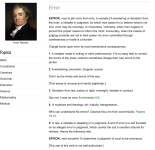
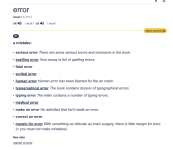
But if you doubt basic English, or you just arrived on planet Earth, or you are still learning to count your ABC's and 123's, perhaps these dictionaries help:
View attachment 296791
Source:
https://webstersdictionary1828.com/Home?word=error
View attachment 296792
Source:
https://dictionary.cambridge.org/dictionary/english/error
An educated person will simply just go by what a trusted dictionary says along with fitting that word in context unless there is another line of evidence that would suggest that the dictionary is wrong or not as precise in some way.
Merriam Websters Dictionary says,
"free from error."
Source:
https://www.merriam-webster.com/dictionary/inerrant
In this 1869 quotation from
The Radical, the writer criticizes those who believed in “the infallibility and absolute freedom from error of King James’s version.” While the writer opposed this belief, his wording shows that belief in an error-free King James Bible was understood and discussed during that time period. The phrase “absolute freedom from error” expresses what we mean by inerrancy. Although the quotation does not use the word “inerrancy” itself, it clearly describes the concept and specifically applies it to the King James Version.
1869: – Sidney H. Morse & Joseph B. Marvin:
“This translation [The New Testament, Translated from the Greek Text of Tischendorf, by George R. Noyes, American Unitarian Association] is a decided help in the great battle against Bibliolatry and the doctrine of verbal and plenary inspiration. Every new version, even if it be not so good as this, aids in overthrowing the power of the ‘Paper-Pope’ which has ruled Protestantism as with a rod of iron...it is asserted on good grounds that nine-tenths of the members of Protestant churches in this country believe as implicitly in the infallibility and absolute freedom from error of King James’s version as the Catholics of Spain do in the infallibility of Pope Pius IX...”
Source:
The Radical, vol. 5 (1869), p. 442. Sidney H. Morse and Joseph B. Marvin:
https://books.google.com/books?id=tSOgAAAAMAAJ&pg=PA442
What is a dog?
What is a cat?
What is air?
What is a house?
What is a human?
Are you going to answer these questions?
Would you expect any normal adult person to answer you if you did ask them such basic questions with them giving you a funny look or by not giving an answer?
How long have you lived on our planet?
The words “the brother of” are italicized or placed in brackets in various KJV editions. This tells the reader that these words are supplied rather than directly represented in the underlying Hebrew of 2 Samuel 21:19. They are supplied to clarify the meaning and avoid confusion, and the parallel passage explicitly identifies the man Elhanan killed as “Lahmi the brother of Goliath” (1 Chronicles 20:5).
If your argument is that even the inspired original languages are not perfect because you have to compare one passage with another to understand what is being said, that is something you are going to have to take up with God. The Lord is not obligated to communicate in the exact way you prefer (if this indeed is an issue for you).
The foreign Bible societies used to use the TR and the King James Bible to translate into other languages.
This has changed in more recent years in that now the Critical Text Bibles are being translated into other languages.
If you do not understand the differences in doctrines between the TR/KJV and the Critical Text/Modern Bibles involving doctrine, then you need to do your homework more. They do not both teach the same exact truths or doctrines.
Men make the translations. But it depends on if the men are faithful to the correct text and if they are faithful to the meaning of the words. The translation is simply a by-product of the integrity of the men, their skill level, their discernment on spiritual matters, their ability in proper textual criticism, and more. Both Bibles lines do not result in the same exact wording, truths, and doctrines. There is also different approaches to the Bible between the two major Bible lines that exist today, as well. One approach (generally the Received Text/KJV side) takes the Bible at face value in what it says in that God's words are pure, and that they would be preserved forever. That Jesus really meant that jots and tittles would not pass away (i.e., the small marks that make up the Hebrew letters). The second approach looks to the Bible as something that every believer can create their own personal Bible in their own mind and take part in textual criticism when they do not even know the original languages or manuscript histories, and they don't take into account all of the millions of lost manuscripts we do not have today. This side thinks more manuscripts are just around the corner as if that will settle the issue when already so much has been lost to such a point that it may never give you that accurate picture of the precise words of God (that of course would never come because of the money involved in making new Critical Text editions and subsequent Modern English translations from these new changes). So one group (the Received Text/KJV) has a settled text, and the other has a shape shifter text with contradictory translations. One leads to unity and understanding and the other to disunity and confusion. God surely is not the author of confusion. So this should tell you which side is the correct one and the other is false.
Which Christ?
You mean the John 1:18 NASB 95 version of Christ that says Jesus is the begotten God?
They are just following their Critical Text on this.
So your Modern Bibles and Critical Text teaches Arianism.
There are also five places I discovered in modern version that make it appear like Jesus sinned.
I talked to one self professing believer who states that Jesus did sin and he pointed to a modern Bible.
Modern Bibles also teach other false doctrines, as well.
You appeal to a false text (or false Bible) as false and that is the point I am trying to make.
Somehow you just do not see how your Modern versions are just as bad.
....