Is Knowledge of the Original Languages Necessary for KJV Believers?

  • Christian Chat is a moderated online Christian community allowing Christians around the world to fellowship with each other in real time chat via webcam, voice, and text, with the Christian Chat app. You can also start or participate in a Bible-based discussion here in the Christian Chat Forums, where members can also share with each other their own videos, pictures, or favorite Christian music.

    If you are a Christian and need encouragement and fellowship, we're here for you! If you are not a Christian but interested in knowing more about Jesus our Lord, you're also welcome! Want to know what the Bible says, and how you can apply it to your life? Join us!

    To make new Christian friends now around the world, click here to join Christian Chat.
In the context of my debate, while it was not mentioned, I am referring to “KJV believer(s)” as:

(1) KJV-English-only believers who believe that the KJV is without error.​
(2) Believers who are for the KJV + Its Underlying Hebrew, Aramaic, and Greek and view both as without error.​

While KJV Preferred believers (who believe the KJV contains errors) can say they are KJV believers, they are not full or entire KJV believers and thus fall short of being pure or true KJV believers in the most absolute sense. They would be 90% KJV believers or some other percentage-type KJV believers. This means some other authority or text must be added to make up the difference. It is also not duplicatable as a belief. One KJV Preferred believer is most likely going to disagree with another KJV Preferred believer over a particular reading in the KJV. So while one of them may think these words should be in their KJV, the other could simply disagree with them.

Therefore, the KJV Preferred belief position is looking at the KJV with a “Pick-And-Choose-Your-Own-Adventure-Bible” type mentality (albeit not as extreme as those who take a Multi-Versional approach in the Modern Bible Movement). The apostle Paul says “that ye all speak the same thing” (1 Corinthians 1:10). This is not possible if believers do not share a settled text.

Side Note:

While I disagree with my KJV-English-only brethren over their refusal to look to the original languages or their downplaying of them, I respect their position in believing Scripture that teaches that God's words are pure words and that they shall be preserved forever.


....
can I ask you what is a definition of " without Error" ? Ans what is an error? Thank you.
 
To all:

The Messenger of the LORD Ascending from the Sacrificial Altar: A Picture of Christ Raising Himself:

The Hebrew word מַלְאָךְ (malʾākh), translated “angel,” means “messenger” in Hebrew. This meaning also existed in Middle English. The Middle English Dictionary defines one sense of “aunǧel” as “A human messenger of God; a priest, a prophet.” It provides this example referring to John the Baptist:

“He [John the Baptist] is þe aungel þat God bihett þat schulde come & make þe weye tofore Crist.”

In present-day English: “He [John the Baptist] is the angel that God promised would come and prepare the way before Christ” (compare Luke 7:27).

This quotation is from the Pepysian Gospel Harmony, dated before 1400 in the MED. John the Baptist was a human messenger. So the expression “angel of the LORD” does not, by itself, mean that this must be a created heavenly or celestial angel. His identity must be understood from the context. https://quod.lib.umich.edu/m/middle-english-dictionary/dictionary/MED3046

The account announcing Samson’s birth provides another important connection (Judges 13). I believe this Messenger of the LORD is a pre-incarnate appearance of Jesus Christ. When Manoah asks His name, He says it is “secret” (Judges 13:18) (KJV). If you go to Blue Letter Bible, you will see that the same Hebrew word, listed as H6383, occurs in two places in the Old Testament. It is translated as “secret” in Judges 13:18 and “wonderful” in Psalm 139:6. So the connection with “wonderful” is established by the KJV’s own use of this Hebrew word. https://www.blueletterbible.org/lexicon/h6383/kjv/wlc/0-1/

This connects with Christ being called “Wonderful, Counsellor, The mighty God” (Isaiah 9:6). The Hebrew word translated “Wonderful” there is a related word from the same root. Christians are familiar with calling Jesus our wonderful Counsellor and singing about Him in those terms. Here, the Messenger’s name is described as wonderful, and after witnessing His miraculous departure, Manoah says that they have seen God (Judges 13:22). These details support identifying this Messenger as the pre-incarnate Christ.

Please take note of how this Messenger departs. Manoah offers a sacrifice, and the Messenger of the LORD ascends in the flame of the altar (Judges 13:19–20). This is an altar of sacrifice. We see here a striking picture of Christ’s sacrifice on the cross as the Passover Lamb followed by His resurrection and ascension. The sacrificial altar corresponds typologically to the cross, where Christ our Passover was sacrificed for us (1 Corinthians 5:7).

The Messenger Himself ascends in the flame. Nobody in the account lifts Him or carries Him upward. I believe the sequence pictures His victory following sacrifice: the divine Messenger rises from the sacrificial altar.

Therefore, we can see this as an Old Testament picture consistent with Jesus raising Himself, just as He expressly says He will raise His own body (John 2:19–21). His acting in unity with the Father does not mean that He lacks or never exercises His own divine power.


Author (Owner) of this writeup: 𝓑𝒾𝒷𝓁ℯ 𝓗𝒾ℊ𝒽𝓁𝒾ℊ𝒽𝓉ℯ𝓇
Date of Writeup: 10-2-2026.
Edition: 1st Edition.
Website: www.affectionsabove.com
Permission of use: Post writeup for free with my author name "Bible Highlighter" as long as it is not for profit.
May the Lord Jesus bless you all.


....
 
can I ask you what is a definition of " without Error" ? Ans what is an error? Thank you.
One is in error. Which one?

2 Samuel 21:19

KJV
19 And there was again a battle in Gob with the Philistines, where Elhanan the son of Jaareoregim, a Bethlehemite, slew the brother of Goliath the Gittite, the staff of whose spear was like a weaver's beam.

ESV
19 And there was again war with the Philistines at Gob, and Elhanan the son of Jaare-oregim, the Bethlehemite, struck down Goliath the Gittite, the shaft of whose spear was like a weaver's beam.
 
John 5:21 ὥσπερ γὰρ ὁ πατὴρ ἐγείρει τοὺς νεκροὺς καὶ ζῳοποιεῖ οὕτως καὶ ὁ υἱὸς οὓς θέλει ζῳοποιεῖ.
Just as the Father is raising the dead and is making alive, even so the Son is raising whom He [the Father (?) or the Son (?) ] is willing [to raise].

It is ambiguous to whom the οὓς refers, whether it is the Father or the Son. The sense could easily be -
"Just as the Father is raising the dead and is making alive, even so the Son is raising whom the Father is willing the Son to raise."

Clearly, Jesus gave His disciples authority in His name to raise the dead. They were not proven to possess omnipotence by this manifest delegated authority and Holy Spirit bestowed power working through them. I don't see how this text proves that Jesus was not raising the dead by the Father's authority and the Holy Spirit's power working in the same way through Him.

Can we agree that this is not a slam dunk for your theory?
You were not able to see how Abraham believed God concerning His promise and how that belief (not faithfulness) was accounted to him as righteousness. Romans 4 is talking about initial salvation and using this clear example. Most Christians understand the basic truth about Abraham and yet you have an oddball interpretation that I do not believe a Greek professor whose native tongue is Greek and who has lived in Greece all their life would agree with.

None of the KJV translators translated it the way you are suggesting, and I am not aware of any of them commenting later in support of your interpretation. I believe the KJV translators were the best scholars who have ever lived. They gave us the Bible that has led to the three greatest revivals and led to a unity and memorization of God's word unlike any other translation. Back in the day, when people thought of the Bible it was the KJV and not your reconstruction that exists most likely only in your own mind that will fade away like the dust in the wind when you pass on in this life. Even if you did manage to publish the edition of what you think the Bible should say in Greek or English, it will die on the shelf along with other obscure and embarrassing books. Your unique text of what you think the Bible will say will not even be a blip on the radar in history. So I fail to see why you feel you should bother to push your oddball theories on what the Bible really says here. God is not going to hold people accountable for not being able to read your mind to get the actual words of God. Nor are they lining up at your home to have you explain what the Bible actually says.

So forgive me if I do not engage with you on the Greek again. Based on our previous exchanges, I do not see how repeating that discussion would help you acknowledge what the biblical text actually says. Going through the Greek with you is time-consuming, so I think this discussion is best left to you and a Greek professor who meets those qualifications.

If you can provide such a Greek scholar who agrees with your interpretation and addresses all nine of my points on Christ having power during His earthly ministry concerning the Greek, then we can talk. Until then, I see you as reading the Bible through your own private interpretations and trying to impose them upon the biblical text. I see what you are doing as eisegesis (reading your own ideas into the text), rather than exegesis (drawing the meaning from the text). But then again, we are living in the last days and everyone thinks they have the real Bible existing ONLY in their own mind. How insane. How utterly stupid.


....
 
can I ask you what is a definition of " without Error" ? Ans what is an error? Thank you.
This sounds like a trap of getting me to define something that I may need to later qualify.
Everyone knows what an error is.
As an example, Mark Ward has claimed an error in the KJV.
He argues that the KJV’s “tabret” should instead refer to spitting.
In one of his videos, at approximately 9:11 minute mark, he also says:
“I believe that God has preserved his word but not in a word perfect way.”
YouTube Video - Mark Ward

I obviously disagree with him.

I believe God preserved his words in a word perfect way in both 1600s English with the KJV and with its underlying Hebrew, Aramaic, and Greek. I would never attack the KJV and say it has errors like what Mark Ward does because I believe every word is correct in the KJV, and in its underlying original languages. If you disagree and try to attack that, we should also consider the illogical nature of having a shape-shifter text like the Critical Text Modern Bible Movement and how that really does not work in the real world. I mean, you obviously would not test fly a plane built on conflicting schematics. You wouldn't buy a house that was based on multiple conflicting contracts. Then why do so with a book that deals with your soul? If there is just one error in the Bible, what makes you to trust the rest of the words? Also, are we to just ignore the heretics that shaped the Modern Critical Text of our day? What about the new ECM reading that has changed the UBS6 to say that Jesus will become the I AM. How insane. How stupid. If you are for the Critical Text, do you really think I am gonna fall for this kind of slop? Its so bad. How on Earth that such a movement still even exists beyond me. All a person to do is research a little and they see all the corrupt doctrines in Modern Bibles. It's not that hard. Only a person who gets a rush out of slicing up the Bible like it is a piece of meat will not be able to see any of the corrupt doctrines in their own Modern Bible Movement. it's spiritual darkness that clouds their eyes because of their addiction to chopping up the Bible with an axe. So I hope that clears things up on what I mean.


....
 
One is in error. Which one?

2 Samuel 21:19

KJV
19 And there was again a battle in Gob with the Philistines, where Elhanan the son of Jaareoregim, a Bethlehemite, slew the brother of Goliath the Gittite, the staff of whose spear was like a weaver's beam.

ESV
19 And there was again war with the Philistines at Gob, and Elhanan the son of Jaare-oregim, the Bethlehemite, struck down Goliath the Gittite, the shaft of whose spear was like a weaver's beam.
so the ESV has a discrepancy in its translation of 2Samuel 21:19, because we have more than one book in the Old Testament that states David Killed Goliath. And the ESV does also. That is known as a Copyist discrepancy.

You had to ignore that truth of all Scriptures in the bible that bring clarity to the text. Those liberal humanistic types choose to attack a version of the bible instead of coming to the unity of scriptures.

Just bad Hermeneutics ones is displaying .
 
This sounds like a trap of getting me to define something that I may need to later qualify.
Everyone knows what an error is.
As an example, Mark Ward has claimed an error in the KJV.
He argues that the KJV’s “tabret” should instead refer to spitting.
In one of his videos, at approximately 9:11 minute mark, he also says:
“I believe that God has preserved his word but not in a word perfect way.”
YouTube Video - Mark Ward

I obviously disagree with him.

I believe God preserved his words in a word perfect way in both 1600s English with the KJV and with its underlying Hebrew, Aramaic, and Greek. I would never attack the KJV and say it has errors like what Mark Ward does because I believe every word is correct in the KJV, and in its underlying original languages. If you disagree and try to attack that, we should also consider the illogical nature of having a shape-shifter text like the Critical Text Modern Bible Movement and how that really does not work in the real world. I mean, you obviously would not test fly a plane built on conflicting schematics. You wouldn't buy a house that was based on multiple conflicting contracts. Then why do so with a book that deals with your soul? If there is just one error in the Bible, what makes you to trust the rest of the words? Also, are we to just ignore the heretics that shaped the Modern Critical Text of our day? What about the new ECM reading that has changed the UBS6 to say that Jesus will become the I AM. How insane. How stupid. If you are for the Critical Text, do you really think I am gonna fall for this kind of slop? Its so bad. How on Earth that such a movement still even exists beyond me. All a person to do is research a little and they see all the corrupt doctrines in Modern Bibles. It's not that hard. Only a person who gets a rush out of slicing up the Bible like it is a piece of meat will not be able to see any of the corrupt doctrines in their own Modern Bible Movement. it's spiritual darkness that clouds their eyes because of their addiction to chopping up the Bible with an axe. So I hope that clears things up on what I mean.


....
sounds like a trap? Why? You can't answer it. One need to validate their position on the inerrant word of God.


"Everyone knows what an error is."

Then you should have no issue answering my question. The fact is not everyone knows in context to the text found in 2sam 21:19 that was used.
FYI God word is effective in Chinese translation, Latin, German, and English.

The issue is man NO the translation. As Long as the foundational truth of the scriptures is CHRIST. All is seen and authoritative.

Remove Christ as our friends of the Jehovah Witnesses with their world translation bible is blasphemy . They deny Christ as God and reduce him to a god. Seen in John chapter 1:1-12 That is error. And deception.
 
You were not able to see how Abraham believed God concerning His promise and how that belief (not faithfulness) was accounted to him as righteousness. Romans 4 is talking about initial salvation and using this clear example. Most Christians understand the basic truth about Abraham and yet you have an oddball interpretation that I do not believe a Greek professor whose native tongue is Greek and who has lived in Greece all their life would agree with.
My post which you are referring to here did not mention Abraham or Romans 4. What are you rambling on about? Is this misdirection, to move the conversation away from the actual content of my post?
None of the KJV translators translated it the way you are suggesting, and I am not aware of any of them commenting later in support of your interpretation. I believe the KJV translators were the best scholars who have ever lived. They gave us the Bible that has led to the three greatest revivals and led to a unity and memorization of God's word unlike any other translation. Back in the day, when people thought of the Bible it was the KJV and not your reconstruction that exists most likely only in your own mind that will fade away like the dust in the wind when you pass on in this life. Even if you did manage to publish the edition of what you think the Bible should say in Greek or English, it will die on the shelf along with other obscure and embarrassing books. Your unique text of what you think the Bible will say will not even be a blip on the radar in history. So I fail to see why you feel you should bother to push your oddball theories on what the Bible really says here. God is not going to hold people accountable for not being able to read your mind to get the actual words of God. Nor are they lining up at your home to have you explain what the Bible actually says.
It is unclear what you are objecting to, since you have been referring in your first paragraph to Romans 4 and Abraham, which are unrelated to the target post. I agreed with the KJV translation of John 11:25-26 as a word for word translation of the Greek. What I am applying is the linguistic discipline of Discourse Analysis, a discipline that arose in the mid 1900s, and so post-dates the KJV and was not applied to the KJV until the 20th Century. I am drawing my interpretation of the sense of John 11:25-26 from its context within a discourse between Martha and Jesus. My interpretation fits the grammar and syntax of the Greek, but also makes inferences from the entire discourse as to what Jesus is actually meaning. You have not explained why my inferences are impossible to draw from the nature of the discourse. You are simply piling up allegations of error, without demonstrating how those alleged errors are dsiproved fromthe greek and the structure of the discourse.

Discourse analysis was first mooted as a discipline in the late 1930s to early 1950s, but it came into general use after Zellig Harris’s papers in 1952. Some accounts also point to Leo Spitzer’s 1928 work as an early precursor. Wikipedia2

So forgive me if I do not engage with you on the Greek again. Based on our previous exchanges, I do not see how repeating that discussion would help you acknowledge what the biblical text actually says. Going through the Greek with you is time-consuming, so I think this discussion is best left to you and a Greek professor who meets those qualifications.
You did not engage with me on the Greek. What do you mean "again"?

I asked AI "Is Jesus, in John 11:25-26, saying that those when He comes who have died physically but are still believing in Him as they wait in heaven for the last day will be resurrected in immortal bodies; and those who are alive and are believing in Him at the last day, will not die, but will be resurrected/changed in the twinkling of an eye into immortal bodies?"

The GPT 5.4 mini response was -
"

Yes—broadly, that’s a defensible reading, with one important nuance.

In John 11:25-26, Jesus is first making a two-part promise:

  • “Whoever believes in me, though he die, yet shall he live” — believers who die physically will live again.
  • “And everyone who lives and believes in me shall never die” — believers who are alive when Jesus’ finalsaving work is completed will not experience permanent death.
Many Christians connect that second line wit "h the later idea in 1 Corinthians 15:51-52 and 1 Thessalonians 4:16-17, where living believers are changed rather than dying, and the dead in Christ are raised.

So your summary fits a common Christian interpretation:

  • Dead believers: resurrected in immortal bodies.
  • Living believers at Christ’s return: transformed into immortal bodies without passing through death.
The nuance is that John 11 itself is mainly about Jesus as the resurrection and the life, not a full end-times timeline. But your reading is very much in line with how that verse is often understood in light of the rest of the New Testament.

A few scholars/commentators who take John 11:25-26 along those lines are:

  • Henry Morris — says those alive at Christ’s coming “will never die, but will be immediately changed andimmortalized.”
  • John Gill — says believers alive at Christ’s second coming “shall never die, but shall be changed.”
  • I. Howard Marshall — in his eschatology work, ties the living to being “changed” at Christ’s coming,alongside the dead being raised.
  • Richard B. Hays — reads 1 Corinthians 15 as the dead being raised and the living being transformed at Christ’s coming.
  • David E. Garland — same basic reading in his 1 Corinthians commentary.
  • Anthony C. Thiselton — likewise treats the “we shall be changed” language as the transformation of living believers at the end."
If you can provide such a Greek scholar who agrees with your interpretation and addresses all nine of my points on Christ having power during His earthly ministry concerning the Greek, then we can talk. Until then, I see you as reading the Bible through your own private interpretations and trying to impose them upon the biblical text. I see what you are doing as eisegesis (reading your own ideas into the text), rather than exegesis (drawing the meaning from the text). But then again, we are living in the last days and everyone thinks they have the real Bible existing ONLY in their own mind. How insane. How utterly stupid.
..
I will deal with your points individually. The discussion stays more focused that way. You may choose to ignore my rebuttals, but readers can decide for themselves, which of us sounds more biblically persuasive.
 
sounds like a trap? Why? You can't answer it.
Uh, actually I did answer it in the form of an example.
I pointed to Mark Ward pointing to a so-called error in the King James Bible.

However, you are reaching an all time level of low to ask me about a word that everyone knows. It's even worse when I gave an example, and you act like I still need to qualify it. What's your education level? How old are you?
Your question is like asking what a dog or cat is. It's an insulting to not only to my intelligence and education but to most other people here, as well. If you think this basic word has changed in meaning involving discussion of the Bible or any other topic, then the burden of proof is on you to define or qualify what "error" actually means and how its normal usage should be ignored.

Generally most Christians and even non-Christians understand an error in the Bible to be a mistake.

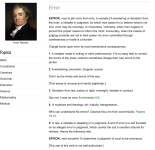
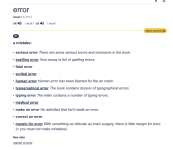
But if you doubt basic English, or you just arrived on planet Earth, or you are still learning to count your ABC's and 123's, perhaps these dictionaries help:

001 Error 1.png
Source:
https://webstersdictionary1828.com/Home?word=error

001 Error 2.png
Source:
https://dictionary.cambridge.org/dictionary/english/error


One need to validate their position on the inerrant word of God.
An educated person will simply just go by what a trusted dictionary says along with fitting that word in context unless there is another line of evidence that would suggest that the dictionary is wrong or not as precise in some way.

Merriam Websters Dictionary says,

"free from error."​

Source:
https://www.merriam-webster.com/dictionary/inerrant

In this 1869 quotation from The Radical, the writer criticizes those who believed in “the infallibility and absolute freedom from error of King James’s version.” While the writer opposed this belief, his wording shows that belief in an error-free King James Bible was understood and discussed during that time period. The phrase “absolute freedom from error” expresses what we mean by inerrancy. Although the quotation does not use the word “inerrancy” itself, it clearly describes the concept and specifically applies it to the King James Version.

1869: – Sidney H. Morse & Joseph B. Marvin:

“This translation [The New Testament, Translated from the Greek Text of Tischendorf, by George R. Noyes, American Unitarian Association] is a decided help in the great battle against Bibliolatry and the doctrine of verbal and plenary inspiration. Every new version, even if it be not so good as this, aids in overthrowing the power of the ‘Paper-Pope’ which has ruled Protestantism as with a rod of iron...it is asserted on good grounds that nine-tenths of the members of Protestant churches in this country believe as implicitly in the infallibility and absolute freedom from error of King James’s version as the Catholics of Spain do in the infallibility of Pope Pius IX...”​

Source:
The Radical, vol. 5 (1869), p. 442. Sidney H. Morse and Joseph B. Marvin:
https://books.google.com/books?id=tSOgAAAAMAAJ&pg=PA442


"Everyone knows what an error is."

Then you should have no issue answering my question.
What is a dog?
What is a cat?
What is air?
What is a house?
What is a human?

Are you going to answer these questions?
Would you expect any normal adult person to answer you if you did ask them such basic questions with them giving you a funny look or by not giving an answer?
How long have you lived on our planet?

The fact is not everyone knows in context to the text found in 2sam 21:19 that was used.
The words “the brother of” are italicized or placed in brackets in various KJV editions. This tells the reader that these words are supplied rather than directly represented in the underlying Hebrew of 2 Samuel 21:19. They are supplied to clarify the meaning and avoid confusion, and the parallel passage explicitly identifies the man Elhanan killed as “Lahmi the brother of Goliath” (1 Chronicles 20:5).

If your argument is that even the inspired original languages are not perfect because you have to compare one passage with another to understand what is being said, that is something you are going to have to take up with God. The Lord is not obligated to communicate in the exact way you prefer (if this indeed is an issue for you).


FYI God word is effective in Chinese translation, Latin, German, and English.
The foreign Bible societies used to use the TR and the King James Bible to translate into other languages.
This has changed in more recent years in that now the Critical Text Bibles are being translated into other languages.
If you do not understand the differences in doctrines between the TR/KJV and the Critical Text/Modern Bibles involving doctrine, then you need to do your homework more. They do not both teach the same exact truths or doctrines.


The issue is man NO the translation.
Men make the translations. But it depends on if the men are faithful to the correct text and if they are faithful to the meaning of the words. The translation is simply a by-product of the integrity of the men, their skill level, their discernment on spiritual matters, their ability in proper textual criticism, and more. Both Bibles lines do not result in the same exact wording, truths, and doctrines. There is also different approaches to the Bible between the two major Bible lines that exist today, as well. One approach (generally the Received Text/KJV side) takes the Bible at face value in what it says in that God's words are pure, and that they would be preserved forever. That Jesus really meant that jots and tittles would not pass away (i.e., the small marks that make up the Hebrew letters). The second approach looks to the Bible as something that every believer can create their own personal Bible in their own mind and take part in textual criticism when they do not even know the original languages or manuscript histories, and they don't take into account all of the millions of lost manuscripts we do not have today. This side thinks more manuscripts are just around the corner as if that will settle the issue when already so much has been lost to such a point that it may never give you that accurate picture of the precise words of God (that of course would never come because of the money involved in making new Critical Text editions and subsequent Modern English translations from these new changes). So one group (the Received Text/KJV) has a settled text, and the other has a shape shifter text with contradictory translations. One leads to unity and understanding and the other to disunity and confusion. God surely is not the author of confusion. So this should tell you which side is the correct one and the other is false.


As Long as the foundational truth of the scriptures is CHRIST. All is seen and authoritative.
Which Christ?
You mean the John 1:18 NASB 95 version of Christ that says Jesus is the begotten God?
They are just following their Critical Text on this.
So your Modern Bibles and Critical Text teaches Arianism.
There are also five places I discovered in modern version that make it appear like Jesus sinned.
I talked to one self professing believer who states that Jesus did sin and he pointed to a modern Bible.
Modern Bibles also teach other false doctrines, as well.

Remove Christ as our friends of the Jehovah Witnesses with their world translation bible is blasphemy . They deny Christ as God and reduce him to a god. Seen in John chapter 1:1-12 That is error. And deception.
You appeal to a false text (or false Bible) as false and that is the point I am trying to make.
Somehow you just do not see how your Modern versions are just as bad.


....

 
You are side stepping the issue and point I was making with God's word.
Was Abraham faith or belief accounted to him for righteousness?

No, we are staying within the context of the passage.
The Bible says,

"Abraham believed God, and it was counted unto him for righteousness." (Romans 4:3).​

Cross reference that ties into this:

Genesis 15:1-6 (KJV):

1 After these things the word of the LORD came unto Abram in a vision, saying, Fear not, Abram: I am thy shield, and thy exceeding great reward.​
2 And Abram said, Lord GOD, what wilt thou give me, seeing I go childless, and the steward of my house is this Eliezer of Damascus?​
3 And Abram said, Behold, to me thou hast given no seed: and, lo, one born in my house is mine heir.​
4 And, behold, the word of the LORD came unto him, saying, This shall not be thine heir; but he that shall come forth out of thine own bowels shall be thine heir.​
5 And he brought him forth abroad, and said, Look now toward heaven, and tell the stars, if thou be able to number them: and he said unto him, So shall thy seed be.​
6 And he believed in the LORD; and he counted it to him for righteousness."​

It says Abraham believed in the LORD (which was in regard to believing the promise) and that belief was counted to him for righteousness. Please keep in mind that there are no works of faith here yet.


....
Gal 6:6 does not say believe in. It says Abraham Believed God. There is a difference in believing in the Lord and believing the Lord. Do you know why there is adifference?

Verse 6 starts with the phrase "even as"
This means as you know that what is about to be said is a direct comparison to what was just said.
Verses 2-3 says we received the Spirit and worketh miracles through the hearing, listening to faith. This faith is the faith of Christ that we now live by. As Gal 2:20 says, we are dead but alive. But it is not us that lives but Christ Jesus in us and the life we now live in the flesh we live by the FAITH OF the Son of God that died for us. This is the faith that we are to hear. This is the faith that believes from the heart even as Abraham believed God in all that He said for him to believe and do.


Gal 3:1 O foolish Galatians, who hath bewitched you, that ye should not obey the truth, before whose eyes Jesus Christ hath been evidently set forth, crucified among you?
Gal 3:2 This only would I learn of you, Received ye the Spirit by the works of the law, or by the hearing of faith?
Gal 3:3 Are ye so foolish? having begun in the Spirit, are ye now made perfect by the flesh?
Gal 3:4 Have ye suffered so many things in vain? if it be yet in vain.
Gal 3:5 He therefore that ministereth to you the Spirit, and worketh miracles among you, doeth he it by the works of the law, or by the hearing of faith?
Gal 3:6 Even as Abraham believed God, and it was accounted to him for righteousness.
 
Uh, actually I did answer it in the form of an example.
I pointed to Mark Ward pointing to a so-called error in the King James Bible.

However, you are reaching an all time level of low to ask me about a word that everyone knows. It's even worse when I gave an example, and you act like I still need to qualify it. What's your education level? How old are you?
Your question is like asking what a dog or cat is. It's an insulting to not only to my intelligence and education but to most other people here, as well. If you think this basic word has changed in meaning involving discussion of the Bible or any other topic, then the burden of proof is on you to define or qualify what "error" actually means and how its normal usage should be ignored.

Generally most Christians and even non-Christians understand an error in the Bible to be a mistake.

But if you doubt basic English, or you just arrived on planet Earth, or you are still learning to count your ABC's and 123's, perhaps these dictionaries help:

View attachment 296791
Source:
https://webstersdictionary1828.com/Home?word=error

View attachment 296792
Source:
https://dictionary.cambridge.org/dictionary/english/error


An educated person will simply just go by what a trusted dictionary says along with fitting that word in context unless there is another line of evidence that would suggest that the dictionary is wrong or not as precise in some way.

Merriam Websters Dictionary says,

"free from error."​

Source:
https://www.merriam-webster.com/dictionary/inerrant

In this 1869 quotation from The Radical, the writer criticizes those who believed in “the infallibility and absolute freedom from error of King James’s version.” While the writer opposed this belief, his wording shows that belief in an error-free King James Bible was understood and discussed during that time period. The phrase “absolute freedom from error” expresses what we mean by inerrancy. Although the quotation does not use the word “inerrancy” itself, it clearly describes the concept and specifically applies it to the King James Version.

1869: – Sidney H. Morse & Joseph B. Marvin:

“This translation [The New Testament, Translated from the Greek Text of Tischendorf, by George R. Noyes, American Unitarian Association] is a decided help in the great battle against Bibliolatry and the doctrine of verbal and plenary inspiration. Every new version, even if it be not so good as this, aids in overthrowing the power of the ‘Paper-Pope’ which has ruled Protestantism as with a rod of iron...it is asserted on good grounds that nine-tenths of the members of Protestant churches in this country believe as implicitly in the infallibility and absolute freedom from error of King James’s version as the Catholics of Spain do in the infallibility of Pope Pius IX...”​

Source:
The Radical, vol. 5 (1869), p. 442. Sidney H. Morse and Joseph B. Marvin:
https://books.google.com/books?id=tSOgAAAAMAAJ&pg=PA442


What is a dog?
What is a cat?
What is air?
What is a house?
What is a human?

Are you going to answer these questions?
Would you expect any normal adult person to answer you if you did ask them such basic questions with them giving you a funny look or by not giving an answer?
How long have you lived on our planet?


The words “the brother of” are italicized or placed in brackets in various KJV editions. This tells the reader that these words are supplied rather than directly represented in the underlying Hebrew of 2 Samuel 21:19. They are supplied to clarify the meaning and avoid confusion, and the parallel passage explicitly identifies the man Elhanan killed as “Lahmi the brother of Goliath” (1 Chronicles 20:5).

If your argument is that even the inspired original languages are not perfect because you have to compare one passage with another to understand what is being said, that is something you are going to have to take up with God. The Lord is not obligated to communicate in the exact way you prefer (if this indeed is an issue for you).


The foreign Bible societies used to use the TR and the King James Bible to translate into other languages.
This has changed in more recent years in that now the Critical Text Bibles are being translated into other languages.
If you do not understand the differences in doctrines between the TR/KJV and the Critical Text/Modern Bibles involving doctrine, then you need to do your homework more. They do not both teach the same exact truths or doctrines.


Men make the translations. But it depends on if the men are faithful to the correct text and if they are faithful to the meaning of the words. The translation is simply a by-product of the integrity of the men, their skill level, their discernment on spiritual matters, their ability in proper textual criticism, and more. Both Bibles lines do not result in the same exact wording, truths, and doctrines. There is also different approaches to the Bible between the two major Bible lines that exist today, as well. One approach (generally the Received Text/KJV side) takes the Bible at face value in what it says in that God's words are pure, and that they would be preserved forever. That Jesus really meant that jots and tittles would not pass away (i.e., the small marks that make up the Hebrew letters). The second approach looks to the Bible as something that every believer can create their own personal Bible in their own mind and take part in textual criticism when they do not even know the original languages or manuscript histories, and they don't take into account all of the millions of lost manuscripts we do not have today. This side thinks more manuscripts are just around the corner as if that will settle the issue when already so much has been lost to such a point that it may never give you that accurate picture of the precise words of God (that of course would never come because of the money involved in making new Critical Text editions and subsequent Modern English translations from these new changes). So one group (the Received Text/KJV) has a settled text, and the other has a shape shifter text with contradictory translations. One leads to unity and understanding and the other to disunity and confusion. God surely is not the author of confusion. So this should tell you which side is the correct one and the other is false.


Which Christ?
You mean the John 1:18 NASB 95 version of Christ that says Jesus is the begotten God?
They are just following their Critical Text on this.
So your Modern Bibles and Critical Text teaches Arianism.
There are also five places I discovered in modern version that make it appear like Jesus sinned.
I talked to one self professing believer who states that Jesus did sin and he pointed to a modern Bible.
Modern Bibles also teach other false doctrines, as well.


You appeal to a false text (or false Bible) as false and that is the point I am trying to make.
Somehow you just do not see how your Modern versions are just as bad.


....
"An educated person will simply just go by what a trusted dictionary "
A Christian would not say the Bible has errors. When they know that God is the one who keeps His word in any language.


"What is a dog?"
"What is a cat?"
"What is air?"
"What is a house?"
"What is a human?"

This why your arrogance most will not listen to you. You are asking what is a Dog or cat. You are saying there is errors in the Bible. Clearly you think you are more educated and all knowing than God who spoke the Word and used imperfect men to write it. You look at the word of God as most liberal Theologians do, from the position "i know more the you. Just pride and buffoonery.
this is why you are like most "Youtube" types and chat site trolls. Thinking you can whada all into your understanding of the word of God. Context is a word you should learn. In any rate what you are is :

A weak teacher :

Descriptive Words for a Weak Teacher​

Here are some terms that capture the essence of a weak teacher. aka Blue_Highlighter

  • Ineffective — Lacking the ability to produce desired results in teaching.
  • Uninspiring — Failing to motivate or engage students in learning.
  • Disorganized — Lacking structure or clarity in lesson planning.
  • Indifferent — Showing a lack of interest or concern for student progress.
  • Unapproachable — Making students feel uncomfortable about seeking help or guidance.
 
2. Jesus had the power to forgive sins and give eternal life (Mark 2:7) (Luke 7:44-50)
John 14:6). This is clearly an act of God here. Only God can truly absolve sin in
regard to our salvation and give us eternal life. No man could ever do this. So clearly
Jesus is exercising His divine power as God on Earth. There are several examples in
Scripture of Jesus forgiving others their sins (Which is clearly a divine act or power
of God alone). Jesus also extended eternal life to others by pointing to Himself. Only
God can truly have this power.
....
This claim that only God can forgive sins seems to be a rather biblically unsound claim, @Bible_Highlighter. It is something you have been told, that is not in scripture as a divine revelation, but as the flawed opinion of the enemies of God.

Luk 5:21 And the scribes and the Pharisees began to reason, saying, “Who is this who speaks blasphemies? Who can forgive sins but God alone?”

Jesus obviously gave His disciples authority to forgive sins.
Jhn 20:23 Whose soever sins ye remit, they are remitted unto them; and whose soever sins ye retain, they are retained.

Stephen forgave his murderers.
Act 7:60 And he kneeled down, and cried with a loud voice, Lord, lay not this sin to their charge. And when he had said this, he fell asleep.

Jesus commanded us to forgive the same person seventy times seven in one day.
Mat 18:21 Then came Peter to him, and said, Lord, how oft shall my brother sin against me, and I forgive him? till seven times?
Mat 18:22 Jesus saith unto him, I say not unto thee, Until seven times: but, Until seventy times seven.

You would need to demonstrate your claims that Jesus was able to extend "eternal life" to others by pointing them to Himself, but the disciples were no able also to extend eternal life to others by pointing them to Jesus.

Mat 18:35 So likewise shall my heavenly Father do also unto you, if ye from your hearts forgive not every one his brother their trespasses.
 
  • Like
Reactions: CS1
This claim that only God can forgive sins seems to be a rather biblically unsound claim, @Bible_Highlighter. It is something you have been told, that is not in scripture as a divine revelation, but as the flawed opinion of the enemies of God.

Luk 5:21 And the scribes and the Pharisees began to reason, saying, “Who is this who speaks blasphemies? Who can forgive sins but God alone?”

Jesus obviously gave His disciples authority to forgive sins.
Jhn 20:23 Whose soever sins ye remit, they are remitted unto them; and whose soever sins ye retain, they are retained.

Stephen forgave his murderers.
Act 7:60 And he kneeled down, and cried with a loud voice, Lord, lay not this sin to their charge. And when he had said this, he fell asleep.

Jesus commanded us to forgive the same person seventy times seven in one day.
Mat 18:21 Then came Peter to him, and said, Lord, how oft shall my brother sin against me, and I forgive him? till seven times?
Mat 18:22 Jesus saith unto him, I say not unto thee, Until seven times: but, Until seventy times seven.

You would need to demonstrate your claims that Jesus was able to extend "eternal life" to others by pointing them to Himself, but the disciples were no able also to extend eternal life to others by pointing them to Jesus.

Mat 18:35 So likewise shall my heavenly Father do also unto you, if ye from your hearts forgive not every one his brother their trespasses.
When I say that only God can forgive sins, I am not referring to how humans cannot forgive each other, obviously. We all know today that other humans can forgive transgressions against one another. To argue otherwise, or claim that another human does not believe that, is just plain dumb. So obviously, I am not claiming that a person cannot forgive another. However, a person who understands the Bible even just a little bit knows that there is a huge difference between God forgiving (absolving) a man of sin vs. man forgiving a specific sin done against him by another. 1 John 1:9 says if we confess our sins, He is faithful and just to forgive us our sins, and to cleanse us from all unrighteousness. This is not something related to what men do. You can confess your sins to a priest all day long, and you will never be cleansed from unrighteousness.

Men can forgive other men for personal offenses committed against them (Matthew 6:14; Luke 17:3–4; Ephesians 4:32), but that is not the same thing as God's forgiveness of sin. Only God can forgive a sinner's guilt before Him, blot out his transgressions, cleanse him from unrighteousness, justify him, and save him from the eternal consequences of sin (Mark 2:7–10; Isaiah 43:25; 1 John 1:9). This saving forgiveness is made possible through the redemptive work and shed blood of Jesus Christ: “In whom we have redemption through his blood, the forgiveness of sins.” In other words, a man forgiving another man does not mean they absolve that person of all sin. However, if God is said to forgive a person of their sin and when it involves that person’s full surrender, God saves them and redeems so that they can be washed clean of their sin and enter the Kingdom of God.


.....
 
The problem is that even one NIV edition says even more heretical things in the newer NIV edition. Not all modernist Bibles agree and they teach false doctrines which people I have talked with online actually believe. They believe these dumb doctrines because of these false Bibles. But lets not the pesky facts get in the way of all the fake news stories that the adherents of the Modern Bible Movement like to promote and repeat. The Modern Bible Movement is so obviously false its not even funny. We really cannot take it seriously. Since 1881, you guys still don't have a Bible or a settled text. Everyone gets to slice and dice up the Bible and have their own preferred Phantom Bible that exists only in their own mind. One eclectic Bible chopper does not agree with the other one. There is no standard. No single text you can agree on. Paul says, "that ye all speak the same thing," (1 Corinthians 1:10).

How is that possible in the Modern Bible Movement or the "Yea, hath God said" society?
The more I talk with Originals Onlyists the more I am convinced we are living in the last days.


....


....
To English is not used accurately in common society. words mean whatever people want them to mean and sometimes the quarter from dictionaries change the meanings with some words don't have a solid meaning like Believe it's not a killer it's not a solid especially in the way it's used in English language as a whole offering in my neighborhood she's as an excuse to cover a lie
So when it comes to the Lord I like to use the word like Trust To Know and I use an old old word many solid traits Thats Aman Abraham would have spoke that word to God. So if it says believe in the Bible King James I myself knows what it means to a salad pillar unmovable unshakable . But they did the best they could to cover all the languages at different angles . There's bothers me the most and it's used often but the meaning is totally wrong that would be John 12:32 with an italicb word added supposedly to remind the reader of subject but in 12:31 the subject is judgment. So that makes me too focus on jesus Lord God and high priest with all authority and judgment . Words that are how we are educated with rhem I may say I serve an awful God. many many people will say that is ungodly but believe it or not I know the true meaning of it and I've even seen the Holy Spirit use it in a child to speak and I smelled the aroma of the Holy Ghost when he said the word awful he was translating from his original language in search for the word within himself and came up with that and it was 100% from the Holy Spirit it means full of awl All Full. But just everyone to understand John 12 31 and 32 cuz that's why Jesus came by his own word judgment
 
"An educated person will simply just go by what a trusted dictionary "
A Christian would not say the Bible has errors. When they know that God is the one who keeps His word in any language.
So you believe there are, no errors in any Modern English translations?
You think all foreign Bibles do not contain any errors?
Do you care to test that theory?
I believe the KJV and its underlying original languages are without error.
Everything else is corrupted.

"What is a dog?"
"What is a cat?"
"What is air?"
"What is a house?"
"What is a human?"

This why your arrogance most will not listen to you. You are asking what is a Dog or cat.
You obviously have not picked up on the fact that I was using these questions in a rhetorical way, and I was not asking you, these questions literally as if I wanted an answer. My point in asking you these questions was to show dumb your question was in asking me in what an error is. Everyone knows what an error is, just as much as they know what a dog is, or what a cat is, etcetera. This is the point I was making. Your question would only apply to a small child who was just learning the basic words for the first time.

Again, how old are you?
What is your education level?
You really did not give me an answer to these questions.

You are saying there is errors in the Bible.
No, I am saying there are, errors in corrupt Modern Crtical Text English translations and the Critical Text.
Some think this is the closest we have to what is the Bible, but it isn't.
There can be only one correct Bible without any errors.
I believe this to be the KJV + Its Underlying Hebrew, Aramaic, and Greek.


Clearly you think you are more educated and all knowing than God who spoke the Word
Uh, no, I don't. I have been corrected by God's word, or the Bible on multiple occasions. I have changed on 22 theological things over the years because of what the Bible says. In other words, I had to amend my personal belief or misunderstanding to what the word of God actually said. Very few actually do this, and if they do, they do not admit it.


and used imperfect men to write it.
All Scripture is given by inspiration of God. Scripture is said to be holy, as well. The Scriptures are referred to as the Scriptures of truth. We are told that we can have the certainty of the words of truth.


You look at the word of God as most liberal Theologians do,
That is very funny. I would actually call the Modern Bible Movement as liberal for many reasons. I mean, you do realize that Unitarians were a part of the origins of this movement, right? Catholics working on behalf of the Vatican, liberals like Bruce Metzger and Kurt Aland, and a Mormon have all worked on the Critical Text. Do you even know what the Critical Text is and who worked on it over the years? Do you care? There are many bad doctrines in Modern Bibles, and you don’t have a settled text. Modern Bible adherents many times will create their own personal Bible in their own mind. So there is no real authority. There is no memorization of God’s word. So you have things backwards.


....
 
A weak teacher :

Descriptive Words for a Weak Teacher​

Here are some terms that capture the essence of a weak teacher. aka Blue_Highlighter

  • Ineffective — Lacking the ability to produce desired results in teaching.
Nobody here is my student as far as I can tell, nor have I declared to be an official teacher here.
I just share my knowledge of what I believe is true according to God's word, and I correct others if they have a wrong belief.
If anybody has been blessed by what things God has revealed to me, then that is something only God can truly and fully know.

  • Uninspiring — Failing to motivate or engage students in learning.
I am not an official teacher with any students here. Most are not on this forum here to simply just be a student. They want to simply share what they believe is true. So the situation does not apply. I just share what I know about the Bible and its history. If a believer (not a student) is uninspired by my defending the truth of Scripture and exposing error, then that is on them. I work at a job, and I have a family and I am very busy with many projects. So the burden you place upon simply does not apply because I am not in that role. Again, your average person would not assume these kinds of things about me.

What is your education level and how old are you?

  • Disorganized — Lacking structure or clarity in lesson planning.
Again, I am not a teacher. I just share the truth of the Bible on forums, and other places. Some of my PDF writeups do have a semi descent organization to them but they are not designed as some kind of learning text book. I teach information the best way I can within my skill level. But again, I am not an official paid teacher in some kind of classroom.


  • Indifferent — Showing a lack of interest or concern for student progress.
Nobody is a student here and so this does not apply.


  • Unapproachable — Making students feel uncomfortable about seeking help or guidance.
Maybe you are speaking about a past school you attended or one you are currently in. This is not a classroom. It's a Christian forum where believers share their thoughts and beliefs about God and the Bible.


.....
 
When I say that only God can forgive sins, I am not referring to how humans cannot forgive each other, obviously. We all know today that other humans can forgive transgressions against one another. To argue otherwise, or claim that another human does not believe that, is just plain dumb. So obviously, I am not claiming that a person cannot forgive another.
Then you have not been communicating clearly. You should have said that no one except God can forgive sins against God. I would have agreed.
However, a person who understands the Bible even just a little bit knows that there is a huge difference between God forgiving (absolving) a man of sin vs. man forgiving a specific sin done against him by another. 1 John 1:9 says if we confess our sins, He is faithful and just to forgive us our sins, and to cleanse us from all unrighteousness. This is not something related to what men do. You can confess your sins to a priest all day long, and you will never be cleansed from unrighteousness.

Men can forgive other men for personal offenses committed against them (Matthew 6:14; Luke 17:3–4; Ephesians 4:32), but that is not the same thing as God's forgiveness of sin. Only God can forgive a sinner's guilt before Him, blot out his transgressions, cleanse him from unrighteousness, justify him, and save him from the eternal consequences of sin (Mark 2:7–10; Isaiah 43:25; 1 John 1:9). This saving forgiveness is made possible through the redemptive work and shed blood of Jesus Christ: “In whom we have redemption through his blood, the forgiveness of sins.” In other words, a man forgiving another man does not mean they absolve that person of all sin. However, if God is said to forgive a person of their sin and when it involves that person’s full surrender, God saves them and redeems so that they can be washed clean of their sin and enter the Kingdom of God.
I
There is no dispute between us that Jesus of Nazareth was an incarnation of One of the Ever-existing Divine Persons Who had created the universe and Who had existed within the Godhead as omnipotent and omniscient and omnipresent before His incarnation. So any sin against God was a sin against Jesus of Nazareth. And just as any human can forgive sins against them, so any member of the Godhead can forgive sins against the Godhead. But Jesus of Nazareth did not need to be omniscient, omnipresent or omnipotent while incarnate, to be One of the Ever-existing Divine Persons while incarnate. So, the fact that during His 33 years pre-death He could forgive sins against the Godhead does not logically prove He was also omnipotent, omniscient,. and omnipresent during His 33 pre-death years. Your scripture does not prove He kept omnipotence, omnipresence and omniscience in His transition to humanity.
 
4. Jesus Christ said wherever two or three are gathered in my name, there I am
among them (Matthew 18:20). This was said to the people he was around and not to
just us today. Meaning, Jesus can be in His spirit among other believers who went
away to some other location. Remember, God is Omnipresent. Jesus can be
anywhere in His spirit as He desires because He is God. No man has such a power
or ability. Only God has this ability.
....
Mat 18:18
Verily I say unto you, Whatsoever ye shall bind on earth shall be bound in heaven: and whatsoever ye shall loose on earth shall be loosed in heaven.
Mat 18:19
Again I say unto you, That if two of you shall agree on earth as touching any thing that they shall ask, it shall be done for them of my Father which is in heaven.
Mat 18:20
“For where two or three are gathered together in My name, I am there in the midst of them.”

1Co 5:1
It is reported commonly that there is fornication among you, and such fornication as is not so much as named among the Gentiles, that one should have his father's wife.
1Co 5:2
And ye are puffed up, and have not rather mourned, that he that hath done this deed might be taken away from among you.
1Co 5:3
For I verily, as absent in body, but present in spirit, have judged already, as though I were present, concerning him that hath so done this deed,
1Co 5:4
In the name of our Lord Jesus Christ, when ye are gathered together, and my spirit, with the power of our Lord Jesus Christ,
1Co 5:5
To deliver such an one unto Satan for the destruction of the flesh, that the spirit may be saved in the day of the Lord Jesus.

If Jesus must be omnipresent when saying Matt. 18:20, then Paul must be omnipresent when writing 1 Cor. 5:1-5. But perhaps there is a more subtle nuance to the language of both.
Maybe Jesus is saying that when two or three pray in agreement to the Father in His name, it is to the Father as though He were also among their number asking the Father with them.
And likewise paul may be saying, when you agree together and hand the reprobate over to satan, it is as though I am also in your midst adding my voice to yours.

Making Matt 18:20 proof positive of Jesus' omnipresence, would have to make 1 Cor. 5 proof positive of Paul's omnipresence.
 
"An educated person will simply just go by what a trusted dictionary "
A Christian would not say the Bible has errors. When they know that God is the one who keeps His word in any language.


"What is a dog?"
"What is a cat?"
"What is air?"
"What is a house?"
"What is a human?"

This why your arrogance most will not listen to you. You are asking what is a Dog or cat. You are saying there is errors in the Bible. Clearly you think you are more educated and all knowing than God who spoke the Word and used imperfect men to write it. You look at the word of God as most liberal Theologians do, from the position "i know more the you. Just pride and buffoonery.
this is why you are like most "Youtube" types and chat site trolls. Thinking you can whada all into your understanding of the word of God. Context is a word you should learn. In any rate what you are is :


A weak teacher :

Descriptive Words for a Weak Teacher​

Here are some terms that capture the essence of a weak teacher. aka Blue_Highlighter

  • Ineffective — Lacking the ability to produce desired results in teaching.
  • Uninspiring — Failing to motivate or engage students in learning.
  • Disorganized — Lacking structure or clarity in lesson planning.
  • Indifferent — Showing a lack of interest or concern for student progress.
  • Unapproachable — Making students feel uncomfortable about seeking help or guidance.
Be objective and address what they say rather than making subjective comments about them.
 
Be objective and address what they say rather than making subjective comments about them.
that standard should apply to those who sowed it first shouldn't it ?

my first question was to this person : "can I ask you what is a definition of " without Error" ? Ans what is an error? Thank you."
His response was:
"This sounds like a trap of getting me to define something that I may need to later qualify.
Everyone knows what an error is.