Unfortunately you cant see how the truths of Tulip are Gospel Truths that Glorify God and His Grace.Its exactly what you represent. You can't see it or you and your theory is more important than GOD.

Calvinism is Gospel !
- Thread starter brightfame52
- Start date
-
Christian Chat is a moderated online Christian community allowing Christians around the world to fellowship with each other in real time chat via webcam, voice, and text, with the Christian Chat app. You can also start or participate in a Bible-based discussion here in the Christian Chat Forums, where members can also share with each other their own videos, pictures, or favorite Christian music.
If you are a Christian and need encouragement and fellowship, we're here for you! If you are not a Christian but interested in knowing more about Jesus our Lord, you're also welcome! Want to know what the Bible says, and how you can apply it to your life? Join us!
To make new Christian friends now around the world, click here to join Christian Chat.
You are using an out of date browser. It may not display this or other websites correctly.
You should upgrade or use an alternative browser.
You should upgrade or use an alternative browser.
- Status
- Not open for further replies.


No, I mean you have not given reasons for what you believe. So far, I'm not expecting you to agree with me. It is obvious that you disagree with me, but for some reason you can't say why.Right. You mean rational according to your interpretation of scripture ie: those who do not see what my obviously (cough cough) superior ability to teach everyone here can lead to.
I understand that the opponents of Calvinism accuse it of being fatalistic. If God's choice is prenatal. then it doesn't matter what a person does. Thus, it is fatalistic. But the teachers of the Reformed doctrine do not argue that it doesn't matter. They argue the opposite. It DOES matter what they do.It does. And I hope and pray you are blind to it and not willingly pushing it.
Let's look at Peter's Second Epistle. After listing a series of qualities and behaviors, he concludes:
Therefore, brethren, be all the more diligent to make certain about His calling and choosing you; for as long as you practice these things, you will never stumble; for in this way the entrance into the eternal kingdom of our Lord and Savior Jesus Christ will be abundantly supplied to you. 2 Peter 1:10-11
Peter’s exhortation to “make certain about his calling” carries an unavoidable implication: if the qualities he has just listed are absent from my life, then I may not be among the called. For Peter, diligence, moral earnestness, and growth in virtue are not optional accessories to the Christian life; they are the visible markers of God’s saving work. What I do actually matters, because my conduct becomes the public evidence of God’s inward call. In Peter’s view, the Spirit‑produced traits he names—faith, virtue, knowledge, self‑control, steadfastness, godliness, brotherly affection, and love—function as identifiers. They distinguish those whom God is saving from those who merely claim to belong to Him. This is why Peter insists on effort: not because our works cause salvation, but because they confirm it. A life devoid of these markers should not presume upon election; it should reconsider its condition before God.
The problem here is not disagreement but the refusal to participate in an actual theological conversation. If you want to offer sound reasons for your view of John 3:16, you are welcome to do so. But yelling down from the peanut gallery contributes nothing edifying or clarifying. Reformed theology does not deny that Christ is the Savior of the world; it explains how His saving work is applied. If you have arguments, you can present them. If you prefer mockery, then you have chosen not to be a participant in the discussion at all.John 3:16 @Roger316 .
You paint a cartoonish picture of God........John 3:16 pictures a Savior of the WORLD......
But NOOOOOO says the calvie, He can't cover all sin and offer salvation to all......Just you and your special ones.
Give me a break, God is shaking His head at you "special ones." And we will teach you the truth in the eternal state.
As my contractor friend used to say, "How's that workin' out for you?'
There’s no question you're clever — that much is obvious from the way you frame your jabs. What’s unfortunate is seeing that cleverness spent in ways that add nothing of value to the discussion. Mockery may feel satisfying in the moment, but it never produces clarity, never advances understanding, and never helps anyone think more carefully about John 3:16 or the nature of salvation. If you want to bring that sharp mind into the conversation with actual reasons, arguments, and biblical engagement, you’d be a welcome participant. But as long as you choose to fire clever insults from the sidelines, your contributions remain non‑productive and ultimately empty.It's only mockery for calvies.
John 3:16, Acts 16:31.
The fatalistic fog IS CALVIE/REFORMED theory.
How can you guys not see this?..........Some of your kids are screwed in calvie theory.
In Bible truth they all have equal Privilege and equal opportunity At HIS salvation.
The Poor kids of calvie theory parents!
Thanks for your thoughtful answers.I see both sets of terminology as synonymous: offer = call; general call = permissive will; effectual call = cooperation;
initiative = invitation.
On the other hand: grace/gift and effectual calling are NOT forcing or programming. Nowhere does the NT frame God as forcing folks to believe against their will or as programming robots so they have no volition.
How can being condemned without having had the opportunity/offer/invitation to repent/be saved be just?!

I understand that the opponents of Calvinism accuse it of being fatalistic. If God's choice is prenatal. then it doesn't matter what a person does. Thus, it is fatalistic. But the teachers of the Reformed doctrine do not argue that it doesn't matter. They argue the opposite. It DOES matter what they do.
Let's look at Peter's Second Epistle. After listing a series of qualities and behaviors, he concludes:
Therefore, brethren, be all the more diligent to make certain about His calling and choosing you; for as long as you practice these things, you will never stumble; for in this way the entrance into the eternal kingdom of our Lord and Savior Jesus Christ will be abundantly supplied to you. 2 Peter 1:10-11Peter’s exhortation to “make certain about his calling” carries an unavoidable implication: if the qualities he has just listed are absent from my life, then I may not be among the called. For Peter, diligence, moral earnestness, and growth in virtue are not optional accessories to the Christian life; they are the visible markers of God’s saving work. What I do actually matters, because my conduct becomes the public evidence of God’s inward call. In Peter’s view, the Spirit‑produced traits he names—faith, virtue, knowledge, self‑control, steadfastness, godliness, brotherly affection, and love—function as identifiers. They distinguish those whom God is saving from those who merely claim to belong to Him. This is why Peter insists on effort: not because our works cause salvation, but because they confirm it. A life devoid of these markers should not presume upon election; it should reconsider its condition before God.
Believing that God's choice is fatalistic and that it DOES matter what they do illustrates the curse/illogic of double-think
instead of the gift/logic of both-and/harmonization.
Peter obviously was not a tulipist.
Did I say that God's choice was fatalistic? I don't think I did. Remember, the Bible teaches that God creates stories. Every event in a person's life is logically connected to every other event in his life. And the choices we make along the way matter within our personal story. To suggest that God saves us despite our decisions isn't fatalistic.Believing that God's choice is fatalistic and that it DOES matter what they do illustrates the curse/illogic of double-think
instead of the gift/logic of both-and/harmonization.
Peter obviously was not a tulipist.
Last Thursday I gave my testimony to the men in my Bible study, and they gave theirs. We each traced our journey through a series of events, some negative and some positive, that led up to our conversion experience. Each of our stories had one thing in common: a Holy Spirit-guided perspective on the purpose and meaning of our experiences.

The issue isn't whether regeneration precedes faith or vice versa. According to Jesus, all kinds of people believe God's word. The question is whether what they heard will have a lasting effect.
In Ephesians, Paul does not invite us to dissect the mechanics of whether faith comes before regeneration or regeneration before faith. Instead, he directs our attention to the activity of the Holy Spirit. The Ephesians heard the gospel, believed, and were sealed with the Spirit as the earnest of their inheritance—and that sealing is the defining mark of the saints. Paul’s emphasis is not on the order of operations but on the reality that salvation is the Spirit’s work from beginning to end. The Spirit opens the heart to believe, grants the seal of sonship, and guarantees the future inheritance. When we focus on the Spirit’s role, the debate over sequencing becomes secondary; the central truth is that salvation is a divine act of the Spirit, not a human achievement.
We often divide salvation into justification, sanctification, and glorification, and while these categories are useful for teaching, they can mislead us into thinking of salvation as a series of disconnected mileposts—places where one could theoretically “exit” the process. But Scripture never treats them that way. For Paul, these are not separate stages but one unified work of God expressed in different dimensions. The same Spirit who justifies also sanctifies, and the same Spirit who sanctifies also guarantees glorification. They are not three roads but one road; not three acts but one movement of divine grace. When we see salvation as a single Spirit‑driven reality, the question of sequencing fades, and the unity of God’s saving work comes into view.
Yes the issue is completely about "regeneration preceding faith" or "God giving faith to some and not others" but since it cannot be supported by scripture the tactic is to side step and go somewhere else.
You are just changing the language>> "the spirit opens the heart to believe"
This has also been dealt with (the case of Lydia) scripture does not teach particular unconditional selection for salvation.
What I read in your posts is a type of stealth TULIPISM.
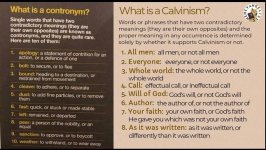

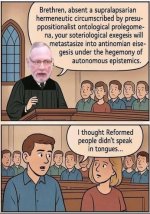
Did I say that God's choice was fatalistic? I don't think I did. Remember, the Bible teaches that God creates stories. Every event in a person's life is logically connected to every other event in his life. And the choices we make along the way matter within our personal story. To suggest that God saves us despite our decisions isn't fatalistic.
Last Thursday I gave my testimony to the men in my Bible study, and they gave theirs. We each traced our journey through a series of events, some negative and some positive, that led up to our conversion experience. Each of our stories had one thing in common: a Holy Spirit-guided perspective on the purpose and meaning of our experiences.
You indicated that the tulipist belief that God's election was "prenatal" is fatalistic.
Now you indicate belief that suggesting God saves us despite our decisions isn't fatalistic.
Sounds fatal for those He doesn't save to me!
Both tulipists and mfwers believe the Holy Spirit guides them, so the only way to discern which belief is correct is by interpreting Scripture correctly/rightly dividing the Word of Truth.
Here is a description of the choice:
A major blind spot or heresy is known as the doctrine of TULIP (tulipism), which may be described as follows:
T – total depravity, meaning souls are unable to exercise sufficient MFW to seek salvation (contradicting Deut. 30:19, Matt. 7:7, 23:37).
U – unconditional election, meaning that souls need not satisfy a divine requirement/condition such as faith or repentance, but God chooses to save some while damning the rest to hell (contradicting Eph. 2:8-10).
L – limited atonement, meaning that Christ died to pay the penalty of sin only for elect souls (contra John 3:16, Rom. 3:21-5:1).
I – irresistible grace, meaning that elect souls cannot resist or refuse God’s will for them to be saved (cf. Matt, 23:37, 2Thes. 2:10-13).
P – perseverance of the saints, meaning that the elect cannot repudiate their salvation and commit apostasy/blasphemy, because God perseveres in keeping them saved (cf. Heb. 6:4-6, Matt. 12:31).
The orthodox viewpoint opposed to TULIP may be termed Moral Free Will (MFW) and described as follows:
M – God’s requirement for salvation (GRFS) is a Moral condition called faith, which is manifested as seeking God’s righteousness or salvation (Matt. 4:17, 7:7), which presumes/implies sufficient human volition for sinners to make them morally accountable (Rom. 1:20, Deut. 30:19, Matt. 23:37), who may become totally depraved via committing apostasy/blasphemy against the HS (per Heb. 6:4- 6, Matt. 12:31).
F – God enables all morally accountable souls sufficient Freedom to satisfy GRFS—or not because His grace is resistible, which means sinners are accountable and justly condemned when they do not repent and accept Christ’s atonement for their sins (John 3:16-18, Rom. 3:21-5:1, Heb. 9:26-28).
W – Faith is almost synonymous with Will, but volition focuses on saving faith as God’s condition for forgiveness, and cooperating with God by accepting His grace through faith is NOT meritorious or working to earn heaven or salvation by obeying moral laws (John 6:29, Eph. 2:8-10).
As for me, I will believe the MFW option.
God’s People Are Charged to Proclaim His Gospel
God ensures that all of His elect hear and receive the good news of their redemption by Jesus Christ. He accomplishes this through the proclamation of the gospel message. This proclamation brings the knowledge of that which Christ has ALREADY accomplished on the behalf of His people.
The Gospel is not God’s OFFER to do something if man will only do something first. The Gospel is the bold proclamation of that which Christ has ALREADY done for the sheep.
Those for whom the gospel message is intended—God’s quickened elect—receive it in reality and with great joy and persevere by God’s preserving grace. The remainder finally reject it as foolishness or a stumbling stone.
(1 Cor 1:22-24) For the Jews require a sign, and the Greeks seek after wisdom: {23} But we preach Christ crucified, unto the Jews a stumblingblock, and unto the Greeks foolishness; {24} But unto them which are called, both Jews and Greeks, Christ the power of God, and the wisdom of God.
(1 Cor 2:12-14) Now we have received, not the spirit of the world, but the spirit which is of God; that we might know the things that are freely given to us of God. {13} Which things also we speak, not in the words which man’s wisdom teacheth, but which the Holy Ghost teacheth; comparing spiritual things with spiritual. {14} But the natural man receiveth not the things of the Spirit of God: for they are foolishness unto him: neither can he know them, because they are spiritually discerned.
The gospel reveals to the quickened elect sinner that which has already been accomplished on his behalf. God-given faith brings him to embrace his Savior and imparts the comfort and peace that such knowledge alone can bring.
The Lord’s church is charged to proclaim the gospel unto all whom the Lord gives them opportunity. In so doing God is glorified whether the message is received or whether it is rejected.
(2 Cor 2:14-17) Now thanks be unto God, which always causeth us to triumph in Christ, and maketh manifest the savour of his knowledge by us in every place. {15} For we are unto God a sweet savour of Christ, in them that are saved, and in them that perish: {16} To the one we are the savour of death unto death; and to the other the savour of life unto life. And who is sufficient for these things? {17} For we are not as many, which corrupt the word of God: but as of sincerity, but as of God, in the sight of God speak we in Christ. https://www.libcfl.com/articles/sovgrace.htm 52
God ensures that all of His elect hear and receive the good news of their redemption by Jesus Christ. He accomplishes this through the proclamation of the gospel message. This proclamation brings the knowledge of that which Christ has ALREADY accomplished on the behalf of His people.
The Gospel is not God’s OFFER to do something if man will only do something first. The Gospel is the bold proclamation of that which Christ has ALREADY done for the sheep.
Those for whom the gospel message is intended—God’s quickened elect—receive it in reality and with great joy and persevere by God’s preserving grace. The remainder finally reject it as foolishness or a stumbling stone.
(1 Cor 1:22-24) For the Jews require a sign, and the Greeks seek after wisdom: {23} But we preach Christ crucified, unto the Jews a stumblingblock, and unto the Greeks foolishness; {24} But unto them which are called, both Jews and Greeks, Christ the power of God, and the wisdom of God.
(1 Cor 2:12-14) Now we have received, not the spirit of the world, but the spirit which is of God; that we might know the things that are freely given to us of God. {13} Which things also we speak, not in the words which man’s wisdom teacheth, but which the Holy Ghost teacheth; comparing spiritual things with spiritual. {14} But the natural man receiveth not the things of the Spirit of God: for they are foolishness unto him: neither can he know them, because they are spiritually discerned.
The gospel reveals to the quickened elect sinner that which has already been accomplished on his behalf. God-given faith brings him to embrace his Savior and imparts the comfort and peace that such knowledge alone can bring.
The Lord’s church is charged to proclaim the gospel unto all whom the Lord gives them opportunity. In so doing God is glorified whether the message is received or whether it is rejected.
(2 Cor 2:14-17) Now thanks be unto God, which always causeth us to triumph in Christ, and maketh manifest the savour of his knowledge by us in every place. {15} For we are unto God a sweet savour of Christ, in them that are saved, and in them that perish: {16} To the one we are the savour of death unto death; and to the other the savour of life unto life. And who is sufficient for these things? {17} For we are not as many, which corrupt the word of God: but as of sincerity, but as of God, in the sight of God speak we in Christ. https://www.libcfl.com/articles/sovgrace.htm 52
M – God’s requirement for salvation (GRFS) is a Moral condition called faith, which is manifested as seeking God’s righteousness or salvation (Matt. 4:17, 7:7), which presumes/implies sufficient human volition for sinners to make them morally accountable (Rom. 1:20, Deut. 30:19, Matt. 23:37), who may become totally depraved via committing apostasy/blasphemy against the HS (per Heb. 6:4- 6, Matt. 12:31).
F – God enables all morally accountable souls sufficient Freedom to satisfy GRFS—or not because His grace is resistible, which means sinners are accountable and justly condemned when they do not repent and accept Christ’s atonement for their sins (John 3:16-18, Rom. 3:21-5:1, Heb. 9:26-28).
W – Faith is almost synonymous with Will, but volition focuses on saving faith as God’s condition for forgiveness, and cooperating with God by accepting His grace through faith is NOT meritorious or working to earn heaven or salvation by obeying moral laws (John 6:29, Eph. 2:8-10).
As for me, I will believe the MFW option.
Agree, the ability to respond positively to the Good News Message of Christ Jesus and His work on our behalf is the truth and explicitly taught in scripture, no eisegesis or inference required.
I don't know why you would see my posts as stealth. I'm trying my best to be clear, thoughtful, and respectful. I appreciate your posts, and I hoped you appreciated mine. I hope we can continue to dialogue on important issues.Yes the issue is completely about "regeneration preceding faith" or "God giving faith to some and not others" but since it cannot be supported by scripture the tactic is to side step and go somewhere else.
You are just changing the language>> "the spirit opens the heart to believe"
This has also been dealt with (the case of Lydia) scripture does not teach particular unconditional selection for salvation.
What I read in your posts is a type of stealth TULIPISM.

I don't know why you would see my posts as stealth. I'm trying my best to be clear, thoughtful, and respectful. I appreciate your posts, and I hoped you appreciated mine. I hope we can continue to dialogue on important issues.
Probably time for me to leave this thread for a bit, I have found most people on the TULIP side rarely handle scripture with integrity and honesty ..let us just say they live up to the stereotype of Calvinism.
But you are not one of them and yes have been respectful.
I just do not agree with you either.
Very funny pictures I saved them lol

No, I mean you have not given reasons for what you believe. So far, I'm not expecting you to agree with me. It is obvious that you disagree with me, but for some reason you can't say why.
Well here again is the post in which I did in fact outline my reasons and added a little regarding my thoughts. This is the third time I am doing this. What kind of a fishing expedition is it you think you are on? It's too bad you cannot accept the fact not everyone in this forum thinks you are the resident teacher here. This is not a teaching platform anyone. This is the BDF....Bible debate forum... not the teaching platform for people who fancy themself here to correct everyone else.
I think most people here and certainly myself, do not need or care for your personal pop psychology and use of AI.
The above, does not do you any favors. This is not how you address people if you actually want to discuss. You do not seem to want to do that though. Your dismissive rhetoric does not really allow for discussion.I understand your emotional reaction to what I said and why you didn't present a rational rebuttal.
So below is my original post 5520 and the 3rd time I respond. I'm not going to answer you again on the same thing should you post the same question a 4th time. It may be that you do not understand what I wrote since you are very Calvinistic in the way you think and I am not. Perhaps that is the reason you keep looking for something to compliment the way you teach. You will not get it from me.
RESPONSE
That's nonsense. Taking God is not willing that any should perish and creating containment to the recipients of the letter, is bogus.
In context, that verse does not mean what you are tying to make it say at all. In fact, that would mean that no one in this century should take anything written 2000 years as meant for them personally. Of course that would be harmful to all the OT scripture the dedicated Calvinist uses to present as useful to the doctrine. In context:
8 But do not forget this one thing, dear friends: With the Lord a day is like a thousand years, and a thousand years are like a day. 9 The Lord is not slow in keeping his promise, as some understand slowness. Instead he is patient with you, not wanting anyone to perish, but everyone to come to repentance.
Peter walked with Jesus. I think he had a far better understanding than the scripture massagers in this forum. He plainly states that
God does not want anyone to perish....unlike Calvinists who seem to love the thought of some people created solely for the purpose of going to hell.
You have created a god after your own heart and God, who is Spirit, and who is love, and who is holy and without fault, does not agree with your devilish assessment of Him.
The gospel, the actual gospel as found in scripture, teaches that through faith in Christ we have forgivness of our sins and that is by the grace of God....not the lies of Calvinism or those who teach it. The hiss of a graceless creature sounds in every teaching of Calvinism and the smell of decay clings to all of it. Those in Christ are given new life. We do not think we are special or chosen above others; indeed, the Bible teaches us to humble ourselves and think of others better than ourselves.
We do not find that in Calvinism. We find braggers and boasters who fancy themselves special to God; those whom God created to spend eternity with Him while the rest of humanity feeds the fires of an eternal hell.
What is the matter with you people? I think you have not found your identity in Christ but you surely have found a false identity in a man named John Calvin.
Don't bother with your AI junk. You have no idea what is actually going on with AI. I mean who needs the Holy Spirit when you have AI, eh? AI is deception and you have seen nothing yet and no, I don't believe you will change a thing and I mean why should you?
Right?
Putting your faith in something, Calvinsim in this case, is as much of a choice as any other of the choices you have made BUT Calvinists deny that we have that ability. And the irony of it all would be funny if it were not so serious.
God did not and would not ever place His Spirit in a degenerate and hopeless sinner who is so depraved he delights in it and seeks every occasion to sin his little heart out. This is not unconditional election. That, is foolish and as close to blasphemy without actually setting your clothes on fire, as God allows.
The Spirit of God seals a person who has accepted Christ as their Redeemer. He does not mess with the depraved and force salvation on anyone. Grace is not irresistable. People resist all the time as they resist truth in order to make themselves the little god instead of falling on their knees before the living One who is actually God.
I have no expectations that you will be at all interested in anything but countering what I wrote but you should understand that I
have the understanding, you are far from the only one reading this.
Yeah I noticed you state you are not a Calvinist. You still slice and dice scripture in a way that brings to mind that doctrine.
As a bonus feature Roger, this is what II Peter is actually about. This is an easy thing to find by actual teachers who have commented on scripture for years, who do not agree with you so even though you try to present Peter as agreeing with you, that is nonsense. Peter does not present a limited atonement and neither does the Bible even though you attempt to persuade us that it does while saying you are not a Calvinist. I consider those who have agreement with Calvinism but say they are not Calvinists, as 'stealth' Calvinists. I mean if it walks like a duck, quacks like a duck and looks like a duck....it is not camel.
II Peter was written to encourage Christians, believers who had accepted Christ, to live out the purpose of their lives IN Christ. Peter also warns the recipients of this letter to be on the watch for false teachers who claim to be believers but present a false version of the actual gospel And yes, he also says believers should watch and wait for the return of the Lord...something it seems we are still doing.
I am referring you to GOT QUESTIONS a pretty basic site that will explain in easy to understand words, the reason for Peter writing his 2nd letter.
Author: 2 Peter 1:1 specifically states that the apostle Peter was the author of 2 Peter. Peter’s authorship of 2 Peter has been challenged more than that of any other book in the New Testament. However, the early church fathers found no good reason to reject it. We find no good reason to reject Peter’s authorship of 2 Peter. Full article: Who wrote the book of 2 Peter? Who was the author of 2 Peter?
Date of Writing: The Book of 2 Peter was written toward the end of Peter’s life. Since Peter was martyred in Rome during the reign of Nero, his death must have occurred prior to A.D. 68. He very likely wrote 2 Peter between A.D. 65 and 68. Full Article: When was 2 Peter written?
Purpose of Writing: Peter was alarmed that false teachers were beginning to infiltrate the churches. He called on Christians to grow and become strong in their faith so that they could detect and combat the spreading apostasy. He strongly stressed the authenticity of the Word of God and the sure return of the Lord Jesus.
Brief Summary: Knowing that his time was short (2 Peter 1:13-15) and these churches faced immediate danger (2 Peter 2:1-3), Peter called upon the readers to refresh their memories (2 Peter 1:13) and stimulate their thinking (2 Peter 3:1-2) so that they would remember his teaching (2 Peter 1:15). He challenged the believers to become more mature in their faith by adding to it specific Christians virtues, thereby becoming effective and productive in their knowledge of Jesus Christ (2 Peter 1:5-9). The Old and New Testament writers were set forth as their authority for their faith (2 Peter 1:12-21, 3:2, 3:15-16). Peter desired they become strong in their faith to withstand the false teachers that had crept in and adversely affected the churches. In his denunciation of them, he described their conduct, their condemnation, and their characteristics (2 Peter chapter 2), and also that they ridiculed the Lord’s Second Coming (2 Peter 3:3-7). For the Christians, Peter taught that the Second Coming is the incentive for holy living (2 Peter 3:14). After a final warning, Peter again encouraged them to grow in the grace and knowledge of their Lord and Savior Jesus Christ. He concluded with a word of praise to his Lord and Savior (2 Peter 3:18).
So yeah, that's it. If anyone is interested, its simple enough to use any search engine you want and you can find pretty much the same thing as I posted above from Got Questions. There is nothing I have found that states that II Peter is in any way, shape or form about limited atonement. Ditto for the rest of scripture.
II Peter was written to encourage Christians, believers who had accepted Christ, to live out the purpose of their lives IN Christ. Peter also warns the recipients of this letter to be on the watch for false teachers who claim to be believers but present a false version of the actual gospel And yes, he also says believers should watch and wait for the return of the Lord...something it seems we are still doing.
I am referring you to GOT QUESTIONS a pretty basic site that will explain in easy to understand words, the reason for Peter writing his 2nd letter.
Author: 2 Peter 1:1 specifically states that the apostle Peter was the author of 2 Peter. Peter’s authorship of 2 Peter has been challenged more than that of any other book in the New Testament. However, the early church fathers found no good reason to reject it. We find no good reason to reject Peter’s authorship of 2 Peter. Full article: Who wrote the book of 2 Peter? Who was the author of 2 Peter?
Date of Writing: The Book of 2 Peter was written toward the end of Peter’s life. Since Peter was martyred in Rome during the reign of Nero, his death must have occurred prior to A.D. 68. He very likely wrote 2 Peter between A.D. 65 and 68. Full Article: When was 2 Peter written?
Purpose of Writing: Peter was alarmed that false teachers were beginning to infiltrate the churches. He called on Christians to grow and become strong in their faith so that they could detect and combat the spreading apostasy. He strongly stressed the authenticity of the Word of God and the sure return of the Lord Jesus.
Brief Summary: Knowing that his time was short (2 Peter 1:13-15) and these churches faced immediate danger (2 Peter 2:1-3), Peter called upon the readers to refresh their memories (2 Peter 1:13) and stimulate their thinking (2 Peter 3:1-2) so that they would remember his teaching (2 Peter 1:15). He challenged the believers to become more mature in their faith by adding to it specific Christians virtues, thereby becoming effective and productive in their knowledge of Jesus Christ (2 Peter 1:5-9). The Old and New Testament writers were set forth as their authority for their faith (2 Peter 1:12-21, 3:2, 3:15-16). Peter desired they become strong in their faith to withstand the false teachers that had crept in and adversely affected the churches. In his denunciation of them, he described their conduct, their condemnation, and their characteristics (2 Peter chapter 2), and also that they ridiculed the Lord’s Second Coming (2 Peter 3:3-7). For the Christians, Peter taught that the Second Coming is the incentive for holy living (2 Peter 3:14). After a final warning, Peter again encouraged them to grow in the grace and knowledge of their Lord and Savior Jesus Christ. He concluded with a word of praise to his Lord and Savior (2 Peter 3:18).
So yeah, that's it. If anyone is interested, its simple enough to use any search engine you want and you can find pretty much the same thing as I posted above from Got Questions. There is nothing I have found that states that II Peter is in any way, shape or form about limited atonement. Ditto for the rest of scripture.
At the risk of repeating myself I beg your patience. Thank-you very much for allowing me to clarify my position. I will try to use your gift wisely.You indicated that the tulipist belief that God's election was "prenatal" is fatalistic.
Now you indicate belief that suggesting God saves us despite our decisions isn't fatalistic.
Sounds fatal for those He doesn't save to me!
The confusion in your comment comes from treating election as if it were the same thing as fatalism. Fatalism teaches that outcomes occur without meaningful causes, choices, or means—everything simply falls into place mechanically. But in Reformed theology, God’s “prenatal” election is not a bare decree; it is the beginning of a story in which God sovereignly uses real human decisions, real preaching, real repentance, and real faith as the instruments by which He brings His people to salvation. Saying God saves us despite our sinful decisions is not fatalism; it is grace. Fatalism erases the significance of human choices, but Scripture shows that God works through those choices to accomplish His purpose. The fact that God saves some and not others doesn’t make the process fatalistic—it makes it personal, purposeful, and relational, because the entire journey matters, not just the final outcome.
The label “tulipist” doesn’t fit my position. I’m not defending the full TULIP system, nor am I arguing for unconditional election in the classic Reformed sense. What I’m saying is simply that God’s saving action is prior to and stronger than human indecision or confusion. That is not the same as affirming total depravity, unconditional election, limited atonement, irresistible grace, or perseverance of the saints as a package. My view is that God’s initiative is decisive, but I do not tie that to the full Calvinist framework. So calling me a tulipist misrepresents what I’m actually saying.
I’m not a tulipist, because I’m not grounding human inability in the classic doctrine of Total Depravity. My Romans work leads me to something different: Paul teaches that God has “given humanity over” to degrading passions and a depraved mind. That’s not a natural inability; it’s a judicial imprisonment. Humanity is trapped in the consequences of God’s wrath, and only God can undo that captivity. So my view isn’t the TULIP framework—it’s a Romans‑based account of divine imprisonment that requires God’s liberating action but doesn’t rely on the Calvinist categories.T – total depravity, meaning souls are unable to exercise sufficient MFW to seek salvation (contradicting Deut. 30:19, Matt. 7:7, 23:37).
I’m not a tulipist because I don’t affirm Unconditional Election in the classic Reformed sense. TULIP teaches that God chooses some for salvation without any conditions at all, including faith or repentance. But Paul’s argument in Romans 9 is different: election is grounded in God’s purpose for each life, not in the absence of conditions. The closest biblical parallel is Genesis 15, where God passes between the cuttings alone. That wasn’t “no conditions”—it was God meeting the covenant conditions Himself. So my view isn’t TULIP; it’s a Pauline, covenantal model where God fulfills the conditions required for His elect rather than eliminating conditions altogether.U – unconditional election, meaning that souls need not satisfy a divine requirement/condition such as faith or repentance, but God chooses to save some while damning the rest to hell (contradicting Eph. 2:8-10).
I’m not a tulipist because I don’t affirm TULIP’s theory of the atonement. TULIP treats the cross like a finite resource—like a gas tank that either has enough fuel for everyone or only enough for the elect. But the New Testament never depicts the cross as a resource. It depicts it as the revelation of God’s justice and the act that pleased the Father, granting Jesus the authority to advocate for whomever He chooses. The atonement isn’t a vending machine dispensing absolution; it’s the basis on which the Son intercedes. Because advocacy isn’t a limited resource, the atonement isn’t limited. That’s why my view is not TULIP’s L, and why calling me a tulipist misrepresents my actual position.L – limited atonement, meaning that Christ died to pay the penalty of sin only for elect souls (contra John 3:16, Rom. 3:21-5:1).
I’m not a tulipist because I don’t affirm Irresistible Grace. TULIP teaches that the elect cannot resist God’s saving will. But resistance to God isn’t a matter of “can’t”—it’s a matter of “won’t,” a willful rejection of God’s moral authority. When God brings someone to salvation, He doesn’t overpower their will; He re‑creates it. That’s why Paul can speak of some as “saints” and others as not—God’s election involves a creative transformation, not an irresistible force. So my view isn’t the TULIP model; it’s a narrative, Pauline model where God changes the will rather than bypassing it.I – irresistible grace, meaning that elect souls cannot resist or refuse God’s will for them to be saved (cf. Matt, 23:37, 2Thes. 2:10-13).
I’m not a tulipist because I don’t affirm Perseverance of the Saints in the TULIP sense. TULIP teaches that the elect cannot fall away because God prevents apostasy by overriding their will. But Paul doesn’t argue that the elect cannot fall away; he argues that they never will fall away. There’s a difference between inability and inevitability. Those in whom God has poured out His Spirit will not repudiate their salvation—not because they’re metaphysically incapable, but because the Spirit’s work produces a hope that “does not disappoint.” Perseverance is a matter of “won’t,” not “can’t,” and that puts my view outside the TULIP framework.P – perseverance of the saints, meaning that the elect cannot repudiate their salvation and commit apostasy/blasphemy, because God perseveres in keeping them saved (cf. Heb. 6:4-6, Matt. 12:31).
I know. But thank you again for providing me with this opportunity to clarify my position by contrasting TULIP with my beliefs. I believe in Moral Free Will, but I don't believe in autonomous free will. But I think we are on the same basic page.As for me, I will believe the MFW option.
- Status
- Not open for further replies.