Christmas

  • Christian Chat is a moderated online Christian community allowing Christians around the world to fellowship with each other in real time chat via webcam, voice, and text, with the Christian Chat app. You can also start or participate in a Bible-based discussion here in the Christian Chat Forums, where members can also share with each other their own videos, pictures, or favorite Christian music.

    If you are a Christian and need encouragement and fellowship, we're here for you! If you are not a Christian but interested in knowing more about Jesus our Lord, you're also welcome! Want to know what the Bible says, and how you can apply it to your life? Join us!

    To make new Christian friends now around the world, click here to join Christian Chat.
You addressed *my* post sir. In this thread. You challenged *my* information (which you're free to do...I welcome it). There was never a problem with your link (go back to my first response to you). But you keep referring to your posts there when I said I would get to them (as I keep my word). And now you've posted the exact same set of posts from that thread into this thread because you weren't patient enough for me or others to follow the link and read it. Meanwhile, I'm trying to keep to the rules of this place as in "no reposts/spamming".
Well, I can assure you/others that my intent wasn't to "spam", but simply to potentially save people the trouble of having to go back and forth to another post via a link in order to understand exactly what it is that I'm saying/suggesting.

Anyhow, if you view me as a "spammer", then just report the posts and the moderators can delete them if they so desire to.

Yahshua said:
You seem quick to antagonize, showing a lack of Proverbs 3:7 counsel right now.
Seriously?

Now you're citing Proverbs 3:7 TO ME?

"Be not wise in thine own eyes: fear the LORD, and depart from evil." (Proverbs 3:7)

Cite it to YOURSELF. I mean, after all, you're the one who has truly been shown to be "wise in his own eyes" in that you stubbornly refuse to see the errors of your own allegations as have already been documented for you ("Zacharias was the High Priest", "Jesus was born of the Feast of Tabernacles", etc.).

Of course, it's also humorous (not really) to have you accuse me of "antagonizing" when you're the one who initially falsely accused me of "pride".

Yahshua said:
Maybe it's my age as compared to yours that you have a problem with. Regardless, words are spirit. And yours is potently clear to me.
Or maybe, just maybe, I couldn't care less how old you or anybody else is, myself included, and instead, as is my norm, I'm addressing what THE WORD OF GOD has to say and you're basically engaging in ad hominems.

Anyhow, I'm not wasting another single second in this personal going back and forth with you. The bottom line is this:

You're in error and you should repent accordingly.

Yahshua said:
Placing a parenthetical statement apart from the actual statement is not a misunderstanding on the part of the reader but an error on the part of the writer if he/she meant otherwise. You said Zech's FIRST (typed in caps) < Parenthetical btw lol..."Zech's FIRST (Not counting the times when all orders of priests served simultaneously)". However I *am* claiming one of the times when all orders of priests served. So again, counter-proof please of *my* timing.
Again, I only meant FIRST and SECOND in relation to the two times that each priestly order was required to serve apart from the three times during the year when all orders of priests served simultaneously. That's already been explained to you, but if you want to keep on straining at that gnat, then go right ahead. From hereon, I'll stick to the actual topic of the thread and you can make as many baseless allegations against me (even as you've already made baseless allegations here in relation to the proper reading and understanding of scripture) as you'd like to.
 
I have NEVER said that His public ministry began on His actual birth date exactly, please read my posts, I am saying around the time of His birth date.

Luk 3:23 And Jesus himself began to be about thirty years of age, being (as was supposed) the son of Joseph, which was the son of Heli,

When one begins to be age thirty, he is not 30-1/2 or 30-3/4 years old, he is about 30 years old.

So if His public ministry began when He began to be 30, it would be around the fall of the year of 27 AD. Add 3-1/2 years and we come to spring of 31AD. We do know for a fact that He was crucified on the Passover (the equivalent Gregorian date of April 25, 31AD).
Hi, john832.

"Beginning to be about thirty years of age" gives us a bit of leeway and your 3 1/2 year calculation isn't set in stone either. I mean, for example, this same Luke wrote:

"He spake also this parable; A certain man had a fig tree planted in his vineyard; and he came and sought fruit thereon, and found none. Then said he unto the dresser of his vineyard, Behold, these three years I come seeking fruit on this fig tree, and find none: cut it down; why cumbereth it the ground? And he answering said unto him, Lord, let it alone this year also, till I shall dig about it, and dung it: And if it bear fruit, well: and if not, then after that thou shalt cut it down." (Luke 13:6-9)

At this juncture in time, Jesus had already been ministering in Israel for "three years". Well, if you do a comparative study in relation to the events which transpired AFTER THIS from all of the gospels, then I highly doubt that you're going to come up with EXACTLY 6 MONTHS FROM THIS TIME FORWARD to the actual date of Christ's crucifixion on Passover.
 
Well, I can assure you/others that my intent wasn't to "spam", but simply to potentially save people the trouble of having to go back and forth to another post via a link in order to understand exactly what it is that I'm saying/suggesting.

Anyhow, if you view me as a "spammer", then just report the posts and the moderators can delete them if they so desire to.


Seriously?

Now you're citing Proverbs 3:7 TO ME?

"Be not wise in thine own eyes: fear the LORD, and depart from evil." (Proverbs 3:7)

Cite it to YOURSELF. I mean, after all, you're the one who has truly been shown to be "wise in his own eyes" in that you stubbornly refuse to see the errors of your own allegations as have already been documented for you ("Zacharias was the High Priest" ??? Though I willingly removed it?, "Jesus was born of the Feast of Tabernacles" Still waiting on this one, etc.).

Of course, it's also humorous (not really) to have you accuse me of "antagonizing" when you're the one who initially falsely accused me of "pride".


Or maybe, just maybe, I couldn't care less how old you or anybody else is, myself included, and instead, as is my norm, I'm addressing what THE WORD OF GOD has to say and you're basically engaging in ad hominems.

Anyhow, I'm not wasting another single second in this personal going back and forth with you I agree...let's get back to the timing. The bottom line is this:

You're in error and you should repent accordingly.

Great! Thanks. Now we can return to the discussion...

Again, I only meant FIRST and SECOND in relation to the two times that each priestly order was required to serve apart from the three times during the year when all orders of priests served simultaneously. That's already been explained to you, but if you want to keep on straining at that gnat, then go right ahead. From hereon, I'll stick to the actual topic of the thread and you can make as many baseless allegations against me (even as you've already made baseless allegations here in relation to the proper reading and understanding of scripture) as you'd like to.

Acknowledged. Let me repeat for the record that you are talking about the *normal* requirements of serving in the temple and not talking about the *special* times when all orders of priests served.

Again, what you are talking about has been acknowledged.


Now...


*I* - contrarily - am talking about one of the *special* times when all orders of priests served; the one time Zechariah's house leads. This is what my posts have been about; the posts you say are incorrect and worthy of repentance.

I'm happy to discuss why you know my selection; one of these *special* times, is in error. I am willing to consider your counter-proof that this timing is wrong...I know you have proof that another time could be a possibility but you said my proof is in fact wrong. So I'm willing to discuss why it's wrong.

As a lead-off; let me ask: were there any other times (besides the 3 Feasts) when the "the whole multitude" is required - or otherwise *definitely* would be - present at the temple? In other words, would the *whole* multitude be presenting at the temple every single Sabbath week of the year?

My point for asking is because Luke's account specifically notes that "the whole multitude" was present during the time of Zechariah's leadership in the temple.

Luke 1:10
10 And the whole multitude of the people were praying without at the time of incense.
 
Last edited:
Yahshua said:
As a lead-off; let me ask: were there any other times (besides the 3 Feasts) when the "the whole multitude" is required - or otherwise *definitely* would be - present at the temple? In other words, would the *whole* multitude be presenting at the temple every single Sabbath week of the year?

My point for asking is because Luke's account specifically notes that "the whole multitude" was present during the time of Zechariah's leadership in the temple.

Luke 1:10 said:
And the whole multitude of the people were praying without at the time of incense.
I'm far from being an expert on normal Jewish temple ceremonies and procedures, but, from what I've read, here are two possibilities:

1. "The whole multitude" could simply refer to "the whole multitude". IOW, there was nothing specific about this particular "whole multitude" as opposed to any other "whole multitude" which might have been present at the temple during what seems to be "the time of prayer" which coincided with the time that the incense was burnt within the temple.

2. "The whole multitude" could have specific meaning in that this "multitude" might have been bigger than other normal gatherings at the temple. Even then, though, we're not specifically told what specific meaning that might be. IOW, even if this "multitude" was bigger than normal, then it could have been the result of that day being a High Day (like a Feast Day) or it could have been a weekly Sabbath when more people gathered together at the temple for prayer than on a normal working day.

Beyond that, I don't know what else to say except to offer this general piece of advice which I regularly seek to follow myself:

When it comes to any Biblical topic, it is always best to gather all of the information available and view it together. When such is done, then I believe that there will always be certain verses which are "black and white" or which clearly state certain things and that there will also inevitably be some "grey" verses which, by themselves, can be puzzling. What I normally seek to do is to establish the "black and white" verses FIRST and then see if the "grey" verses adequately match up with the same. If they do, then I'm pretty confident that I have arrived at Biblical truth. Contrariwise, I think that it is very dangerous to begin our quest for Biblical truth with a "grey" or vague verse and then use the same as some sort of foundation...especially if/when "black and white" verses greatly contradict the "grey" verse. In this particular case, I've raised what I believe to be some "black and white" objections to Jesus possibly being born on the Feast of Tabernacles. I first raised them days ago and I've yet to see anybody challenge my objections from a scriptural perspective. If anybody feels that they can do so, then I'll certainly consider what they have to say. Until that time comes, however, I'm going to stick with what I believe to be "black and white" and that which the "grey" verses easlily align themselves with. That's basically my position, but I am always open to additional insight...as long as it doesn't contradict scripture.
 
Hi, john832.

"Beginning to be about thirty years of age" gives us a bit of leeway and your 3 1/2 year calculation isn't set in stone either. I mean, for example, this same Luke wrote:

"He spake also this parable; A certain man had a fig tree planted in his vineyard; and he came and sought fruit thereon, and found none. Then said he unto the dresser of his vineyard, Behold, these three years I come seeking fruit on this fig tree, and find none: cut it down; why cumbereth it the ground? And he answering said unto him, Lord, let it alone this year also, till I shall dig about it, and dung it: And if it bear fruit, well: and if not, then after that thou shalt cut it down." (Luke 13:6-9)

At this juncture in time, Jesus had already been ministering in Israel for "three years". Well, if you do a comparative study in relation to the events which transpired AFTER THIS from all of the gospels, then I highly doubt that you're going to come up with EXACTLY 6 MONTHS FROM THIS TIME FORWARD to the actual date of Christ's crucifixion on Passover.

This was a parable not an actual occurrence. You are using a parable to set an actual time? You do know the purpose of parables don't you?

Mat 13:10 And the disciples came, and said unto him, Why speakest thou unto them in parables?
Mat 13:11 He answered and said unto them, Because it is given unto you to know the mysteries of the kingdom of heaven, but to them it is not given.
Mat 13:12 For whosoever hath, to him shall be given, and he shall have more abundance: but whosoever hath not, from him shall be taken away even that he hath.
Mat 13:13 Therefore speak I to them in parables: because they seeing see not; and hearing they hear not, neither do they understand.
Mat 13:14 And in them is fulfilled the prophecy of Esaias, which saith, By hearing ye shall hear, and shall not understand; and seeing ye shall see, and shall not perceive:

He did not speak parables to make the meaning clear, He spoke them to conceal the meaning from the masses.
 
If Christmas was such a pagan holiday, then the world would embrace it (as the celebration of Jesus' birth), but they do not!

That should speak for itself.
 
This was a parable not an actual occurrence. You are using a parable to set an actual time? You do know the purpose of parables don't you?

Mat 13:10 And the disciples came, and said unto him, Why speakest thou unto them in parables?
Mat 13:11 He answered and said unto them, Because it is given unto you to know the mysteries of the kingdom of heaven, but to them it is not given.
Mat 13:12 For whosoever hath, to him shall be given, and he shall have more abundance: but whosoever hath not, from him shall be taken away even that he hath.
Mat 13:13 Therefore speak I to them in parables: because they seeing see not; and hearing they hear not, neither do they understand.
Mat 13:14 And in them is fulfilled the prophecy of Esaias, which saith, By hearing ye shall hear, and shall not understand; and seeing ye shall see, and shall not perceive:

He did not speak parables to make the meaning clear, He spoke them to conceal the meaning from the masses.
Jesus spoke a similar parable here and the chief priests and Pharisees perceived that He was speaking of them:

Matthew chapter 21

[33] Hear another parable: There was a certain householder, which planted a vineyard, and hedged it round about, and digged a winepress in it, and built a tower, and let it out to husbandmen, and went into a far country:
[34] And when the time of the fruit drew near, he sent his servants to the husbandmen, that they might receive the fruits of it.
[35] And the husbandmen took his servants, and beat one, and killed another, and stoned another.
[36] Again, he sent other servants more than the first: and they did unto them likewise.
[37] But last of all he sent unto them his son, saying, They will reverence my son.
[38] But when the husbandmen saw the son, they said among themselves, This is the heir; come, let us kill him, and let us seize on his inheritance.
[39] And they caught him, and cast him out of the vineyard, and slew him.
[40] When the lord therefore of the vineyard cometh, what will he do unto those husbandmen?
[41] They say unto him, He will miserably destroy those wicked men, and will let out his vineyard unto other husbandmen, which shall render him the fruits in their seasons.
[42] Jesus saith unto them, Did ye never read in the scriptures, The stone which the builders rejected, the same is become the head of the corner: this is the Lord's doing, and it is marvellous in our eyes?
[43] Therefore say I unto you, The kingdom of God shall be taken from you, and given to a nation bringing forth the fruits thereof.
[44] And whosoever shall fall on this stone shall be broken: but on whomsoever it shall fall, it will grind him to powder.
[45] And when the chief priests and Pharisees had heard his parables, they perceived that he spake of them.
[46] But when they sought to lay hands on him, they feared the multitude, because they took him for a prophet.

Also, going back to Jesus' parable as recorded by Luke for a moment, we read:

Luke chapter 13

[1] There were present at that season some that told him of the Galilaeans, whose blood Pilate had mingled with their sacrifices.
[2] And Jesus answering said unto them, Suppose ye that these Galilaeans were sinners above all the Galilaeans, because they suffered such things?
[3] I tell you, Nay: but, except ye repent, ye shall all likewise perish.
[4] Or those eighteen, upon whom the tower in Siloam fell, and slew them, think ye that they were sinners above all men that dwelt in Jerusalem?
[5] I tell you, Nay: but, except ye repent, ye shall all likewise perish.
[6] He spake also this parable; A certain man had a fig tree planted in his vineyard; and he came and sought fruit thereon, and found none.
[7] Then said he unto the dresser of his vineyard, Behold, these three years I come seeking fruit on this fig tree, and find none: cut it down; why cumbereth it the ground?
[8] And he answering said unto him, Lord, let it alone this year also, till I shall dig about it, and dung it:
[9] And if it bear fruit, well: and if not, then after that thou shalt cut it down."

IOW, Jesus' intention in telling this parable seems to have been to inform those of Jerusalem that they needed to repent or else they were likewise going to perish...and, for the most part, they hadn't and didn't during the approximately three years that Jesus had been ministering there already. Israel is also referred to as being God's "fig tree" in Joel 1:7, btw, and, again, if we do a comparative study between the various gospel accounts, then we can get a rather accurate timeframe for these Words of Jesus. IOW, shortly after uttering this parable as recorded by Luke, Jesus said the following:

Luke chapter 13

[31] The same day there came certain of the Pharisees, saying unto him, Get thee out, and depart hence: for Herod will kill thee.
[32] And he said unto them, Go ye, and tell that fox, Behold, I cast out devils, and I do cures to day and to morrow, and the third day I shall be perfected.
[33] Nevertheless I must walk to day, and to morrow, and the day following: for it cannot be that a prophet perish out of Jerusalem.
[34] O Jerusalem, Jerusalem, which killest the prophets, and stonest them that are sent unto thee; how often would I have gathered thy children together, as a hen doth gather her brood under her wings, and ye would not!
[35] Behold, your house is left unto you desolate: and verily I say unto you, Ye shall not see me, until the time come when ye shall say, Blessed is he that cometh in the name of the Lord.


Not only do these comments, when standing alone, place these Words near the end of Jesus' public ministry, but, again, when compared to other gospel accounts, we basically see Jesus saying the same thing here in verses 34-35 that Matthew recorded in Matthew 23:37-38 and the events which immediately follow that utterance also give us a fairly accurate timeframe in relation to when Jesus uttered these Words and it would definitely coincide with this being somewhere around 3 years after Jesus' public ministry began.

Anyhow, in any case, like I said, your 3 1/2 year timeframe isn't etched in stone. Seeing how this thread is about "Christmas", I'll refrain from getting too deep into Jesus' parables on this thread.
 
I'm far from being an expert on normal Jewish temple ceremonies and procedures, but, from what I've read, here are two possibilities:

1. "The whole multitude" could simply refer to "the whole multitude". IOW, there was nothing specific about this particular "whole multitude" as opposed to any other "whole multitude" which might have been present at the temple during what seems to be "the time of prayer" which coincided with the time that the incense was burnt within the temple.

2. "The whole multitude" could have specific meaning in that this "multitude" might have been bigger than other normal gatherings at the temple. Even then, though, we're not specifically told what specific meaning that might be. IOW, even if this "multitude" was bigger than normal, then it could have been the result of that day being a High Day (like a Feast Day) or it could have been a weekly Sabbath when more people gathered together at the temple for prayer than on a normal working day.

Beyond that, I don't know what else to say except to offer this general piece of advice which I regularly seek to follow myself:

When it comes to any Biblical topic, it is always best to gather all of the information available and view it together. When such is done, then I believe that there will always be certain verses which are "black and white" or which clearly state certain things and that there will also inevitably be some "grey" verses which, by themselves, can be puzzling. What I normally seek to do is to establish the "black and white" verses FIRST and then see if the "grey" verses adequately match up with the same. If they do, then I'm pretty confident that I have arrived at Biblical truth. Contrariwise, I think that it is very dangerous to begin our quest for Biblical truth with a "grey" or vague verse and then use the same as some sort of foundation...especially if/when "black and white" verses greatly contradict the "grey" verse.

That's sound advice and I actually believe there is no other way to study. Establish what's in "black and white" first, corroborated by other text (as much as is relevant), as there's always at least one additional witness to a truth to establish it.

It's pretty gray simply to say "multitude".. There are instances in scripture when the text says "multitude" and even "great multitude", never describing the number of people (except for the loaves & fishes miracles where the number of people is specifically detailed). But when this text says "whole multitude" to me (at least) that's as black and white as one can read. The Greek phrase "pan to plethos" is literally "all/every the multitude". The most plausible understanding of this phrase is everyone; all, as in "the entire assembly" (as was commanded).

- Then as an additional witness, we can read throughout the NT accounts that on weekly Sabbaths scripture is often taught/debated in community synagogues in the land (both during Christ's ministry he taught there, and Paul in the Acts of the Apostles), showing that the "whole" (Pan) multitude would not have been at the temple during these weekly Sabbaths.

- Also, there are several gospel accounts where Christ did not travel to the temple on weekly Sabbaths, yet every time there was a feast Christ went to the temple in obedience to his father's command. Not even all/every Pharisee - the religious leaders who were self-proclaimed keepers of the law - were present at the temple on weekly Sabbaths (they were busy accusing Christ of breaking it). And when a high day (feast) approached they definitely made it a point to follow the law.

So there are only five times when Zech's house serves in the temple...and only three times when the *whole* multitude would definitely be present at that temple. Together, there is only one time when both coincide to match the text, and that's during the 3rd month at the feast of Shavuot...then we follow Luke's monthly account to Feast of tabernacles as Christ's birth.

But as you've alluded to (and as I agree with), there must be other witnesses of this. But before I share another, I'll address your posts like I promised...just give me some time.
 
Take your time...I'll pop in here periodically today and then I'm on the road the next two days for work.

P.S.

I know of a certainty when I was born. Check my age...it will increase by one year tomorrow.
 
If Christmas was such a pagan holiday, then the world would embrace it (as the celebration of Jesus' birth), but they do not!

That should speak for itself.

Huh??????? What is the most popular holiday of the year? (I'm willing to be it is not the Day of Atonement.)
 
If Christmas was such a pagan holiday, then the world would embrace it (as the celebration of Jesus' birth), but they do not!

That should speak for itself.

Christmas is the largest "holiday" celebrated virtually worldwide.

Matt 7:13, "Enter in through the narrow gate; for wide is the gate and broad is the way that leads to destruction, and many are those who go that way. Because straight is the gate, and narrow is the way which leads to life, and few there are who find it."

Yeremyah 10:1-6, "Hear the word which Yahweh speaks concerning you, O house of Israyl. This is what Yahweh says: Do not learn the way of the heathen and do not be deceived by the signs of heaven; though the heathen are deceived by them For the religious customs of the peoples are vain; worthless! For one cuts a tree out of the forest, the work of the hands of the workman, with the ax. They decorate it with silver and with gold; they fasten it with nails and with hammers, so that it will not move; topple over. They are upright, like a palm tree, but they cannot speak; they must be carried, because they cannot go by themselves. Do not give them reverence! They cannot do evil, nor is it in them to do righteousness!"

Colossians 2:8, "Beware that no one leads you away like a prize because of philosophy or empty, false statements, according to the traditions of men, after the elements of the world, and not after the Messiah!"

Mark 7:13, "Making the Laws of Yahweh of no effect through your tradition you have handed down! And many other similar things you do."
 
Last edited:
Christmas is the largest "holiday" celebrated virtually worldwide.

Matt 7:13, "Enter in through the narrow gate; for wide is the gate and broad is the way that leads to destruction, and many are those who go that way. Because straight is the gate, and narrow is the way which leads to life, and few there are who find it."

Yeremyah 10:1-6, "Hear the word which Yahweh speaks concerning you, O house of Israyl. This is what Yahweh says: Do not learn the way of the heathen and do not be deceived by the signs of heaven; though the heathen are deceived by them For the religious customs of the peoples are vain; worthless! For one cuts a tree out of the forest, the work of the hands of the workman, with the ax. They decorate it with silver and with gold; they fasten it with nails and with hammers, so that it will not move; topple over. They are upright, like a palm tree, but they cannot speak; they must be carried, because they cannot go by themselves. Do not give them reverence! They cannot do evil, nor is it in them to do righteousness!"

Colossians 2:8, "Beware that no one leads you away like a prize because of philosophy or empty, false statements, according to the traditions of men, after the elements of the world, and not after the Messiah!"

Mark 7:13, "Making the Laws of Yahweh of no effect through your tradition you have handed down! And many other similar things you do."
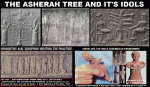
That Jeremiah quote is referencing an idol and not a Christmas tree.
 
I care less about the tree, next year I might just suspend lights from the ceiling in a nice way
" representing the light and truth of Yah ". The gifts that our brought around it, are gifts from God. All the elements of giving, love, singing to Yahshua, are just apart of His birth. I might even bring something to the homeless as I would do year round anyway, along with giving, peace, and love. As the wiseman brought baby Yahshua gifts as well. He said to love and do for one another as we would ourselves.
 
  • Like
Reactions: Yahshua
I care less about the tree, next year I might just suspend lights from the ceiling in a nice way
" representing the light and truth of Yah ". The gifts that our brought around it, are gifts from God. All the elements of giving, love, singing to Yahshua, are just apart of His birth. I might even bring something to the homeless as I would do year round anyway, along with giving, peace, and love. As the wiseman brought baby Yahshua gifts as well. He said to love and do for one another as we would ourselves.

Praise Yah!

This is an amazing passage IMO;

Mattithyah 19:17-21, "But He said to him: Why do you question Me about righteousness? There is only One Who is the standard of perfection, and that is Yahweh; so if you would enter into life, keep the Laws of Yahweh. He then asked Yahshua; Which ones? Yahshua said: You shall not murder. You shall not commit adultery. You shall not steal. You shall not bear false testimony. Honor your father and mother, and; You shall love your neighbor as yourself. The young man said to Him; All these things I have kept from my youth up; what do I yet lack? Yahshua said to him: If you want to come to the perfection of Yahweh, go and sell of what you have, and give to the poor, and you will have treasure in heaven; and you will be walking in Yahweh's ways, and following Me."
 
Praise Yah!

This is an amazing passage IMO;

Mattithyah 19:17-21, "But He said to him: Why do you question Me about righteousness? There is only One Who is the standard of perfection, and that is Yahweh; so if you would enter into life, keep the Laws of Yahweh. He then asked Yahshua; Which ones? Yahshua said: You shall not murder. You shall not commit adultery. You shall not steal. You shall not bear false testimony. Honor your father and mother, and; You shall love your neighbor as yourself. The young man said to Him; All these things I have kept from my youth up; what do I yet lack? Yahshua said to him: If you want to come to the perfection of Yahweh, go and sell of what you have, and give to the poor, and you will have treasure in heaven; and you will be walking in Yahweh's ways, and following Me."

Yes brother, but we should be wise enough to know not to tell people to become homeless themselves. We wouldn't be able to tap on a keyboard to talk about Yahshua or have shoes to walk and preach if we had nothing.

Matthew 6:33 - But seek ye first the kingdom of God, and his righteousness; and all these things shall be added unto you.

Proverbs 11:1 A false balance is abomination to Yah: but a just weight is his delight.

Ecclesiastics 7:16 Be not righteous over much; neither make thyself over wise: why shouldest thou destroy thyself?
 
Yes brother, but we should be wise enough to know not to tell people to become homeless themselves. We wouldn't be able to tap on a keyboard to talk about Yahshua or have shoes to walk and preach if we had nothing.

Matthew 6:33 - But seek ye first the kingdom of God, and his righteousness; and all these things shall be added unto you.

Proverbs 11:1 A false balance is abomination to Yah: but a just weight is his delight.

Ecclesiastics 7:16 Be not righteous over much; neither make thyself over wise: why shouldest thou destroy thyself?

Your right IMO.

I read that passage(Mt19), and wonder if I am fully committed...

I pray Yahweh gives me the strength through Yahshua, that I may do His will.
 
You sure about that?
Yes, as a matter of fact, I'm quite sure of the same. For starters, here's a fuller version of your quote:

Jeremiah chapter 10

[1] Hear ye the word which the LORD speaketh unto you, O house of Israel:
[2] Thus saith the LORD, Learn not the way of the heathen, and be not dismayed at the signs of heaven; for the heathen are dismayed at them.
[3] For the customs of the people are vain: for one cutteth a tree out of the forest, the work of the hands of the workman, with the axe.
[4] They deck it with silver and with gold; they fasten it with nails and with hammers, that it move not.
[5] They are upright as the palm tree, but speak not: they must needs be borne, because they cannot go. Be not afraid of them; for they cannot do evil, neither also is it in them to do good.
[6] Forasmuch as there is none like unto thee, O LORD; thou art great, and thy name is great in might.
[7] Who would not fear thee, O King of nations? for to thee doth it appertain: forasmuch as among all the wise men of the nations, and in all their kingdoms, there is none like unto thee.
[8] But they are altogether brutish and foolish: the stock is a doctrine of vanities.
[9] Silver spread into plates is brought from Tarshish, and gold from Uphaz, the work of the workman, and of the hands of the founder: blue and purple is their clothing: they are all the work of cunning men.
[10] But the LORD is the true God, he is the living God, and an everlasting king: at his wrath the earth shall tremble, and the nations shall not be able to abide his indignation.
[11] Thus shall ye say unto them, The gods that have not made the heavens and the earth, even they shall perish from the earth, and from under these heavens.
[12] He hath made the earth by his power, he hath established the world by his wisdom, and hath stretched out the heavens by his discretion.
[13] When he uttereth his voice, there is a multitude of waters in the heavens, and he causeth the vapours to ascend from the ends of the earth; he maketh lightnings with rain, and bringeth forth the wind out of his treasures.
[14] Every man is brutish in his knowledge: every founder is confounded by the graven image: for his molten image is falsehood, and there is no breath in them.
[15] They are vanity, and the work of errors: in the time of their visitation they shall perish.

I mean, c'mon...the context alone tells us that the LORD was speaking about idols/graven images/false gods through the prophet Jeremiah. Beyond that, just compare what was said here to what was said elsewhere:

"For the customs of the people are vain: for one cutteth a tree out of the forest, the work of the hands of the workman, with the axe. They deck it with silver and with gold; they fasten it with nails and with hammers, that it move not." (Jeremiah 10:3-4)

"The workman melteth a graven image, and the goldsmith spreadeth it over with gold, and casteth silver chains. He that is so impoverished that he hath no oblation chooseth a tree that will not rot; he seeketh unto him a cunning workman to prepare a graven image, that shall not be moved." (Isaiah 40:19-20)

"They helped every one his neighbour; and every one said to his brother, Be of good courage. So the carpenter encouraged the goldsmith, and he that smootheth with the hammer him that smote the anvil, saying, It is ready for the sodering: and he fastened it with nails, that it should not be moved." (Isaiah 41:6-7)


Contextually, all of these verses are speaking of idols/graven images/false gods.

"They are upright as the palm tree, but speak not: they must needs be borne, because they cannot go. Be not afraid of them; for they cannot do evil, neither also is it in them to do good." (Jeremiah 10:5)

"Their idols are silver and gold, the work of men's hands. They have mouths, but they speak not: eyes have they, but they see not: They have ears, but they hear not: noses have they, but they smell not: They have hands, but they handle not: feet have they, but they walk not: neither speak they through their throat. They that make them are like unto them; so is every one that trusteth in them." (Psalm 115:4-8)

"Let them bring them forth, and shew us what shall happen: let them shew the former things, what they be, that we may consider them, and know the latter end of them; or declare us things for to come. Shew the things that are to come hereafter, that we may know that ye are gods: yea, do good, or do evil, that we may be dismayed, and behold it together. Behold, ye are of nothing, and your work of nought: an abomination is he that chooseth you." (Isaiah 41:22-24)

Again, contextually, all of these verses are speaking of idols/graven images/false gods...unless you somehow believe that God was talking about Christmas trees which cannot speak and which can do neither good nor evil.

"Silver spread into plates is brought from Tarshish, and gold from Uphaz, the work of the workman, and of the hands of the founder: blue and purple is their clothing: they are all the work of cunning men." (Jeremiah 10:9)

"Every man is brutish in his knowledge: every founder is confounded by the graven image: for his molten image is falsehood, and there is no breath in them." (Jeremiah 10:14)

"What profiteth the graven image that the maker thereof hath graven it; the molten image, and a teacher of lies, that the maker of his work trusteth therein, to make dumb idols? Woe unto him that saith to the wood, Awake; to the dumb stone, Arise, it shall teach! Behold, it is laid over with gold and silver, and there is no breath at all in the midst of it." (Habakkuk 2:18-19)

Once more, contextually, all of these verses are speaking of idols/graven images/false gods.

I trust that this will suffice.