
Does my Bible follow Pharisee, Rabbinical or Judaism Laws?
- Thread starter Hizikyah
- Start date
-
Christian Chat is a moderated online Christian community allowing Christians around the world to fellowship with each other in real time chat via webcam, voice, and text, with the Christian Chat app. You can also start or participate in a Bible-based discussion here in the Christian Chat Forums, where members can also share with each other their own videos, pictures, or favorite Christian music.
If you are a Christian and need encouragement and fellowship, we're here for you! If you are not a Christian but interested in knowing more about Jesus our Lord, you're also welcome! Want to know what the Bible says, and how you can apply it to your life? Join us!
To make new Christian friends now around the world, click here to join Christian Chat.
You are using an out of date browser. It may not display this or other websites correctly.
You should upgrade or use an alternative browser.
You should upgrade or use an alternative browser.

To me, his name is "Father," and isn't that what Jesus called him?I understand, but what if He said to call upon His name? What would you think about that if so?
Micahyah (Micah) 4:5, "For all people walk each in the name of his god, but we will walk in the Name of YHWH our Father forever and ever."
Psalm 116:13, "We will take the cup of salvation, and we will call upon Your Name, O YHWH."
Zecharyah 13:9, "And I will bring the third part through the fire, and will refine them as silver is refined, and will try them as gold is tried. They will call with My Name, and I will hear them. I will say: It is My people! And they will say; YHWH is my Strength!"
Malakyah 1:11, "For from the rising of the sun, to the going down of the same, My Name will be great among the Gentiles. In every place incense will be offered to My Name, with a pure offering; for My Name will be great among the Gentiles, says YHWH of hosts."
Yahchanan (John) 17:6, "I have manifested Your Name to the men that You gave Me out of the world. They were yours, and You gave them to Me; and they have kept Your word."
Malakyah 3:16, "Then those who reverenced YHWH spoke often one to another, and YHWH paid attention and heard them; and a Book of Remembrance was written in His presence of those who gave reverence to YHWH, and who thought upon His Name."
Exodus 34:5-7, "Then YHWH descended in the cloud, and stood with him there, and proclaimed the Name of YHWH. YHWH passed in front of him, and proclaimed: YHWH, YHWH Almighty, merciful and compassionate, longsuffering, and abounding in righteousness and truth. Keeping mercy for thousands, forgiving iniquity, and transgression, and sin; but by no means leaving unpunished those who are guilty; Who visits the sin of the fathers upon the children and the children's children, to the third and fourth generation."

To me, his name is "Father," and isn't that what Jesus called him?
I love to call Him Father also! Just trying to provide truth my brother, He did call Him Father, and He also called Him by His name, YHWH:
Yahchanan (John) 17:6, "I have manifested Your Name to the men that You gave Me out of the world. They were yours, and You gave them to Me; and they have kept Your word."
Yahchanan (John) 5:43, "I have come in My Father's Name, but you do not follow Me. Let another come in his own name; him you will follow."
Mattithyah 23:39, "For I say to you: From this moment you will not see Me, until you say: Blessed is He Who comes in the Name of YHWH!"
Yahshua/Jesus literally quoted: Psalm 118:26, "Blessed be He Who comes in the Name of YHWH!.."
and He said is as He stormed off the "Temple Mount"
(Bayith YHWY/House of YHWH)
Psalm 118:26 Blessed is He who is coming in the Name of יהוה ! We shall bless you from the House of יהוה.
then they killed Him, He won tho!
I understand, but what if He said to call upon His name? What would you think about that if so?
Micahyah (Micah) 4:5, "For all people walk each in the name of his god, but we will walk in the Name of YHWH our Father forever and ever."
Psalm 116:13, "We will take the cup of salvation, and we will call upon Your Name, O YHWH."
Zecharyah 13:9, "And I will bring the third part through the fire, and will refine them as silver is refined, and will try them as gold is tried. They will call with My Name, and I will hear them. I will say: It is My people! And they will say; YHWH is my Strength!"
Malakyah 1:11, "For from the rising of the sun, to the going down of the same, My Name will be great among the Gentiles. In every place incense will be offered to My Name, with a pure offering; for My Name will be great among the Gentiles, says YHWH of hosts."
Yahchanan (John) 17:6, "I have manifested Your Name to the men that You gave Me out of the world. They were yours, and You gave them to Me; and they have kept Your word."
Malakyah 3:16, "Then those who reverenced YHWH spoke often one to another, and YHWH paid attention and heard them; and a Book of Remembrance was written in His presence of those who gave reverence to YHWH, and who thought upon His Name."
Exodus 34:5-7, "Then YHWH descended in the cloud, and stood with him there, and proclaimed the Name of YHWH. YHWH passed in front of him, and proclaimed: YHWH, YHWH Almighty, merciful and compassionate, longsuffering, and abounding in righteousness and truth. Keeping mercy for thousands, forgiving iniquity, and transgression, and sin; but by no means leaving unpunished those who are guilty; Who visits the sin of the fathers upon the children and the children's children, to the third and fourth generation."
No secret names or handshakes, Christians are a new creation having nothing to do with the flesh of any man .
God has no name needed to tell him apart from the creatures to include the administering spirits that have no form, not made from the dust .
God is not in competition with His creation and has a secret name .He is not a man as us. He is God like no other savior.
Names as invisible powers are attributes of God as His immutable authority. Jehovah simply means mighty savior.
No secret names .
The phrase: I have manifested Your Name, written throughout the scriptures simply means I have given them your authority to believe. That authority alone is JEHOVAH for he who dwells in men has become the one source of salvation. Words in the scriptures have meanings attached to them .
Psalms 83:18 That men may know that thou, whose name "alone isJEHOVAH", art the most high over all the earth.
Isaiah 12:2 Behold, God is my salvation; I will trust, and not be afraid: for the LORD JEHOVAH is my strength and my song; he also is become my salvation.
Psalm 118:26 Blessed is He who is coming in the Name of יהוה ! We shall bless you from the House of יהוה.
then they killed Him, He won tho!
Jehovah our eternal savoir cannot die .He is eternal God without mother or father, beginning of days or end of Spirit life.

1Co 8:5 For though there be that are called gods, whether in heaven or in earth, (as there be gods many, and lords many,)
there is ONE Eternal One, and he wants us not only to address him by the Name he revealed to mankind (Gen 4:26 And to Shĕth, to him also a son was born. And he called his name Enosh. Then it was begun to call on the Name of יהוה
there is ONE Eternal One, and he wants us not only to address him by the Name he revealed to mankind (Gen 4:26 And to Shĕth, to him also a son was born. And he called his name Enosh. Then it was begun to call on the Name of יהוה

1Co 8:5 For though there be that are called gods, whether in heaven or in earth, (as there be gods many, and lords many,)
there is ONE Eternal One, and he wants us not only to address him by the Name he revealed to mankind (Gen 4:26 And to Shĕth, to him also a son was born. And he called his name Enosh. Then it was begun to call on the Name of יהוה
"Our Father who are in heavens" seems to be a good identification of the right God, too.
This is how our Lord taught us.
Well, my question is - why does the New Testament uses the "Lord" and has never used the word YHWH?
If we agree that the New Testament is inspired by God... why would He allow such error, if it is so important?
He uses the word Jesus to indicate savoir rather than to word Jehovah which means the same attribute of the Lord as our Savior. Jesus denoting savior and Christ the anointing Holy Spirit of God. They are not used differently .Christ uses Jehovah as the same savoir.
John 14:6-7
[FONT="]6 Jesus saith unto him, I am the way, the truth, and the life: no man cometh unto the Father, but by me.[/FONT]
[FONT="]7 If ye had known me, ye should have known my Father also: and from henceforth ye know him, and have seen him.[/FONT]
[FONT="]6 Jesus saith unto him, I am the way, the truth, and the life: no man cometh unto the Father, but by me.[/FONT]
[FONT="]7 If ye had known me, ye should have known my Father also: and from henceforth ye know him, and have seen him.[/FONT]
He uses the word Jesus to indicate savoir rather than to word Jehovah which means the same attribute of the Lord as our Savior. Jesus denoting savior and Christ the anointing Holy Spirit of God. They are not used differently .Christ uses Jehovah as the same savoir.
I was not asking about the name of Jesus, but why does NT uses the word "Lord" for God when quoting the OT texts. Why not YHWH...
It just seems to me that the apostles/The Holy Spirit did not have any problem with not using YHWH. So why should we?
E
eternally-gratefull
Guest
My bible follows neither, It follows the torah of God.. which started in Genesis, and ended with revelation.
No secret names or handshakes, Christians are a new creation having nothing to do with the flesh of any man .
God has no name needed to tell him apart from the creatures to include the administering spirits that have no form, not made from the dust .
God is not in competition with His creation and has a secret name .He is not a man as us. He is God like no other savior.
Names as invisible powers are attributes of God as His immutable authority. Jehovah simply means mighty savior.
No secret names .
The phrase: I have manifested Your Name, written throughout the scriptures simply means I have given them your authority to believe. That authority alone is JEHOVAH for he who dwells in men has become the one source of salvation. Words in the scriptures have meanings attached to them .
Psalms 83:18 That men may know that thou, whose name "alone isJEHOVAH", art the most high over all the earth.
Isaiah 12:2 Behold, God is my salvation; I will trust, and not be afraid: for the LORD JEHOVAH is my strength and my song; he also is become my salvation.
Except that the letter "J" did not even exist intl the 16th century,
Online Etymology Dictionary
J Look up J at Dictionary.com
10th letter of the English alphabet, pronounced "jay," as in "kay" for -k-, but formerly written out as jy, rhyming with -i- and corresponding to French ji.
one of the most stable English letters (it has almost always the same sound), it is a latecomer to the alphabet and originally had no sound value. The letter itself began as a scribal modification of Roman -i- in continental Medieval Latin. The scribes added a "hook" to small -i-, especially in the final position in a word or roman numeral, to distinguish it from the strokes of other letters. The dot on the -i- (and thus the -j-) and the capitalization of the pronoun I are other solutions to the same problems.
In English, -j- was used as a roman numeral throughout Middle English, but the letter -y- was used to spell words ending an "i" sound, so -j- was not needed to represent a sound. Instead, it was introduced into English c. 1600-1640 to take up the consonantal sound that had evolved from the Roman i- since Late Latin times. In Italian, g- was used to represent this, but in other languages j- took the job. This usage is attested earliest in Spanish, where it was in place before 1600.
No word beginning with J is of Old English derivation. [OED]
English dictionaries did not distinguish words beginning in -i- and -j- until 19c., and -j- formerly was skipped when letters were used to express serial order.
In Latin texts printed in modern times, -j- often is used to represent Latin -i- before -a-, -e-, -o-, -u- in the same syllable, which in Latin was sounded as the consonant in Modern English you, yam, etc., but the custom has been controversial among Latinists:
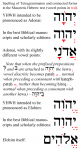
and the vowels for Jehovah, (JeHoVaH) were added by vowel points no earlier than 900 AD.
Y H W H
e o a
YeHoWaH
JeHoVaH
e o a
YeHoWaH
JeHoVaH
Last edited:
He uses the word Jesus to indicate savoir rather than to word Jehovah which means the same attribute of the Lord as our Savior. Jesus denoting savior and Christ the anointing Holy Spirit of God. They are not used differently .Christ uses Jehovah as the same savoir.
Jesus real name is Yahshua/Yahushua, and it means YHWH is Salvation/YHWH's Salvation!
Proverbs 30:4, "Who has ascended into heaven, or descended? Who has gathered the wind in His fists? Who has bound up the waters in His garment? Who has established all the ends of the earth? What is His Name? And what is the Name of His Son? Tell me, if you know!"
יהוה YHWH יהושע Yahshua
Well, my question is - why does the New Testament uses the "Lord" and has never used the word YHWH?
If we agree that the New Testament is inspired by God... why would He allow such error, if it is so important?
YHWH is used a single time in Corinthians, 1 or 2 I don't remember. I'm not sure, but some scholars that acknoledge this singe use believe it was to avoid persecution. I believe this is likely, but also think that since it was their cultural custom they grew up in, as the name was banned before anyone alive at this time was born they were simply used to it also. As the Jewish and Roman people of power would take issue with the use of the name. The Jewish Pharisees killed peple for speaking it hundreds of years before Yahshua/Jesus was born.
Talmud - Mas. Yoma 39b
His brethren [that year]the priests forbore to mention the Ineffable Name (YHWH) in pronouncing the [priestly] blessing.4 Our Rabbis taught: During the last forty years before the destruction of the Temple the lot [‘For the Lord’] did not come up in the right hand; nor did the crimson-coloured strap become white/"
Numbers 6:23-27, "Speak to Aaron and his sons, saying; This is how you are to bless the children of Israyl. Say to them; YHWH BLESS YOU AND KEEP YOU. YHWH MAKE HIS FACE SHINE UPON YOU AND BE MERCIFUL TO YOU. YHWH LIFT UP HIS COUNTENANCE UPON YOU, AND GIVE YOU PEACE. So they will put MY NAME on the children of Israyl, and I will bless them."
His brethren [that year]the priests forbore to mention the Ineffable Name (YHWH) in pronouncing the [priestly] blessing.4 Our Rabbis taught: During the last forty years before the destruction of the Temple the lot [‘For the Lord’] did not come up in the right hand; nor did the crimson-coloured strap become white/"
Numbers 6:23-27, "Speak to Aaron and his sons, saying; This is how you are to bless the children of Israyl. Say to them; YHWH BLESS YOU AND KEEP YOU. YHWH MAKE HIS FACE SHINE UPON YOU AND BE MERCIFUL TO YOU. YHWH LIFT UP HIS COUNTENANCE UPON YOU, AND GIVE YOU PEACE. So they will put MY NAME on the children of Israyl, and I will bless them."
Talmud - Mas. Sanhedrin 56a
THE WHOLE DAY [OF THE TRIAL] THE WITNESSES ARE EXAMINED BY MEANS OF A SUBSTITUTE FOR THE DIVINE NAME, THUS, ‘MAY JOSE SMITE JOSE.’1 WHEN THE TRIAL WAS FINISHED, THE ACCUSED WAS NOT EXECUTED ON THIS EVIDENCE, BUT ALL PERSONS WERE REMOVED [FROM COURT], AND THE CHIEF WITNESS WAS TOLD, ‘STATE LITERALLY WHAT YOU HEARD. THEREUPON HE DID SO, [USING THE DIVINE NAME]. THE JUDGES THEN AROSE AND RENT THEIR GARMENTS, WHICH RENT WAS NOT TO BE RESEWN. THE SECOND WITNESS STATED; I TOO HAVE HEARD THUS’ [BUT NOT UTTERING THE DIVINE NAME], AND THE THIRD SAYS: ‘I TOO HEARD THUS’. GEMARA. It has been taught: [The blasphemer is not punished] unless he ‘blesses’ the Name, by the Name.
THE WHOLE DAY [OF THE TRIAL] THE WITNESSES ARE EXAMINED BY MEANS OF A SUBSTITUTE FOR THE DIVINE NAME, THUS, ‘MAY JOSE SMITE JOSE.’1 WHEN THE TRIAL WAS FINISHED, THE ACCUSED WAS NOT EXECUTED ON THIS EVIDENCE, BUT ALL PERSONS WERE REMOVED [FROM COURT], AND THE CHIEF WITNESS WAS TOLD, ‘STATE LITERALLY WHAT YOU HEARD. THEREUPON HE DID SO, [USING THE DIVINE NAME]. THE JUDGES THEN AROSE AND RENT THEIR GARMENTS, WHICH RENT WAS NOT TO BE RESEWN. THE SECOND WITNESS STATED; I TOO HAVE HEARD THUS’ [BUT NOT UTTERING THE DIVINE NAME], AND THE THIRD SAYS: ‘I TOO HEARD THUS’. GEMARA. It has been taught: [The blasphemer is not punished] unless he ‘blesses’ the Name, by the Name.
"Our Father who are in heavens" seems to be a good identification of the right God, too.
This is how our Lord taught us.
He did say that and I personally love calling Him Father also. But Yahshua/Jesus did also use His name:
Yahchanan (John) 17:6, "I have manifested Your Name to the men that You gave Me out of the world. They were yours, and You gave them to Me; and they have kept Your word."
Yahchanan (John) 5:43, "I have come in My Father's Name, but you do not follow Me. Let another come in his own name; him you will follow."
Mattithyah 23:39, "For I say to you: From this moment you will not see Me, until you say: Blessed is He Who comes in the Name of YHWH!"
I was not asking about the name of Jesus, but why does NT uses the word "Lord" for God when quoting the OT texts. Why not YHWH...
It just seems to me that the apostles/The Holy Spirit did not have any problem with not using YHWH. So why should we?
I agree. We simply have grown up with it not in our translations, so we are used to not using it, by way of Jewish custom....
[FONT=Arial, serif]Psalm 116:13, "[/FONT][FONT=Arial, serif]We will take the cup of salvation, and we will call upon Your Name, O YHWH[/FONT][FONT=Arial, serif]."[/FONT]
[FONT=Arial, serif]Psalm 118:26, "Blessed be He Who comes in the Name of [/FONT][FONT=Arial, serif]YHWH[/FONT][FONT=Arial, serif]!.."[/FONT]
[FONT=Arial, serif]Zephanyah 3:9, "Yes, at that time I will return to the peoples a pure language, so that all of [/FONT][FONT=Arial, serif]them may call on the Name of YHWH, and serve Him with one accord[/FONT][FONT=Arial, serif]."[/FONT]
Last edited:
My bible follows neither, It follows the torah of God.. which started in Genesis, and ended with revelation.
But do most translations really follow YHWH's Instructions, if He commanded His name "not to be made empty" and His name is removed, does that not directly go against His word?
Removing His name is a sin (if you say the Law is done away it "was" a sin at that time):
Exodus 20:7, "You shall not take the name of the LORD your God in vain, for the LORD will not leave him unpunished who takes His name in vain." NASB
The word vain is the Hebrew word shav meaning: emptiness, vanity. Is it possible that removing YHWH's name and replacing it with "the Lord" is making it empty?
Exodus 20:7, ""You shall not take the name of YHWH your God in vain, for YHWH will not hold him guiltless who takes his name in vain." WEB
Exodus 20:7, "You shall not take the Name of YHWH your strength to bring it to nothing, for YHWH will not hold him guiltless who brings it to nothing."
Psalm 199:55, "We remember Your Name in the night, O YHWH, and we keep Your Law."
7723 - shav
shav: emptiness, vanity - Original Word: שָׁוְא - Part of Speech: Noun Masculine - Transliteration: shav - Phonetic Spelling: (shawv) - Short Definition: vain
7723 - shav
NAS Exhaustive Concordance - Word Origin from an unused word - Definition: emptiness, vanity
7723 - shav
Brown-Driver-Briggs שָׁוְא noun [masculine] emptiness, vanity
7723 - shav
Hebrew Word Study (Transliteration-Pronunciation Etymology & Grammar)
1) emptiness, vanity, falsehood - 1a) emptiness, nothingness, vanity - 1b) emptiness of speech, lying - 1c) worthlessness (of conduct)
Psalm 22:22, "I will declare Your Name to My brothers! In the midst of the congregation I will give You praise!"
and it was prophesied:
Yeremyah 23:26-27, "How long will this be in the heart of the prophets who prophesy lies? Yes, they are prophets of the deceit of their own minds; Who devise; plan and scheme, to cause My people to forget My Name through their dreams, which they tell every man to his neighbor, just as their fathers have forgotten My Name for Baal (Lord)."
BAAL (DEITY) [Hebrew - baal] . Canaanite storm and fertility god. The name, which means “lord, ” is an epithet of the god Hadad (lit. “thunderer” ). Well-known from the OT, he is now extremely well-attested in the Ugaritic texts, in addition to being mentioned in other ancient texts. (Freedman, David Noel: The Anchor Bible Dictionary. New York : Doubleday, 1996, c1992, S. 1:546)
BA´AL (ba'al; Heb. baal, “lord, possessor”).
1. A common name for god among the Phoenicians; also the name of their chief male god. See Gods, False.
(Unger, Merrill Frederick ; Harrison, R. K. ; Vos, Howard Frederic ; Barber, Cyril J. ; Unger, Merrill Frederick: The New Unger's Bible Dictionary. Rev. and updated ed. Chicago : Moody Press, 1988)
Baal (Heb. baal) DEITY
The Canaanite storm- and fertility-god. As an epithet for various West Semitic deities, especially Hadad, the name means “lord,” designating a legal state of ownership or social superiority. With the obvious exception of YHWH, Baal is the most significant deity in the OT. (Freedman, David Noel ; Myers, Allen C. ; Beck, Astrid B.: Eerdmans Dictionary of the Bible. Grand Rapids, Mich. : W.B. Eerdmans, 2000)
BAAL [BAY uhl] (lord, master) — the name of one or more false gods, a place, and two people in the Old Testament:
1. A fertility and nature god of the Canaanites and Phoenicians. Also see Gods, Pagan.
(Youngblood, Ronald F. ; Bruce, F. F. ; Harrison, R. K. ; Thomas Nelson Publishers: Nelson's New Illustrated Bible Dictionary. Nashville : T. Nelson, 1995)
Hosheyah 2:16-17, "And it will be in that day, says YHWH: that you will call Me Ishi; (My Husband), and will no longer call Me Baali; (My Lord). For I will take away the names of Baalim (1168 - Ba'al) out of her mouth, and their names will no longer be called upon!"
My bible follows neither, It follows the torah of God.. which started in Genesis, and ended with revelation.
But do most translations really follow YHWH's Instructions, if He commanded His name "not to be made empty" and His name is removed, does that not directly go against His word?
and they readily admit and explin it in the preface:
New English Translation - Preface
"The translation of the Divine Name... This was rendered traditionally as “Jehovah” in the King James Version, but it is generally recognized that this represents a combination of the consonants of the tetragrammaton, YHWH, and the vowels from a completely different Hebrew word, adonai (“master”), which were substituted by the Masoretes so that pronunciation of the Divine Name could be avoided: whenever YHWH appeared in the text, the presence of the vowels from the word adonai signaled to the reader that the word adonai was to be pronounced instead... In spite of this, however, the Committee eventually decided to follow the usage of most English translations and render the Divine Name as “LORD” in small caps. Thus the frequent combination Yahweh elohim is rendered as LORD God...Other combinations like Yahweh Sebaoth, traditionally rendered “Lord of Hosts,” have been translated either as “Sovereign Lord” or “the Lord who leads armies” depending on the context. Such instances are typically indicated by a translator’s note [tn]."
No, it is not.YHWH is used a single time in Corinthians, 1 or 2 I don't remember.
He did say that and I personally love calling Him Father also. But Yahshua/Jesus did also use His name:
Yahchanan (John) 17:6, "I have manifested Your Name to the men that You gave Me out of the world. They were yours, and You gave them to Me; and they have kept Your word."
Yahchanan (John) 5:43, "I have come in My Father's Name, but you do not follow Me. Let another come in his own name; him you will follow."
I dont see any use of YHWH there.
Mattithyah 23:39, "For I say to you: From this moment you will not see Me, until you say: Blessed is He Who comes in the Name of YHWH!"
You wrote it wrong. The right reading is:
"For I tell you, you will not see me again until you say, 'Blessed is he who comes in the name of the Lord.'"
I agree. We simply have grown up with it not in our translations, so we are used to not using it, by way of Jewish custom....
I was not talking about any translation but about the texts the apostles/The Holy Spirit made - The Greek New Testament.
No, it is not.
My fault for not fully explaining. In the konie greek manuscripts (there are many different versions of konie greek ) YHWH is used a single time in 1 or 2 Corinthians.
I dont see any use of YHWH there.
No? Ok, every one sees things from their own perspective, but when he said: "I have manifested Your Name" and "I have come in My Father's Name" I think it's clear, unless He obeyed the Pharisees by not speaking the name, but I doubt that because He broke their Pharisee law while upholding the Laws of the Most High evr chance He got.
Yahchanan (John) 17:6, "I have manifested Your Name to the men that You gave Me out of the world. They were yours, and You gave them to Me; and they have kept Your word."
Yahchanan (John) 5:43, "I have come in My Father's Name, but you do not follow Me. Let another come in his own name; him you will follow."
You wrote it wrong. The right reading is:
"For I tell you, you will not see me again until you say, 'Blessed is he who comes in the name of the Lord.'"
I was not talking about any translation but about the texts the apostles/The Holy Spirit made - The Greek New Testament.
Ohh and there is a copy of Matt in Hebrew that has 2 "correctins" where the greek has 2 erros, but that is too deep for right now. Also there are many New Testament manuscripts in Hebrew at Hebrew uniersity, but since Jews don't believe in Yahshua/Jesus they are not studied, and are packed away amongst 1,000s of manuscripts at thier manuscript library...
Yahshua said this as He marched off the "Temple Mount" (Bayith YHWH/House of YHWH)
Mattithyah 23:39, "For I say to you: From this moment you will not see Me, until you say: Blessed is He Who comes in the Name of YHWH!"
He was quoting this:
Psalm 118:26, "Blessed is He who is coming in the Name of יהוה ! We shall bless you from the House of יהוה”
He was quoting this:
Psalm 118:26, "Blessed is He who is coming in the Name of יהוה ! We shall bless you from the House of יהוה”
E
eternally-gratefull
Guest
This YHWH stuff is what makes people call you a judiaser.
It might be his Hebrew name, Or a name he used to tell moses (who spoke in the hebrew) But he had a name in other languages too. He spoke it to Adam (who most likely did not speak hebrew) and he has a name which is given to the angels (a name we can not understand)
This speaking in Hebrew jiberish is actually quite offensive, and wreaks of judaism,, The NT was written in Hebrew for a reason. It did not use hebrew jiberish for a reason..
If you want to speak to Hebrew speaking people that way, that is fine, But we do not speak hebrew.. so can you do what God would do and honor us by speaking to us in our own language..
It might be his Hebrew name, Or a name he used to tell moses (who spoke in the hebrew) But he had a name in other languages too. He spoke it to Adam (who most likely did not speak hebrew) and he has a name which is given to the angels (a name we can not understand)
This speaking in Hebrew jiberish is actually quite offensive, and wreaks of judaism,, The NT was written in Hebrew for a reason. It did not use hebrew jiberish for a reason..
If you want to speak to Hebrew speaking people that way, that is fine, But we do not speak hebrew.. so can you do what God would do and honor us by speaking to us in our own language..