The issue here is not whether faith & obedience matter, but whether Scripture treats them as the same thing.
You've received two likes from persons that give lip service to obedience but do not believe it's important and, in fact, reject the idea when we get right down to the bottom line.
They believe in faith only....
faith only means that no good deeds are necessary.
(they will, however, reply by saying that they do believe in doing good...it's a conundrum).
But all Jesus taught was doing good deeds.
The issue here IS that FAITH AND OBEDIENCE matter.
Scripture DOES teach them as being exactly the same.
Faith means trusting in the one a person is learing from.
If we trust a person...we will do as they say.
ESPECIALLY if that Person is Jesus...
to whom we entrust our very soul.
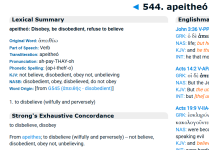
It doesn't. You're blending categories the Bible keeps distinct. Hebrews 3 itself proves this: verse 18 says they failed to enter because of disobedience (apeitheia), while verse 19 says they failed to enter because of unbelief (apistia) 2 different Greek words used side‑by‑side show 2 different categories describing the same event from different angles, not definitional equivalence. Parallel descriptions do not collapse the categories.
Hebrews 3:18-19
18 and to whom did He swear that they shall not enter into His rest, except to those who did not believe? --
19 and we see that they were not able to enter in because of unbelief.
Verse 18 no. 544 Strong's apeitheo'
Verse 19 no. 570 Strong's apistia
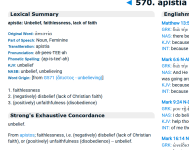
Please explain the difference between apeitheo and apistia.
Throughout the New Testament, faith is consistently treated as the root & obedience as the fruit (Rom 1:5 & Gal 5:6). Paul explicitly separates the 2 when he says salvation is ""to the one who does not work but believes"" (Rom 4:5) & again when he insists salvation is NOT of works (Eph 2:8–9) & NOT by works of righteousness (Titus 3:5).
One is not saved by works.
I don't know any Christian that believes this and this is a strawman argument.
A person must have faith.
A person must obey.
We are discussing Christianity here,,,not atheism.
Abraham believed and was justified.
Abraham always obeyed God...from the moment He heard from God and moved from his home.
If Abraham had not obeyed God,,,his faith would have been useless to God's plan.
His faith would have been a dead faith.
Paul is speaking to persons that had worked for their salvation and did not trust their faith.
The pharisees did not properly teach them.
Jesus said the pharisees put a burden on them...
He did NOT say that the commandments are not to be kept.
Matthew 23:1-6
1 Then Jesus said to the crowds and to his disciples:
2 “The teachers of the law and the Pharisees sit in Moses’ seat.
3 So you must be careful to do everything they tell you. But do not do what they do, for they do not practice what they preach.
4 They tie up heavy, cumbersome loads and put them on other people’s shoulders, but they themselves are not willing to lift a finger to move them.
5 “Everything they do is done for people to see: They make their phylacteries wide and the tassels on their garments long;
6 they love the place of honor at banquets and the most important seats in the synagogues;
Jesus taught that the commandments must be kept,,,but by HIS power:
Matthew 11:28-30
28 “Come to me, all you who are weary and burdened, and I will give you rest.
29 Take my yoke upon you and learn from me, for I am gentle and humble in heart, and you will find rest for your souls.
30 For my yoke is easy and my burden is light.”
However, we are still required to pick up our burden daily:
Matthew 16:24
24 Then Jesus said to his disciples, “Whoever wants to be my disciple must deny themselves and take up their cross and follow me.
To follow Jesus means to obey Jesus.
If faith were obedience, Paul would be contradicting himself in every one of those passages. Likewise, Rom 10:16 shows the order clearly: They did not obey the gospel, for who has believed our report? - unbelief is the cause, disobedience the effect, not the definition & 1 John 3:23 reinforces the distinction by giving 2 separate commands: believe in Christ & love one another.
Who denies that faith comes first?
We must believe in order to love.
There is no contradiction in the NT.
Any contradiction is man-made.
Matthew 22:37-39
37 Jesus replied: “ ‘Love the Lord your God with all your heart and with all your soul and with all your mind.’
38 This is the first and greatest commandment.
39 And the second is like it: ‘Love your neighbor as yourself.’
Thinking that anyone believes they should obey without having faith is a strawman arguement I come across often
on these theads.
Commands do not redefine the nature of the thing commanded, God commands rest, but rest is not a work. God commands faith, but faith is not obedience. God commands love, but love is not faith. The believer's obedience matters deeply (1 Pet 1:14 & 1 Jn 5:3), but it flows from faith, not into it. When you reverse the order, you turn the fruit into the root & end up redefining the gospel itself.
Again...
WHO is reversing the order?
Believing and obeying are tied together.
They cannot be separated.
If one believes...he trusts....he obeys.
If that order breaks it means the person does not believe.
A person that does not believe cannot be saved.



