Loss of salvation???

  • Christian Chat is a moderated online Christian community allowing Christians around the world to fellowship with each other in real time chat via webcam, voice, and text, with the Christian Chat app. You can also start or participate in a Bible-based discussion here in the Christian Chat Forums, where members can also share with each other their own videos, pictures, or favorite Christian music.

    If you are a Christian and need encouragement and fellowship, we're here for you! If you are not a Christian but interested in knowing more about Jesus our Lord, you're also welcome! Want to know what the Bible says, and how you can apply it to your life? Join us!

    To make new Christian friends now around the world, click here to join Christian Chat.
Some notes from the NET Bible Translators re: "obedience [of] faith" - they're discussing the different ways the ["of"] can be translated - their is no word "of" in the Greek here - it's a catch-all translation of the specific grammar/wording:

NET Notes (Rom 1:5)

12 tn Grk "through whom."
13 tn Some interpreters understand the phrase "grace and apostleship" as a hendiadys, translating "grace [i.e., gift] of apostleship." The pronoun "our" is supplied in the translation to clarify the sense of the statement.
14 tn Grk "and apostleship for obedience."
15 tn The phrase ὒπακοὴν πίστεως has been variously understood as (1) an objective genitive (a reference to the Christian faith, "obedience to [the] faith"); (2) a subjective genitive ("the obedience faith produces [or requires]"); (3) an attributive genitive ("believing obedience"); or (4) as a genitive of apposition ("obedience, [namely] faith") in which "faith" further defines "obedience." These options are discussed by C. E. B. Cranfield, Romans (ICC), 1:66. Others take the phrase as deliberately ambiguous; see D. B. Garlington, "The Obedience of Faith in the Letter to the Romans: Part I: The Meaning of ὒπακοὴ πίστεως (Rom 1:5; 16:26)," WTJ 52 (1990): 201-24.
You've appealed to a list of theoretical genitive categories, but Paul's actual usage eliminates your interpretation. Romans 10:16 is the controlling text because Paul uses the same 2 nouns OBEY (ὑπακούω) & BELIEVE (πιστεύω) & he treats them as cause & effect, not as identical. He explains disobedience by unbelief: They did not obey the gospel... for Isaiah says, Who has believed our report?

If your reading of Romans 1:5 & 16:26 were correct (obedience = faith), then Paul would be saying, they DID NOT OBEY because DID NOT OBEY, which is absurd. But Paul actually says, They DID NOT OBEY because they DID NOT BELIEVE. That distinction destroys the appositional reading & confirms that ""obedience of faith"" means obedience produced by faith. If you insist that obedience is faith, then you must also accept the consequence that faith is a work & salvation is by obedience - directly contradicting Paul in Rom 3–5, Gal 2–3, Eph 2 & Titus 3. So 2 options: either keep Paul consistent - faith produces obedience or claim Paul contradicts himself. Collapse the categories make's Paul consistent position incoherent.
 
post 2 of 2


Who said belief is a work but calvinists?

Paul clearly taught that faith is NOT a work.
Faith is a gift.

Ephesians 2:8
8 For by grace you have been saved through faith; and that not of yourselves, it is the gift of God;

Faith is by grace and not by works....either of The Law OR good deeds:

Romans 11:6
6 But if it is by grace, it is no longer on the basis of works, otherwise grace is no longer grace.


Obedience is not a work.
If this is what you believe,,,then everything is a work.
Is baptism a work?
If believing a work?
Is loving your neighbor a work?


Are we conflating obedience with faith?

God does not consider obedience to Him to be this WORK we here on these forums discuss.
God must be obeyed....
if it's a work...so be it....

works are not filthy...they are what God demands from us.

Good deeds are taught by all the writers, to say nothing of the fact that this is all Jesus taught.


1. Unbelief = disobedience.
2. Disobedience = unbelief.

The two are inexorably intertwined.

1. If a person is an unbeliever,,,he is disobedient to the gospel...you showed this with your very own verse: Romans 10:16
The gospel must be obeyed to become effectual.

2. If a person is a believer but disobeys constantly...he becomes an unbeliever again because he is not following the teachings of jesus.


1 John 3:18.24
18 Little children, let us not love with word or with tongue, but in deed and truth.
19 We will know by this that we are of the truth, and will assure our heart before Him
20 in whatever * * our heart condemns us; for God is greater than our heart and knows all things.
21 Beloved, if our heart does not condemn us, we have confidence before God;
22 and whatever * we ask we receive from Him, because we keep His commandments and do the things that are pleasing in His sight.
23 This is His commandment, that we believe in the name of His Son Jesus Christ, and love one another, just as He commanded * us.
24 The one who keeps His commandments abides in Him, and He in him. We know by this that He abides in us, by the Spirit whom He has given us.

A person who has FAITH IN JESUS...
will DO as Jesus commanded.
He will practice obedience.


Faith does not always produce obedience.

It's obvious on this very thread that some do not obey and yet believe they have faith in God.

Faith and obedience cannot be separated or the teachings of Jesus will fail.


1 Peter 1:4 He is speaking to believers
4As obedient children, do not be conformed to the passions of your former ignorance,

Those with faith must be obedient.


1 John 5:3
3For this is the love of God, that we keep his commandments. And his commandments are not burdensome.


That WE keep His commandments.


Unbelievers are not required to obey God.
Believers are required to obey God.
The issue here is not whether faith & obedience matter, but whether Scripture treats them as the same thing. It doesn't. You're blending categories the Bible keeps distinct. Hebrews 3 itself proves this: verse 18 says they failed to enter because of disobedience (apeitheia), while verse 19 says they failed to enter because of unbelief (apistia) 2 different Greek words used side‑by‑side show 2 different categories describing the same event from different angles, not definitional equivalence. Parallel descriptions do not collapse the categories.

Throughout the New Testament, faith is consistently treated as the root & obedience as the fruit (Rom 1:5 & Gal 5:6). Paul explicitly separates the 2 when he says salvation is ""to the one who does not work but believes"" (Rom 4:5) & again when he insists salvation is NOT of works (Eph 2:8–9) & NOT by works of righteousness (Titus 3:5).

If faith were obedience, Paul would be contradicting himself in every one of those passages. Likewise, Rom 10:16 shows the order clearly: They did not obey the gospel, for who has believed our report? - unbelief is the cause, disobedience the effect, not the definition & 1 John 3:23 reinforces the distinction by giving 2 separate commands: believe in Christ & love one another.

Commands do not redefine the nature of the thing commanded, God commands rest, but rest is not a work. God commands faith, but faith is not obedience. God commands love, but love is not faith. The believer's obedience matters deeply (1 Pet 1:14 & 1 Jn 5:3), but it flows from faith, not into it. When you reverse the order, you turn the fruit into the root & end up redefining the gospel itself.
 
I agree.

So,,, since we agree,
are you comfortable stating that we must obey God after we're saved?

Or does that go too far for you?

Do you think God requires obedience or do you think He just suggests it?

You did make several statements that are confusing....if you care to clarify:

You said that faith produces obedience.
THEN
you said that the verdict at justificaiton changes the believer's status before God but not their internal moral condition.
THEN
you said the Holy Spirit indwells the believer & sets them apart for a lifelong work of moral & spiritual transformation.


So, if I've understood:
We are saved at justification
but then we do have to move on to sanctification.
As an end result the internal moral condition must be changed/there must be a transformation.

Since this thread is about loss of salvation...
would you say that this transformation must take place?
What if it does NOT?

If the person does not act on the words of Jesus...
and the winds come...
does his house fall?

Matthew 7:26-27

26 "Everyone who hears these words of Mine and does not act on them, will be like a foolish man who built his house on the sand.
27 "The rain fell, and the floods came, and the winds blew and slammed against that house; and it fell -and great was its fall."
The reason your system ends in you can LOSE salvation if you don't obey enough is because you're mixing law that demands with grace that supplies. Paul says the law increases sin, not obedience (Rom 5:20) & where sin increases, grace doesn’t shrink. It super‑abounds! That alone destroys the idea that insufficient obedience can overthrow salvation.

Paul gives the clearest example in 1 Cor 3:15: the believer whose entire life's work burns up, who produces no lasting obedience, no enduring fruit, no visible perseverance & Paul still says, ""he himself will be saved."" That's because obedience belongs to sanctification, not justification.

Grace saves, grace keeps, grace finishes. The house in Matt 7 falls because it had no foundation, not because the saved man didn't obey enough. When you mix law & grace, you end up with a salvation that depends on human performance. When you keep Paul's categories, you end up with a salvation that depends on faith alone in Christ alone.
 
Not only that
BUT
Not even everyone that actually HEARS the word will be saved.

However, faith does come by hearing the word...IF it is accepted.

The other member makes is sound as if just hearing the word will save someone.
Frankly, I don't understand what he's saying and he wasn't willing to explain properly.
He maybe an OSAS believer? They only believe a part of Scripture.
 
Yes, as if saved by fire:

2 Timothy 2:11-13
11 It is a faithful saying: For if we be dead with him, we shall also live with him:
12 If we suffer, we shall also reign with him: if we deny him, he also will deny us:
13 If we believe not, yet he abideth faithful: he cannot deny himself.

Some eisegetically transplant/inject "salvation" into that denial of Christ, presuming they have license to do so on whatever basis they point out as being their justification for such an interpretation.

What they fail to realize is that Holy Spirit, having been given as "earnest" for salvation once given, they therefore ignore what Paul said in the above quote in that it would be Christ denying even Himself on the basis of forfeiting Holy Spirit, which is absolutely not ever going to happen.

2 Corinthians 1:22
Who hath also sealed us, and given the earnest of the Spirit in our hearts.

Where it may seem counterintuitive that one could trapse into the arena of disbelief at a later time after salvation and still be saved, to say that Christ then forfeits Holy Spirit leading to self-denial...no. That one can be saved as if by fire after having sinned by whatever means, be it even denial, they are then building with hay, wood and stubble that will indeed burn. That some will show up in Heaven with absolutely no other reward, that will also be a form of suffering in Heaven:

1 Corinthians 3:15
If any man's work shall be burned, he shall suffer loss: but he himself shall be saved; yet so as by fire.

Suffering, even in Heaven, will therefore indeed be a reality for some as a price to pay for disloyalties through sin, even to the extent of "atheism," that seems to trigger doctrinal aneurisms for some out there who try promoting themselves as authorities over the word of God to the extent of adding whatever whim they feel license to add therein.

That some find it so hard to believe one can still be saved in disbelief after initial salvation, that seems to speak of a personal problem, perhaps pride and/or some other insidious flaw in character and/or beliefs; perhaps rooted in some warped, works-based system of supposed salvation some religions and groupings tend to gravitate into with appeals to the Law and/or misguided hermeneutics that are failures to rightly divide the word of truth.

MM
I see a few problems with your interpretation of those scriptures.

2 Timothy 2:11-13
11 It is a faithful saying: For if we be dead with him, we shall also live with him:
12 If we suffer, we shall also reign with him: if we deny him, he also will deny us:
13 If we believe not, yet he abideth faithful: he cannot deny himself.

v 12 says that "if we deny Him, He will also deny us" - and this agrees with what Jesus said directly Himself to his disciples.

Mat 10:33
But whosoever shall deny me before men, him will I also deny before my Father which is in heaven.
Luk 12:9
But he that denieth me before men shall be denied before the angels of God.

You are then negating verse 12 and claiming that Jesus denying someone who has been given the earnest of the Holy Spirit would be Jesus denying Himself. However, if Jesus has stated to His disciples that He would deny before His Father and the angels those who abandon him, then Jesus reversing that word at the judgment and not denying once-upon-a-time reneging believers would amount to Him denying Himself.

The arrabona was a down-payment promising to pay the rest at the settlement date. Bu bit was not an unbreakable commitment. If the buyer or the seller reneged on the terms of the sale, the aggrieved party could refuse to go throug with the transfer and penalise the unfaithful party.

Google AI -
In extra-biblical literature and historical records, an arrabona (arrhabōn) established a contract that was legally binding but not necessarily "unbreakable" in the modern sense; rather, it defined the severe financial penalties for breaking it.
Evidence from Hellenistic papyri and ancient Greek legal customs reveals how this "earnest money" functioned as a mechanism for contract enforcement:

1. Legal Function in Trade
In the marketplace, the arrabona served as a technical business term for a guaranteed purchase. Once the deposit was exchanged, the buyer was legally committed to the transaction. If the buyer failed to complete the payment, they forfeited the deposit entirely.

2. Penalties for the Seller
Extra-biblical sources indicate that the contract placed obligations on the seller as well. If a seller backed out after receiving an arrabona, they were often legally required to pay back double the amount to the buyer. This "double repayment" (known as diplous) acted as a deterrent, making the contract functionally "unbreakable" for those who could not afford the penalty.
www.austriaca.atwww.austriaca.at

God would not "forfeit the Holy Spirit" if He backed out at the first resurrection from completing the deal with a deserting disciple. The penalty for the seller who withholds the contracted possession is to pay back the arrabona and as much again. That would be the deserter forfeiting the Holy Spirit and his own spirit.

Your last two paragraphs may be you projecting your own Yungian shadow onto others.
 
  • Like
  • Love
Reactions: studier and Toknow
Unbelievers by definition do not possess faith. If faith is obedience, unbelievers do not obey. So the command to believe is impossible, by your own reasoning, by anyone but a believer.

Further, without faith, it is impossible to please God. Thus, no unbeliever pleases God. Does obedience please God?
A person can believe aiding the poor is a good thing and give to the poor without being a believer in Christ.And God is pleased with this conscience-driven alms-giving, Cornelius in Acts being an example.

Everyone has faith. The problem is that most choose foolish objects for their faith.
 
An unbeliever doesn't believe. No unbeliever has ever believed. Believers believe. Unbelievers need to become believers.
Your statements are riddled with equivocations.

A. "An unbeliever doesn't believe". Do you mean,
1. "An unbeliever is someone who is not presently believing"? Or,
2. "An unbeliever is someone who will never believe"? Or,
3. "An unbeliever is someone who has not believed yet"?

B. "No unbeliever has ever believed."
If you mean 1 above, this is not true.
If you mean 2 above, this is not true.
If you mean 3 above, this is not true.

C. "Believers believe." Do you mean
4. "Believers are people who are presently believing? Or,
5. "Believers are people who are always believing"? Or,
6. "Believers are people who will eventually believe?

D. "Unbelievers need to become believers."
If you mean 4 above, this is true.
If you mean 5 above, this assumes a believer cannot stop believing, which does not match reality.
If you mean 6 above, this conflicts with 2 and 3 above.

So, it seems that you could only possibly believe 1 above, i.e. "An unbeliever is someone who is not presently believing."
Your statement, "No unbeliever has ever believed," is unsound, as people can stop believing.
You believe 4 above, i.e. "Believers are people who are presently believing?
You believe unbelievers are presently believing and need to become those who are presently believing.

5 conflicts with D.
6. Conflicts with 1.

So, by precess of elimination, you must believe that -
"An unbeliever is someone who is not presently believing."
"Believers are people who are presently believing". And,
"Unbelievers are presently not believing and need to become those who are presently believing."

In which case, we agree. Those who are putting their faith in unprofitable objects instead of in Christ need to choose to make Christ the object of their faith.
 
  • Like
  • Love
Reactions: studier and Toknow
You've appealed to a list of theoretical genitive categories, but Paul's actual usage eliminates your interpretation. Romans 10:16 is the controlling text because Paul uses the same 2 nouns OBEY (ὑπακούω) & BELIEVE (πιστεύω) & he treats them as cause & effect, not as identical. He explains disobedience by unbelief: They did not obey the gospel... for Isaiah says, Who has believed our report?

If your reading of Romans 1:5 & 16:26 were correct (obedience = faith), then Paul would be saying, they DID NOT OBEY because DID NOT OBEY, which is absurd. But Paul actually says, They DID NOT OBEY because they DID NOT BELIEVE. That distinction destroys the appositional reading & confirms that ""obedience of faith"" means obedience produced by faith. If you insist that obedience is faith, then you must also accept the consequence that faith is a work & salvation is by obedience - directly contradicting Paul in Rom 3–5, Gal 2–3, Eph 2 & Titus 3. So 2 options: either keep Paul consistent - faith produces obedience or claim Paul contradicts himself. Collapse the categories make's Paul consistent position incoherent.

You’ve simply eisegeted a cause‑and‑effect into Rom10:16 that isn’t there. The two clauses are joined by the explanatory gar, not any wording that means “because.” Paul uses “believe” to explain “obey,” not “obey because believe.”

All you’ve done is take your preferred reading of “obedience [of] faith” and read it back into Rom10:16. But the cause‑effect structure you need simply isn’t in the language of Rom10:16.

Rom10:16 actually shows lexical equivalence between believing and obeying - Paul treats them as parallel expressions. That’s why “obedience [of] faith” naturally reads as “obedience which is faith,” - faith/obedience. Paul explains the ambiguous phrase himself.
 
You’ve simply eisegeted a cause‑and‑effect into Rom10:16 that isn’t there. The two clauses are joined by the explanatory gar, not any wording that means “because.” Paul uses “believe” to explain “obey,” not “obey because believe.”

All you’ve done is take your preferred reading of “obedience [of] faith” and read it back into Rom10:16. But the cause‑effect structure you need simply isn’t in the language of Rom10:16.

Rom10:16 actually shows lexical equivalence between believing and obeying - Paul treats them as parallel expressions. That’s why “obedience [of] faith” naturally reads as “obedience which is faith,” - faith/obedience. Paul explains the ambiguous phrase himself.
I agree. Having living faith is having a faith that is living. And to be living faith, the faith must be sufficient to move the living body, the living soul, to behave commensurate to what is professed to be one's belief. One can be persuaded to be 40% in agreement with a biblical statement, but harbour 60% of conflicting opinions and fear of the consequences of acting commensurately. The result is that one does not act on what one feels could be true, and what one publicly or mentally professes to believe is true because one' knows one's religious peers require that profession, but one still does not act in accordance with that profession. And acting in accordance with the profession is obedience and the fruit of faith. Acting contrary to the profession is disobedience and the fruit of unbelief
 
  • Like
Reactions: Toknow
We are not God and we do not command Him. He commands us.

When we believe/obey Him and willingly do what He wills in faith, we can be found to be faithful.

She can correct me, but I think I see @Toknow speaking about the overlap where all works that are based in faith/obedience as judged by God, are faithful acts. What I mentioned before is that being a faithful person is in consistency over time in faith/obedience.

Jesus is called faithful. In Heb2:17 there is experiential time in a past tense ongoing tense in order for Him to become a faithful High Priest. This speaks of a process lived before being deemed faithful.

Jesus learned obedience through what He suffered. He always did what He saw the Father do and said what He heard the Father say. In the end He said nevertheless Your will be done.

This is why I mentioned that though there is overlap with faith/obedience, I see faithfulness as being a more developed trait. In one sense it means trustworthy - someone and/or something whose trustworthiness is proven. For us that's doing what God says - For God it's God doing what He says.
When faith is used as an adjective, πιστὸς it conveys the idea of "trust." Luke 16:10
 
Agreed that there is overlap, but I'm thinking faithfulness is mostly developed by functioning in faith-obedience.

In this thinking, for example, Paul bookends Romans with his mission to bring the nations to faith-obedience (Rom1:5; Rom16:26) and he states how Christ accomplished through him for obedience of Gentiles in word and work (Rom15:18).

He interestingly as far as I've seen doesn't bring up faithfulness which he easily could have in light of this bookended faith-obedience.

When I think through the faith-obedience it logically seems to end up in faithfulness but I like to see the actual connections in the Text and am cautious when it's not used. It may well be connected via other writings. It's been quite a while since I looked at all of this.
The gospel demands a response and so when someone hears the gospel and believes it, they are obeying the gospel. This idea isn't about keeping the rules. It's about accepting and agreeing with the truth.
 
  • Like
Reactions: mailmandan
The gospel demands a response and so when someone hears the gospel and believes it, they are obeying the gospel. This idea isn't about keeping the rules. It's about accepting and agreeing with the truth.
Are we not told the commandments of God are truth?

Psa119:151
You are near, O Lord,
And all Your commandments are truth.

Psa 119:142 Your righteousness is an everlasting righteousness,
And Your law is truth.

Psa 119:172 My tongue shall speak of Your word,
For all Your commandments are righteousness.

The Ten Commandments was written by the Holy Spirit of Truth Exo31:18 so how can we separate Truth from what God asks us to do if we love Him Exo20:6 John14:15 because they are Truth according to God.
 
The gospel demands a response and so when someone hears the gospel and believes it, they are obeying the gospel. This idea isn't about keeping the rules. It's about accepting and agreeing with the truth.
Amen! Romans 10:16 - But they have not all obeyed the gospel. For Isaiah says, “Lord, who has believed our report?”

We obey the gospel by choosing to believe the gospel. Not to be confused with multiple acts of obedience/works which "follow" choosing to believe the gospel.

The gospel is the "good news" of the death, burial and resurrection of Jesus Christ (1 Corinthians 15:1-4) and is the power of God unto salvation to everyone that BELIEVES.. (Romans 1:16) To "believe" the gospel is to trust in the death, burial and resurrection of Christ as the ALL-sufficient means of our salvation. ✝️

The gospel is a message of grace that is to be received through faith. The gospel is not a set of rituals to perform, a code of laws to be obeyed or a check list of good works to accomplish as a prerequisite for salvation.

The gospel is hid to those who DO NOT BELIEVE. (2 Corinthians 4:3,4)
 
If we are not obeying God by default we are not obeying the everlasting gospel. Rev14:6-7

John 3: 36 Whoever believes in the Son has eternal life; whoever does not obey the Son shall not see life, but the wrath of God remains on him.

Heb 5: 8 ;though He was a Son, yet He learned obedience by the things which He suffered. 9;And having been perfected, He became the author of eternal salvation to all who obey Him,

Sadly why this is even a debate as if faith would lead anyone in rebellion to God and what He asks we can be saved in our sins when we are plainly told we are not Mat1:21 Pro28:13 Heb10:26-30 Mat5:19-30
 
Faithfulness isn't about me being obedient to someone; faithfulness is about me keeping my word to someone -- doing what we promised. God is faithful and he doesn't obey anyone.
What you've posted is a good definition of faithfulness as derived from Webster's Dictionary.

It is not how faithfulness is understood in biblical terms.

God is faithful to Himself.

2 Timothy 2:13
13 If we are faithless, He remains faithful, for He cannot * deny Himself.


God is faithful....this is about keeping His word, His promises.
Nothing to do with obedience.
Correct.


But are we as Jesus followers also to be faithful?
In this case obedience is being faithful.

We are faithful to God....in keeping HIS commandments.
Keeping the commandments IS faithfulness.

Luke 16:10
10 "He who is
faithful in a very little thing is faithful also in much; and he who is unrighteous in a very little thing is unrighteous also in much.


1 corinthians 4:2
2 Now it is required that those who have been given a trust must prove faithful.


Revelation 2:10
10Do not fear what you are about to suffer. Behold, the devil is about to throw some of you into prison, that you may be tested, and for ten days you will have tribulation. Be faithful unto death, and I will give you the crown of life.


Proverbs 3:4
4Let not steadfast love and faithfulness forsake you; bind them around your neck; write them on the tablet of your heart. So you will find favor and good success in the sight of God and man.


Faithfulness, for the believer, is about obedience.
It's about being obedient to God...
This is how we can be faithful.

How else could a person be faithful towards God?
 
  • Like
Reactions: studier
The gospel demands a response and so when someone hears the gospel and believes it, they are obeying the gospel. This idea isn't about keeping the rules. It's about accepting and agreeing with the truth.
Everything about Christianity is about accepting and agreeing to the rules.

If we agree to the rules....
it also means we will keep the rules.

Do YOU accept a condition you know full well you will not be keeping??

How much more severe if we trample underfoot the Son of God?
 
We are not God and we do not command Him. He commands us.

When we believe/obey Him and willingly do what He wills in faith, we can be found to be faithful.

She can correct me, but I think I see @Toknow speaking about the overlap where all works that are based in faith/obedience as judged by God, are faithful acts. What I mentioned before is that being a faithful person is in consistency over time in faith/obedience.

Jesus is called faithful. In Heb2:17 there is experiential time in a past tense ongoing tense in order for Him to become a faithful High Priest. This speaks of a process lived before being deemed faithful.

Jesus learned obedience through what He suffered. He always did what He saw the Father do and said what He heard the Father say. In the end He said nevertheless Your will be done.

This is why I mentioned that though there is overlap with faith/obedience, I see faithfulness as being a more developed trait. In one sense it means trustworthy - someone and/or something whose trustworthiness is proven. For us that's doing what God says - For God it's God doing what He says.
Yes sir.

See here,,,post 10,495 .....


You’ve simply eisegeted a cause‑and‑effect into Rom10:16 that isn’t there. The two clauses are joined by the explanatory gar, not any wording that means “because.” Paul uses “believe” to explain “obey,” not “obey because believe.”

All you’ve done is take your preferred reading of “obedience [of] faith” and read it back into Rom10:16. But the cause‑effect structure you need simply isn’t in the language of Rom10:16.

Rom10:16 actually shows lexical equivalence between believing and obeying - Paul treats them as parallel expressions. That’s why “obedience [of] faith” naturally reads as “obedience which is faith,” - faith/obedience. Paul explains the ambiguous phrase himself.
Sin has dominion over a person until faith & the indwelling Holy Spirit sanctifying work, not until obedience.

Acts 11:18 says God GRANTED the Gentiles repentance unto life, the Holy Spirit is the GRANT, the GIFT, not a human achievement & 1 Jn 1:8 makes it clear that anyone who thinks they can conquer their sin nature by obedience is deceiving themselves. Obedience doesn't break sin’s power, the Holy Spirit does. Faith doesn't flow from obedience, obedience flows from faith. Until God GRANTS repentance & indwells a person with His Spirit, sin reigns. After He GRANTS repentance & indwells them, sin's dominion is broken & not because they obeyed their way out of bondage, but because God GRANTED them freedom. Any system that makes obedience the key to conquering sin or keeping salvation is simply replacing grace with law & divine GIFT with human effort.

Your reading of Paul collapses at the Greek level. If Paul meant ""obedience is faith,"" he wouldn't use 2 different nouns in a genitive construction - ὑπακοή (obedience) & πίστις (faith). The grammar itself requires a source‑result relationship, making ""obedience that comes from faith"" the only reading that doesn't force Paul to contradict his own gospel

The NIV translators make it clear: ""the obedience that comes from faith."" If obedience comes from faith, then obedience is not faith. Paul keeps the categories distinct. Faith is the source & obedience is the result. Your interpretation requires them to be identical, but Paul & the major translations do not support that.

Faith is the root - Obedience is the fruit. Faith is the cause - Obedience is the effect. Faith is the source - Obedience is the result.
 
Not only do we go beyond what Jesus said...
we like to change what He said to suit our own needs or beliefs.

Would you care to expound?
Because it's a question that begs for hard lines to not cross....and instead of fulfilling the desire of being able to put a label on specific actions it puts the question on your real identity of who you are and who you really want to be.

Specific actions doesn't necessarily expose people's selfish desires....AKA their heart....but identity does. And self made "leaders" do not want to be exposed for who they really are.

CIP is two missionaries from the USA.
One was indeed the first missionary but unheralded and one was highly touted to be America's first missionary.
George Lyle was God's CHOSEN first missionary but Adoniram Judson was given that honor among men.
Their success rates are the tell. George (native born in America) was highly successful in America in converting and church planting until he had to escape the Colonials who wished to enslave him and his family. (George had never been a slave) He got a ride with escaping British soldiers who put him off in Jamaica where he founded over 11,000 churches. Judson went to India where he failed miserably after 20 years of trying and losing his wife and children to illnesses. He finally returned with one half converted Hindu man. However, he had several churches and missionary programs named after him.

Today, nobody really talks a lot about George Lyle or his family much out of embarrassment in America....but he truly was Chosen by God to do great things.

Judson? Heralded by millions of people over the past 250 years and mostly a failure on many counts. Judson was always a believer in God but what was termed a "Deist" as he subscribed to no particular denomination. He was preached at until he converted to becoming a Virginia Baptist and ultimately became their first missionary sent abroad.

George? Came out of nowhere and was instantly successful. Always under persecution.

Judson? Completely contrived and formally taught. Heralded from the moment of his conversion by his peers.

Judson was "called"
Lyle was "Chosen"

People don't like the reality-based understanding because it's too revealing. Pointing to which side of an egg you crack first before you eat it is a much more simple way of pointing out who is possibly the worst sinner amongst us. Nevermind the worthlessness of such a thing.
 
The issue here is not whether faith & obedience matter, but whether Scripture treats them as the same thing.

You've received two likes from persons that give lip service to obedience but do not believe it's important and, in fact, reject the idea when we get right down to the bottom line.

They believe in faith only....
faith only means that no good deeds are necessary.
(they will, however, reply by saying that they do believe in doing good...it's a conundrum).

But all Jesus taught was doing good deeds.

The issue here IS that FAITH AND OBEDIENCE matter.

Scripture DOES teach them as being exactly the same.

Faith means trusting in the one a person is learing from.
If we trust a person...we will do as they say.

ESPECIALLY if that Person is Jesus...
to whom we entrust our very soul.


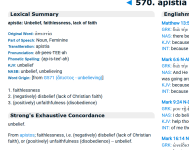
It doesn't. You're blending categories the Bible keeps distinct. Hebrews 3 itself proves this: verse 18 says they failed to enter because of disobedience (apeitheia), while verse 19 says they failed to enter because of unbelief (apistia) 2 different Greek words used side‑by‑side show 2 different categories describing the same event from different angles, not definitional equivalence. Parallel descriptions do not collapse the categories.

Hebrews 3:18-19
18 and to whom did He swear that they shall not enter into His rest, except to those who did not believe? --
19 and we see that they were not able to enter in because of unbelief.


Verse 18 no. 544 Strong's apeitheo'
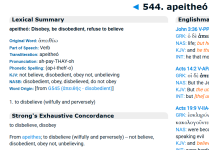
1774875145890.png


Verse 19 no. 570 Strong's apistia

1774875334633.png


Please explain the difference between apeitheo and apistia.

Throughout the New Testament, faith is consistently treated as the root & obedience as the fruit (Rom 1:5 & Gal 5:6). Paul explicitly separates the 2 when he says salvation is ""to the one who does not work but believes"" (Rom 4:5) & again when he insists salvation is NOT of works (Eph 2:8–9) & NOT by works of righteousness (Titus 3:5).
One is not saved by works.
I don't know any Christian that believes this and this is a strawman argument.

A person must have faith.
A person must obey.

We are discussing Christianity here,,,not atheism.

Abraham believed and was justified.
Abraham always obeyed God...from the moment He heard from God and moved from his home.

If Abraham had not obeyed God,,,his faith would have been useless to God's plan.
His faith would have been a dead faith.

Paul is speaking to persons that had worked for their salvation and did not trust their faith.
The pharisees did not properly teach them.
Jesus said the pharisees put a burden on them...
He did NOT say that the commandments are not to be kept.


Matthew 23:1-6
1 Then Jesus said to the crowds and to his disciples:
2 “The teachers of the law and the Pharisees sit in Moses’ seat.
3 So you must be careful to do everything they tell you. But do not do what they do, for they do not practice what they preach.
4 They tie up heavy, cumbersome loads and put them on other people’s shoulders, but they themselves are not willing to lift a finger to move them.
5 “Everything they do is done for people to see: They make their phylacteries wide and the tassels on their garments long;
6 they love the place of honor at banquets and the most important seats in the synagogues;


Jesus taught that the commandments must be kept,,,but by HIS power:

Matthew 11:28-30
28 “Come to me, all you who are weary and burdened, and I will give you rest.
29 Take my yoke upon you and learn from me, for I am gentle and humble in heart, and you will find rest for your souls.
30 For my yoke is easy and my burden is light.”


However, we are still required to pick up our burden daily:


Matthew 16:24
24 Then Jesus said to his disciples, “Whoever wants to be my disciple must deny themselves and take up their cross and follow me.


To follow Jesus means to obey Jesus.


If faith were obedience, Paul would be contradicting himself in every one of those passages. Likewise, Rom 10:16 shows the order clearly: They did not obey the gospel, for who has believed our report? - unbelief is the cause, disobedience the effect, not the definition & 1 John 3:23 reinforces the distinction by giving 2 separate commands: believe in Christ & love one another.
Who denies that faith comes first?
We must believe in order to love.

There is no contradiction in the NT.
Any contradiction is man-made.

Matthew 22:37-39
37 Jesus replied: “ ‘Love the Lord your God with all your heart and with all your soul and with all your mind.’
38 This is the first and greatest commandment.
39 And the second is like it: ‘Love your neighbor as yourself.’


Thinking that anyone believes they should obey without having faith is a strawman arguement I come across often
on these theads.


Commands do not redefine the nature of the thing commanded, God commands rest, but rest is not a work. God commands faith, but faith is not obedience. God commands love, but love is not faith. The believer's obedience matters deeply (1 Pet 1:14 & 1 Jn 5:3), but it flows from faith, not into it. When you reverse the order, you turn the fruit into the root & end up redefining the gospel itself.
Again...
WHO is reversing the order?

Believing and obeying are tied together.

They cannot be separated.

If one believes...he trusts....he obeys.

If that order breaks it means the person does not believe.
A person that does not believe cannot be saved.

 
  • Like
Reactions: studier