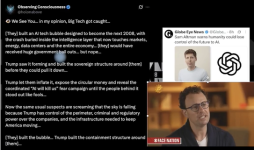
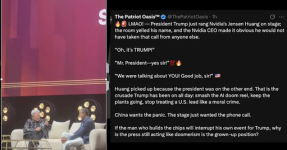
Lol, it must be nice going thru life blissfullyNot a huge fan of a strategy that relies entirely on mass-defection; but if nothing else, maybe it at least keeps the IRGC paranoid.
I know exactly what the risks are; our government is going to blow bajillions of dollars on weapons that are retardedly expensive and largely unnecessary, and completely ignore and alienate the population; while the fear of China turns the US into China.
Neither China or Russia are actually on course to out-tech the United States.
What we actually need advanced AI for is sustainable fusion reactors; but there's not even a guarantee that AI can find the materials solutions we need; because they may not even exist.
You might as well try and say we need a moon-base with moon-trains, or the terrorists win. That's basically what you're saying.
 believing that you know everything, when in actuality you don’t even know what you don’t know…
You might be right in general, but it remains debatable as the do have their advantages – see below…
lol, speaking of things that are affected by intellectual disability : intellectually disabled... your use of Flawed Logic and reasoning is consistently aligned with Fallacies of Logic!~ in this case Your Terrorists Moon analogy argument is both a Strawman and Red Herring Fallacy of Logic!
Lol, HOWEVER, the context of my perspective is based upon Military Use and Applications of AI… As I am a Warfighter, Analysts, Planner and Strategist...
Lol, have you ever been to China? Besides having been to Hong Kong a few times, I was the CO of Troops on the first Amphibious Vessel that ported in Shanghai in decades back in the 90s… We hosted their military for tours and dog and pony displays on the flight deck and well deck of our equipment. Lol, they would put their scientists and engineers in uniforms and send them to blend in within their troops so that that could re-tour our amphibious ship and assault vehicles over and over… sure enough, they were able to replicate our amphibious assault vehicles years later…
Have you ever been to a Military Operations Research Symposium Special Session on AI with Experts on China and Russia? Well I have… like I said, this is one of my areas of expertise…
The difference between our approach and our Pacing Threat is that we are inclined to play by the rules of humanity to ensure the requisite checks and balances and guardrails – they are NOT… They are more willing to accept RISK, where we ARE NOT…
They have already infiltrated our Data in more ways than most can imagine, as demonstrated via the Declass Election Interference Data… Therefore, they have the means to plant Trojan Horses within our Data Sources…
Lol, it’s evident that you ONLY have access to Unclassified and Open Sources of materials from questionable sources. I have access to all levels of Department threat assessments that drive our current and future Defense Plans…
Here’s just a small sampling of information that debunks your flawed assumptions about their abilities…
Here is a summary of Chinese students attending US universities and their return/stay patterns.
1. Annual Numbers of Chinese Students in the US (Enrollment)
The number of Chinese students in the US grew dramatically from the early 2000s until peaking around 2018–2019, then declined due to COVID-19, geopolitical tensions, and visa issues. Data primarily comes from the Institute of International Education (IIE) Open Doors reports.
Approximate yearly figures (Chinese students enrolled in US higher education):
- 2000/01: ~60,000
- 2005/06: ~62,600
- 2010/11: ~158,000
- 2015/16: ~328,500
- 2017/18: ~363,000 (peak era)
- 2018/19: ~369,500 (all-time peak)
- 2019/20: ~317,000
- 2020/21: ~317,000 (COVID low)
- 2021/22: ~290,000
- 2022/23: ~289,500
- 2023/24: ~277,000–290,000 (slight recovery/stabilization)
2. Return to China vs. Remain in the USA
This is harder to measure precisely because it depends on the time frame (immediately after graduation vs. 5–10 years later) and degree level.
Long-term Historical Picture (1978–2024)
According to China’s Ministry of Education:
- Cumulative total who went abroad to study since 1978: ~8.88 million
- Cumulative who returned to China: ~6.44 million
- Overall return rate ≈ 73% (some sources cite ~87% of those who completed their studies have returned in more recent decades).
Stay Rates in the US (Especially for Advanced Degrees)
- STEM PhDs (the group most studied): Historically very high stay rates.
- 2000s–2010s: 85–90% of Chinese STEM doctoral graduates remained in the US long-term (5–10+ years after graduation).
- Recent years (post-2020 data): Declining to around 76% or lower, according to analyses from Georgetown, Harvard, and CSET.
- Overall (all degree levels): The majority of undergraduate and master’s students traditionally returned to China, while PhD students were much more likely to stay.
- Return rates have increased (or intent to stay has decreased) due to:
- Stronger Chinese government incentives (“Thousand Talents” and similar programs).
- Geopolitical tensions, visa difficulties, and perceived hostility in the US.
- Improved job opportunities and salaries in China’s tech/innovation sectors.
- Many recent analyses describe this as a partial “reverse brain drain.”
- IIE Open Doors Report (annual)
- China Ministry of Education (cumulative return statistics)
- Studies by Center for Security and Emerging Technology (CSET), Georgetown University, and others on STEM PhD stay rates.