Revolution in Iran

  • Christian Chat is a moderated online Christian community allowing Christians around the world to fellowship with each other in real time chat via webcam, voice, and text, with the Christian Chat app. You can also start or participate in a Bible-based discussion here in the Christian Chat Forums, where members can also share with each other their own videos, pictures, or favorite Christian music.

    If you are a Christian and need encouragement and fellowship, we're here for you! If you are not a Christian but interested in knowing more about Jesus our Lord, you're also welcome! Want to know what the Bible says, and how you can apply it to your life? Join us!

    To make new Christian friends now around the world, click here to join Christian Chat.
Actually "IN THAT DAY", yes there will be war in heaven to remove evil from it, and that war will be waged out of Zion. Then something like 3.5 years later Christ will descend to earth with the resurrected Israel to wage war against the "anti-christ" and his armies.
Yes — “in that day” is one of the major prophetic time-markers in the Old Testament. In the prophetic/eschatological passages it most often points to the future Day of the LORD complex: Israel’s final crisis, national repentance, cleansing, restoration, and Messiah’s reign.


The strongest proof-text chain is Zechariah 12–14.


1. Israel is besieged, then YHWH intervenes “in that day”​


Zechariah 12:2–3


“Behold, I will make Jerusalem a cup of trembling unto all the people round about…
And in that day will I make Jerusalem a burdensome stone for all people…”

This is not merely ancient history. The scope is international: “all the people of the earth” are gathered against Jerusalem. That places the passage in an end-time setting.


2. The house of David and Jerusalem are supernaturally defended​


Zechariah 12:8–9


In that day shall the LORD defend the inhabitants of Jerusalem…
And it shall come to pass in that day, that I will seek to destroy all the nations that come against Jerusalem.”

Again, this is national deliverance centered on Jerusalem. It is not the Church replacing Israel. The text names Jerusalem, Judah, and the house of David.


3. Israel finally looks upon the pierced Messiah​


Zechariah 12:10


“And I will pour upon the house of David, and upon the inhabitants of Jerusalem, the spirit of grace and of supplications: and they shall look upon me whom they have pierced, and they shall mourn for him…”

This is the heart of the argument. The same nation that rejected/pierced Messiah finally receives divine grace, looks upon Him, and mourns in repentance.


This connects directly with the New Testament:


John 19:37


“They shall look on him whom they pierced.”

Revelation 1:7


“Behold, he cometh with clouds; and every eye shall see him, and they also which pierced him: and all kindreds of the earth shall wail because of him.”

So Zechariah’s “in that day” culminates at Messiah’s visible return.


4. The repentance is national, tribal, and deeply personal​


Zechariah 12:11–14


The mourning includes: (HINT - NOT GENTILES NOR THE ALREADY RAPTURED CHURCH!)


“the house of David”
“the house of Nathan”
“the house of Levi”
“the family of Shimei”
“all the families that remain…”

That is not vague “spiritual Israel.” It is organized around Israel’s actual covenant families and leadership lines. The repentance is national, but also individual: “every family apart.”


5. “In that day” Israel is cleansed from sin​


Zechariah 13:1


In that day there shall be a fountain opened to the house of David and to the inhabitants of Jerusalem for sin and for uncleanness.”

This follows immediately after Zechariah 12:10. So the order is:


Israel is besieged → Messiah appears → Israel looks on the pierced One → national mourning/repentance → cleansing from sin.


That is exactly the salvation of a reformed/remnant nation Israel.


6. Idolatry and false prophecy are removed from the land​


Zechariah 13:2


“And it shall come to pass in that day, saith the LORD of hosts, that I will cut off the names of the idols out of the land…”

This is covenant purification. Israel is not merely politically rescued; the nation is spiritually cleansed.


7. The remnant passes through refining and finally says, “The LORD is my God”​


Zechariah 13:8–9


“And I will bring the third part through the fire…
they shall call on my name, and I will hear them: I will say, It is my people: and they shall say, The LORD is my God.”

This is national covenant restoration language. It echoes the old covenant formula: “I will be their God, and they shall be my people.”


8. Messiah physically returns to the Mount of Olives​


Zechariah 14:4


“And his feet shall stand in that day upon the mount of Olives, which is before Jerusalem on the east…”

This locks the passage into a future, visible, earthly return of Messiah. It also matches Acts 1.


Acts 1:11–12


“This same Jesus… shall so come in like manner as ye have seen him go into heaven.”
Then the disciples return from “the mount called Olivet.”

So Zechariah 14 is not merely symbolic church language. Messiah returns to the very region from which He ascended.


9. The LORD becomes King over all the earth​


Zechariah 14:9


“And the LORD shall be king over all the earth: in that day shall there be one LORD, and his name one.”

That is the Messianic kingdom. It is global, earthly, and centered on YHWH/Messiah’s rule.


Yes — “in that day” is one of the major prophetic time-markers in the Old Testament. In the prophetic/eschatological passages it most often points to the future Day of the LORD complex: Israel’s final crisis, national repentance, cleansing, restoration, and Messiah’s reign.


The strongest proof-text chain is Zechariah 12–14.


1. Israel is besieged, then YHWH intervenes “in that day”​


Zechariah 12:2–3


This is not merely ancient history. The scope is international: “all the people of the earth” are gathered against Jerusalem. That places the passage in an end-time setting.


2. The house of David and Jerusalem are supernaturally defended​


Zechariah 12:8–9


Again, this is national deliverance centered on Jerusalem. It is not the Church replacing Israel. The text names Jerusalem, Judah, and the house of David.


3. Israel finally looks upon the pierced Messiah​


Zechariah 12:10


This is the heart of the argument. The same nation that rejected/pierced Messiah finally receives divine grace, looks upon Him, and mourns in repentance.


This connects directly with the New Testament:


John 19:37


Revelation 1:7


So Zechariah’s “in that day” culminates at Messiah’s visible return.


4. The repentance is national, tribal, and deeply personal​


Zechariah 12:11–14


The mourning includes: (HINT - NOT GENTILES NOR THE ALREADY RAPTURED CHURCH!)


That is not vague “spiritual Israel.” It is organized around Israel’s actual covenant families and leadership lines. The repentance is national, but also individual: “every family apart.”


5. “In that day” Israel is cleansed from sin​


Zechariah 13:1


This follows immediately after Zechariah 12:10. So the order is:


Israel is besieged → Messiah appears → Israel looks on the pierced One → national mourning/repentance → cleansing from sin.


That is exactly the salvation of a reformed/remnant nation Israel.


6. Idolatry and false prophecy are removed from the land​


Zechariah 13:2


This is covenant purification. Israel is not merely politically rescued; the nation is spiritually cleansed.


7. The remnant passes through refining and finally says, “The LORD is my God”​


Zechariah 13:8–9


This is national covenant restoration language. It echoes the old covenant formula: “I will be their God, and they shall be my people.”


8. Messiah physically returns to the Mount of Olives​


Zechariah 14:4


This locks the passage into a future, visible, earthly return of Messiah. It also matches Acts 1.


Acts 1:11–12


So Zechariah 14 is not merely symbolic church language. Messiah returns to the very region from which He ascended.


9. The LORD becomes King over all the earth​


Zechariah 14:9


That is the Messianic kingdom. It is global, earthly, and centered on YHWH/Messiah’s rule.


Every bit of that has been fulfilled. Zechariah 12 foretold the Maccabee wars.


John 19:37 says that Christ being stabbed by the Roman soldier fulfilled Zechariah 12:10
 
  • Haha
Reactions: Caan and Kroogz
Actually "IN THAT DAY", yes there will be war in heaven to remove evil from it, and that war will be waged out of Zion. Then something like 3.5 years later Christ will descend to earth with the resurrected Israel to wage war against the "anti-christ" and his armies.

And there was war in heaven: Michael and his angels fought against the dragon; and the dragon fought and his angels, And prevailed not; neither was their place found any more in heaven. And the great dragon was cast out, that old serpent, called the Devil, and Satan, which deceiveth the whole world: he was cast out into the earth, and his angels were cast out with him. And I heard a loud voice saying in heaven, Now is come the salvation and power of the kingdom of our God, and the authority of his Christ: for the accuser of our brethren is cast down, which accused them before our God day and night. Revelation 12:7-10
Best to grab a handful of your migraine meds ROFL.
BTW, these posts are meant for those who are packing the gear to read and comprehend a legit comprehensive topical study on the term "IN THAT DAY". You are blissfully excluded.

*******************************************************

Yes — “in that day” is one of the major prophetic time-markers in the Old Testament. In the prophetic/eschatological passages it most often points to the future Day of the LORD complex: Israel’s final crisis, national repentance, cleansing, restoration, and Messiah’s reign.

Parallel passages proving the same doctrine​


Isaiah 11:11 — Israel is recovered “the second time”​


Isaiah 11:11


“And it shall come to pass in that day, that the Lord shall set his hand again the second time to recover the remnant of his people…”

This is not merely the return from Babylon, because the text says a second recovery from a worldwide dispersion, including “the islands of the sea.” The context includes Messiah ruling in righteousness and the earth being full of the knowledge of the LORD.


Isaiah 11:10


“And in that day there shall be a root of Jesse, which shall stand for an ensign of the people…”

This connects the regathering of Israel with Messiah, the Root of Jesse.


Isaiah 27:12–13 — Israel gathered and worshiping at Jerusalem​


Isaiah 27:12–13


“Ye shall be gathered one by one, O ye children of Israel.
And it shall come to pass in that day, that the great trumpet shall be blown…”

The result:


“they shall worship the LORD in the holy mount at Jerusalem.”

This is regathered Israel worshiping YHWH in Jerusalem.


Jeremiah 30:7 — Jacob’s trouble, followed by deliverance​


Jeremiah 30:7


“Alas! for that day is great, so that none is like it: it is even the time of Jacob’s trouble; but he shall be saved out of it.”

The crisis belongs to Jacob, meaning Israel. But the end result is salvation/deliverance.


Jeremiah 30:9


“But they shall serve the LORD their God, and David their king, whom I will raise up unto them.”

This points beyond mere ancient restoration. It includes the Davidic/Messianic kingdom.


Jeremiah 31:31–34 — the New Covenant with Israel and Judah​


Jeremiah 31:31


“Behold, the days come, saith the LORD, that I will make a new covenant with the house of Israel, and with the house of Judah.”

And the result:


Jeremiah 31:34


“for I will forgive their iniquity, and I will remember their sin no more.”

This is decisive. The New Covenant is explicitly made with Israel and Judah, and it includes national forgiveness.


Ezekiel 36:24–28 — regathering, cleansing, new heart, Spirit​


Ezekiel 36:24–26


“For I will take you from among the heathen, and gather you out of all countries…
Then will I sprinkle clean water upon you, and ye shall be clean…
A new heart also will I give you, and a new spirit will I put within you…”

Then:


Ezekiel 36:28


“And ye shall dwell in the land that I gave to your fathers; and ye shall be my people, and I will be your God.”

That is the same order: regathering, cleansing, spiritual renewal, restoration to the land.


Ezekiel 37:21–28 — Israel restored under one Davidic King​


Ezekiel 37:21–22


“Behold, I will take the children of Israel from among the heathen… and bring them into their own land:
And I will make them one nation in the land…”

Ezekiel 37:24


“And David my servant shall be king over them…”

Ezekiel 37:26–27


“Moreover I will make a covenant of peace with them…
My tabernacle also shall be with them: yea, I will be their God, and they shall be my people.”

This is not the Church replacing Israel. The passage says children of Israel, their own land, one nation, and David my servant.


Hosea 3:4–5 — Israel returns to seek the LORD and David their king​


Hosea 3:4–5


“For the children of Israel shall abide many days without a king…
Afterward shall the children of Israel return, and seek the LORD their God, and David their king…”

The “many days” fit Israel’s long dispersion and lack of Davidic monarchy. The final result is repentance and restoration.


Matthew 23:39 — Israel will not see Messiah again until they bless Him​


Matthew 23:39


“Ye shall not see me henceforth, till ye shall say, Blessed is he that cometh in the name of the Lord.”

Jesus places a condition on His national return to Jerusalem: Israel must finally welcome Him as Messiah. That fits Zechariah 12:10 exactly.


Romans 11:25–27 — all Israel shall be saved​


Romans 11:25–27


“blindness in part is happened to Israel, until the fulness of the Gentiles be come in.
And so all Israel shall be saved…”

Paul then quotes the Old Testament promise:


“There shall come out of Sion the Deliverer, and shall turn away ungodliness from Jacob.”

The language is plain: Israel’s present blindness is partial and temporary. After the fullness of the Gentiles, Israel is nationally restored.


Summary argument​


The prophetic pattern is:


1. Israel is in unbelief for a long period.
Hosea 3:4; Romans 11:25.


2. Israel enters final crisis/Jacob’s trouble.
Jeremiah 30:7; Zechariah 12–14.


3. Messiah returns visibly and physically.
Zechariah 14:4; Acts 1:11–12; Revelation 1:7.


4. Israel looks upon the pierced Messiah and repents.
Zechariah 12:10–14.


5. Israel is cleansed from sin.
Zechariah 13:1; Jeremiah 31:34; Ezekiel 36:25–27.


6. The nation is restored under Messiah’s kingdom rule.
Zechariah 14:9; Ezekiel 37:21–28; Isaiah 11:10–12.


So, yes: in the key eschatological passages, “in that day” refers to the future day when the remnant/nation Israel finally repents, receives the pierced Messiah, is cleansed, and enters the Messianic kingdom.
 
  • Like
  • Heart
Reactions: Caan and LTTexan
Actually "IN THAT DAY", yes there will be war in heaven to remove evil from it, and that war will be waged out of Zion. Then something like 3.5 years later Christ will descend to earth with the resurrected Israel to wage war against the "anti-christ" and his armies.

And there was war in heaven: Michael and his angels fought against the dragon; and the dragon fought and his angels, And prevailed not; neither was their place found any more in heaven. And the great dragon was cast out, that old serpent, called the Devil, and Satan, which deceiveth the whole world: he was cast out into the earth, and his angels were cast out with him. And I heard a loud voice saying in heaven, Now is come the salvation and power of the kingdom of our God, and the authority of his Christ: for the accuser of our brethren is cast down, which accused them before our God day and night. Revelation 12:7-10
I take great pleasure in confounding those who say they are Jews and are not.

Yes. Daniel has the same basic eschatological pattern, though Daniel usually uses phrases like “at that time,” “the time of the end,” “the latter days,” “the end,” rather than Zechariah’s repeated “in that day.”


The Daniel pattern is:


Israel is under Gentile domination → final ruler/persecutor arises → Israel enters extreme tribulation → Michael stands up for Israel → the remnant is delivered → resurrection occurs → the kingdom is given to the saints → Messiah receives universal dominion.


1. Daniel 2 — Gentile kingdoms end with Messiah’s kingdom​


Daniel 2:34–35


“Thou sawest till that a stone was cut out without hands… and the stone that smote the image became a great mountain, and filled the whole earth.”

Then Daniel interprets:


Daniel 2:44


“And in the days of these kings shall the God of heaven set up a kingdom, which shall never be destroyed…”

This is a major parallel to Zechariah 14:9:


“And the LORD shall be king over all the earth…”

Daniel 2 gives the broad structure: the Gentile world-empires are finally crushed and replaced by the divine Messianic kingdom.


2. Daniel 7 — the Son of Man receives the kingdom​


Daniel 7:13–14


“One like the Son of man came with the clouds of heaven…
And there was given him dominion, and glory, and a kingdom, that all people, nations, and languages, should serve him…”

This is directly Messianic. Jesus applies this kind of language to Himself.


Matthew 24:30


“And they shall see the Son of man coming in the clouds of heaven with power and great glory.”

Matthew 26:64


“Hereafter shall ye see the Son of man sitting on the right hand of power, and coming in the clouds of heaven.”

Daniel’s “Son of Man” receives the kingdom after the beastly Gentile powers. That harmonizes with Zechariah: Messiah returns, judges the nations, and reigns.


3. Daniel 7 — the little horn persecutes the saints​


Daniel 7:21–22


“I beheld, and the same horn made war with the saints, and prevailed against them;
Until the Ancient of days came, and judgment was given to the saints of the most High…”

This is very close in theme to Zechariah 12–14:


Israel/Jerusalem is under attack → divine intervention occurs → the kingdom follows.


Daniel 7 also says:


Daniel 7:25


“And he shall speak great words against the most High… and they shall be given into his hand until a time and times and the dividing of time.”

That equals three and a half years — the same prophetic period seen in Revelation 12:6, Revelation 12:14, and Revelation 13:5.


4. Daniel 8 — final blasphemous ruler and sanctuary defilement themes​


Daniel 8:23–25


“A king of fierce countenance… shall destroy the mighty and the holy people…
he shall also stand up against the Prince of princes; but he shall be broken without hand.”

Daniel 8 has near-historical application to Antiochus Epiphanes, but its language also anticipates the final Antichrist pattern: a fierce ruler, persecution of the holy people, defilement connected to the sanctuary, opposition to the Prince, and final destruction by God.


This theme connects with:


Daniel 11:36


“And the king shall do according to his will; and he shall exalt himself, and magnify himself above every god…”

And with Paul’s description:


2 Thessalonians 2:4


“Who opposeth and exalteth himself above all that is called God…”

5. Daniel 9 — Israel’s future repentance is implied in the seventy weeks​


This is one of the strongest Daniel passages for Israel’s future national restoration.


Daniel 9:24


“Seventy weeks are determined upon thy people and upon thy holy city, to finish the transgression, and to make an end of sins, and to make reconciliation for iniquity…”

The seventy weeks are explicitly determined upon:


thy people = Daniel’s people, Israel
thy holy city = Jerusalem


The final goals include:


“to finish the transgression”
“to make an end of sins”
“to make reconciliation for iniquity”
“to bring in everlasting righteousness”
“to seal up the vision and prophecy”
“to anoint the most Holy”

That is not merely the Church age in general. It is God completing His covenant program with Israel and Jerusalem.


6. Daniel 9 — Messiah is cut off before the final crisis​


Daniel 9:26


“And after threescore and two weeks shall Messiah be cut off, but not for himself…”

This fits perfectly with Zechariah 12:10:


“they shall look upon me whom they have pierced…”

Daniel says Messiah is cut off. Zechariah says Israel will later look upon the pierced One and mourn. The two passages fit together beautifully:


Messiah is cut off → Israel remains in unbelief → final crisis comes → Israel looks upon the pierced Messiah → national repentance and cleansing.


7. Daniel 9 — the final prince makes a covenant, then causes abomination​


Daniel 9:27


“And he shall confirm the covenant with many for one week: and in the midst of the week he shall cause the sacrifice and the oblation to cease…”

This connects directly to Jesus’ Olivet Discourse:


Matthew 24:15–16


“When ye therefore shall see the abomination of desolation, spoken of by Daniel the prophet, stand in the holy place…
Then let them which be in Judaea flee into the mountains.”

Jesus treats Daniel’s abomination as future from His own day. That is a huge point.


So Daniel’s final week is connected to:


Judea
holy place
abomination of desolation
great tribulation
Messiah’s visible coming


That is the same prophetic world as Zechariah 12–14.


  • Like
Reactions: Caan and LTTexan
I take great pleasure in confounding those who say they are Jews and are not.

8. Daniel 11 — the final king exalts himself and persecutes​


Daniel 11:36–37


“And the king shall do according to his will; and he shall exalt himself, and magnify himself above every god…”

Then:


Daniel 11:40


“And at the time of the end shall the king of the south push at him…”

The phrase “the time of the end” is important. This section moves beyond ordinary ancient political struggle into the final crisis period.


Daniel 11:41


“He shall enter also into the glorious land…”

The “glorious land” points to Israel’s land. Again, the geography is not vague. Daniel’s final crisis is centered around Israel and the land.


9. Daniel 12 — “at that time” Israel is delivered​


This is probably the closest Daniel equivalent to Zechariah’s “in that day.”


Daniel 12:1


“And at that time shall Michael stand up, the great prince which standeth for the children of thy people: and there shall be a time of trouble, such as never was since there was a nation even to that same time: and at that time thy people shall be delivered, every one that shall be found written in the book.”

This is massive.


Notice the elements:


Michael stands for Daniel’s people — Israel.
There is unprecedented trouble — same theme as Jeremiah 30:7 and Matthew 24:21.
Daniel’s people are delivered — national/remnant deliverance.
Only the written/remnant are delivered — not every ethnic Israelite indiscriminately.


This is the Daniel equivalent of:


Jeremiah 30:7


“It is even the time of Jacob’s trouble; but he shall be saved out of it.”

And:


Zechariah 13:8–9


“I will bring the third part through the fire… they shall call on my name… It is my people… The LORD is my God.”

10. Daniel 12 — resurrection follows the tribulation​


Daniel 12:2


“And many of them that sleep in the dust of the earth shall awake, some to everlasting life…”

This places the deliverance of Daniel 12:1 in an end-time resurrection context. That means Daniel 12 is not merely about Antiochus or ancient Israel’s political trouble. The passage reaches the final resurrection horizon.


11. Daniel 12 — the wise remnant shines​


Daniel 12:3


“And they that be wise shall shine as the brightness of the firmament…”

This fits the remnant theme. During the final crisis, some in Israel are purified, wise, and faithful.


Daniel 12:10


“Many shall be purified, and made white, and tried; but the wicked shall do wickedly…”

This is very close to Zechariah 13:9:


“I will bring the third part through the fire, and will refine them as silver is refined…”

Daniel and Zechariah both present a purified remnant brought through severe tribulation.


12. Daniel 12 — the 1,290 and 1,335 days​


Daniel 12:11–12


“And from the time that the daily sacrifice shall be taken away, and the abomination that maketh desolate set up, there shall be a thousand two hundred and ninety days.
Blessed is he that waiteth, and cometh to the thousand three hundred and five and thirty days.”

This connects with Daniel 9:27 and Matthew 24:15. The abomination starts the final countdown. After that comes deliverance and kingdom blessing.


The extra days beyond 1,260 likely relate to the transition period after the tribulation: judgment, cleansing, restoration, and kingdom inauguration.


13. Daniel 12 — Daniel himself is promised resurrection inheritance​


Daniel 12:13


“But go thou thy way till the end be: for thou shalt rest, and stand in thy lot at the end of the days.”

Daniel is told he will rest, meaning die, and then stand in his appointed inheritance at the end. This matches the resurrection and kingdom expectation.


This also supports the idea that the final restoration is not merely spiritualized into the Church age. Daniel himself, an Israelite prophet, is promised a future portion at the end.


Major Daniel themes matching Zechariah, Jeremiah, Ezekiel, and Romans 11​


Theme 1: Israel remains central​


Daniel 9:24 says the seventy weeks are for:


“thy people” and “thy holy city.”

Daniel 12:1 says Michael stands for:


“the children of thy people.”

So the final crisis and deliverance are specifically tied to Daniel’s people: Israel.


Theme 2: Jerusalem and the sanctuary remain central​


Daniel 9:24 — “thy holy city”
Daniel 9:27 — sacrifice stopped
Daniel 11:31 — sanctuary polluted
Daniel 12:11 — daily sacrifice removed
Matthew 24:15 — abomination in the holy place


That requires an Israel/Jerusalem/temple framework in the final prophetic crisis.


Theme 3: Messiah is rejected before Israel’s final restoration​


Daniel 9:26 says Messiah is cut off.


Zechariah 12:10 says Israel later looks upon the pierced One and mourns.


That is the same broad story: rejected Messiah first, repentant Israel later.


Theme 4: Final tribulation precedes national deliverance​


Daniel 12:1:


“a time of trouble, such as never was…”

Jeremiah 30:7:


“the time of Jacob’s trouble; but he shall be saved out of it.”

Matthew 24:21:


“then shall be great tribulation…”

These passages speak the same language.


Theme 5: The remnant is refined​


Daniel 12:10:


“Many shall be purified, and made white, and tried…”

Zechariah 13:9:


“I will refine them as silver is refined…”

So Daniel supports the idea that Israel’s final salvation involves a purified remnant, not an unrepentant nation entering the kingdom unchanged.


Theme 6: Messiah’s kingdom replaces Gentile dominion​


Daniel 2:44:


“the God of heaven set up a kingdom…”

Daniel 7:14:


“there was given him dominion, and glory, and a kingdom…”

Zechariah 14:9:


“the LORD shall be king over all the earth…”

Revelation 11:15:


“The kingdoms of this world are become the kingdoms of our Lord, and of his Christ…”

Daniel gives the kingdom structure; Zechariah gives the Jerusalem/repentance/return details.


Best Daniel passages to use in your study​


The strongest Daniel texts for this subject are:


Daniel 2:34–35, 44–45 — Messiah’s kingdom crushes Gentile kingdoms.
Daniel 7:13–14 — Son of Man receives universal dominion.
Daniel 7:21–27 — little horn persecutes saints until kingdom is given.
Daniel 9:24–27 — seventy weeks for Israel and Jerusalem; Messiah cut off; final abomination.
Daniel 11:36–45 — final arrogant king in the time of the end.
Daniel 12:1–3 — Israel’s final trouble, deliverance, and resurrection.
Daniel 12:7, 11–13 — final time periods and Daniel’s resurrection inheritance.


Bottom line​


Daniel absolutely supports the same eschatological doctrine:


Israel enters a final unprecedented trouble, centered on Jerusalem and the sanctuary; Messiah, previously cut off, returns as Son of Man; the final persecutor is destroyed; the faithful remnant of Daniel’s people is delivered; resurrection follows; and the kingdom is established under Messiah’s universal rule.
 
  • Love
Reactions: LTTexan
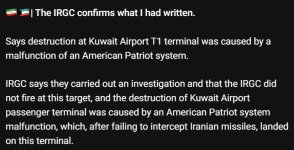
So apparently the damage to the Kuwaiti airport was caused by a Patriot missile.
View attachment 289909
Try fact-checking


AI

Was the destruction in Kuwait caused by a patriot missile?

No. The destruction and fires at Kuwait International Airport and the Ali al-Salem Airbase were the result of a deliberate barrage of drones and missiles launched by Iran.The conflicting claims regarding the incident are:The U.S. Military: U.S. Central Command (CENTCOM) strongly denied that any malfunctioning U.S. interceptor caused the damage. Officials officially stated that Iran struck the civilian airport deliberately in a "calculated and unjustified attack".The Iranian Government: Iran’s Islamic Revolutionary Guard Corps (IRGC) claimed that they did not target the airport. Instead, they alleged the terminal's destruction was caused by a malfunctioning American Patriot missile that failed to intercept Iranian targets.The attacks took place during a major escalation in the Gulf, in which Iran targeted U.S. military sites in retaliation for earlier U.S. strikes in Iran.Updates and detailed reporting on the incident are available via Al Jazeera and Middle East Eye.

is Iran attempting to blame the USA?

Yes, Iran is actively attempting to shift the blame to the United States.The Iranian government and its state media are using the following narratives to deflect responsibility:The Patriot Missile Claim: Iran's Revolutionary Guard (IRGC) asserts that a malfunctioning U.S. Patriot missile defense system, rather than an Iranian weapon, destroyed the airport terminal.The Provocation Argument: Iranian officials argue that their overall military actions are purely defensive responses to what they label as illegal U.S. aggression and strikes on Iranian territory.Information Warfare: Independent geopolitical analysts view Iran's statements as a deliberate disinformation campaign designed to minimize international backlash for striking civilian infrastructure.
 
Try fact-checking


AI

Was the destruction in Kuwait caused by a patriot missile?

No. The destruction and fires at Kuwait International Airport and the Ali al-Salem Airbase were the result of a deliberate barrage of drones and missiles launched by Iran.The conflicting claims regarding the incident are:The U.S. Military: U.S. Central Command (CENTCOM) strongly denied that any malfunctioning U.S. interceptor caused the damage. Officials officially stated that Iran struck the civilian airport deliberately in a "calculated and unjustified attack".The Iranian Government: Iran’s Islamic Revolutionary Guard Corps (IRGC) claimed that they did not target the airport. Instead, they alleged the terminal's destruction was caused by a malfunctioning American Patriot missile that failed to intercept Iranian targets.The attacks took place during a major escalation in the Gulf, in which Iran targeted U.S. military sites in retaliation for earlier U.S. strikes in Iran.Updates and detailed reporting on the incident are available via Al Jazeera and Middle East Eye.

is Iran attempting to blame the USA?

Yes, Iran is actively attempting to shift the blame to the United States.The Iranian government and its state media are using the following narratives to deflect responsibility:The Patriot Missile Claim: Iran's Revolutionary Guard (IRGC) asserts that a malfunctioning U.S. Patriot missile defense system, rather than an Iranian weapon, destroyed the airport terminal.The Provocation Argument: Iranian officials argue that their overall military actions are purely defensive responses to what they label as illegal U.S. aggression and strikes on Iranian territory.Information Warfare: Independent geopolitical analysts view Iran's statements as a deliberate disinformation campaign designed to minimize international backlash for striking civilian infrastructure.

Some are led of the spirit, some are led by the law and some are led by AI.
 
Newton was an occultist, and yes he was a zionist.
Kind of like an ad hom which ignores his prediction about Israel using the Bible when Israel did not exist nor was there any reason to suppose Israel would return at the same spot. I do not know how you get that Newton was a Zionist when all he did was interpret scripture. and was right.
 
  • Like
Reactions: LTTexan
Kind of like an ad hom which ignores his prediction about Israel using the Bible when Israel did not exist nor was there any reason to suppose Israel would return at the same spot. I do not know how you get that Newton was a Zionist when all he did was interpret scripture. and was right.

Newton studied all of the Jewish writings (e.g, Talmud, kabbalah) that predicted such a return. He didn't get it strictly from the bible
 
  • Like
Reactions: Charlesiii
Quit with the sniveling insinuations. Your moniker pic suits you.
Bullseye. Why would anyone choose the loathsome hypocritical Church Lady avatar? Is it because this is the perfect personification of the deceiving spirit, odious demeanor, and stygian ignorance that is being expressed day in and day out?

A bizarre Freudian manifestation of inner guilt perhaps?
 
Yes — “in that day” is one of the major prophetic time-markers in the Old Testament. In the prophetic/eschatological passages it most often points to the future Day of the LORD complex: Israel’s final crisis, national repentance, cleansing, restoration, and Messiah’s reign.


The strongest proof-text chain is Zechariah 12–14.


1. Israel is besieged, then YHWH intervenes “in that day”​


Zechariah 12:2–3


This is not merely ancient history. The scope is international: “all the people of the earth” are gathered against Jerusalem. That places the passage in an end-time setting.


2. The house of David and Jerusalem are supernaturally defended​


Zechariah 12:8–9


Again, this is national deliverance centered on Jerusalem. It is not the Church replacing Israel. The text names Jerusalem, Judah, and the house of David.


3. Israel finally looks upon the pierced Messiah​


Zechariah 12:10


This is the heart of the argument. The same nation that rejected/pierced Messiah finally receives divine grace, looks upon Him, and mourns in repentance.


This connects directly with the New Testament:


John 19:37


Revelation 1:7


So Zechariah’s “in that day” culminates at Messiah’s visible return.


4. The repentance is national, tribal, and deeply personal​


Zechariah 12:11–14


The mourning includes: (HINT - NOT GENTILES NOR THE ALREADY RAPTURED CHURCH!)


That is not vague “spiritual Israel.” It is organized around Israel’s actual covenant families and leadership lines. The repentance is national, but also individual: “every family apart.”


5. “In that day” Israel is cleansed from sin​


Zechariah 13:1


This follows immediately after Zechariah 12:10. So the order is:


Israel is besieged → Messiah appears → Israel looks on the pierced One → national mourning/repentance → cleansing from sin.


That is exactly the salvation of a reformed/remnant nation Israel.


6. Idolatry and false prophecy are removed from the land​


Zechariah 13:2


This is covenant purification. Israel is not merely politically rescued; the nation is spiritually cleansed.


7. The remnant passes through refining and finally says, “The LORD is my God”​


Zechariah 13:8–9


This is national covenant restoration language. It echoes the old covenant formula: “I will be their God, and they shall be my people.”


8. Messiah physically returns to the Mount of Olives​


Zechariah 14:4


This locks the passage into a future, visible, earthly return of Messiah. It also matches Acts 1.


Acts 1:11–12


So Zechariah 14 is not merely symbolic church language. Messiah returns to the very region from which He ascended.


9. The LORD becomes King over all the earth​


Zechariah 14:9


That is the Messianic kingdom. It is global, earthly, and centered on YHWH/Messiah’s rule.


We get this in depth, scripture included analysis AND the response is ALWAYS" That is fulfilled or you are out of your mind."

The "other side" has NOTHING.