The US Joins WW3

  • Christian Chat is a moderated online Christian community allowing Christians around the world to fellowship with each other in real time chat via webcam, voice, and text, with the Christian Chat app. You can also start or participate in a Bible-based discussion here in the Christian Chat Forums, where members can also share with each other their own videos, pictures, or favorite Christian music.

    If you are a Christian and need encouragement and fellowship, we're here for you! If you are not a Christian but interested in knowing more about Jesus our Lord, you're also welcome! Want to know what the Bible says, and how you can apply it to your life? Join us!

    To make new Christian friends now around the world, click here to join Christian Chat.
Sub-note: Helium Supply Disruption & Semiconductor Manufacturing (Inelastic Chokepoint)

Source tier:
T1 (QatarEnergy official statements, Moody's, Bank of America, S&P Global, Reuters-sourced reporting)

Why this is structurally different from other fault lines — inelasticity:
Unlike oil (where the Strait reopening restores flow almost immediately) or even LNG contracts (renegotiable), helium is a byproduct of natural gas liquefaction with no independent production process, no substitute gas for semiconductor-grade (6N, 99.9999% purity) use, no strategic stockpile, and a 45-day degradation window in storage. It cannot be stored ahead of demand the way oil can, and it cannot be synthesized — once vented, it permanently escapes the atmosphere. This means the shortage does not track the war/ceasefire cycle the way other fault lines do. A ceasefire fixes Hormuz transit; it does not fix Ras Laffan's physical infrastructure.

Timeline of cumulative damage since March 2026:
  • Feb 28 – Mar 2, 2026: Initial Iranian drone/missile strikes hit Ras Laffan Industrial City (Qatar), the world's largest single helium-production complex (~30% of global supply). QatarEnergy declared force majeure and halted all production March 2.
  • Mar 18–19, 2026: Follow-up missile strikes caused "extensive" structural damage to LNG Trains 4 and 6 (12.8 million tpy combined, ~17% of Qatar's LNG export capacity) and the Pearl GTL plant (operated by Shell) — Qatar's largest single source of co-produced helium.
  • Official Qatari damage accounting (Energy Minister Saad al-Kaabi, Mar 19–20):
    • Condensate loss: 18.6 million barrels (~24% of exports)
    • LPG loss: 1.28 million tonnes (~13% of exports)
    • Naphtha loss: ~6% of exports
    • Sulfur loss: ~6% of exports
    • Helium loss: 309.54 million cubic feet annualized, ~14% of Qatar's helium exports (separate from the ~30% global supply figure — this is Qatar's own export-loss accounting)
    • Total repair cost estimate: ~$26 billion, with ~$20 billion/year in lost revenue until repaired
    • Repair timeline: 3–5 years — bottlenecked not by financing but by a global turbine shortage (the specialized cryogenic/compression turbines needed can't be manufactured or sourced faster regardless of money spent)
  • Global helium market effect: ~2.1 billion cubic feet of annual helium capacity removed from global markets; spot prices up 40–100%; contract prices projected up 40–60% under prolonged disruption; this is being called the fifth global helium shortage since 2006, and the most severe on record.
Semiconductor exposure:
  • South Korea sourced 64.7% of its helium from Qatar in 2025; Samsung and SK Hynix together control the majority of global DRAM/HBM production feeding Nvidia, Apple, and AI-infrastructure buildouts.
  • Semiconductor/electronics share of global helium demand grew from ~6% (2015) to an estimated 21-25% (2025), driven by EUV lithography and AI chip demand — meaning the exposure is growing structurally even independent of this disruption.
  • Current status: SK Hynix says it has diversified supply and secured adequate inventory; TSMC says it doesn't anticipate significant impact and is monitoring. So as of the most recent reporting, this remains a cost and rationing crisis, not yet a production-halt crisis — worth flagging as the key distinction from the more alarmist framing in circulation.
Distortion check: The ~30% global-supply figure and "no substitute" mechanism are solid and consistently corroborated across independent sources (Moody's, S&P, USGS-referenced reporting, multiple trade press). The $20-26bn figures come directly from QatarEnergy's own disclosure, not third-party estimate, so treat as company-reported rather than independently audited. The "5-year repair, turbine-bottlenecked" claim is repeated across enough independent industry sources (WestAir, LightSource, Tim Harper's semiconductor supply chain analysis) to treat as reliable consensus.

Next checkpoint: Whether SK Hynix/TSMC's "no significant impact" holds through Q4 2026, or whether rationing starts hitting actual wafer output rather than just margins.
 
Looks like Iran has done the ole rope a dope strategy on the US


Trump has NO CONTROL as DUBAI PORT HIT HARD!!!​

 
This Time Will Be Different


Since the war between the U.S. and Israel and Iran began on February 28, 2026, one phrase has recurred like a metronome: talks are close, a deal is imminent, peace is finally at hand. On March 9, Trump declared the war "very complete," claiming Iran's military had been destroyed — fighting continued regardless. By March 23, he spoke of "very good and productive conversations," only for Iranian officials to deny any contact the same day. Two days later, Iran's ambassador in Islamabad and Israel's UN envoy each denied knowing of any peace overtures at all, while Tehran rejected a 15-point truce proposal outright, insisting no negotiations had ever taken place.


April brought the same rhythm at a faster tempo. On April 1, Trump announced that Iran's president had personally requested a ceasefire; Iran's foreign ministry called the claim "false and baseless." Days later, Pakistan's proposed 45-day ceasefire framework was rejected in favor of Iran's own terms. Then, on April 7, Trump warned that "a whole civilization will die tonight" — and hours later, a two-week ceasefire was announced instead. When that ceasefire's deadline arrived on April 21, he threatened bombing once more, then extended it indefinitely that same day.


By May 1, Trump told Congress that hostilities "have terminated." A week later, American and Iranian forces exchanged fire near the Strait of Hormuz. Strikes he canceled in mid-May over "serious negotiations" resumed by month's end when those negotiations collapsed. On June 11, he vowed to hit Iran "VERY HARD TONIGHT," then called it off hours later, citing a breakthrough. That breakthrough became a real, signed 14-point memorandum on June 17 — the closest the year came to substance. It didn't hold. Within days, Iran struck a commercial ship in the Strait, and the retaliatory cycle resumed.


July delivered the starkest reversal yet. After indirect talks in Doha stalled and a Supreme Leader's funeral turned into calls for vengeance, Iran struck three commercial vessels; the U.S. retaliated on July 7, and on July 8 Trump declared the ceasefire "over" outright. A late-July pause dissolved within days when Iran launched missiles at U.S. forces in Jordan.


Then, on August 1, the pattern repeated once more: Trump said he'd called off "the biggest attack since World War II" so talks could resume Monday. Monday came, and Iran said no such talks existed. Tuesday, U.S. officials insisted they were "going on right now." Wednesday's oil prices moved on the strength of that insistence alone.


Each time, the same choreography: a threat, a claimed opening, a deal declared close — and then the ground shifting again before anyone could stand on it.
 
The Rope-a-Dope Theory — Summary

The theory: since the Iran war began February 28, 2026, the conflict has followed a repeating pattern — the U.S. inflicts heavy damage, signals victory or an imminent deal, and Iran absorbs the punishment without capitulating, then strikes back at a moment of its choosing (a tanker, a Gulf facility, U.S. forces nearby) and resets the cycle. This resembles Muhammad Ali's rope-a-dope against George Foreman: Iran, backed tacitly by Russia and China, is absorbing blows on the ropes rather than fighting back symmetrically, conserving its own resources while letting the U.S. burn through its more expensive arsenal — betting that by "round eight," America's reserves (munitions, fiscal capacity, allied economies) will be spent, shifting leverage to whoever conserved theirs.

Predicate 1 — U.S. munitions depletion (independently verified):
  • ATACMS and PrSM long-range missile stockpiles: "virtually all" expended over five months of fighting (Reuters/CBS, Aug 4)
  • Tomahawk cruise missiles: roughly 50% of the global stockpile used
  • Patriot interceptors: 1,500+ expended, fewer than 1,000 left in reserve, overall stock down about two-thirds (WSJ/NPR)
  • WSJ reporting ties the depleted air-defense inventory directly to Trump's decision to pause a planned strike campaign in favor of renewed diplomacy — meaning the shortage may be steering the war's on-again, off-again ceasefire pattern
  • Caveat included: Pentagon messaging on this has been inconsistent (Hegseth called depletion reports "manufactured" in June, then acknowledged a multi-year rebuild two months later), so the fact of depletion is treated as solid while attributions of blame are flagged as unverified

Predicate 2 — Allied/global economic strain ("the world economy gassed"):
  • U.S. 30-year Treasury yield hit its highest level since July 2007 (~5.2–5.27%), rising even after the Fed held rates steady — a sign markets, not the Fed, are now pricing the war's fiscal cost
  • Japan: stagflation (inflation near 2.8% against ~0.5% growth), the yen at multi-decade lows, a record-high 30-year bond yield, and a single-day Nikkei drop over 5%
  • South Korea: the won at its weakest since 2009, the KOSPI's steepest one-day drop since 2008, a $68 billion market-stabilization program, and the country's first gas price caps in thirty years
  • Broader Asia: even a 10% oil price rise can shave up to 0.3% of GDP off import-dependent economies' current accounts, with India and Southeast Asia flagged as most exposed

The synthesis: the theory connects these two data sets — a war fought through expensive precision strikes against cheap, asymmetric counter-strikes produces exactly the cost profile that drains the stronger side's inventory while the weaker side survives relatively intact. Iran's refusal to either capitulate or escalate to a scale that invites total war is read as a deliberate exhaustion strategy rather than simple stubbornness.
 
Ebola (Bundibugyo strain) — DRC/Uganda


  • WHO declared a Public Health Emergency of International Concern on May 16, 2026.
  • As of early August, 1,751 confirmed deaths in the DRC and 2 in Uganda; poor healthcare infrastructure and ongoing armed conflict are hindering detection and treatment, so the true scale likely exceeds confirmed numbers. Wikipedia
  • Existing Ebola treatments were certified for the Zaire species, not Bundibugyo, complicating the clinical response. Wikipedia
  • Response underway: WHO-sponsored PARTNERS clinical trial protocol active in DRC/Uganda; CEPI funding three vaccine candidates (IAVI, Moderna, Oxford); remdesivir and another drug entered trials July 12.
  • 17th Ebola outbreak in DRC overall, starting just five months after the prior one ended.

Measles — United States


  • 2,371 confirmed cases in 2026 as of July 30 — already above the 2,289 total for all of 2025, and both are the highest annual counts since 1991. CIDRAP
  • 37 new outbreaks reported this year; 94% of cases are outbreak-associated. CIDRAP
  • The US was declared measles-free in 2000 but is likely to lose elimination status later this year when PAHO reviews transmission data. CIDRAP
  • 20% of cases are in children under 5, 49% in ages 5–19; 7% hospitalized (down from 11% in 2025); no deaths so far. CIDRAP
  • Active hotspots: Utah (largest single outbreak, 514 cases), South Carolina (Spartanburg-centered, ~973 cases from the 2025 outbreak carrying over), plus newer clusters in Virginia and Pennsylvania.
  • Driver: 93% of cases are in people who were unvaccinated or had unknown vaccination status — identical to 2025's share — with only 4% occurring in fully vaccinated individuals.
 

Escalation Log Entry — AI Bubble (Fault Line)​


Date logged: August 5, 2026
Source tier: T1 (DOE official press release, energy.gov, July 29, 2026) — corroborated by T2 (Bloomberg, PowerMag, RTO Insider)


Signal: DOE announced a partnership with Brookfield, NextEra Energy, Big Rivers Electric, Jackson Purchase Energy Cooperative, and Paducah Power System to redevelop the former Paducah gaseous diffusion (Cold War uranium enrichment) site into a $100B+ AI data center campus. Structure: Brookfield leases DOE land and operates the data center; NextEra builds/owns up to 2GW gas generation + 2.6GW battery storage; project targets completion in 2032, with up to 1.8GW utility capacity and 1.2GW+ compute capacity. DOE frames this explicitly under a "Ratepayer Protection Pledge" — project costs walled off from residential/small-business rates, subject to Kentucky PSC approval. ~8,000 construction jobs, 600 permanent positions projected.


Why it triggers: This is a concrete, capital-committed, federally-brokered instance of AI infrastructure buildout being co-located on federal land with dedicated (non-grid) power generation — a pattern distinct from the earlier speculative/announcement-only entries in this fault line. The DOE explicitly ties the rationale to the US-China AI race, and the "own power, own infrastructure" framing signals an emerging template (federal land + private capital + dedicated generation, bypassing public grid capacity constraints) that may repeat at other DOE sites under the "American Energy Hubs" initiative referenced by DOE Assistant Secretary Tim Walsh. Worth flagging as a possible model for future entries rather than an isolated data point.


Prophecy Parallel Note (non-analytical)​


Prophecy parallel (non-analytical): Ricky Scarpel (End Time Headlines, Aug. 4, 2026 broadcast) identifies the current wave of AI data center buildout — including this Paducah project — as infrastructure-laying for the coming beast system of Revelation 13, framing the moment as a "Tower of Babel" event (Genesis 11) in which global technological unity is being reassembled ahead of a divine interruption. He explicitly declines to read AI as an extinction-level threat on the grounds that Scripture doesn't support human extinction by this means, but frames it as building the technical/surveillance substrate for the Antichrist/false prophet system. Noted for reference only — not a T1-T3 signal.
 
A summary of what we are seeing right now

1. It is confirmed that the US is running out of amunition. By "running out" I mean that the amount of amunition the US has for the Mideast theater has run out. They can borrow from other theaters like Asia but then in the event we have a war with Russia and China we would not have enough.

2. Not to worry, the Pentagon has everything under control, they are changing their nuclear policy so that they can use tactical nukes quicker in the event they don't have any other weapons.

3. Diesel futures are up 11% to $154 and that is an $80 premium over WTI. Please realize that virtually everything that is sent by rail or ships or trucks uses diesel. So this is inflationary pressure on everything.

4. Despite Trump saying (for the 39th time) that we are about to have a peace agreement with Iran to open the Strait, people should understand that even if they do have a peace agreement it is unlikely for us to return to normal shipping for at least 30 days and more likely 60 days. Also even if it is reopened the damage done to the infrastructure and refineries in the area will likely take a year or even two years to fully repair. Meanwhile gold is up almost 5% today and silver is up almost 4%.

So things are still going to get worse, best case scenario is that they start getting better in 2 months. Worst case scenario is we will be in a nuclear war soon.

But here is the really big issue. If Iran comes out of this without giving up anything it will be a major victory for BRICS. Now if 40% of the world uses BRICS you will have the other 60% using it a little. This is a major problem for the US dollar as the reserve currency. I believe the reason for this war is to see if you can buy and sell MidEast oil using BRICS currency. If you can then it is the beginning of the end for the US dollar. We know that we are going to see inflation for the next two months as a best case scenario and no one wants to buy bonds when you have high inflation. However, gold is a far better investment when you are in an inflationary cycle. Because BRICS offers an alternative it will mean central banks around the world will be buying gold, and US sanctions on countries will become useless as a result, and the US having used sanctions on countries is a major motivation for them to move to BRICS.

Because of this I think it is an existential crisis for the US to let Iran win. Trump has two choices, allow Iran to get a victory now that will really hurt him at the mid term elections, but allow the US to have a slow demise, or he can take munitions that would be used to defend the US from attack either at home or in the Pacific and send them to Iran, continue bombing Iran and change the nuclear policy so that if we are attacked we can quickly respond with nukes. Trump tries to be unpredictable, but I think everyone knows which option Trump will choose.

This just in: Pentagon policy chief Elbridge Colby drafting new nuclear strategy emphasizing shorter-range tactical nuclear weapons over long-range strategic missiles for a regional war scenario with Russia or China
 
Fault Line: Domestic Critical Infrastructure — Water/OT Targeting (proposed FL14, or sub-entry under Iran/Energy Disruption)
Date logged:
August 5, 2026
Source tier: T2 (CISA advisories, FBI/EPA joint PSA — direct federal agency statements); T2/T3 for state/utility confirmations (MNIT, Clayton County Water Authority); T3 for outlet aggregation (SecurityWeek, The Record, NBC, Newsweek, Tenable)
Signal: Coordinated intrusions into internet-facing PLCs at water/wastewater utilities, now spanning at least 7-12 states (MN, MI, SD, GA, NJ + others per ABC/CBS reporting), with confirmed operational degradation (boil advisories, manual-mode failover, one plant temporarily offline) in MN and GA. CISA has issued a sector-wide advisory (AA26-097A) naming Iranian-affiliated actors and expanded targeted device vendors (Rockwell, Schneider Electric, Siemens).
Why it triggers:
Direct, multi-state, sustained targeting of US critical infrastructure OT systems, consistent with prior IRGC-linked campaign TTPs (CyberAv3ngers/2023), now with confirmed public-safety impact (boil advisories) and CISA formal attribution to Iranian state actors — this crosses from "warning" to "active domestic infrastructure campaign" status.
 

Refining capacity damaged — current snapshot​


Russia: Estimates diverge by source and haven't converged into one T1 number, but the range as of early August:
  • Ukraine's General Staff claims 42.7% of Russia's total oil refining capacity disabled as of early July, with $13.5 billion in industry losses since August 2025. RFE/RLRFE/RL
  • IEA's independent estimate is more conservative: more than 20% of Russia's total refining capacity knocked offline, which IEA called unprecedented in the history of the Russia-Ukraine conflict. QC IntelQC Intel
  • Finland's President Stubb put it in between: Russia's capacity to produce and export oil had been reduced by 40% due to Ukrainian mid- and long-range drone strikes (early July). Kyiv Insider
  • Ukraine's own cumulative strike count: a cumulative total of 108 hits after three years of war, 246 after four years, and 305 strikes when including 24 February 2022 to 25 June 2026. Kyiv Insider
  • Effect on actual output has lagged the capacity-loss figures because Russia has spare-capacity buffer: Russia's daily output of refined oil dropped by up to 700,000 barrels in April and May — a 13% decline from the ~5.2 million bpd baseline. Razumkov
  • Distortion check: treat the 42.7%/40%/20%+ spread as reflecting different denominators (Ukrainian MoD "projected capacity disabled" vs. IEA "capacity offline" vs. Stubb's broader "production and export" framing) — not a contradiction to resolve, but three overlapping metrics.

Ukraine's own refining sector isn't separately targeted by Russia in the same systematic way (Ukraine imports most refined product rather than domestically refining), so there's no comparable capacity-loss figure to report there — Russian strikes on Ukraine hit grid/rail/logistics more than refineries specifically, per this week's Euronews reporting on the reciprocal strikes.


Iran / Middle East: No single clean percentage exists for Iran's own refining capacity — reporting focuses on the broader Gulf energy-infrastructure toll: Rystad Energy's assessment put combined Gulf energy damage at up to $58 billion, covering more than 80 facilities across the region, more than a third of which sustained severe damage, as of Iran's March 2026 retaliation wave alone (figure has likely grown since). More than 40 key energy assets have been damaged, causing the largest supply disruption in history, per the IEA, and Hormuz-adjacent flows were at one point down at least 60% from pre-war levels. No Iran-specific refinery-capacity percentage has surfaced in T1 reporting; Iran's domestic refining has been a secondary target relative to export/transit infrastructure and Gulf-neighbor retaliation targets. Global Security + 2


Global Fuel Crisis Tracker — Update Note, August 6, 2026​


NEW — Fault Line 2 (Hormuz/Russia) escalation entries


1. Russia refinery strikes — Yaroslavl and Bashkortostan, night of Aug 5–6

Signal: Zelensky confirmed strikes on the Slavneft-Yanos refinery in Yaroslavl and the Bashneft-Novoil refinery in Ufa, calling them "long-range sanctions." Slavneft-Yanos ranks among Russia's five largest oil refineries, with annual processing capacity of around 15 million metric tons; Ukraine's military claims to have struck it twice already in July — this is at least a third hit. Separately, two military patrol boats and Russia's shadow-fleet vessels were struck in the Black Sea, per Zelensky — shadow fleet being the tanker network Russia uses to evade Western export restrictions, a new target category worth tracking alongside refineries.
Source tier: T1/T2 — Moscow Times, Kyiv Independent, Euronews all corroborate independently; Governor Mikhail Yevrayev confirmed the drone attack and traffic restrictions around the refinery (Russian official source, doesn't deny the strike, disputes framing).


2. Hormuz status — de-escalating rhetoric, structure still broken
Signal: As of Aug 4–5, Trump said the Strait of Hormuz would be reopened "soon" or he would launch a harsh new attack on Iran. Iran has required vessels to use its own designated route since June 19, and the US naval blockade on Iran, reimposed after the ceasefire MOU collapse, remains in place — CENTCOM reported redirecting 44 commercial vessels, disabling two, and boarding two. Iran and Oman talks on Hormuz are reportedly advancing "positively" as of Aug 4.
Why this matters for the tracker: This is the first real "off-ramp" signal since the July 20 MoU-suspension entry — but it's rhetoric-plus-negotiation, not a physical transit-data change yet, which is exactly the pattern your July 20 note warned against over-reading.


3. Margin Addendum — new 3-2-1 record supersedes $69.66 close
Signal: The NYMEX 3-2-1 crack spread reached an all-time high of $72/bbl in recent trading (OPIS, reporting as of Aug 4), surpassing the $69.66 closing benchmark already in your addendum. The diesel crack has not yet reached the ~$100 levels seen briefly in 2022, but reached the high $90s in late July, and Q2 2026's 3-2-1 average of over $51/bbl was just 20 cents shy of the same quarter four years ago — with July alone showing potential to shatter that record. Structural framing carried forward from your July 28 note remains current: permanent plant closures and war-related damage have cut global refinery output by an estimated 4.5 million bpd (5.4%) in Q2 2026 per the IEA, and refiner equities continue climbing on that thesis.
Source tier: T1/T2 — OPIS (industry data provider, T1-equivalent for this metric), Forbes citing IEA (T1 underlying).
 
Analysis

It can take a year or longer to repair damage to a refinery to get it to return to full capacity. This analysis estimates from the damage already done we will see an impact lasting for four years to overall inflation due to higher energy costs and food costs as well as food shortages.

What's actually happened so far (grounded, not projected)

  • Urea spiked from ~$400–490/mt pre-war to over $850/mt by April 2026 (roughly +80%), then partially reverted to ~$453/mt by June as the initial shock eased — this system moves in spikes tied to specific escalation events, not a smooth elevated plateau.

  • Nitrogen fertilizer's cost driver is mostly natural gas (~80% of nitrogen fertilizer cost), not crude directly — so it tracks gas/Hormuz-LNG disruption as much as crude/diesel. Roughly 24–30% of global ammonia trade and ~30% of urea trade move through Hormuz.

  • Critically, there's a structural one-year lag independent of how the war itself resolves: most farmers had already pre-bought nitrogen for the 2026 crop before the war started in February, so 2026 yields were largely insulated. Illinois farm economists were explicit that "the full effect of these price increases will be felt in 2027" — the next full purchasing cycle. That lag exists regardless of whether Hormuz reopens tomorrow.

  • Real yield damage is already showing up, but it's tangled with an independent variable: the Kansas winter wheat tour found ~20% of fields abandoned with average yields near 28 bu/acre vs. a typical high-30s/40s, and Texas/Oklahoma winter wheat is tracking to its smallest crop since 1957 — but this region is also dealing with what's being described as the worst western drought in centuries. Attributing that yield loss cleanly to fertilizer costs vs. weather isn't really possible from current reporting; treat it as unresolved rather than confirmed fertilizer-driven.

  • The World Bank's own baseline (as of May 2026, before layering in the SPR-refill thesis) already expected fertilizer prices to ease in 2027 as new nitrogen capacity (+4% globally per IFA) comes online and exports recover — i.e., the "normal" recovery path was already pricing in 2027 relief.
Extending the previous estimate
Currently there is a best case estimate that we will have 18–36 month SPR-refill-driven elevated-energy-price window feeds this chain through two channels: diesel (farm equipment, transport, drying/processing) and natural gas (fertilizer feedstock). Add to that the documented ~12-month purchase-to-harvest lag on top of that window:
Best caseWorst case (2x)
SPR-driven elevated energy costs (prior estimate)~18 months~36 months
+ purchase-cycle lag before full crop-cycle effect clears+~9–12 months+~9–12 months
Reduced yields / elevated food inflation persist from now (Aug 2026)~24 months (through ~mid-2028)~48 months (through ~mid-2030)

Our best case scenario considers the war ends today, and everyone does everything in their power to get things back to normal. Best case is highly unlikely. The worst case is simply doubling the best case and should be called a far more likely case. This indicates food shortages and inflation on food for the next 4 years.

Distortion check on this answer specifically: three things could break this estimate in either direction that I can't quantify from here — (1) El Niño, assessed at 61–87% probability of developing through 2026 into 2027, is an independent driver of yield loss in South Asia, Australia, and Southern Africa that could compound with or be mistaken for the fertilizer-cost effect; and (2) fertilizer prices have already shown they can revert quickly (the April-to-June urea reversal) when disruptions ease even temporarily, so "elevated" is more likely to mean recurring spikes around each escalation. and (3) continued war. Both the US and China are by far the two biggest nations on earth for refining capacity. It is highly likely that Iran and Russia would target the US refineries since we targeted theirs and of course if China goes to war with Taiwan we can expect retaliation on their refineries. Attacks on these refineries could dwarf what we have seen so far.
 
The new tactical nuke posture that the Pentagon is drawing up says that if we are attacked by Russia or China we can immediately go to tactical nukes. Why? The reason is that we don't have enough munitions for Iran if we reserve enough munitions for wars against China and Iran to defend the homeland. Trump wants to move the munitions to Iran so that he can make good on his pledge to make this the biggest bombardment ever. But to take away the munitions for defending the US they have to have a policy in place for defending the US, and so the Pentagon says they can use Tactical nukes. I don't know how many tactical nukes the US has. My understanding from a simple google search is that we have 200. They might be smaller than the Nagasaki and Hiroshima bombs, but both of those bombs would be considered "tactical". But the smallest tactical nuke ever was a thousandth of the size of Hiroshima bomb. The smallest was equivalent to 20 tons of TNT and the biggest can take out a small city. But think how little 200 is. Supposing you have 80 on the East coast and 80 on the west coast and 40 on the Gulf coast, if China were to attack from the west coast with a thousand small landing craft what are you going to do with 80 nukes? You can put 40 Amphibious assault vehicles in one amphibious assault ship. Tactical nukes would be useless against an assault with 10,000 amphibious assault vehicles. Each vehicle can carry 24 to 28 men.

Basically the strategy is this: If China invades the US with a million men from north, south, east and west then the US will nuke 100 cities in China. Tactical nukes aren't going to stop an invasion, it will only insure that the number of Americans killed equals the number of Chinese killed. As long as the leaders of these countries are not psychopaths who don't care about how many people are killed, but instead value every single life whether American or Chinese, then the tactical nukes will be a viable deterrent.
 
The new tactical nuke posture that the Pentagon is drawing up says that if we are attacked by Russia or China we can immediately go to tactical nukes. Why? The reason is that we don't have enough munitions for Iran if we reserve enough munitions for wars against China and Iran to defend the homeland. Trump wants to move the munitions to Iran so that he can make good on his pledge to make this the biggest bombardment ever. But to take away the munitions for defending the US they have to have a policy in place for defending the US, and so the Pentagon says they can use Tactical nukes. I don't know how many tactical nukes the US has. My understanding from a simple google search is that we have 200. They might be smaller than the Nagasaki and Hiroshima bombs, but both of those bombs would be considered "tactical". But the smallest tactical nuke ever was a thousandth of the size of Hiroshima bomb. The smallest was equivalent to 20 tons of TNT and the biggest can take out a small city. But think how little 200 is. Supposing you have 80 on the East coast and 80 on the west coast and 40 on the Gulf coast, if China were to attack from the west coast with a thousand small landing craft what are you going to do with 80 nukes? You can put 40 Amphibious assault vehicles in one amphibious assault ship. Tactical nukes would be useless against an assault with 10,000 amphibious assault vehicles. Each vehicle can carry 24 to 28 men.

Basically the strategy is this: If China invades the US with a million men from north, south, east and west then the US will nuke 100 cities in China. Tactical nukes aren't going to stop an invasion, it will only insure that the number of Americans killed equals the number of Chinese killed. As long as the leaders of these countries are not psychopaths who don't care about how many people are killed, but instead value every single life whether American or Chinese, then the tactical nukes will be a viable deterrent.
I just realized I was a little too optimistic in the last post, it doesn't require that both US and Chinese leaders are not psychopaths only that the leader of the attacking nation is not a psychopath. Once the US is invaded the nukes are our only defense. So as long as Putin, Xi, the IRGC and Kim Jong Un are not psychopaths we'll be alright.
 
Some people claim the US has run out of munitions in this war with Iran and Pete Hegseth says we haven't. Both are right.

We have run out of munitions in the Mideast theater of operations, however, if we strip all our weapons stores from Europe and Asia we still have more munitions we can fire. The nervous nellies didn't consider that because they think it is crazy, to leave ourselves and our allies completely open to attack. But hey, these nervous nellies don't even understand crazy. Trump is willing to use "tactical nukes" a name for those small tactical nuclear weapons that obliterated Hiroshima and Nagasaki. Not the big ones, the "little ones". Now the reason that some so called "experts" in the military consider this crazy is because Russia and China have both said they would not be the first ones to use nuclear weapons, but as Putin puts it "he won't be the second, either". By that he means you drop a nuclear bomb and before it hits the ground he has hit that little red button which is every bit as big as Trumps red button.

So the good news is that Trump can keep his promise to bomb Iran with a bigger air campaign than we had in WW2. He can keep his word and if it turns out that Russia and China use that as an opening to attack Europe and Taiwan well then he can follow up the biggest aerial bombardment ever with the biggest World War ever.
 
This reminds me of that old song where the guy on the ship is watching a fort get bombarded and asks if you can still see the US flag waving in the midst of all the bombs and smoke.
 
Escalation Entry 1 — FL12 Gulf Desalination / Water Security (UPGRADE)


Source tier: T1 — CNN (Aug 4, Aug 6 reporting), corroborated by PBS NewsHour and Middle East Eye reporting on the same underlying interceptor-shortage dynamic
Signal: Gulf leaders have acknowledged to US officials that their own air-defense stockpile shortages could hinder their ability to intercept Iranian missile and drone attacks. Separately, a regional official confirms Iran has directly conveyed to Gulf states that any renewed American strikes on Iran will trigger Iranian retaliation against energy infrastructure and desalination facilities across the region. This was reportedly a decisive factor in Trump's decision to stand down a planned weekend strike after Gulf allies voiced fear of Iranian retaliation on their infrastructure.
Why it triggers: This is a direct, sourced Iranian threat against desalination infrastructure — not inference or analyst extrapolation — and it's now confirmed as a live factor in US strike/no-strike decision-making at the highest level. Meets FL12 threshold with room to spare.


Escalation Entry 2 — Dollar Hegemony Transition (NEW)


Source tier: T1 — Reuters (via TASS republication), NPR (Aug 6-7), corroborated by BusinessToday and multiple secondary outlets
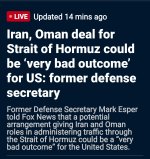
Signal: Iran and Oman are negotiating a Strait of Hormuz transit-fee regime; Iran is holding out for 5-7% of cargo value, Oman is proposing 3%. For comparison: Suez and Panama charge 0.1-0.5%; the Bosphorus/Dardanelles charge 0.01-0.1%. Separately, and more significantly, Iran's parliament is finalizing legislation to ban US- and Israel-linked vessels from the strait outright, fine violators 20% of cargo value, and route traffic through separate Iranian (northern) and Omani (southern) corridors. The US has categorically rejected any Iran-collected transit fee; Gulf states insist any payments must be strictly voluntary.
Why it triggers: This is a direct challenge to freedom-of-navigation norms and a structural attempt to convert a global chokepoint into sovereign Iranian revenue and leverage — a genuine node in the broader dollar-hegemony/global-trade-architecture thesis, not just a wartime nuisance fee. If implemented, this reshapes shipping economics for roughly one-fifth of world oil supply.


Escalation Entry 3 — US Military Resource Allocation Strain: Homeland vs. Israel vs. Indo-Pacific (NEW FAULT LINE)


Source tier: T1 — Washington Post (Aug 1, original reporting), corroborated by Times of Israel and multiple secondary outlets
Signal: Gen. Alexus Grynkewich — EUCOM commander and NATO Supreme Allied Commander Europe — sent Pentagon leadership a written warning that without an additional Aegis-equipped Navy destroyer, he will be forced to choose between defending the US homeland and defending Israel from Iranian/Houthi missile and drone attacks. Context: US Navy destroyers based in Rota, Spain (five currently, sixth expected later this year) have carried much of the Mediterranean missile-defense burden for Israel; Patriot inventories are now below 1,000 and THAAD around 250 per CSIS estimates. Experts cited by CNN separately note the broader stockpile drawdown could affect readiness for a future China contingency.
Why it triggers: This is the clearest documented instance yet of the munitions-depletion fault line translating into an actual command-level operational tradeoff, stated in writing by a named four-star combatant commander — not commentary, not a leak characterization, but a formal resource request framed around a binary choice. Directly links your existing Cross-Theater Munitions (FL13) tracking to a live Israel-vs.-homeland-vs.-Indo-Pacific allocation problem.
 
  • Source tier: T2 (state-linked wire/network reporting official IRGC statement — direct quote from named spokesperson, but filtered through Tasnim/ABC)
  • Signal: IRGC decouples Strait reopening from Oman route talks; reopening now conditioned on US "non-interference," not just route-safety mechanics
  • Why it triggers: Shifts the negotiating frame from a near-term technical fix (route coordinates, IMO-style safe corridor) to an open-ended political concession — raises probability that "reopening soon" (Trump's framing) and "reopening" (Iran's framing) mean different things, which is exactly the kind of expectations-gap that has produced prior escalation cycles in this crisis
 
Escalation Log Entry — Terafab Megafab (AI Bubble / Cross-Theater Munitions-Resource Competition)


Source tier:
T1 — corroborated by company press releases (SpaceX, Tesla) and multiple independent outlets (TechCrunch, Electrek, Fox Business), Aug 6–7, 2026


Signal: Tesla/SpaceX/xAI (with Intel as fab partner) confirmed the site for "Terafab" in Grimes County, TX — $16.8B first-phase investment, 100M+ sq ft planned, targeting 1 terawatt of compute/year output. This moves the project from March keynote/announcement stage to a funded, sited, permitted build.


Why it triggers: Represents an unprecedented vertical-integration bet by a single private actor (Musk, as CEO of all three companies) into leading-edge semiconductor fabrication — a capability previously concentrated in TSMC/Samsung/Intel and geopolitically tied to Taiwan. Relevant to AI Bubble (capex intensity, sustainability of spend given Tesla's declining auto revenue) and to Cross-Theater resource competition (a hedge against Taiwan Strait disruption to chip supply, independent of whether that's the stated motive).
 
Escalation Log Entry — Terafab Megafab (AI Bubble / Cross-Theater Munitions-Resource Competition)


Escalation Log Entry — US Intel Assessment: Russia Could Test NATO (Nuclear Posture Doctrine Shift / Diesel-adjacent Cross-Theater)


Source tier:
T1 — Wall Street Journal original reporting (Aug 7, 2026), corroborated by Fox News, Yahoo, and multiple secondary outlets citing officials briefed on the assessment


Signal: US intelligence has shifted its prior assessment (that Putin would not risk provoking NATO while tied up in Ukraine) to now judge that Russia could attempt a limited land incursion or cyberattack against a NATO member — most likely the Baltics or Poland — to test Article 5 resolve, with a window running from this fall through 2029.


Why it triggers: This is a genuine reassessment by US intelligence, not a media speculation piece — it reflects a real shift in the threat model for the Eastern European/NATO fault line, and ties into your existing tracking of Polish-airspace incidents, Baltic drone threats, and Lithuania's "false flag" warning.
 
Escalation Log Entry — Sanctioning Russia and Iran Act of 2026 (Dollar Hegemony / BRICS Transition)


Source tier:
T1 — direct legislative action, corroborated by CNBC, CBS News, Al Jazeera, and Senate press releases


Signal: Senate passed the bill 86-11 on Aug 7-8, authorizing up to 100% tariffs on the top five purchasers of Russian oil/gas (China, India, plus Slovakia, Hungary, Azerbaijan), alongside sanctions on Russia's shadow fleet and financial network. Heads to House, which is in recess until September/August 31.


Why it triggers: This directly threatens the two largest BRICS economies' energy-import arrangements with Russia — exactly the kind of forcing event that could accelerate (or, conversely, expose the limits of) BRICS payment-system workarounds like mBridge and BRICS Pay. It's also a live test of whether "secondary tariff" threats actually get used at scale rather than staying rhetorical, which matters for your Dollar Hegemony framework's core question: is de-dollarization being driven by choice or by being pushed out.
 
1000013176.jpg
I would love to hear some good news for a change in the news but that seems to be asking too much. 🤨