
The US Joins WW3
- Thread starter ZNP
- Start date
-
Christian Chat is a moderated online Christian community allowing Christians around the world to fellowship with each other in real time chat via webcam, voice, and text, with the Christian Chat app. You can also start or participate in a Bible-based discussion here in the Christian Chat Forums, where members can also share with each other their own videos, pictures, or favorite Christian music.
If you are a Christian and need encouragement and fellowship, we're here for you! If you are not a Christian but interested in knowing more about Jesus our Lord, you're also welcome! Want to know what the Bible says, and how you can apply it to your life? Join us!
To make new Christian friends now around the world, click here to join Christian Chat.
You are using an out of date browser. It may not display this or other websites correctly.
You should upgrade or use an alternative browser.
You should upgrade or use an alternative browser.

State of Emergency in Louisianna due to shortage of Diesel, State of Emergency in Hawaii due to incoming hurricane and State of Emergency in California due to Hurricane.
- At least 5 countries are actively rationing fuel or facing empty pump scenarios due to the ongoing refined-product squeeze. [1]
- 🗒 Specific nations implementing direct rationing or severe caps include:
- Sri Lanka: Re-implemented a QR-code-based National Fuel Pass for weekly diesel and petrol limits.
- Myanmar: Instituted odd-even license plate rules to restrict daily purchases.
- Bangladesh: Enforced strict vehicle fuel rationing and early holiday closures.
- Slovenia: Imposed per-day limits on private and commercial fuel fills.
- Moldova: Declared broader emergency/alert states as part of compounding energy and resource shortages
- Crimea (Russia-controlled): Formally declared a local state of emergency due to severe domestic fuel shortages driven by refinery disruptions and the broader conflict.
France: Avoided a blanket national emergency but rushed out sweeping €450 million emergency interventions and subsidies as diesel prices hit record highs and roughly 14% of filling stations ran completely dry. [1, 2, 3, 4, 5]
Pakistan, Kenya and Ethiopia have all been hit hard by the 2026 global energy crisis. Each country has rolled out sweeping, emergency-style interventions—ranging from strict energy rationing and commercial shutdowns to multi-billion-dollar supply restructurings—to survive the severe macro-economic pressure. [1, 2, 3, 4, 5]
 Pakistan: Mandatory Early Closures & 50% Fuel Cuts
Pakistan has enacted some of the most visible emergency conservation measures in South Asia. Because the nation faces critical winter gas and fuel shortages due to ongoing shipping blockades and Red Sea detours, the government implemented a strict, mandatory three-month conservation mandate: [1, 2]
- Commercial Lockdowns: All markets, bazaars, and shopping malls must close strictly by 9:00 PM; wedding halls by 10:00 PM; and restaurants by 11:00 PM. [1, 2]
- State Fleet Rationing: Fuel allocations for official government vehicles have been cut by 50%, alongside absolute bans on the state purchase of new vehicles and non-essential foreign travel. [1, 2]
- Public Relief: To mitigate public unrest as high-speed diesel prices hit an eighth consecutive record increase, the government launched a targeted fuel relief scheme providing a 100-rupee-per-liter subsidy on petrol for low-income motorcycle and auto-rickshaw operators. [1, 2]
 Ethiopia: Half-Supply Shocks & Prioritization Emergency
Ethiopia experienced massive structural disruptions when 180,000 metric tons of fuel failed to arrive due to Middle East war chokepoints. This slashed the country's daily white diesel supply by half—from 9.2 million liters down to just 4.5 million liters—forcing the Ministry of Trade and Regional Integration to declare immediate emergency fuel distribution measures. [1, 2]
- Rationing & Logistics: Cargo lines from Djibouti were prioritized to restore baseline operations. The state enacted strict prioritization rules to route remaining diesel exclusively to critical agriculture, heavy transit, and public transport infrastructure. [1, 2]
- Subsidies: The government continues to inject massive financial buffers to stave off economic collapse, spending billions of birr to heavily subsidize diesel and gasoline at the pump. [1]
 Kenya: Forex Defenses & Lower-Quality Fuel Waivers
Kenya has successfully managed to keep its local pumps running without broad shortages, but doing so required dramatic emergency policy pivots and state intervention to combat a crippling U.S. dollar shortage exacerbated by the soaring import costs of refined oil. [1, 2]
- The G2G Credit Shield: Kenya fundamentally restructured its import economy by relying on a strict Government-to-Government (G2G) framework. By negotiating 180-day credit terms with Gulf oil majors (like Aramco and ADNOC), the government bypasses immediate USD requirements, preserving its national foreign exchange reserves.
- Quality Waivers: At the peak of the import constraints, Kenya passed an emergency mandate waiving its standard fuel quality regulations, allowing lower-grade fuel imports to enter the country to ensure logistics and supply lines didn't freeze completely. [1, 2, 3, 4]

If it were the spring and farmers were plowing and panting 6.20-6.50 fuel would be bad. Everyone would hope that the price would fall back to normal across the summer. The difference in the fall harvest is that the whole years crop is on the line and it's make it or break it time so the extra cost just has to be extended to the consumers buying the corn,and wheat and all the rest of the groceries we eat because it's too late to wait for the diesel prices to go back down. People think they pay too much already but the 6.50 diesel markup from the fall harvest hasn't even hit the store shelves yet. May as well get use to eating less food before the prices all double and stock up on beans and rice and such.
State of Emergency in Louisianna due to shortage of Diesel, State of Emergency in Hawaii due to incoming hurricane and State of Emergency in California due to Hurricane.
Bangladesh & Vietnam: Enacted swift emergency interventions, with Bangladesh rationing vehicle fuel and closing universities early, and Vietnam suspending VAT and environmental taxes to stave off economic paralysis.
- At least 5 countries are actively rationing fuel or facing empty pump scenarios due to the ongoing refined-product squeeze. [1]
- 🗒 Specific nations implementing direct rationing or severe caps include:
- Sri Lanka: Re-implemented a QR-code-based National Fuel Pass for weekly diesel and petrol limits.
- Myanmar: Instituted odd-even license plate rules to restrict daily purchases.
- Bangladesh: Enforced strict vehicle fuel rationing and early holiday closures.
- Slovenia: Imposed per-day limits on private and commercial fuel fills.
- Moldova: Declared broader emergency/alert states as part of compounding energy and resource shortages
- Crimea (Russia-controlled): Formally declared a local state of emergency due to severe domestic fuel shortages driven by refinery disruptions and the broader conflict.
France: Avoided a blanket national emergency but rushed out sweeping €450 million emergency interventions and subsidies as diesel prices hit record highs and roughly 14% of filling stations ran completely dry. [1, 2, 3, 4, 5]
Pakistan, Kenya and Ethiopia have all been hit hard by the 2026 global energy crisis. Each country has rolled out sweeping, emergency-style interventions—ranging from strict energy rationing and commercial shutdowns to multi-billion-dollar supply restructurings—to survive the severe macro-economic pressure. [1, 2, 3, 4, 5]
Pakistan has enacted some of the most visible emergency conservation measures in South Asia. Because the nation faces critical winter gas and fuel shortages due to ongoing shipping blockades and Red Sea detours, the government implemented a strict, mandatory three-month conservation mandate: [1, 2]
- Commercial Lockdowns: All markets, bazaars, and shopping malls must close strictly by 9:00 PM; wedding halls by 10:00 PM; and restaurants by 11:00 PM. [1, 2]
- State Fleet Rationing: Fuel allocations for official government vehicles have been cut by 50%, alongside absolute bans on the state purchase of new vehicles and non-essential foreign travel. [1, 2]
- Public Relief: To mitigate public unrest as high-speed diesel prices hit an eighth consecutive record increase, the government launched a targeted fuel relief scheme providing a 100-rupee-per-liter subsidy on petrol for low-income motorcycle and auto-rickshaw operators. [1, 2]
Ethiopia experienced massive structural disruptions when 180,000 metric tons of fuel failed to arrive due to Middle East war chokepoints. This slashed the country's daily white diesel supply by half—from 9.2 million liters down to just 4.5 million liters—forcing the Ministry of Trade and Regional Integration to declare immediate emergency fuel distribution measures. [1, 2]
- Rationing & Logistics: Cargo lines from Djibouti were prioritized to restore baseline operations. The state enacted strict prioritization rules to route remaining diesel exclusively to critical agriculture, heavy transit, and public transport infrastructure. [1, 2]
- Subsidies: The government continues to inject massive financial buffers to stave off economic collapse, spending billions of birr to heavily subsidize diesel and gasoline at the pump. [1]/
Kenya has successfully managed to keep its local pumps running without broad shortages, but doing so required dramatic emergency policy pivots and state intervention to combat a crippling U.S. dollar shortage exacerbated by the soaring import costs of refined oil. [1, 2]
- The G2G Credit Shield: Kenya fundamentally restructured its import economy by relying on a strict Government-to-Government (G2G) framework. By negotiating 180-day credit terms with Gulf oil majors (like Aramco and ADNOC), the government bypasses immediate USD requirements, preserving its national foreign exchange reserves.
- Quality Waivers: At the peak of the import constraints, Kenya passed an emergency mandate waiving its standard fuel quality regulations, allowing lower-grade fuel imports to enter the country to ensure logistics and supply lines didn't freeze completely. [1, 2, 3, 4]
Not sure who all is following what your trying to show about the diesel/food/harvest equation but keep trying to get it across. There's news article after article from the US farm report, Ag-day and YT videos ect. about the impacts of cost at the grocery stores and the shortages of fertilizer, diesel prices ect. and the fall harvest in 2026. It looks as if this is about to sneak up on the vast majority from the way some are responding when anyone post something on it. Maybe it's best to just be blunt and say look people we are past the pivot point of fixing this this year and the grocery prices are about to double if not triple at best. when all the prices goes up in a few months there's going to be things like staple foods that people are going to buy in a panic and shelves will be empty because of it. Things like a .92 cent can of beans jumping to 3.00 a can will wake them up i guess.lol.
The conflict in the Persian Gulf and the subsequent closure of the Strait of Hormuz have triggered a severe global fertilizer shortage. Because the Middle East produces and ships roughly one-third of the world’s fertilizers (and a massive share of the natural gas needed to make them), countries reliant on agricultural imports have been hit hard. [1, 2, 3, 4, 5]Not sure who all is following what your trying to show about the diesel/food/harvest equation but keep trying to get it across. There's news article after article from the US farm report, Ag-day and YT videos ect. about the impacts of cost at the grocery stores and the shortages of fertilizer, diesel prices ect. and the fall harvest in 2026. It looks as if this is about to sneak up on the vast majority from the way some are responding when anyone post something on it. Maybe it's best to just be blunt and say look people we are past the pivot point of fixing this this year and the grocery prices are about to double if not triple at best. when all the prices goes up in a few months there's going to be things like staple foods that people are going to buy in a panic and shelves will be empty because of it. Things like a .92 cent can of beans jumping to 3.00 a can will wake them up i guess.lol.
The nations and regions experiencing the most critical fertilizer shortages and vulnerabilities include:
 Sub-Saharan Africa
Many African nations struggle to secure physical shipments at all due to soaring prices and severe supply chain disruptions. [1]
- Sudan: Extremely vulnerable, as it imports over half of its fertilizer directly from Gulf states while already navigating active famine and food insecurity. [1]
- Regional Impact: The International Monetary Fund (IMF) warns that limited fertilizer access across Sub-Saharan Africa puts up to 20 million people at an increased risk of hunger. [1]
 South and Southeast Asia
Rationing and gas shortages are hampering agricultural yields across these heavy rice- and vegetable-producing regions. [1]
- Pakistan, Bangladesh, and Sri Lanka: Highlighted as exceptionally vulnerable. For instance, local fertilizer factories in parts of South Asia have been forced to operate at just 70% capacity due to regional natural gas shortages. [1]
- India: While India holds stable domestic reserves, it is heavily exposed because it traditionally imports roughly 40% of its urea and phosphate from the Middle East. The government has had to spend massive sums—exceeding 3 trillion rupees ($31 billion)—on emergency subsidies to protect farmers. [1, 2]
- Vietnam: Farmers have faced dwindling supplies and high input costs right at the start of crucial planting seasons. [1]
 Latin America
Brazil: As one of the world's largest agricultural exporters, Brazil is almost entirely reliant on foreign fertilizer imports. Local prices jumped over 35%, forcing domestic industries to request emergency government subsidies to cover the soaring cost of imported sulfur. [1, 2]
This makes an incredible observation that I had not considered.
He points out that these countries that are exporting oil are only exporting 1/3rd of the oil they produce. So when these countries are at war they are not going to reduce their own consumption. So if oil production is down 15% it means oil exports are down 50%.
So that means you have to add South Korea, Japan, India and Germany to the list of countries where this is an existential crisis. Granted, these countries have large Strategic Oil Reserves that can last 200+ days. But what happens at the end of April if this is still a problem? Right now we are looking at tens of millions of starving refugees due to famine, but if this continues for another 200 days the crisis becomes impossible to describe, it would be the greatest tribulation the world has ever seen.
The Middle East War Is Changing Fast — Pedram Reveals What’s Really Happening
He points out that these countries that are exporting oil are only exporting 1/3rd of the oil they produce. So when these countries are at war they are not going to reduce their own consumption. So if oil production is down 15% it means oil exports are down 50%.
So that means you have to add South Korea, Japan, India and Germany to the list of countries where this is an existential crisis. Granted, these countries have large Strategic Oil Reserves that can last 200+ days. But what happens at the end of April if this is still a problem? Right now we are looking at tens of millions of starving refugees due to famine, but if this continues for another 200 days the crisis becomes impossible to describe, it would be the greatest tribulation the world has ever seen.
The conflict in the Persian Gulf and the subsequent closure of the Strait of Hormuz have triggered a severe global fertilizer shortage. Because the Middle East produces and ships roughly one-third of the world’s fertilizers (and a massive share of the natural gas needed to make them), countries reliant on agricultural imports have been hit hard. [1, 2, 3, 4, 5]
The nations and regions experiencing the most critical fertilizer shortages and vulnerabilities include:
Many African nations struggle to secure physical shipments at all due to soaring prices and severe supply chain disruptions. [1]
- Sudan: Extremely vulnerable, as it imports over half of its fertilizer directly from Gulf states while already navigating active famine and food insecurity. [1]
- Regional Impact: The International Monetary Fund (IMF) warns that limited fertilizer access across Sub-Saharan Africa puts up to 20 million people at an increased risk of hunger. [1]
Rationing and gas shortages are hampering agricultural yields across these heavy rice- and vegetable-producing regions. [1]
- Pakistan, Bangladesh, and Sri Lanka: Highlighted as exceptionally vulnerable. For instance, local fertilizer factories in parts of South Asia have been forced to operate at just 70% capacity due to regional natural gas shortages. [1]
- India: While India holds stable domestic reserves, it is heavily exposed because it traditionally imports roughly 40% of its urea and phosphate from the Middle East. The government has had to spend massive sums—exceeding 3 trillion rupees ($31 billion)—on emergency subsidies to protect farmers. [1, 2]
- Vietnam: Farmers have faced dwindling supplies and high input costs right at the start of crucial planting seasons. [1]
Brazil: As one of the world's largest agricultural exporters, Brazil is almost entirely reliant on foreign fertilizer imports. Local prices jumped over 35%, forcing domestic industries to request emergency government subsidies to cover the soaring cost of imported sulfur. [1, 2]
You should also look into some of the current Texas news. Texas is about 875 miles wide east to west and about 800 miles north to south. So not only are there farmers in panic mode over the cost of diesel for their tractors to harvest the truck drivers are considering parking their rigs because of the price over distance and the amount of fuel it takes verses the profit they would make. Which has some doing the math and making them think it's cheaper to just let this years crop dry up and rot and take the loss that way instead of harvesting it at all. It's a long way from Brownsville Texas to Dallas and every mile the truckers travel with those crops adds more to the final cost. https://www.kiiitv.com/article/news...ture/503-811d19fd-84f6-4a62-a254-8cb0fffd272f
The difference between the US and China is like the difference between management of a company and the workers. Think of the Chinese government as "the union bosses". Why do the Chinese work like slaves, have nothing and yet trust their leaders? It is the same reason that union workers trust the union bosses. Imagine you had a coal mine with 10 people in management and 1,000 miners. That is the relationship between the US and China. The miners know if this becomes violent they win. Yes, they will probably lose more than ten men, maybe even 100, but they can afford to lose 100 a lot easier than the US can afford to lose 10."The Most Cynical Man on the internet"
ALERT! Its ALL FAKE. US and China are 100% GOING to WAR.
In the first generation the people who dug the mine become the managers. But after successive generations the management become those who never got their hands dirty and so a gulf between workers and managers widens with the workers losing respect for the management.
The problem with Communism is that you let a couple of people at the top do all the thinking and strategizing so that the ratio is like 1,000:1 between workers and leaders. A lot of wasted and lost brain power in those 1,000 workers. But now we see the problem in Capitalism, everyone wants to be the leader, no one wants to be the worker. So the ratio flips with 1:1,000. In 1914 under 3% of Americans held a college degree, similar to the ratio between those that run businesses and those that are employed by them. Today the ration is right around 40%. In 1914 approximately 36% of businesses were independent, today it is around 8%. The strength of the US was from independent businesses, capitalizing on the ingenuity of 36% of the population. Today those people have been taken over by corporate over lords. So the advantage of capitalism is gone in the US while the delusion that we have an advantage is still there. In a country like China they can decide to do something and do it immediately without debate, without complaint or dissent. In the US every move has to be debated ad nauseum and the complaint and dissent is like gnats or flies or mosquitoes making it horrible on anyone trying to move forward. Lawyers like hyenas attack any that would trespass on the turf of the multinational corporations.
He makes a very strong case that what we are witnessing in Ukraine and Iran is actually a war between the US and China over access to oil. The US is trying to stop China from stockpiling oil for WW3. Hence the attack on Russian oil exports and refineries, same with Iran, and even with the shutting down of both Hormuz strait and Red Sea."The Most Cynical Man on the internet"
ALERT! Its ALL FAKE. US and China are 100% GOING to WAR.
Many people still do not understand the bond market and if you don't understand that then you can't understand this war.
Virtually every country in the world will accept US dollars. Suppose Australia wants to import oil from Saudi Arabia. They could pay cash. But they can also trade US bonds which are equivalent to US cash. The difference is while you are holding these bonds they pay you interest. So Australia gives Saudi Arabia US bonds for the oil and then Saudi Arabia gives the bonds back to Australia to buy agricultural products. The central banks of these countries hold US bonds rather than US cash so they can collect interest while they are holding it.
Now consider another example. A billionaire wants to buy a skyscraper costing $100 million. Instead of paying cash he gives the bank $100 million in US bonds. This is a collaterlized loan. Since it is risk free to the bank they give him the lowest interest rate, say 3% but the bonds are paying him 4%. So he is clearing a full 1% interest, or $1 million a year which he would have lost out on if he had paid cash. Meanwhile the interest on the mortgage is tax deductible. US bonds are how people handle large transactions.
But here is the thing, they use bonds because of the 1%. If inflation is too great then you can lose that 1% and no one wants the bonds. The US is now selling short term debt and then using the proceeds to buy their own long term debt. This is the same thing as using a credit card to pay off your mortgage and car loan. Meanwhile BRICS is giving you a currency backed by gold which is going up significantly, rather than losing buying power due to inflation you are gaining buying power due to appreciation.
Virtually every country in the world will accept US dollars. Suppose Australia wants to import oil from Saudi Arabia. They could pay cash. But they can also trade US bonds which are equivalent to US cash. The difference is while you are holding these bonds they pay you interest. So Australia gives Saudi Arabia US bonds for the oil and then Saudi Arabia gives the bonds back to Australia to buy agricultural products. The central banks of these countries hold US bonds rather than US cash so they can collect interest while they are holding it.
Now consider another example. A billionaire wants to buy a skyscraper costing $100 million. Instead of paying cash he gives the bank $100 million in US bonds. This is a collaterlized loan. Since it is risk free to the bank they give him the lowest interest rate, say 3% but the bonds are paying him 4%. So he is clearing a full 1% interest, or $1 million a year which he would have lost out on if he had paid cash. Meanwhile the interest on the mortgage is tax deductible. US bonds are how people handle large transactions.
But here is the thing, they use bonds because of the 1%. If inflation is too great then you can lose that 1% and no one wants the bonds. The US is now selling short term debt and then using the proceeds to buy their own long term debt. This is the same thing as using a credit card to pay off your mortgage and car loan. Meanwhile BRICS is giving you a currency backed by gold which is going up significantly, rather than losing buying power due to inflation you are gaining buying power due to appreciation.

Gold backed currency is treated the same way as the US dollar. Australia doesn't ship gold to Saudi Arabia for oil and then Saudi Arabia has to ship the gold back to Australia for agricultural products. No, you simply exchange ownership of the gold in various central banks. You need a central bank that both Saudi Arabia and Australia trust. Suppose that is in Switzerland. When Australia buys the oil they have a little pile of gold in a Swiss bank with the name "Australia" over the gold. They then switch the name to Saudi Arabia. Then when Saudi Arabia buys the agricultural products from Australia they switch the name back to Australia from Saudi Arabia. Currency is designed to facilitate global trade between two parties that do not fully trust each other.Simple question. What happens when countries run out of gold?
This is the currency that BRICS nations are creating. So along with their currency they can also create a bond. Initially the selling point on the currency is that there is no run away inflation. Later to make it more attractive they add interest to using the currency by being able to buy the bond instead. However, when the transition from US dollars to gold is made you would have to allow gold to be the collateral for all transactions. If you do that gold will go to $30,000 an ounce. So there is no need to be giving interest on top of that. In order for gold to go to $30,000 you will have a 6x increase in its value.
Nothing to see here
Poland is evacuating cities
Several nations are advising citizens to have their go bags ready.
Finland is checking their underground bunkers to make sure they are ready for 5 million people.
CIA has warned that Russia has extensively mapped undersea cables in order to be able to shut down banking and electronic communications. They claim that Russia has already planted the bombs on the sea bed, push one button, say goodbye to global finance.
AI has proven it is able to hack the most heavily protected online sites.
Poland is evacuating cities
Several nations are advising citizens to have their go bags ready.
Finland is checking their underground bunkers to make sure they are ready for 5 million people.
CIA has warned that Russia has extensively mapped undersea cables in order to be able to shut down banking and electronic communications. They claim that Russia has already planted the bombs on the sea bed, push one button, say goodbye to global finance.
AI has proven it is able to hack the most heavily protected online sites.
Good News!
Elon Musk is announcing his automated electronic trucks are now ready to operate! Whew, just when diesel was getting too expensive for shipping Elon to the rescue! Oh well, bad time to be a truck driver with those old diesel powered trucks or to run a truck stop. This is certainly serendipitous for those of you who believe in coincidence. Any way, if you are a trucker being put out of work there is an opportunity for temporary work to train the AI running these Elon trucks. I suppose if he can hire 1,000 truck drives they can have these trucks trained in a month. Maybe six months at the longest.
Elon Musk is announcing his automated electronic trucks are now ready to operate! Whew, just when diesel was getting too expensive for shipping Elon to the rescue! Oh well, bad time to be a truck driver with those old diesel powered trucks or to run a truck stop. This is certainly serendipitous for those of you who believe in coincidence. Any way, if you are a trucker being put out of work there is an opportunity for temporary work to train the AI running these Elon trucks. I suppose if he can hire 1,000 truck drives they can have these trucks trained in a month. Maybe six months at the longest.
No one needs to worry about WW3 starting, it won't start while Xi is in the US.
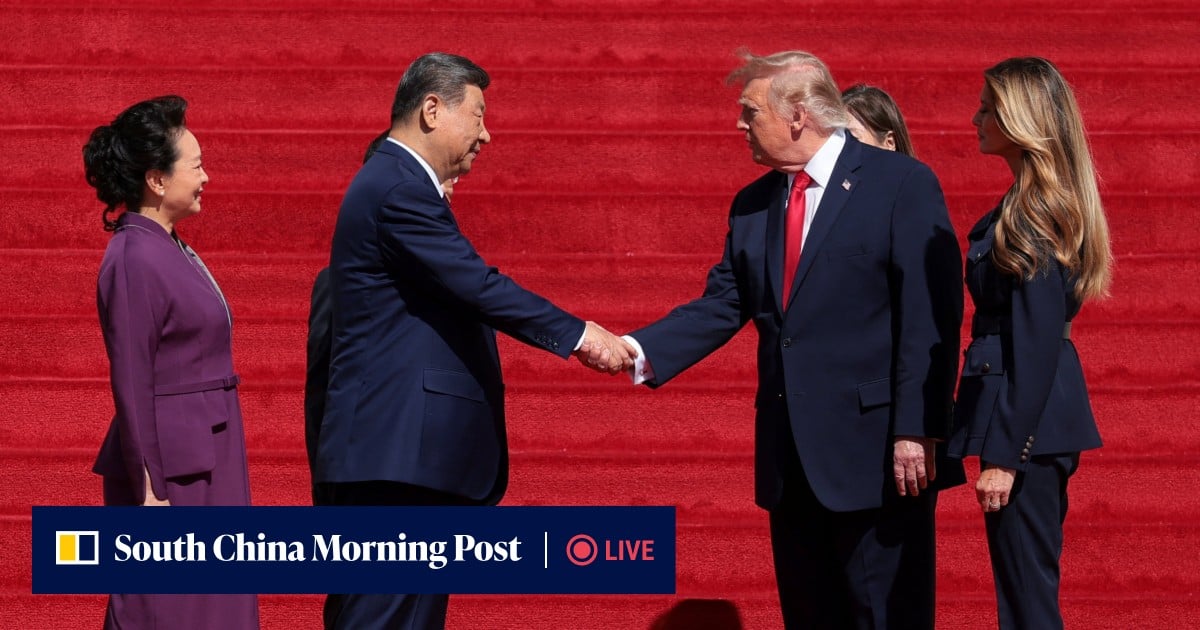
 www.scmp.com
Never mind
Xi ends 3-day Trump visit with promise to meet again in November in China
Chinese president confirms that more meetings are expected with US leader on final day of his state visit.
www.scmp.com
Never mind
Over the last 5 years, US government bond yields have skyrocketed by roughly 3.60 to 4.60 percentage points.
In September 2021, the global economy was still navigating post-pandemic reopening policies. The Federal Reserve maintained near-zero interest rates, which anchored shorter-term yields and kept the 10-year note well under 2.00%. Today, a rigorous regime of rate hikes to combat persistent inflation has drastically shifted the fixed-income landscape.
The direct comparisons demonstrate this multi-year upward trajectory:
In September 2021, the global economy was still navigating post-pandemic reopening policies. The Federal Reserve maintained near-zero interest rates, which anchored shorter-term yields and kept the 10-year note well under 2.00%. Today, a rigorous regime of rate hikes to combat persistent inflation has drastically shifted the fixed-income landscape.
The direct comparisons demonstrate this multi-year upward trajectory:
| Maturity | Yield 5 Years Ago (Sept 2021) | Current Yield (Sept 2026) | Total Increase (Basis Points) |
|---|---|---|---|
| 2-Year Treasury | ~0.25% | 4.87% | +4.62% (+462 bps) |
| 5-Year Treasury | ~0.80% | 5.03% | +4.23% (+423 bps) |
| 10-Year Treasury | ~1.35% | 5.18% | +3.83% (+383 bps) |
| 30-Year Treasury | ~1.90% | 5.48% | +3.58% (+358 bps) |