What is the Abomination of Desolation?

  • Christian Chat is a moderated online Christian community allowing Christians around the world to fellowship with each other in real time chat via webcam, voice, and text, with the Christian Chat app. You can also start or participate in a Bible-based discussion here in the Christian Chat Forums, where members can also share with each other their own videos, pictures, or favorite Christian music.

    If you are a Christian and need encouragement and fellowship, we're here for you! If you are not a Christian but interested in knowing more about Jesus our Lord, you're also welcome! Want to know what the Bible says, and how you can apply it to your life? Join us!

    To make new Christian friends now around the world, click here to join Christian Chat.
That is a misinterpretation. Let's look at the verse again:

Daniel 12:11 - And from the time that the daily sacrifice shall be taken away, and the abomination that maketh desolate set up, there shall be a thousand two hundred and ninety days.

At first glance, it sounds like there are two separate events being described that are separated by 1290 days:
  1. The time that the daily sacrifice shall be taken away
  2. The abomination that maketh desolate set up
That is not the case. These two events happen at the same time. What so many fail to do is look at the context of the entire chapter as well as the entire book of Daniel. What one will find if they do their homework is that there is a common starting point for all of the 'days' prophecies.

It is a simple timeline of years:
  • 0 = Exodus (woman flees to wilderness)
  • 1260 = Jesus is born
  • 1290 = Jesus begins ministry
  • 1335 = Destruction of Jerusalem in 70 AD
The day/year principle must be applied to all of Daniel's prophecy, not just the seventy weeks. People flip-flop back and forth like sleazy politicians to make it all fit some convoluted eschatology. No mental gymnastics are required. God made it easy for us to understand.

Yet if we do and use chapter 8 we end up with 3.2 years of evening and morning sacrifices(2300 hat-tam-id's) instead of 1260,1290 or 1335. https://biblehub.com/interlinear/daniel/8.htm
 
False.
The Abomination of Desolation spoken of by Daniel and reaffirmed by Jesus is yet future.

And the coming desolator is the climactic enemy of God and Israel—the greater Antiochus, the greater Goliath, the greater Haman, the greater Absalom, and the greater Judas.

He is the final Satan-energized man of lawlessness, the supreme counterfeit ruler, the one who exalts himself against God and desecrates the holy place.

He is the man of sin / man of lawlessness, the son of perdition (2 Thess. 2:3–4), the Beast of Revelation 13, and the ruler commonly known as the Antichrist.

Daniel foretells his desecration of the sanctuary (Dan. 9:27; 11:36–37; 12:11), and Jesus deliberately places that Abomination in relation to a still-future crisis: “When ye therefore shall see the abomination of desolation, spoken of by Daniel the prophet, stand in the holy place…” (Matt. 24:15).

Thus Antiochus IV was an extraordinary historical prototype, but not the exhaustive fulfillment of Christ’s prophecy. The final desolator will reproduce Antiochus’s sacrilege on a vastly greater scale during Daniel’s climactic seventieth week.

He is Christ’s satanic counterfeit and adversary—the final ruler who opposes God, profanes the sanctuary, persecutes the saints, and is personally destroyed by the returning Messiah (2 Thess. 2:8; Rev. 19:19–20).

Oh and BTW, you might note the fact that this Satan-man counterfeit PRECEDES the God-man Jesus Christ.
And the WHOLE WORLD will be thrust into a situation where they will make a CHOICE between the two.
I will stick with the fact that Yeshua was able to recall an event that did happen in the past so those listening to Him could reference to about the future.
 
I appreciate the clarity of your argument, but Daniel 9:4 does not establish the Sinai covenant as the referent of the covenant in 9:27, and the Hebrew of higbîr berît (“he will make strong/confirm a covenant”) does not mean “strengthen the existing covenant” unless the context explicitly identifies the covenant being strengthened. Daniel’s prayer in 9:4 is retrospective — he is confessing Israel’s violation of the Mosaic covenant — but the angel’s prophecy in 9:24–27 is prospective, describing future events, future actors, and a future covenant action. The shift from Daniel’s prayer to Gabriel’s prophecy breaks the referential chain; the covenant Daniel mentions is not the covenant Gabriel describes. And the grammar reinforces this: the subject of higbîr is the same subject who “causes sacrifice to cease” and who is associated with “abominations” and “desolation.” That cannot be Jesus, because Jesus does not cause the sacrificial system to cease in history (it continues until AD 70), nor is He ever associated with “abominations” or “desolation.” Your appeal to Jeremiah’s New Covenant is theologically beautiful but exegetically mismatched: Jeremiah’s New Covenant replaces the Sinai covenant, not “strengthens” it, and Hebrews explicitly says the Old Covenant is “obsolete and vanishing away,” not “strengthened.” So the logic you’re proposing — Sinai covenant → strengthened by Jesus → internalized by the Spirit — is good theology, but it is not what Daniel 9:27 is describing. The covenant in 9:27 is not identified, not tied to 9:4, and not connected to Messiah’s ministry; it is tied grammatically to the coming prince of 9:26.

but that still doesn’t solve the core textual problem: symbolism can veil events, but it cannot override the subject‑chain Daniel himself establishes. Daniel absolutely uses symbolic titles (little horn, king of fierce countenance, ram, goat), but he never uses symbolism to transfer agency from one subject to another within the same sentence. In Daniel 9:26–27, the “people of the prince who is to come” destroy the city; that prince is the referent of the next verse’s “he”; that same he confirms a covenant; that same he stops sacrifice; that same he is associated with abominations and desolation. Symbolism can make the nature of the covenant action opaque, but it cannot make the actor ambiguous. Your AD 70 footprint argument is thoughtful, but it’s backwards: you’re letting history determine the agent, then reading that agent back into the text, even though the grammar ties the agent to the destroyers, not to Messiah. The destruction of Jerusalem in AD 70 fits Daniel 9:26 perfectly — but Daniel never says the covenant‑maker is Messiah, never says the desolator is a first‑century Jewish leader, and never symbolically reassigns the subject. The footprint matches the event, not the agent.

that argument still runs into a hard textual wall: Hebrew prophetic symbolism can veil events, but it does not veil or reassign the grammatical subject inside a tightly linked verbal chain. Daniel absolutely shifts agents in long symbolic visions (the ram, the goat, the little horn), but he never shifts agents mid‑sentence or mid‑clause without introducing a new subject. In 9:26–27, the chain is syntactically unbroken: the “people of the prince who is to come” destroy the city; that prince is the antecedent of the next verse’s “he”; that same he confirms a covenant; that same he stops sacrifice; that same he is associated with abominations and desolation. Your claim that “the Messiah is the primary subject of v. 26” is not supported by the grammar — the Messiah is the subject of the first clause (“Messiah shall be cut off”), but the next clause introduces a new subject, “the people of the prince who is to come,” and Hebrew does not allow you to skip that subject and resume Messiah without a re‑introduction. Daniel’s prayer in 9:4 does not control Gabriel’s prophecy; the covenant Daniel mentions is retrospective, the covenant in 9:27 is prospective, and nothing in the text identifies them as the same. Your AD 70 footprint is real — the destruction fits 9:26 perfectly — but the footprint matches the event, not the agent, because Daniel’s grammar ties the covenant‑maker, the sacrificestopper, and the desolator to the coming prince, not to Messiah.

Never will understand how 4 simple verses can be so confusing unless one just does not want to see.

I tend to agree with Roger. I suggest you reread the text again before going on. Do you have your own KJV?
The last week of the 70 began in 27AD and ended in 34AD. It follows in chronological order after the first 69 weeks (483 years).
Jesus was baptized (Fall 27 AD) and began His public ministry. From the moment the Holy Spirit landed on Him He became the Messiah (The Anointed One). "Cut off" to do not His own work but the works of His Father. He was a carpenter by trade. When did He ever make anything out of wood during His public ministry?
He continued the 70 week covenant with the Jews (Daniel's people) until that last week was finished. Not just alone but with the help of His followers.
In the middle of that last week He was crucified (spring 31AD). This put and end to the sacrifices and oblations (we no longer kill animals for redemption from sin). AT THE SAME TIME the hand writings of ordinances that was against us was nailed to that same cross.
Jesus made desolate the overspreading of abominations the Levitical laws had become by His time.

3 1/2 years after the crucifixion Stephen was stoned and the Gospel went to the Gentiles. The Jewish Dispensation was over and the Christian Dispensation had begun. Specifically mid-late October 34 AD.

Making desolate on overspreading of abominations is not at all the same thing as an abomination that makes desolate.

Destroying the earth by flood was God's doing. He made desolate an overspreading of abominations. Same thing for Sodom and Gomorrah.
Trampling bibles through poopy streets before burning them and killing those who follow God's teachings is an abomination of desolation.
I don't understand why people cannot see the difference between what God does vs what Satan does.....
 
I will stick with the fact that Yeshua was able to recall an event that did happen in the past so those listening to Him could reference to about the future.
Right. However this particular future prevails post Church age only.

FYI, according to Daniel, this particular future pertains primary to his people Israel and his holy city Jerusalem.
 
Right. However this particular future prevails post Church age only.

FYI, according to Daniel, this particular future pertains primary to his people Israel and his holy city Jerusalem.
The claiming to be God is not as great of an Abomination to the Jews because at first they will believe he is, who will witness the Antichrist in the future as the ungodly Offering upon the Altar of the Temple would be. This is why Yeshua mentioned Daniel.
 
The Book of Daniel describes something called 'the abomination that maketh desolate':

Daniel 11:31 - And arms shall stand on his part, and they shall pollute the sanctuary of strength, and shall take away the daily sacrifice, and they shall place the abomination that maketh desolate.

Daniel 12:11 - And from the time that the daily sacrifice shall be taken away, and the abomination that maketh desolate set up, there shall be a thousand two hundred and ninety days.

What is it? Has it happened already?

According to Daniel 9:27, the Abomination of Desolation happens in the 'midst of the week':

Daniel 9:27 - And he shall confirm the covenant with many for one week: and in the midst of the week he shall cause the sacrifice and the oblation to cease, and for the overspreading of abominations he shall make it desolate, even until the consummation, and that determined shall be poured upon the desolate.

Isn't that when the Crucifixion happened?
This is my best guess.

When Jerusalem fell to the Romans in AD 70, they installed in Jerusalem, images of Vespasian Caesar in Jerusalem and then one inside the temple, which they sacrificed to and worshipped. After the man of sin makes public claims to being a god above all other gods, and takes over Jerusalem, I think he will install images of himself throughout Jerusalem, and an AI robotic image of himself to be worshipped in Jerusalem at the same site as where Titus placed the image of Vespasian in the temple in AD 70.
 
Do me a favor and please don't patronize me. It's incredibly rude. You can disagree with me, it's fine, but patronizing is going to get you no where. Do you talk to everyone like this? Someone disagrees with you and you talk down to them and assume they aren't studying scripture and get their info from Youtube? Goodness gracious ....
Yes, he talks to me like that, too. But - my skin is thick enough - I am not worried in the slightest. One day God will show forth the truth ---

"I can wait..." :)

Does no one on this site actually have a debate without arrogant attitudes?
I always do my very best to focus on what is being discussed and never target individuals with personal insults, etc.

There are many people on here who I disagree with on certain things; nonetheless, I actually like the person(a).

It is never my intent to create adversarial attitudes/situations/etc. with regard to any member of the site.

If someone on here is my brother/sister in Christ - I consider that to be the most important thing.

So, I try to treat them as such - in the hope of the greatest opportunity for real fellowship.

There is a big difference between confidently stating what you believe and being arrogant to the point of boasting absolute infallibility.

When people get a bit too proud and turn a thread into "nothing but a big argument" - I tend to start getting ready to make an exit - because, at that point, it is just a waste of time to participate - there is no sense in putting up with all of that...

Again ---

"I can wait..." :)
 
I often find it very interesting when I discover that - with pretty-much everyone in a "discussion" ('argument'?) in a thread - I agree with them with regard to one thing while I disagree with them with regard to another - such is the highly-variable nature of what folks come to believe - however they came to believe it.
 
  • Like
Reactions: WayneNSO
There can be 5 people in a discussion - and, no 2 of them agree totally 100% - yet, there are "overlaps" in what all 5 people believe. It is, in a way, almost 'bizarre' to watch the conversation progress.

(At least, until one or more decide that they just cannot have a calm considerate conversation anymore - then, it becomes something else altogether.)
 
I know we have some different views, although pretty close on many, but this thread is more often than not >>>>> error refuting error.
Agree there is no point in engaging.
It is all over the map!!
"more often than not >>>>> error refuting error"

You can say that again - and again - and again. ;)
 
  • Like
Reactions: HeIsHere
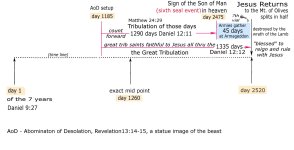
I was watching to see if anyone would post Daniel 12:11 and point out that it says the AOD would be set up 1290 days after the Daily Sacrifice was taken away not 1290 days/years from when it began. https://biblehub.com/interlinear/daniel/12-11.htm
Daniel 12:

11 And from the time that the daily sacrifice shall be taken away, and the abomination that maketh desolate set up, there shall be a thousand two hundred and ninety days.


The 'taken away' phrase and the 'set up' phrase go together - the time span is after both of them occurring together at the same [relative] point in time - not between them as though they occurred at different times '1290 days' apart. (And, they are actual [24-hour] days.)
 
The question is - what is at the end of that 1290 days - and that must be discerned from the passage. (And, backed up by history, of course.)
 
KJV and Erasmus Majority text and Hebrew Masoretic Text

I suppose it could be read - from the daily sacrifice taken away which obviously was Christs crucifixion to the abomination that maketh desolate is 1290 days
There are two different times in biblical prophecy and history when the 'daily sacrifice' was 'taken away'/'caused to cease':

1) The Abomination of Desolation in/of 167 B.C. (Daniel 11:31)

2) When Christ was crucified. (Daniel 9:27, Matthew 27:51, Mark 15:38 - and, of course, 70 A.D.)

Be careful not to conflate or confuse them.
 
2) When Christ was crucified. (Daniel 9:27, Matthew 27:51, Mark 15:38 - and, of course, 70 A.D.)
I was so busy trying to include all of the "data points" that I ended up appending the 70 A.D. part onto #2 when it really should have been #3 - so, technically, there are three times when...

( Originally, I was not thinking about or intending to include the [painfully obvious] 70 A.D. part - then, I changed my mind - not a good thing to do when trying to beat the 5 minute edit limit. :oops: :rolleyes: )
 
There are two different times in biblical prophecy and history when the 'daily sacrifice' was 'taken away'/'caused to cease':

1) The Abomination of Desolation in/of 167 B.C. (Daniel 11:31)

2) When Christ was crucified. (Daniel 9:27, Matthew 27:51, Mark 15:38 - and, of course, 70 A.D.)

Be careful not to conflate or confuse them.
I was so busy trying to include all of the "data points" that I ended up appending the 70 A.D. part onto #2 when it really should have been #3 - so, technically, there are three times when...

( Originally, I was not thinking about or intending to include the [painfully obvious] 70 A.D. part - then, I changed my mind - not a good thing to do when trying to beat the 5 minute edit limit. :oops: :rolleyes: )
Correction so that it is perfectly clear:

There are three different times in biblical prophecy and history when the 'daily sacrifice' was 'taken away'/'caused to cease':

1) The Abomination of Desolation in/of 167 B.C. (Daniel 11:31, 12:11)

2) When Christ was crucified. (Daniel 9:27, Matthew 27:51, Mark 15:38)

3) 70 A.D.

Be careful not to conflate or confuse them.
 
And the most often overlooked might be in the very time period when the vision was given to Daniel. One may find seventy years with no daily sacrifices along with a sixty-six by six idol one is commanded to worship.
 
Here are a couple of charts I made that involves the 1290 days and the 1335th day.
The 1335 days are past history.

The 1290 days are the time span of there being no sacrifices made in the temple after it was "polluted" in 167 B.C. (Daniel 11:31)

The rest of the days mark the time span of the temple being cleansed and "rededicated" back into service after that.