Finneyists among us

  • Christian Chat is a moderated online Christian community allowing Christians around the world to fellowship with each other in real time chat via webcam, voice, and text, with the Christian Chat app. You can also start or participate in a Bible-based discussion here in the Christian Chat Forums, where members can also share with each other their own videos, pictures, or favorite Christian music.

    If you are a Christian and need encouragement and fellowship, we're here for you! If you are not a Christian but interested in knowing more about Jesus our Lord, you're also welcome! Want to know what the Bible says, and how you can apply it to your life? Join us!

    To make new Christian friends now around the world, click here to join Christian Chat.
Horton was cited in the opening post. I am comparing scripture with assertions on the teachings of Finney as they have been asserted here so far. I am not advocating for (or against) Finney, but rather doing just what you ask - comparing his teachings as asserted to the scriptures. You may want to question the motives of some of Finney's detractors is all, with Horton you may find yourself in the not too distant future in the Synagogue of Satan, kissing pictures of Jesus. The background and setting on Finney I believe is important in the sense of context and audience. Press on with doctrines you find questionable, it is good that we should study them.

My use of another's commentary on Finney's doctrines doesn't of itself vouch for my acceptance or rejection of all of that person's doctrines. If your concerns with Horton pertain in any way to what is written against him on the Christiancitizens.org website, I am not really concerned.
 
My use of another's commentary on Finney's doctrines doesn't of itself vouch for my acceptance or rejection of all of that person's doctrines. If your concerns with Horton pertain in any way to what is written against him on the Christiancitizens.org website, I am not really concerned.

Horton rejects Finney on the premise of Finney's rejection of inability. It is on top of this notion of inability that the Reformed doctrine of Penal Substitution is established for inability and ongoing inward depravity in salvation precludes heart purity being possible in salvation and henceforth a doctrine of a forensic judicial exchange fits perfectly.

Horton in effect rests upon a whole onion of error.

Finney on the other hand peeled away several of the underlying layers yet still left that which was established on those underlying errors firmly in place.
 
The only reason you say that is because I don't believe you really understand my perspective and that you also have an uncritical approach to the tenets of Reformed Theology.

I do have an uncritical approach to Reformed Theologians, and I don't really care about your perspective. I care about the doctrine you teach. I do not base my beliefs on Reformed theology, even though I recognize that its tenets have heavily influenced by beliefs. I base my beliefs on the witness of the holy spirit vis-a-vis the word; the same thing the reformers did.

It is the spirit that gave me witness when I first read your comments that something was seriously wrong. The reason I say that yours and Finney's beliefs are in many respects identical is because when I first read some of Finney's doctrines, I said to myself, 'That's skinski'. IMO you are really desperate or in denial to say otherwise.

If you did not have an uncritical approach to the Reformed system you would clearly be willing to address the clear shortcomings within the context of "escaping the corruption that is in the world through lust" and "heart purity" as it applies to Reformed Theology. Both of those biblical precepts are pretty much elephants standing in the room which are completely ignored, the only exception really being diversionary canned responses.

I don't argue from a position of reformed theology; you do. I base my arguments on what the word says as witnessed by the spirit. You apparently are helpless in that regard because you have only been able to argue from the perspective of your contrived theological framework that requires reams of text to make the simplest point. Your are completely lost without the laundry list of talking points and dubious theological connections built upon fallacies that you have devised. I don't need a framework; I have the spirit of truth residing within me who witnesses to the truth in the word.

As this thread progresses, we will see if your claim that your and his beliefs aren't virtually identical.
 
Horton rejects Finney on the premise of Finney's rejection of inability. It is on top of this notion of inability that the Reformed doctrine of Penal Substitution is established for inability and ongoing inward depravity in salvation precludes heart purity being possible in salvation and henceforth a doctrine of a forensic judicial exchange fits perfectly.

Horton in effect rests upon a whole onion of error.

Finney on the other hand peeled away several of the underlying layers yet still left that which was established on those underlying errors firmly in place.

Horton was certainly right to reject Finney's doctrines that are based on the denial of the inherent corruption of man.
 
I do have an uncritical approach to Reformed Theologians, and I don't really care about your perspective. I care about the doctrine you teach. I do not base my beliefs on Reformed theology, even though I recognize that its tenets have heavily influenced by beliefs. I base my beliefs on the witness of the holy spirit vis-a-vis the word; the same thing the reformers did.

It is the spirit that gave me witness when I first read your comments that something was seriously wrong. The reason I say that yours and Finney's beliefs are in many respects identical is because when I first read some of Finney's doctrines, I said to myself, 'That's skinski'. IMO you are really desperate or in denial to say otherwise.


I don't argue from a position of reformed theology; you do. I base my arguments on what the word says as witnessed by the spirit. You apparently are helpless in that regard because you have only been able to argue from the perspective of your contrived theological framework that requires reams of text to make the simplest point. Your are completely lost without the laundry list of talking points and dubious theological connections built upon fallacies that you have devised. I don't need a framework; I have the spirit of truth residing within me who witnesses to the truth in the word.

As this thread progresses, we will see if your claim that your and his beliefs aren't virtually identical.

I am very interested to hear your perspective on what "having escaped the corruption that is in the world through lust" means?

2Pe 1:3 According as his divine power hath given unto us all things that pertain unto life and godliness, through the knowledge of him that hath called us to glory and virtue:
2Pe 1:4 Whereby are given unto us exceeding great and precious promises: that by these ye might be partakers of the divine nature, having escaped the corruption that is in the world through lust.

My understanding is that when we come to Christ through repentance and faith we lay aside our old way of doing things and therefore submit ourselves to God. Thus we are no longer being led around by the natural passions of the human body as our god but rather yield our body as a living sacrifice to God.

Thus...

1Pe 4:1 Forasmuch then as Christ hath suffered for us in the flesh, arm yourselves likewise with the same mind: for he that hath suffered in the flesh hath ceased from sin;
1Pe 4:2 That he no longer should live the rest of his time in the flesh to the lusts of men, but to the will of God.

Eph 5:1 Be ye therefore followers of God, as dear children;
Eph 5:2 And walk in love, as Christ also hath loved us, and hath given himself for us an offering and a sacrifice to God for a sweetsmelling savour.
Eph 5:3 But fornication, and all uncleanness, or covetousness, let it not be once named among you, as becometh saints;
Eph 5:4 Neither filthiness, nor foolish talking, nor jesting, which are not convenient: but rather giving of thanks.
Eph 5:5 For this ye know, that no whoremonger, nor unclean person, nor covetous man, who is an idolater, hath any inheritance in the kingdom of Christ and of God.
Eph 5:6 Let no man deceive you with vain words: for because of these things cometh the wrath of God upon the children of disobedience.
Eph 5:7 Be not ye therefore partakers with them.
Eph 5:8 For ye were sometimes darkness, but now are ye light in the Lord: walk as children of light:
Eph 5:9 (For the fruit of the Spirit is in all goodness and righteousness and truth;)
Eph 5:10 Proving what is acceptable unto the Lord.
Eph 5:11 And have no fellowship with the unfruitful works of darkness, but rather reprove them.

Rom 6:1 What shall we say then? Shall we continue in sin, that grace may abound?
Rom 6:2 God forbid. How shall we, that are dead to sin, live any longer therein?
Rom 6:3 Know ye not, that so many of us as were baptized into Jesus Christ were baptized into his death?
Rom 6:4 Therefore we are buried with him by baptism into death: that like as Christ was raised up from the dead by the glory of the Father, even so we also should walk in newness of life.
Rom 6:5 For if we have been planted together in the likeness of his death, we shall be also in the likeness of his resurrection:
Rom 6:6 Knowing this, that our old man is crucified with him, that the body of sin might be destroyed, that henceforth we should not serve sin.
Rom 6:7 For he that is dead is freed from sin.

Eph 2:1 And you hath he quickened, who were dead in trespasses and sins;
Eph 2:2 Wherein in time past ye walked according to the course of this world, according to the prince of the power of the air, the spirit that now worketh in the children of disobedience:
Eph 2:3 Among whom also we all had our conversation in times past in the lusts of our flesh, fulfilling the desires of the flesh and of the mind; and were by nature the children of wrath, even as others.
Eph 2:4 But God, who is rich in mercy, for his great love wherewith he loved us,
Eph 2:5 Even when we were dead in sins, hath quickened us together with Christ, (by grace ye are saved;)

In all the time I have posted on this forum I don't believe I have seen a single response ever address "having escaped the corruption in the world through lust." The reason for this, in my mind, is that most people believe such a thing is impossible whilst we are in flesh bodies due to an underlying belief of inward depravity inherited from Adam thus they simply ignore all the verses in regards to a manifest state of the old man being crucified with the passions and desires.

Care to address it? Or will you let it slide off and speak about something else?

 
Last edited:
Horton rejects Finney on the premise of Finney's rejection of inability. It is on top of this notion of inability that the Reformed doctrine of Penal Substitution is established for inability and ongoing inward depravity in salvation precludes heart purity being possible in salvation and henceforth a doctrine of a forensic judicial exchange fits perfectly.

Horton in effect rests upon a whole onion of error.

Finney on the other hand peeled away several of the underlying layers yet still left that which was established on those underlying errors firmly in place.

Well now we can start a list of common beliefs held by you and Finney:

  • Denial of the inherent corruption of man
 
I am very interested to hear your perspective on what "having escaped the corruption that is in the world through lust" means?

...

Care to address it? Or will you let it slide off and speak about something else?

OK, I'll try to get to it later.
 
Well now we can start a list of common beliefs held by you and Finney:

  • Denial of the inherent corruption of man

I don't deny the corruption of men. I deny that men are BORN ALREADY condemned and in rebellion to God.

I deny that infants are depraved, wicked, condemned and enemies of God. Infants are INNOCENT and are neither righteous nor unrighteous. They are upright in their hearts because they know no sin because the sin that cuts one off from God is any act of known rebellion, ie. choosing evil when you know it is evil. Not falling short due to ignorance like when a baby demands a toy or throws a tantrum.

Augustine taught that unelect infants go to hell. Likewise John Calvin taught the same thing. Many other Calvinists slide around the issue to varying degrees but they all confess as truth that babies are guilty before God, they just differ in that some believe that the blood may be applied in some way.
 
I. Our first parents, being seduced by the subtilty and temptations of Satan, sinned, in eating the forbidden fruit.[1] This their sin, God was pleased, according to His wise and holy counsel, to permit, having purposed to order it to His own glory.[2]
II. By this sin they fell from their original righteousness and communion, with God,[3] and so became dead in sin,[4] and wholly defiled in all the parts and faculties of soul and body.[5]
III. They being the root of all mankind, the guilt of this sin was imputed;[6] and the same death in sin, and corrupted nature, conveyed to all their posterity descending from them by ordinary generation.[7]
IV. From this original corruption, whereby we are utterly indisposed, disabled, and made opposite to all good,[8] and wholly inclined to all evil,[9] do proceed all actual transgressions.[10]

V. This corruption of nature, during this life, does remain in those that are regenerated;[11] and although it be, through Christ, pardoned, and mortified; yet both itself, and all the motions thereof, are truly and properly sin.[12]
VI. Every sin, both original and actual, being a transgression of the righteous law of God, and contrary thereunto,[13] does in its own nature, bring guilt upon the sinner,[14] whereby he is bound over to the wrath of God,[15] and curse of the law,[16] and so made subject to death,[17] with all miseries spiritual,[18] temporal,[19] and eternal.[20]
WCF
Westminster Confession of Faith

Look at Article 4 above. That document blames sin on a birth defect. How can any individual be held responsible for their sin if they sin by necessity? Adam made me do it? Really?

How can someone come clean in repentance if in their heart they honestly believe that their sin is not really their fault? How can someone forsake a birth nature? The Bible clearly says in many places that we are to forsake unrighteousness as a condition of mercy being granted, how is that possible if one is unable to forsake unrighteousness due to a birth defect?

Reformed Theology has revered the Gospel in teaching that we get saved first and then we can repent and forsake our wickedness.
 
How can someone come clean in repentance if in their heart they honestly believe that their sin is not really their fault?

ha?
you're the guy who no longer needs to confess any sins.

you're also the guy who claimed Emmanuel experienced sexual lust.

right...like God with us is tempted sexually by sinful people. sickening skinski.
 
ha?
you're the guy who no longer needs to confess any sins.

you're also the guy who claimed Emmanuel experienced sexual lust.

right...like God with us is tempted sexually by sinful people. sickening skinski.

Zone can you substantiate that with quotes provided in context?

I don't think so. Therefore prove me wrong. I charge that you are lying when you claim that.

Jesus was in a flesh and blood body and therefore experienced all the natural passions and desires that we have. Sexual desire is not sin. Sexual desire draws people to sin in both mind (lust in the heart) and deed.

I have never claimed that Jesus lusted in the sense of committing adultery in His heart and you will be unable to find any quote of me saying such a thing.

The Bible says that Jesus was tempted in ALL points as we are.

Heb 4:15 For we have not an high priest which cannot be touched with the feeling of our infirmities; but was in all points tempted like as we are, yet without sin.

Temptation is common to man.

1Co 10:13 There hath no temptation taken you but such as is common to man: but God is faithful, who will not suffer you to be tempted above that ye are able; but will with the temptation also make a way to escape, that ye may be able to bear it.

Jesus condemned sin in the flesh because He walked according to the Spirit
Rom 8:3 For what the law could not do, in that it was weak through the flesh, God sending his own Son in the likeness of sinful flesh, and for sin, condemned sin in the flesh:

The reason He did this was so that true righteousness be fulfilled in us when we, in like manner, also walk according to the Spirit.

Rom 8:4 That the righteousness of the law might be fulfilled in us, who walk not after the flesh, but after the Spirit.

Thus it is by the Spirit that we put to death the deeds of the body for we are not called to walk according to the flesh but to walk according to the Spirit.
Rom 8:11 But if the Spirit of him that raised up Jesus from the dead dwell in you, he that raised up Christ from the dead shall also quicken your mortal bodies by his Spirit that dwelleth in you.
Rom 8:12 Therefore, brethren, we are debtors, not to the flesh, to live after the flesh.
Rom 8:13 For if ye live after the flesh, ye shall die: but if ye through the Spirit do mortify the deeds of the body, ye shall live.
Rom 8:14 For as many as are led by the Spirit of God, they are the sons of God.

Jesus lived through the Spirit and we find life through that very same Spirit. The Spirit of life IN Jesus Christ.

Rom 8:1 There is therefore now no condemnation to them which are in Christ Jesus, who walk not after the flesh, but after the Spirit.
Rom 8:2 For the law of the Spirit of life in Christ Jesus hath made me free from the law of sin and death.


It is very easy to misrepresent people, create a strawman, and then pull down that strawman. Yet it is very dishonest.
 
The natural passions and desires of the flesh are not sin. They are simply the natural passions. Sinners misuse their natural passions by seeking to gratify them in discordance to the will of God.

Sexual desire for example is not sinful. It is a natural draw that God created in men and women in order to facilitate the union of a husband and wife.

It is sin when people dwell in the mind of fulfilling such desire in an illicit manner say by viewing pornography or by mentally undressing people etc. Thus to look on a woman in lust is not to simply be sexually attracted to a member of the opposite sex, that is merely temptation and temptation is common to man. It is sin when we let such a desire to take hold of our imagination and thus to think on an illicit fulfillment of such things. Likewise it is sin to actually act out physically such an illicit fulfillment.

Again, Jesus was tempted in ALL POINTS as we are yet without sin. Therefore we have no excuse because like God told Cain we can rule over sin if we so wish to do so.

Gen 4:6 And the LORD said unto Cain, Why art thou wroth? and why is thy countenance fallen?
Gen 4:7 If thou doest well, shalt thou not be accepted? and if thou doest not well, sin lieth at the door. And unto thee shall be his desire, and thou shalt rule over him.

How do we rule over it? By submitting ourselves to God from the heart and walking in the power of His Spirit.

1Jn 2:14 I have written unto you, fathers, because ye have known him that is from the beginning. I have written unto you, young men, because ye are strong, and the word of God abideth in you, and ye have overcome the wicked one.
1Jn 2:15 Love not the world, neither the things that are in the world. If any man love the world, the love of the Father is not in him.
1Jn 2:16 For all that is in the world, the lust of the flesh, and the lust of the eyes, and the pride of life, is not of the Father, but is of the world.
1Jn 2:17 And the world passeth away, and the lust thereof: but he that doeth the will of God abideth for ever.


Many people confuse temptation with sin. Augustine made this error because he viewed the natural passions and desires of the flesh as "concupiscence" and he taught that concupiscence was proof of the sin nature passed down from Adam. Yet in Genesis 3:6 we read that Eve was drawn away by concupiscence BEFORE she corrupted herself with sin.

Gen 3:6 And when the woman saw that the tree was good for food, and that it was pleasant to the eyes, and a tree to be desired to make one wise, she took of the fruit thereof, and did eat, and gave also unto her husband with her; and he did eat.

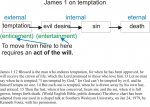
James sums it up nicely...

Jas 1:14 But every man is tempted, when he is drawn away of his own lust, and enticed.
Jas 1:15 Then when lust hath conceived, it bringeth forth sin: and sin, when it is finished, bringeth forth death.
 
Last edited:
5767132101_26f58f1801_o.jpgpride-fall1.jpg

Sorry for using a Wesleyan reference - it looks scriptural.

ID -->> Desires of the Flesh, the uncontrolled reactions to the five sense, taste, touch, sight, hearing, smelling

EGO -->> The desires of the mind

SUPER-EGO -->> the Database of precepts of right living - i.e. the gospel - that restrain the ID (flesh / works of the flesh) and restrain the EGO (spirits, attitudes of the mind)
 
That is a great image there Digital. It nails it right on.

Yet the issue found in both Wesleyian Theology and Reformed Theology is in how they teach "act of the will." Due to both systems upholding the notion of birth depravity, with Reformers it is total whilst with Wesleyian's it is partial, both systems by necessity teach the notion of inability.

Thus The Gospel is approached with this notion of inability in mind. Reformed Theology uses "Irresistible Grace" as the means of offsetting inability whilst the Arminian/Wesleyian side use "Prevenient Grace" as the means to offset inability. Reformed Theology teaches that the rebellion to God never stops (as indicated in the quote from the WCF above) whilst the Arminiam/Wesleyian side generally teach "Entire Sanctifcation" where the inward corruption due to birth depravity is gradually purged out completely (very similar to what Cobus teaches).

The Bible does not teach inability because from beginning to end men are presented with a choice of who will they serve?

Jos_24:15 And if it seem evil unto you to serve the LORD, choose you this day whom ye will serve; whether the gods which your fathers served that were on the other side of the flood, or the gods of the Amorites, in whose land ye dwell: but as for me and my house, we will serve the LORD.

We get to choose. Many people err in thinking giving men "choice" somehow infringes on the grace of God but it does not because Grace is the free provision by which God draws us but we have to comply with faith. This is why Paul connects "working together with God" to "grace being effectual."

2Co 5:21 For he hath made him to be sin for us, who knew no sin; that we might be made the righteousness of God in him.
2Co 6:1 We then, as workers together with him, beseech you also that ye receive not the grace of God in vain.

To work together with God is a choice that God compels us to make but does not force us to do so.

Many will object and claim "faith is a gift." Yet they negate that the "means" of receiving this gift is due diligence on the part of an individual. (Heb 11:6). God does not make people diligently seek Him but He rewards all those who do so with the gift of faith.

The gift of God is eternal life THROUGH Jesus Christ but the means of abiding in the "through" is always a choice. That is why we are all acountable for our rebellion to God because it is something we freely chose to do.

Sinners and Saints are not robots. They are individuals with the capacity to choose. Of course sinning hardens the heart and can lead one into a situation where godly sorrow working repentance that leads to salvation may not be found. That is why we ought not take for granted the grace of God for it does not abide on sinners forever.
 
Last edited:
Zone can you substantiate that with quotes provided in context?

I don't think so. Therefore prove me wrong. I charge that you are lying when you claim that.

Jesus was in a flesh and blood body and therefore experienced all the natural passions and desires that we have. Sexual desire is not sin. Sexual desire draws people to sin in both mind (lust in the heart) and deed.

you have NO evidence that Jesus experienced "sexual desire".
none.

in order to experience sexual desire, He would have had to look upon a woman and lust OR to fantasize.

God and Man in human flesh....GOD EXPERIENCED SEXUAL DESIRE? nah.

i'm sorry skinski, but Emmanuel did not experience sexual desire for wretched filthy human beings He came to die for.
walking in the midst of filth...and experiencing sexual desire for it?

let's have your documentation that He did.

ya....born without sin into a world of a heaping steaming mass of vile sinners....and he wants sex.

eh....see ya.
 
this is what you (skinski) charged The Christ with:

concupiscence
kənˈkjuːpɪs(ə)ns/
nounformal
1.
strong sexual desire; lust.
"St Anthony's battle with concupiscence"
synonyms: sexual desire, lust, lustfulness, sexual appetite, sexual longing, sexual passion, ardour, desire, passion;
 
only problem with that DA, is: why the evil desire? (without a fallen nature)

where'd that come from?
skinski will go to the gnostics and apostate judaism...do you?

Find any contextual quotes to support your accusation of me yet Zone?

Of course not. It is much easier to stick to snide remarks with more out of context misrepresentations.


As to your question. "Evil Desire" was how the Jews termed it with their teaching of "Yetzer Ra" yet if you read the context I don't for a minute think they are literally teaching that this "desire" is actually "evil." The context is clearly that the desire brings is a draw to do evil if one resists the moral conscience.

Thus James writes...

Jas 1:12 Blessed is the man that endureth temptation: for when he is tried, he shall receive the crown of life, which the Lord hath promised to them that love him.

Eve experienced...

Gen 3:6 And when the woman saw that the tree was good for food, and that it was pleasant to the eyes, and a tree to be desired to make one wise, she took of the fruit thereof, and did eat, and gave also unto her husband with her; and he did eat.

She did not endure the lusts of the eyes, lust of the flesh, nor the pride of life. Instead she let it rule over her and she sinned. The temptation was not evil but rather a test.

Jesus likewise was tempted in ALL POINTS as we are. Jesus was either tempted in ALL POINTS or the Bible is lying when it says that. Jesus had no sin therefore being tempted in all points is not sin. Jesus would have sinned if He "yielded in all points as we have" yet Jesus did not for He offered Himself without spot.
 
you have NO evidence that Jesus experienced "sexual desire".
none.

in order to experience sexual desire, He would have had to look upon a woman and lust OR to fantasize.

God and Man in human flesh....GOD EXPERIENCED SEXUAL DESIRE? nah.

i'm sorry skinski, but Emmanuel did not experience sexual desire for wretched filthy human beings He came to die for.
walking in the midst of filth...and experiencing sexual desire for it?

let's have your documentation that He did.

ya....born without sin into a world of a heaping steaming mass of vile sinners....and he wants sex.

eh....see ya.

Jesus experienced hunger desire.

Jesus experienced thirst desire.

Jesus experienced wanting to be warm desire.

Jesus experienced wanting to be comfortable desire.

And I put it to you that Jesus experienced sexual desire because He was a human being. Sexual desire is not evil.

You are hung up in your mind that sexual desire is evil. Misusing sexual desire in thought and deed is evil.

The Bible states that Jesus was tempted in ALL POINTS as we are. It doesn't say in SOME POINTS. It doesn't say in all points EXCEPT natural sexual desire.

Heb 4:15 For we have not an high priest which cannot be touched with the feeling of our infirmities; but was in all points tempted like as we are, yet without sin.


Sexual desire is not evil. To think it is evil is a huge stumbling block in your mind. Augustine stumbled over this also, so you are not the first to be deceived in this manner.
 
Not trying to rain on Finney's parade but I believe Jesus was tested in every count of sin. He even had to deal with homosexuality. The scripture reads:

Hebrews 4:15 For we have not an high priest which cannot be touched with the feeling of our infirmities; but was in all points tempted like as we are, yet without sin.

All points he was tempted. He just didn't sin, he gave no place to the devil.