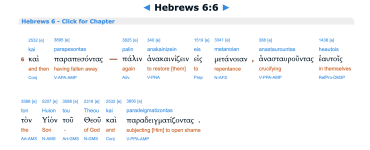
In Hebrews 6:6 a present infinitive is followed by a bare present participle with no connecting particle.

  • Christian Chat is a moderated online Christian community allowing Christians around the world to fellowship with each other in real time chat via webcam, voice, and text, with the Christian Chat app. You can also start or participate in a Bible-based discussion here in the Christian Chat Forums, where members can also share with each other their own videos, pictures, or favorite Christian music.

    If you are a Christian and need encouragement and fellowship, we're here for you! If you are not a Christian but interested in knowing more about Jesus our Lord, you're also welcome! Want to know what the Bible says, and how you can apply it to your life? Join us!

    To make new Christian friends now around the world, click here to join Christian Chat.
You seem like you know where I am at....

Look at the Greek in 6:1 leaving the beginning (Archen) message/word (LOGOS - see 5:13 as well) of Christ and not laying again a foundation of repentance from dead works and faith toward God. This is the message of Christ to repent and believe. These are actions not teachings. Teachings in Greek is in verse 2 and not in verse 1. Verse two is about what other people do to you. The repentance in 6:6 is the repentance in 6:1 in context foundational repentance.

5:11 you need to be taught "again", 6:1 not to lay "again" 6:6 impossibe to make yourself new in kind "again". New in kind is the root word for renew. the ana is upward not again as proof in ana used in 7:27 offered "up" once -> hapax. this is not renewing your magazine subscription. This is about laying your foundation again. Impossible. Look at the Greek for Impossible. It is impersonal. It applies to no one because no one can do this next statement. The Impossible is first word preeminence. It controls the whole clause.

9:25 shows you why it is impossible. He was a once for all sacrifice. -> 9: 25Nor was it to ****offer himself repeatedly****, as the high priest enters the holy places every year with blood not his own,26for then he would have had to ****suffer repeatedly*** since the foundation of the world. But as it is, he has appeared ******once for all**** at the end of the ages to put away sin by the sacrifice of himself.

Read this book again and place yourself as an audience member who has been treating Christ as a repeatable sacrifice (in some way - and it is actually mentioned in the book). The audience had knowledge of what they were doing. We do not. But if you do a test case and read the book, it is one message. The old testament is used as a foil and why you do not treat Christ the same way.

2:1-3 They were neglecting a GREAT salvation. They needed to pay attention to what they first heard, they were drifting by it, not away from it. 5:9 Jesus is the source for eternal salvation for all those who "obey" -> Listen under. But they are dull of hearing.

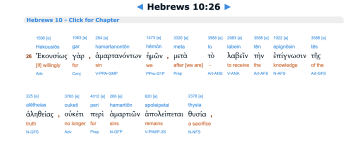
Blow your mind moment 10:26... the knowledge of the truth -> 10:18 repeated. That is the knowledge of the truth he has been telling them for 3 chapters. There is no "if" in the Greek. Young Bible got this one right. The willful sin is not any sin in 10:26 -> 6:1 is the wilful sin that leads to 6:8... the same as 10:27-31

You may be inferring that repenting of later sins and asking for forgiveness for them, when Jesus already forgave once for all, islayimg again a foundation of repentance from dead works and of faith toward God, making Jesus sacrifice repeatable. However, the foundation the author describes has four more elementary doctrines involved in it.

Go read Isaiah 26:9-12 quoted in 10:27:
9My soul yearns for you in the night;
my spirit within me earnestly seeks you.
For when your judgments are in the earth,
the inhabitants of the world ****learn righteousness****.
10If favor is shown to the wicked,
he does not ****learn righteousness****;
in the land of uprightness he deals corruptly
and does not see the majesty of the Lord.
11O Lord, your hand is lifted up,
but they do not see it.
Let them see your *****zeal for your people*****, and be ashamed.
Let the fire for your adversaries (those under but against in LLX) consume them.

How do you treat Christ blood as common in 10:29. Try treating Him as a goat or bull and repeat the sacrifice. How do you outrage the spirit of Grace... try saying 10:17-18 is not enough you need more. How do you cast on him contempt and shame. Ask for another crucifixion.

One Message.

Esau wanted what was impossible. The blessing had been given and could not be taken away.
Esaa changed his mind and wanted the impossible - the blessing could not be taken back
laying repentance again is impossible - Christ died once for all

Fall away... the noun form is used 19 times as transgression and sin in the NT. The Septuagint uses the verb form in Ezekiel 5 times and our English word each time is transgression. And every time it is used, God call for repentance. This word is inflated because we dont know the meaning of the book of Hebrews.

How can we see Jesus being the opposite of what he did with Peter's denial, the prodigal son, calling Israel back after sacrificing to demons, and calling for us to forgive 7X77 as many times as a brother repents.
Do you agree that Heb. 6:4-6 does not say repentance is impossible for such a person, only that it is impossible for the author to bring them to repentance?
Chapter 6 says if we have a dispute it is settle by the oath and it is Impossible for God to lie. You want to know God's oath to us? Go read chapter 8 and 10:17-18. That is His oath. No extra words. Read them plainly as written. He does not lie and we should not call him a liar.

Now, can you find how they were treating Jesus as a repeatable sacrifice in the book of Hebrews?
I think it may be that you think that repenting and asking for forgiveness for later sins would be expecting Jesus to die again for new sins when He has already died once for all sins. Is that what you have in mind?
 
  • Like
Reactions: Mem
You may be inferring that repenting of later sins and asking for forgiveness for them, when Jesus already forgave once for all, islayimg again a foundation of repentance from dead works and of faith toward God, making Jesus sacrifice repeatable. However, the foundation the author describes has four more elementary doctrines involved in it.


Do you agree that Heb. 6:4-6 does not say repentance is impossible for such a person, only that it is impossible for the author to bring them to repentance?

I think it may be that you think that repenting and asking for forgiveness for later sins would be expecting Jesus to die again for new sins when He has already died once for all sins. Is that what you have in mind?
This crossed my mind as some parts recalled to me some that have said, "I don't have to repented" DJ Trump, for example. I did not inquire into it, considering 2Cor 7:10's godly sorrow that "brings to repentance that leads to salvation not to be repented of (KJV)." might also be suggesting the same.

But I'm glad you asked, if only for clarity's sake.
 
"For if we sin willfully after we have received the knowledge of the truth, there no longer remains a sacrifice for sins, 27 but a certain fearful expectation of judgment, and fiery indignation which will devour the adversaries. 28 Anyone who has rejected Moses’ law dies without mercy on the testimony of two or three witnesses. 29 Of how much worse punishment, do you suppose, will he be thought worthy who has trampled the Son of God underfoot, counted the blood of the covenant by which he was sanctified a common thing, and insulted the Spirit of grace?"

Certainly there are many warnings about partaking of sin once one is born again.

This section, however, is about how it is impossible to be born again after being born again.

It is impossible to renew such a person in the manner in which they were brought into salvation.


Now that they are a child of God they will face correction, punishment, or even excommunication with the intent to produce godly sorrow so that they might confess their sins and turn from their ways.

The writer ends the passage with this:
“Vengeance is Mine, I will repay,” says the Lord. And again, “The Lord will judge His people.” 31 It is a fearful thing to fall into the hands of the living God."

So this is about correcting the wayward believer who is willfully sinning NOT about losing his place in Christ.

Furthermore, no man may crucify the Lord for themselves. It is impossible.
And no man may bring shame upon the Lord. That is also impossible.

The believer caught in sin cannot, AGAIN, be born of the Spirit. But because he is born of the Spirit and of the house of God, he will face the correction that God brings to him; first through the saints and lastly by His own hand. It is always best to heed the word of correction spoken by the elders than to have the Lord intervene directly.
Exactly right.

I’ve thought it twisted and sick to think our Heavenly Father would toss His Born Again Children into the Lake of Fire, instead of disciplining them.

And we are NOT His Children UNTIL we are Born Again.
 
  • Like
Reactions: Aaron56
Exactly right.

I’ve thought it twisted and sick to think our Heavenly Father would toss His Born Again Children into the Lake of Fire, instead of disciplining them.

And we are NOT His Children UNTIL we are Born Again.
@Longestdays offered an interesting observation that otherwise might go unnoticed. There's no "if" in Heb 10:26.
10:26--31 --- The second warning. The Greek has no “if.” Every English translation adds it. The author wrote a genitive absolute — a circumstantial description: while we go on sinning deliberately after receiving the full knowledge of the truth, no sacrifice remains for sins. The knowledge is 10:18’s conclusion — the sentence the author formally stated three verses earlier, now restated with near-identical vocabulary. No longer any offering for sin (10:18). No longer remains a sacrifice for sins (10:26). Same words. Same truth. The author didn’t announce a new consequence. He restated the truth the community already received — and named their behavior as the contradiction of it.

The sin is the same sin as 6:1 — the seeking of what was declared finished — now done with full knowledge. What was done from ignorance before the proof (their faculties were unformed, 5:14) is now done deliberately (ἑκουσίως) after the proof has been delivered. The sin didn’t change. The knowledge changed.

The sentence is one sentence through 10:27. While you continue to contradict what you know — here is what’s true: no sacrifice remains, but fire does. The truth was there before the sinning. The fire was there before the sinning. The sinning is the circumstance in which both are encountered.
 
@Longestdays offered an interesting observation that otherwise might go unnoticed. There's no "if" in Heb 10:26.
Young Literal translation: 26For we — willfully sinning after the receiving the full knowledge of the truth — no more for sins doth there remain a sacrifice, 27but a certain fearful looking for of judgment, and fiery zeal, about to devour the opposers

On a technical basis "if" could be implied. But there is no clue in the text that it is implied if the knowledge of the trth is the very thing 7-10 had arrived oat.

Here is the interlinear. Notice the if in brackets. That means the IF is not written explicitly.

the "while" or "since" is not explicitly written in Hebrews 6:6 either. Restore is a very poor translation of something that is profoundly new like new creation new.


Screenshot 2026-04-05 at 4.23.24 PM.pngScreenshot 2026-04-05 at 4.26.04 PM.png
 
You may be inferring that repenting of later sins and asking for forgiveness for them, when Jesus already forgave once for all, islayimg again a foundation of repentance from dead works and of faith toward God, making Jesus sacrifice repeatable. However, the foundation the author describes has four more elementary doctrines involved in it.


Do you agree that Heb. 6:4-6 does not say repentance is impossible for such a person, only that it is impossible for the author to bring them to repentance?

I think it may be that you think that repenting and asking for forgiveness for later sins would be expecting Jesus to die again for new sins when He has already died once for all sins. Is that what you have in mind?
Thank you for sharing your thoughts. I can see you are well-read and I value your engagement with this — you're asking the right questions and pushing me to be clearer. That matters.


Let me try to answer directly.


You asked: "Is it that repenting and asking for forgiveness for later sins would be expecting Jesus to die again?" That's close but not quite what I'm seeing. The issue isn't ordinary repentance for daily sin. The issue is foundational repentance — the one in 6:1. The repentance from dead works that was the entry point. The initial turning. That specific repentance appears in 6:1 and then again in 6:6, five verses later, same word, same author, same argument, connected by gar ("for"). The repentance of 6:6 IS the repentance of 6:1 — sought again.


But to see this you need to see what the six foundation items actually are. The translations have contused this by placing elementry teachings in 6:1 And to see that, you need to catch something the English translations obscure. Let me walk you through it.


Start at 5:11. The author rebukes the community: you have become dull of hearing. Then 5:12 — you need someone to teach you again the basic principles. The Greek word your Bible translates as "teach" here is didasko. Hold that.


Now 5:13. Everyone who lives on milk is unskilled in the word of righteousness. The Greek word here is logos. Not "teaching." Not "doctrine." Word. Message. Proclamation. The same word John uses: "In the beginning was the logos." Hold that too.


Now 6:1. Your English Bible probably says something like "leaving the elementary teachings about Christ." But look at the Greek: ton tes arches tou Christou logon. That's not "teachings." That's logon — the same word as 5:13. It means the beginning message of Christ. The proclamation. What Christ announced. And what did Christ announce at the beginning? Mark 1:15 — "Repent and believe." That is the arche (beginning) logos (message) of Christ. Repent and believe.


Now watch what happens next in 6:1-2. A different word shows up. baptismon didaches — teaching about washings. There is the teaching word — didache. The author saved it for the second part of the list. He used logos for the opening and didache for what follows. These are two different Greek words and the author chose both on purpose. Your English Bible used one English word for both and the distinction disappeared.


So what are the six items? They break into three pairs, and the pairs are grammatically bound by their conjunctions (kai and te):


Pair 1: Repentance from dead works and faith toward God.These are things you do. You heard the message (logos). You repented. You believed. These are your response to Christ's beginning message. You enacted them once, at the beginning, when you first came to him.


Pair 2: Teaching (didache) about washings and laying on of hands.These are things done to you. Someone baptized you. Someone laid hands on you. These are acts performed by others — authorized people in a functioning community doing authorized things to your body. Water on skin. Hands on head. This is the institutional, embodied, ritual pair.


Pair 3: Resurrection of the dead and eternal judgment.These are things God does. Christ raises the dead. God judges. These are the settled eschatological convictions. You were taught these. They are doctrine. They belong to the future that God controls.
 
Just so everyone knows, my reading is not the scholars reading. I have been reading and studying the text and I started to notices issues with translation. Once Hebrews 6:6 became clear, the book aligns into a single message. I am not cleaver enough to align the whole book's understanding into a single message. All the scholars have to work on alignment with extra words not written on the page. This reading falls into place.
 
  • Like
Reactions: Mem
@Longestdays offered an interesting observation that otherwise might go unnoticed. There's no "if" in Heb 10:26.
The whole context of Hebrews 10:26 is the whole chapter.
There were those that basically said “ Jesus is great, but we still need to sacrifice bulls and goats to atone for our sin”.

Jesus’s sacrifice is no longer applicable for them.

They have trampled on His Blood.

That’s the sin they willingly commit.

Trying to parse other sins as willing or unwilling is a fruitless endeavor.

When we try and say we never willingly sin, we inevitably stray into the sinless perfection heresy, and cheapen God's perfect standard, thinking God grades on a curve.

He doesn’t.
He demands absolute perfection. Which we cannot attain outside of being in Jesus and relying SOLELY on Him, and His sacrifice alone.
 
  • Like
Reactions: Mem
Just so everyone knows, my reading is not the scholars reading. I have been reading and studying the text and I started to notices issues with translation. Once Hebrews 6:6 became clear, the book aligns into a single message. I am not cleaver enough to align the whole book's understanding into a single message. All the scholars have to work on alignment with extra words not written on the page. This reading falls into place.
"to their own harm and holding up to contempt (which, btw, he has already (disregarded) for the joy set before Him (Heb 12:2) and sat down at the right hand of the throne of God"
The whole context of Hebrews 10:26 is the whole chapter.
There were those that basically said “ Jesus is great, but we still need to sacrifice bulls and goats to atone for our sin”.

Jesus’s sacrifice is no longer applicable for them.

They have trampled on His Blood.

That’s the sin they willingly commit.

Trying to parse other sins as willing or unwilling is a fruitless endeavor.

When we try and say we never willingly sin, we inevitably stray into the sinless perfection heresy, and cheapen God's perfect standard, thinking God grades on a curve.

He doesn’t.
He demands absolute perfection. Which we cannot attain outside of being in Jesus and relying SOLELY on Him, and His sacrifice alone.
IOW, even if anyone might, whether unwillingly or willingly, tried to subject Jesus to shame, He's already said, "shame, schwame, I'm King Forever! and I'd like to see anyone so much as even try and dethrone Me!" (According to The Backstreet Bible Translation :cool:).
 
The whole context of Hebrews 10:26 is the whole chapter.
There were those that basically said “ Jesus is great, but we still need to sacrifice bulls and goats to atone for our sin”.

Jesus’s sacrifice is no longer applicable for them.

They have trampled on His Blood.

That’s the sin they willingly commit.

Trying to parse other sins as willing or unwilling is a fruitless endeavor.

When we try and say we never willingly sin, we inevitably stray into the sinless perfection heresy, and cheapen God's perfect standard, thinking God grades on a curve.

He doesn’t.
He demands absolute perfection. Which we cannot attain outside of being in Jesus and relying SOLELY on Him, and His sacrifice alone.
read 10:10-18. Does 10:26 undo 10:10-18? If you ask for a second crucifying then you trample on the blood (Isaiah 1.), you treat it as common (not profane) 10:1-3 and 9:25-26, and outrage the spirit of grace. 4:16 tells us where to go for grace. 6:1-8 is the same sin as 10:26-31. He delivered the full knowledge of the truth from chapters 6 through 10. How do you sin against that truth and what is that truth? If they continue to treat Christ as an extension of the old convent as a repeatable sacrifice they should expect Isiah 26:9-12.
 
  • Like
Reactions: HeIsHere
Can someone verify the following for accuracy

A person swinging an axe splits the wood. The swinging is the action. The splitting is what the swinging does. No one reads that sentence and thinks the splitting caused the swinging.

Now apply to Hebrews 6:6:

Swinging the axe is anakainizein or “renew” or continuously make upwardly profoundly new

Splits the wood is anastaurountas or “crucifies” or continuously upwardly crucify

Renew is what causes crucifixion. Hebrews declares the sacrifice once for all making this impossible.

When a bare participle follows a governing verb with no connecting particle, the participle describes what the action inherently involves. The swinging and the splitting. One motion described from two directions.

In Hebrews 6:6 a present infinitive is followed by a bare present participle with no connecting particle. Both present tense. Both carrying the same prefix. Both appearing nowhere else in the New Testament. Both placed side by side by the most sophisticated Greek writer in the canon.
It would have been helpful to quote Hebrews 6:6 in the version you are describing so that we can see the issue as you see it.

Consider that word order (grammar) is very different in Greek than in English. Consider also that there are two different subjects (the backslider and Jesus) and that the two verbs refer to two different subjects.

In light of these things , I suggest there is no issue here.
 
read 10:10-18. Does 10:26 undo 10:10-18? If you ask for a second crucifying then you trample on the blood (Isaiah 1.), you treat it as common (not profane) 10:1-3 and 9:25-26, and outrage the spirit of grace. 4:16 tells us where to go for grace. 6:1-8 is the same sin as 10:26-31. He delivered the full knowledge of the truth from chapters 6 through 10. How do you sin against that truth and what is that truth? If they continue to treat Christ as an extension of the old convent as a repeatable sacrifice they should expect Isiah 26:9-12.
Nah. I’m good.

Be well and believe as you wish!
 
read 10:10-18. Does 10:26 undo 10:10-18? If you ask for a second crucifying then you trample on the blood (Isaiah 1.), you treat it as common (not profane) 10:1-3 and 9:25-26, and outrage the spirit of grace. 4:16 tells us where to go for grace. 6:1-8 is the same sin as 10:26-31. He delivered the full knowledge of the truth from chapters 6 through 10. How do you sin against that truth and what is that truth? If they continue to treat Christ as an extension of the old convent as a repeatable sacrifice they should expect Isiah 26:9-12.

I am so glad this thread came back up, Hebrews is my favorite book... I did not see it back in April, at first glance I am on board with what you write but I need to read with more focus.

I have read some pretty good research/thinking that the writer was a woman. I think it has merit, the expressive style is very different than Paul, just something I thought I would share as well.
 
  • Haha
Reactions: PennEd
I am so glad this thread came back up, Hebrews is my favorite book... I did not see it back in April, at first glance I am on board with what you write but I need to read with more focus.

I have read some pretty good research/thinking that the writer was a woman. I think it has merit, the expressive style is very different than Paul, just something I thought I would share as well.
Not many people have Hebrews as their favorite book. It has become my favorite book as well. Hebrews is an amazing wonderful book.
 
  • Like
Reactions: HeIsHere
Not many people have Hebrews as their favorite book. It has become my favorite book as well. Hebrews is an amazing wonderful book.

I am still intending to read your posts more carefully, I have been side-tracked. I do have a few questions but I need to reread. :)
 
I am still intending to read your posts more carefully, I have been side-tracked. I do have a few questions but I need to reread. :)
You might enjoy this and would be helpful if you saw without me completely telling. Verse 5:14 has a purpose and it is explicit. It is not general good and evil the mature can distinguish. The Greek word for "therefore" is word that connects it forward. What about 6:1 could appear good yet is evil - something they cannot distinguish as the immature. The "for" in 6:4 also carries the Greek logic forward connecting the structure. 6:4-6 tells you what is evil about 6:1.
 
  • Like
Reactions: HeIsHere