

Is Knowledge of the Original Languages Necessary for KJV Believers?
- Thread starter Bible_Highlighter
- Start date
-
Christian Chat is a moderated online Christian community allowing Christians around the world to fellowship with each other in real time chat via webcam, voice, and text, with the Christian Chat app. You can also start or participate in a Bible-based discussion here in the Christian Chat Forums, where members can also share with each other their own videos, pictures, or favorite Christian music.
If you are a Christian and need encouragement and fellowship, we're here for you! If you are not a Christian but interested in knowing more about Jesus our Lord, you're also welcome! Want to know what the Bible says, and how you can apply it to your life? Join us!
To make new Christian friends now around the world, click here to join Christian Chat.
You are using an out of date browser. It may not display this or other websites correctly.
You should upgrade or use an alternative browser.
You should upgrade or use an alternative browser.
This Friday at 7:00PM (Eastern) / 6:00PM (Central Time):
Knowledge of the original languages is necessary for translating into other languages including English.

By using software like esword, one can make use of bible dictionaries like Strong's and Thayer's to investigate the meaning of Greek words. One does not need to master these languages in order to use tools that give language insights.
The software also allows a quick comparison between versions as well. I find some use ib comparing the KJV to YLT.
The software also allows a quick comparison between versions as well. I find some use ib comparing the KJV to YLT.


How is this relevant to the thread topic?There is only God, He parted the waters and preserved His word.


A lot of KJVO believe the KJV English is inspired and without error; thus, no knowledge of the original languages is necessary. KJVO is wacky enough already, but this kind of thinking propels it to a whole new level of crazy.


Even if one continues to use the KJV exclusively, knowledge of the original languages should help to lessen the dislike or disdain for other Bible translations. The foundation that KJVO stands on is mainly the idea that all other translations/versions are unreliable at best and Satanic at worst.

This Friday at 7:00PM (Eastern) / 6:00PM (Central Time):
languages are very difficult -- all of them
Greek is abstract --- love, grace, glory, faith -- no mental picture
Hebrew is clear mental picture -- rock, king, water, cow
plus every translation is by men and every one is influenced by their own beliefs
a concordance is a must, as one word can have 50 diverse translations, look up soul
one word can change the meaning of a thought

The idea that a person must know the Bible’s original languages in order to understand God’s truth is questionable—especially when eternal salvation is connected to believing and obeying the Word of God. Jesus said, “The word that I have spoken, the same shall judge him in the last day” (John 12:48).
Equally important is what Jesus taught about the Holy Ghost. He said that the Spirit would lead believers into all truth (John 16:13). This indicates that understanding God’s truth is not reserved only for scholars or those trained in Hebrew and Greek, but is available to sincere believers through the guidance of the Holy Ghost.
For those who criticize the King James Version, consider this: the KJV has been the most widely distributed and influential English translations in history. Surely that was not without purpose.
If the KJV were incapable of conveying truth reliably, how would it be just for God to judge generations of people who had no access to the original languages and depended on that translation to know His Word?
If its message were fundamentally unreliable, how could people be held accountable for what they had no ability to verify or control?
Equally important is what Jesus taught about the Holy Ghost. He said that the Spirit would lead believers into all truth (John 16:13). This indicates that understanding God’s truth is not reserved only for scholars or those trained in Hebrew and Greek, but is available to sincere believers through the guidance of the Holy Ghost.
For those who criticize the King James Version, consider this: the KJV has been the most widely distributed and influential English translations in history. Surely that was not without purpose.
If the KJV were incapable of conveying truth reliably, how would it be just for God to judge generations of people who had no access to the original languages and depended on that translation to know His Word?
If its message were fundamentally unreliable, how could people be held accountable for what they had no ability to verify or control?
No disrespect, but "a must" is the indwelling presence of the Holy Ghost. Our undisputed champion.languages are very difficult -- all of them
Greek is abstract --- love, grace, glory, faith -- no mental picture
Hebrew is clear mental picture -- rock, king, water, cow
plus every translation is by men and every one is influenced by their own beliefs
a concordance is a must, as one word can have 50 diverse translations, look up soul
one word can change the meaning of a thought


No disrespect, but "a must" is the indwelling presence of the Holy Ghost. Our undisputed champion.
I too believe with out the Father's Spirit in a person it is impossible to understand the Word of God.
I do not believe in ghost or the trinity
God is a Spirit, I admit I do not understand Spirit, but I look forward to being one.
21 Who shall change our vile body, that it may be fashioned like unto his glorious body, according to the working whereby he is able even to subdue all things unto himself.
Personally I don't believe it matters whether God's Spirit is referred to as the Holy Ghost or Holy Spirit. Usage of the term Holy Ghost actually predates the KJV translation. And it is my understanding that new translations opted to use Holy Spirit due to the modern meaning of a ghost.I too believe with out the Father's Spirit in a person it is impossible to understand the Word of God.
I do not believe in ghost or the trinity
God is a Spirit, I admit I do not understand Spirit, but I look forward to being one.
21 Who shall change our vile body, that it may be fashioned like unto his glorious body, according to the working whereby he is able even to subdue all things unto himself.
I am defending the King James Bible. I do not believe the standardized KJV (PCE) (circa 1900) contains any errors. I believe that defending the KJV is best done by also consulting the original languages (at whatever skill level a person has if they have access to such study tools).The idea that a person must know the Bible’s original languages in order to understand God’s truth is questionable—especially when eternal salvation is connected to believing and obeying the Word of God. Jesus said, “The word that I have spoken, the same shall judge him in the last day” (John 12:48).
Equally important is what Jesus taught about the Holy Ghost. He said that the Spirit would lead believers into all truth (John 16:13). This indicates that understanding God’s truth is not reserved only for scholars or those trained in Hebrew and Greek, but is available to sincere believers through the guidance of the Holy Ghost.
For those who criticize the King James Version, consider this: the KJV has been the most widely distributed and influential English translations in history. Surely that was not without purpose.
If the KJV were incapable of conveying truth reliably, how would it be just for God to judge generations of people who had no access to the original languages and depended on that translation to know His Word?
If its message were fundamentally unreliable, how could people be held accountable for what they had no ability to verify or control?
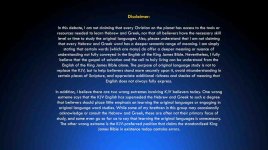
This is a disclaimer that is a part of my Powerpoint slide so that there is no confusion by anyone:
.....

Well at least some rudimentary knowledge of the meaning of the Hebrew that isn't directly translated. There are a lot of Hebrew names in the Bible, people and places, there's Hebrew in the psalms, etc.
For the New testament, which was greek at least some knowledge of the basics of greek language or greek words that aren't directly translated or transliterated. For example Jesus is the greek translation of Yeshua. Christ is Messiah.
Alpha and Omega are Greek alphabet, it's never translated as the A and the Z.
I mean just even an awareness that the Jews spoke Hebrew, not English, and that speaking in tongues, when it happened on Pentecost was not exclusively the English tongue, which didn't even exist back then.
For the New testament, which was greek at least some knowledge of the basics of greek language or greek words that aren't directly translated or transliterated. For example Jesus is the greek translation of Yeshua. Christ is Messiah.
Alpha and Omega are Greek alphabet, it's never translated as the A and the Z.
I mean just even an awareness that the Jews spoke Hebrew, not English, and that speaking in tongues, when it happened on Pentecost was not exclusively the English tongue, which didn't even exist back then.
The debate centers around two different KJV-believing positions. My position is that I am KJV, anchored in the underlying Hebrew and Greek texts. My brother, Matthew Verschuur (my opponent in the debate), is comfortable identifying as KJV-only, and he primarily focuses on defending the English of the KJV for understanding Scripture. While I believe one can be saved and even live a holy life through the King James Bible alone, there are words in the original languages (not all of them) that sometimes convey a deeper layer of meaning not fully expressed in the English of the KJV. This does not mean that I believe the KJV contains errors. Rather, I believe that the underlying original language printed texts (primarily the Beza 1598 Greek New Testament and the Ben Chayyim Hebrew Text) also convey truths that enrich the KJV believer’s understanding and spiritual life.The title of the thread is: Is Knowledge of the Original Languages Necessary for KJV Believers?
The focus of this debate is between two KJV believers and their respective positions. Please note that my debate opponent says he is not anti-TR by any means. He believes the best form of the TR is the King James Bible. Edward F. Hills expressed the view that the King James Bible is a unique form of the Textus Receptus. I would personally rather say that the TR refers to the Greek printed editions themselves.
I hope you get a chance to check it out, even if you may not agree with either of our positions.
May the Lord Jesus Christ bless you richly.
....
.....
Personally I don't believe it matters whether God's Spirit is referred to as the Holy Ghost or Holy Spirit. Usage of the term Holy Ghost actually predates the KJV translation. And it is my understanding that new translations opted to use Holy Spirit due to the modern meaning of a ghost.
“During the Middle Ages, "Christian translators" created a way to make the English Bible ---- reflect -- their -- belief---
--- that the Holy “Ghost” was not the Holy Spirit.---
These theologians -- coined the phrase--- "Holy Ghost" to designate the Third Person of the Trinity. In contrast, they used "Holy Spirit" to refer to the Spirit of God or Spirit of the LORD encountered by the Hebrews and Jews in the Old Testament.
Then, in the 16th century, Bible printers reinforced this distinction by introducing capital and small letters. In the OT they used "spirit" and "holy spirit." In the NT they printed "Spirit" and "Holy Ghost," but with subtle distinctions.
These translation and printing differences do not exist in the Bible itself, in either Hebrew or Greek.
They are invented theological biases – imported - into the (English) Bible.
They provided both verbal and visual validation for the already existing “conviction” --- that Christianity --- must be separated from its Hebraic/Jewish foundations”
Wansvic, it matters not what I think or what you think -- only TRUTH matters.
the greek word translated as ghost is -- wind, spirit, breath
so replacing a word with another that is not even on the same page, so to speak -- that ain't Truth.
I have no interest in debates, I find them boring; but if that's your bag then hey, knock yourself out.The debate centers around two different KJV-believing positions.