Is "touch starvation" a real thing?

  • Christian Chat is a moderated online Christian community allowing Christians around the world to fellowship with each other in real time chat via webcam, voice, and text, with the Christian Chat app. You can also start or participate in a Bible-based discussion here in the Christian Chat Forums, where members can also share with each other their own videos, pictures, or favorite Christian music.

    If you are a Christian and need encouragement and fellowship, we're here for you! If you are not a Christian but interested in knowing more about Jesus our Lord, you're also welcome! Want to know what the Bible says, and how you can apply it to your life? Join us!

    To make new Christian friends now around the world, click here to join Christian Chat.

Lovette

Well-known member
Jan 20, 2026
2,194
589
113
You've probably heard this frequently, a lack of touch - not verbal or textual contact via any form of communication, as in "keep in touch", but physical, skin to skin contact - with other human beings leads to oxytoxin deficiency, suboptimal mental state, sadness and other consequences. So I wonder:

  1. Is this a real thing, or just whining from lonely losers?
  2. If it is a real legitimate thing, is it a nicety or a necessity? In other words, a luxurious want or a basic need?
  3. If it is a basic need, is it limited to infants, who can't survive without caretakers' touch, as reported?
  4. If not just limited to infants, but also affecting adults, can it be substituted with pets or devices? Does holding a fuzzy kitty help?
  5. If affecting adults, and can't be substituted with pets or devices, what's your solution? Go to a massage therapist? Prayer session? Or total denial of "touch starvation"?
 
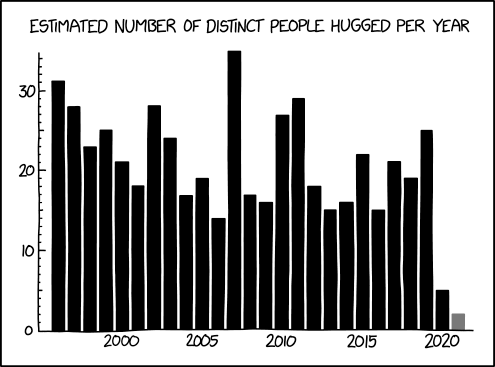
hug_count.png


From the author of this cartoon: "I've never been that big of a hug person, but it turns out I'm not quite THIS small of a hug person either."
 
You've probably heard this frequently, a lack of touch - not verbal or textual contact via any form of communication, as in "keep in touch", but physical, skin to skin contact - with other human beings leads to oxytoxin deficiency, suboptimal mental state, sadness and other consequences. So I wonder:

  1. Is this a real thing, or just whining from lonely losers?
  2. If it is a real legitimate thing, is it a nicety or a necessity? In other words, a luxurious want or a basic need?
  3. If it is a basic need, is it limited to infants, who can't survive without caretakers' touch, as reported?
  4. If not just limited to infants, but also affecting adults, can it be substituted with pets or devices? Does holding a fuzzy kitty help?
  5. If affecting adults, and can't be substituted with pets or devices, what's your solution? Go to a massage therapist? Prayer session? Or total denial of "touch starvation"?
I think it varies. I've never been especially "touchy feely." I know others who crave physical affection.
 
Well what I understand is that oxytocin is the hormone that makes us feel connected to others and can be released in multiple types of in person interactions including hugs and petting dogs as well as eye contact, laughing together etc. Lack of it probably does contribute to feeling lonely.

Hormones are real, but you can live without them being at ideal levels. Connecting with animals or over devices isn't as good as connecting with people in person, just like caffiene isn't as good as a good night's sleep, but it can help. And this is one under mentioned benefit of being involved in a local church: you can find a few people that you can get regular weekly hugs from.

Other than that, I have a hugging pillow in my bed that takes the place of childhood stuffed animals and a stuffed dog to pet when the real dog is done being petted. Those are my best coping strategies.
 
You've probably heard this frequently, a lack of touch - not verbal or textual contact via any form of communication, as in "keep in touch", but physical, skin to skin contact - with other human beings leads to oxytoxin deficiency, suboptimal mental state, sadness and other consequences. So I wonder:

  1. Is this a real thing, or just whining from lonely losers?
  2. If it is a real legitimate thing, is it a nicety or a necessity? In other words, a luxurious want or a basic need?
  3. If it is a basic need, is it limited to infants, who can't survive without caretakers' touch, as reported?
  4. If not just limited to infants, but also affecting adults, can it be substituted with pets or devices? Does holding a fuzzy kitty help?
  5. If affecting adults, and can't be substituted with pets or devices, what's your solution? Go to a massage therapist? Prayer session? Or total denial of "touch starvation"?

Hi Lovette!

Excellent question.

I've told this story before, but I once wrote to a prison inmate who was in for LWOP (Life Without Parole,) and we corresponded about this very subject. We talked about the fact that babies die without touch, and he wrote in his reply, "Grown men die too, just in other ways."

I will never forget that.

I often think about the many, many ways that this life is not the way God intended because of sin. I understand that different people have different opinions and needs regarding touch, but I frequently wonder what things would be like in God's perfect creation for those who need touch. Who would provide it (always from a spouse?) or would other forms of touch be satisfying enough if there was no sin?

One of the saddest things to me about this sinful, broken world is that everyone has to go without something they teel they want or need, even it's simple affection. I guess learning to everything we think is is missing is all part of Paul's lesson in learning to "be content in any situation" (Philippians 4:11-15.)

I always think of the story of Jacob (the father of the 12 tribes of Israel) and his wives, Leah and Rachel. We all know the story of how Jacob longed for Rachel, but was tricked into marrying Leah.

When reading through their story, it often strikes me that all Leah seemed to want was the genuine affection of her husband. When she had her 3rd son, the Bible says that Leah though to herself, "Surely now my husband will be attached to me, because I have born him 3 sons."

But no. There were stories of Rachel bargaining with Leah over who could spend time with Jacob, always hoping to produce another son to win his love. Leah wound up giving Jacob 6 sons by birth, and 2 more through her maidservant.

When Jacob went to meet his brother Esau after years of Esau wanting to kill him, he put his maidservants and the children they had born him in front (in case Esau still had murderous intentions,) Leah and her children next, and then his precious Rachel and Joseph in the very back. Imagine how Leah and her sons must have felt by being told, through actions, they they were expendable, as long as Rachel and Joseph would survive.

Imagine having to live with this constant reminder that you are an obligation and disposable, but never one to be loved, and that your younger, prettier sister and her sons would always be the chosen one.

Leah literally had provided Jacob with nearly an entire sports team worth of sons (the grand prize of the day,) and surely had her sons' love (which had a lot to do with why they hated Joseph, the favorite son,) but yet it could not replace the affection (and I'm guessing, loving touch) that could be provided by her husband.

If the lack of touch for those who see it as a need in this life, and not just a want, is yet another thing we just have to learn to live without, I guess it's yet another reminder that this life is not what God meant it to be.

And it makes me wonder all the more what we will find in heaven.

Will the need for touch just go away?

Or will it be provided in another?

 
You've probably heard this frequently, a lack of touch - not verbal or textual contact via any form of communication, as in "keep in touch", but physical, skin to skin contact - with other human beings leads to oxytoxin deficiency, suboptimal mental state, sadness and other consequences. So I wonder:

  1. Is this a real thing, or just whining from lonely losers?
  2. If it is a real legitimate thing, is it a nicety or a necessity? In other words, a luxurious want or a basic need?
  3. If it is a basic need, is it limited to infants, who can't survive without caretakers' touch, as reported?
  4. If not just limited to infants, but also affecting adults, can it be substituted with pets or devices? Does holding a fuzzy kitty help?
  5. If affecting adults, and can't be substituted with pets or devices, what's your solution? Go to a massage therapist? Prayer session? Or total denial of "touch starvation"?
It is definitely a real thing. I call it emotional starvation, especially between children and married couples. It is a form of abuse and neglect. Sad.
 
  • Heart
Reactions: seoulsearch
My translation of the Bible mentions Leah but it doesn't say she was not attached just that Jacob didn't LOVE her.
Not that he didn't touch her (they had to have touched to do the baby-making) but he just had no affection for her.

So, I don't necessarily read all 'touch' as out of love. It can be a comfort, but depends on how and where you touch someone, the amount of pressure etc.

Sensory modulation -- there are ways to emotionally calm oneself but with all five senses not just touch.
many who have Autism as a condition are sensitive to touch - the skin is the largest organ of your body after all, and needs to be taken care of. We don't have fur, but we can definitely be rubbed the wrong way.

Children/babies who can't read, and are unable to do be independent (yet) learn a lot through their senses, and often they need some kind of restraint at first to feel secure. Touch is the very FIRST sense they encounter. Hence attachment theory of parenting. But really I think affection is paramount -can be soothing/kind words, food that is prepared especially, visual cues -babies nurseries are decorated in nice colours and images- the smells of food and fresh air...and of course, cuddles.

As we get older and separate from our parents we can then learn what good touch and bad touch does. Nobody wants to be ignored, bruised and battered or left out in the cold. So I think it's definitely a thing.
 
  • Like
Reactions: tourist
Jesus healed people with just a touch of his hands. Even the lady with the bleeding said to herself if I can just touch his garment...
Jesus also healed people with just a word. But he demonstrated with touch, that he could transfer his virtue to others. (in my Bible it translates as virtue)

Also recall that..nobody was supposed to touch the precious Ark of the Covenant. Didn't two men die when they touched it (even when they were just adjusting it on the poles)

We are supposed to have clean hands when we touch each other, and food, because if we have dirty, thats how germs spread.
 
  • Like
Reactions: tourist
My solution - skin care, yes sometimes go to massage therapist (places I can't reach like my back) pets, warm clothes, blankets, cuddly toys, pets, and hugs from others.

You can actually buy weighted blankets and weighted cuddly animals. But yea it's a thing. They can be expensive, but you can just pile on the blankets and cushions, or insert a sack of rice or something heavy inside a cuddly toy. You can make wheat bags and put them around your neck. Lots of things. Slippers, fluffy socks.

The reason why we have seat belts in cars, its for our safety, because we can't always have someone holding us in the car, when going at speed! Or holding on to the back of the seat or door handle.

Contact sport is a thing, I mean there are ball skills, touching bases, climbing, jumping...all the things you learn to do in physical education, so you can coordinate and exercise your body. Nobody is designed to sit around all day...living in a virtual world where they never touch anyone or anything.

Touch screens!!
 
You've probably heard this frequently, a lack of touch - not verbal or textual contact via any form of communication, as in "keep in touch", but physical, skin to skin contact - with other human beings leads to oxytoxin deficiency, suboptimal mental state, sadness and other consequences. So I wonder:

  1. Is this a real thing, or just whining from lonely losers?
  2. If it is a real legitimate thing, is it a nicety or a necessity? In other words, a luxurious want or a basic need?
  3. If it is a basic need, is it limited to infants, who can't survive without caretakers' touch, as reported?
  4. If not just limited to infants, but also affecting adults, can it be substituted with pets or devices? Does holding a fuzzy kitty help?
  5. If affecting adults, and can't be substituted with pets or devices, what's your solution? Go to a massage therapist? Prayer session? Or total denial of "touch starvation"?
I have this. I don't talk talk about it, because the 'whining from lonely losers' presumption is present among people.
The side-effects add up, but y'know, what can I say? I can't wish a person who'll touch me into existence, I just have to wait for the appointment to come to pass.

I am very happy when I get to interact with an animal. I make fun of all the different bugs I see around.
And, the Lord does help me with Joy when I remember his Goodness.
 
It is definitely a real thing. I call it emotional starvation, especially between children and married couples. It is a form of abuse and neglect. Sad.
I gotta admit I'm very skeptic on this, that's why I asked these four questions following the subject. I assume it's just a form of nostalgia, maybe you've experienced physical touch regularly in your childhood, maybe before COVID, maybe in a past relationship, now you're alone and you're just missing what you used to have.
 
  • Like
Reactions: tourist
Weaknesses can be a good thing. They should lead us to more dependence on God.
Yeah, when Jesus is all you have, Jesus is all you need. Which kind of echos this quote from the Sing! animated movie - "you know what's awesome about hitting rock bottom? The only way out is UP!"
 
  • Like
Reactions: Gideon300
I gotta admit I'm very skeptic on this, that's why I asked these four questions following the subject. I assume it's just a form of nostalgia, maybe you've experienced physical touch regularly in your childhood, maybe before COVID, maybe in a past relationship, now you're alone and you're just missing what you used to have.
There are plenty who aren't missing something they used to have. They're longing for something they've never had.
Also, don't you think it's odd to boil down fundamental human companionship to terms like 'nostalgia'?
"Wow, I remember when I used to be heard out and other people actually followed along with what I'm trying to say. I remember when I used to be consoled and payed attention to and hugged. Ah, oh rose tinted glasses."

You know, animals die from lonliness. Scientists say that humans need hugs.
 
There are plenty who aren't missing something they used to have. They're longing for something they've never had.
Also, don't you think it's odd to boil down fundamental human companionship to terms like 'nostalgia'?
"Wow, I remember when I used to be heard out and other people actually followed along with what I'm trying to say. I remember when I used to be consoled and payed attention to and hugged. Ah, oh rose tinted glasses."

You know, animals die from lonliness. Scientists say that humans need hugs.
No, I think it's NOT odd to point out the obvious possibility of such "rose tinted glasses". How do you know whether it's "longing for something they've never had" - or longing for what other people have and they don't?

Maybe it's odd to you, but in my line of thinking, whenever I hear any strange, grandiose, absolute claims or theories, instead of instictively following their claim, I assume it's made up or irrelevant first, until it's corrocobated by another independent source with concrete evidence.

In this case, calling the need for touch a "fundamental human companionship" first and foremost and then build a set of argument around it is such a "strange, grandiose, absolute claim"; I did some digging, reading and listening many testimonies from ordinary people and theories from experts, many of them mentioned their past experience and how they're missing it, such as post #2 in this thread, combined with my personal experience, I reached a reasonable conclusion, that it must be a nostalgia; if not a nostalgia, then a GRIEF over a loss of something precious, which you only realize it's precious after you lost it.
 
No, I think it's NOT odd to point out the obvious possibility of such "rose tinted glasses". How do you know whether it's "longing for something they've never had" - or longing for what other people have and they don't?
What difference does it make? If I were a beggar like Lazarus who just wanted a little food from fromeone who had a lot, is that proud?
 
What difference does it make? If I were a beggar like Lazarus who just wanted a little food from fromeone who had a lot, is that proud?
"You shall not covet." Envy is the second deadliest sin.