The book of Job

  • Christian Chat is a moderated online Christian community allowing Christians around the world to fellowship with each other in real time chat via webcam, voice, and text, with the Christian Chat app. You can also start or participate in a Bible-based discussion here in the Christian Chat Forums, where members can also share with each other their own videos, pictures, or favorite Christian music.

    If you are a Christian and need encouragement and fellowship, we're here for you! If you are not a Christian but interested in knowing more about Jesus our Lord, you're also welcome! Want to know what the Bible says, and how you can apply it to your life? Join us!

    To make new Christian friends now around the world, click here to join Christian Chat.
reneweddaybyday said:
Job 14:6 ... first of all, in Job 14:1 Job indicates he is speaking of mankind in general ... secondly, look at Job 14:2 ... are you going to assume Job was a flower because Job is speaking figuratively?​

So you are the one that decides if Job is speaking figuratively, or if he really means it?
do you know what a figure of speech is? If you do not, then you will continue to misinterpret Scripture if and when a figure is used and you believe a passage is literal.

You are the one who claimed Job was a hireling:


Job was a hireling.​

You finally provided Job 14:6 as support for your claim

Job 14:6 Turn from him, that he may rest, till he shall accomplish, as an hireling, his day.

see the words "as an hireling"? That is a figure of speech ... simile. We know it is a simile because of the word "as".

Job was comparing the life of a man to a hired laborer. The laborer works strenuously ... and sometimes in difficult situations.


In Job 14:2 Job compared the life of a man to a flower and a shadow.

Job 14:2 He cometh forth like a flower, and is cut down: he fleeth also as a shadow, and continueth not.

The figures used in vs 6 ("as an hireling") and in vs 2 ("like a flower" ... "as a shadow") are similes.


There is another closely related figure of speech called metaphor.

In Job 8, Bildad uses comparative speech, but instead of simile ("like" or "as"), Bildad uses metaphor:

Job 8:14 Whose hope shall be cut off, and whose trust shall be a spider's web.

Job 8:16-17 He is green before the sun, and his branch shooteth forth in his garden. His roots are wrapped about the heap, and seeth the place of stones.


Bildad does not say that the hypocrite is as "a spider's web" ... or that the hypocrite shall be as "green before the sun" ... or as "roots wrapped". This type of comparative language is referred to as a metaphor.

Similes and metaphors are both types of comparisons. The difference between similes and metaphors is that similes use words such as "like" or "as" when comparing. If a comparison does not contain the "like" or "as" and says one thing is another, the figure of speech is a metaphor.


hope/pray this makes sense and you are able to read some of the verses in Job and understand what phrases are figures of speech and which phrases are literal.


.
 
  • Like
Reactions: DavidLamb
My claim is that Job was serving two masters.
I know that is your claim ... but your support for making the claim was to quote Matthew 6:24:

Job had two masters. Mat 6:24 No man can serve two masters: for either he will hate the one, and love the other; or else he will hold to the one, and despise the other. Ye cannot serve God and mammon.

which is why I asked you:

This is part of the record the Lord Jesus Christ taught the multitudes. Is it your claim that the Lord Jesus Christ was speaking concerning Job here?​

and I provided three verses wherein God tells you Job was a man who reverenced Him.

You obviously do not believe what God says about Job ... smh ...


.
 
tttallison said:
You still haven't answered with a yes or no as to whether Job could save himself.​
reneweddaybyday said:
such a frivolous question ... no need to answer ... time to move along.​

Was it frivolous when God asked it? Job 40:14 Then will I also confess unto thee that thine own right hand can save thee.
s-i-g-h ... I have gone through this record with you multiple times already tttallison ... in February, March, April, May, and earlier this month.

Here is what was submitted back in May:


Your question has been answered ... and you have not rebutted ... instead you just disregard and keep asking your question over and over. Do you want to understand the Book of Job? ... then consider the information you have been given.​
In Job 40:6-14, God asked Job a series of rhetorical questions:​
8 Wilt thou also disannul my judgment? wilt thou condemn me, that thou mayest be righteous?

9 Hast thou an arm like God? or canst thou thunder with a voice like him?

10 Deck thyself now with majesty and excellency; and array thyself with glory and beauty.
11 Cast abroad the rage of thy wrath: and behold every one that is proud, and abase him.

12 Look on every one that is proud, and bring him low; and tread down the wicked in their place.

13 Hide them in the dust together; and bind their faces in secret.

14 Then will I also confess unto thee that thine own right hand can save thee.
The point behind these verses is -
vs 8 – if Job could disannul the judgment of God ... or condemn God ...​
vs 9 – if Job had an arm like God ... or if Job could thunder with a voice like God ...​
vs 10 – if Job could deck himself with majesty and excellency and array himself with glory and beauty as God is in His majesty, excellence, glory and beauty ...​
vs 11 – if Job could abase with a glance every one that is proud ...​
vs 12 – if Job could bring low the proud and tread down the wicked ...​
vs 13 – if Job could hide them in the dust never to arise ...​
vs 14 – if Job could do the things described in the above verses, then God would confess that Job could save himself.​
What God revealed to Job here (as well as what is stated from chapter 38 to 41) is that that God's ways are so far above man's ways, and it is God alone Who is the Creator of all, Who knows the ways of all creation, Who is more powerful than the most powerful creature.​
Both God and Job knew Job could do none of those things. Both God and Job knew Job could not save himself. Job relied upon the same Redeemer you and I rely upon.​


you did not agree then ... you do not agree now ... just leave it at that ... there is no need for me to answer your frivolous question ... how about you just move along now.

.

 
  • Like
Reactions: DavidLamb
reneweddaybyday said:
God tells you three times Job was a believer who reverenced God:​


all three verses are provided in the post you replied to ... I even bolded and underlined the pertinent text.

.

Those three verses do not contain reverence. Job feared God, but that does not equate to reverence. A person who reverences God does not condemn God. Job 40:8 Will you also disannul my judgment? will you condemn me, that you may be righteous?

Nor do they reprove God. Job 40:2 Shall he that contendeth with the Almighty instruct him? he that reproveth God, let him answer it.

Nor do they strive with God. Isa 45:9 Woe unto him that striveth with his Maker! Let the potsherd strive with the potsherds of the earth. Shall the clay say to him that fashioneth it, What makest thou? or thy work, He hath no hands?

Job was not a true believer. A true believer believes that God is good, and that God is righteous.

A true believer of God's goodness would not say God rejoices when a person does not get a fair trial. Job 9:23 If the scourge slay suddenly, he will laugh
at the trial of the innocent.

A true believer would not say God is unjust. Job 9:24 The earth is given into the hand of the wicked: he covereth the faces of the judges thereof; if not, where, and who is he?

A true believer would not say God punishes people without cause. Job 9:17 For he breaketh me with a tempest, and multiplieth my wounds without cause.


A true believer would not exalt his own righteousness above God's righteousness.
The spirit. Job 4:17 Shall mortal man be more just than God? shall a man be more pure than his maker?

The three friends. Job 32:1 So these three men ceased to answer Job, because he
was righteous in his own eyes.

Elihu. Job 32:2 Then was kindled the wrath of Elihu the son of Barachel the Buzite, of the kindred of Ram: against Job was his wrath kindled, because he justified himself rather than God. Job 35:2 Thinkest thou this to be right, that thou saidst, My righteousness is more than God's? Job 34:17 Shall even he that hateth right govern? and will you condemn him that is most just?

God. Job 40:8 Will you also
disannul my judgment? will you condemn me, that you may be righteous?

Jas 2:19 you believest that there is one God; thou doest well: the devils also believe, and tremble.
 
reneweddaybyday said:
God tells you three times Job was a believer who reverenced God:​
all three verses are provided in the post you replied to ... I even bolded and underlined the pertinent text.​

Those three verses do not contain reverence.
In all three verses, the word "feared" (Job 1:1) and "feareth" (Job 1:8; Job 2:3) are translated from the Hebrew word yārē' which means reverence. Job revered God.

Job also "eschewed" (Job 1:1) and "escheweth" (Job 1:8; Job 2:3) evil. The words "eschewed" and "escheweth" are translated from the Hebrew word sûr which means to turn away from, avoid. Job turned away from and avoided evil.

These are words written by God about Job ... not what Job said about himself. How about you just believe what God said about Job and quit following Job's friends who, by the way, were chastened by God because they had "not spoken of me [God] the thing that is right, as my servant Job hath."


.
 
  • Like
Reactions: DavidLamb
reneweddaybyday said:
God tells you three times Job was a believer who reverenced God:​
all three verses are provided in the post you replied to ... I even bolded and underlined the pertinent text.​


In all three verses, the word "feared" (Job 1:1) and "feareth" (Job 1:8; Job 2:3) are translated from the Hebrew word yārē' which means reverence. Job revered God.

Job also "eschewed" (Job 1:1) and "escheweth" (Job 1:8; Job 2:3) evil. The words "eschewed" and "escheweth" are translated from the Hebrew word sûr which means to turn away from, avoid. Job turned away from and avoided evil.

These are words written by God about Job ... not what Job said about himself. How about you just believe what God said about Job and quit following Job's friends who, by the way, were chastened by God because they had "not spoken of me [God] the thing that is right, as my servant Job hath."


.

Gen 32:11 Deliver me, I pray thee, from the hand of my brother, from the hand of Esau for I fear (yārē') him, lest he will come and smite me, and the mother with the children.

Perhaps you missed the following verse. Job 40:2 Shall he that contendeth with the Almighty instruct
him? he that reproveth God, let him answer it.

Does the course on "Protecting the Narrative, and Propping Job Up", come with a set of blinders?
 
Gen 32:11 Deliver me, I pray thee, from the hand of my brother, from the hand of Esau for I fear (yārē') him, lest he will come and smite me, and the mother with the children.
From Blue Letter bible:

1785269627206.png

From Bible hub:

Topical Lexicon
Overview
יָרֵא appears approximately three hundred thirty-one times in the Old Testament, embracing the spectrum from terror before danger to reverent awe before the LORD. The context determines whether the fear is crippling or faith-filled, yet Scripture consistently urges the latter as the only right and life-giving posture toward God.​

So, the context determines whether the fear is crippling or faith-filled.

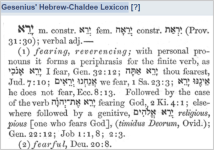
And the Gesenius' Hebrew Chaldee Lexicon specifically states that Job 1:1, 8; 2:3 refer to "religious, pious [one who fears God]".


Perhaps you missed the following verse. Job 40:2 Shall he that contendeth with the Almighty instruct him? he that reproveth God, let him answer it.
perhaps you missed the following verses:

Job 40:3-5 Then Job answered the LORD, and said, Behold, I am vile; what shall I answer thee? I will lay mine hand upon my mouth. Once have I spoken; but I will not answer: yea, twice; but I will proceed no further.

then God declared He would treat Job as a man (one who is mature ... not an immature person):

Job 40:6-7 Then answered the LORD unto Job out of the whirlwind, and said, Gird up thy loins now like a man: I will demand of thee, and declare thou unto me.

and God goes on to explain wonderful truths concerning Himself, His power over all His creation, His intimate knowledge of creation, etc., etc. This further instruction augments what God revealed about Himself in chapters 38 and 39.


Does the course on "Protecting the Narrative, and Propping Job Up", come with a set of blinders?
when you grow up, we may be able to have meaningful discussion concerning Scripture. Until then, I suppose I'm going to have to put up with your immature utterings ...

.
 
From Bible hub:

Topical Lexicon
Overview
יָרֵא appears approximately three hundred thirty-one times in the Old Testament, embracing the spectrum from terror before danger to reverent awe before the LORD. The context determines whether the fear is crippling or faith-filled, yet Scripture consistently urges the latter as the only right and life-giving posture toward God.​

So, the context determines whether the fear is crippling or faith-filled.

And the Gesenius' Hebrew Chaldee Lexicon specifically states that Job 1:1, 8; 2:3 refer to "religious, pious [one who fears God]".

.

I like the statement, "So, the context determines whether the fear is crippling or faith-filled."

I like the statement because that is exactly what I gave you, context. The following are examples of context. Job 40:2 Shall he that contendeth with the Almighty instruct him? he that reproveth God, let him answer it. Job 40:8 Will you also disannul my judgment? will you condemn me, that y
ou may be righteous? In the above verses God is giving us context of Job's purity.

Then we have Job giving us context of his reverence for God. Job 9:23 If the scourge slay suddenly, he will laugh at the trial of the innocent. Job 9:24 The earth is given into the hand of the wicked: he covereth the faces of the judges thereof; if not, where, and who is he? Job 9:17 For he breaketh me with a tempest, and multiplieth my wounds without cause.

You would be correct in comparing Job to the pious Pharisees. The bible gives us definitions within its context.
 
I like the statement, "So, the context determines whether the fear is crippling or faith-filled."
too bad you don't like it enough to apply it when it comes to your reading of Scripture.


I like the statement because that is exactly what I gave you, context.
nope ... rather than reading what is written in Job, you you run hither and yon ... thinking that just because a word appears in Job and the same word appears in another book, both refer to the same thing ... like when you claimed "Job received the same cup of woe as Israel received" when you know Job was not being chastened because of sin ... that satan smote Job because Job was "perfect and upright, and one that feared God, and eschewed evil" (Job 1:1; Job 1:8; Job 2:3) ... yet Israel was being chastened because of transgressions and sins (Lamentations 1:5; Lamentations 1:8).

The very last verse in the Book of Lamentations confirms that Israel never repented (Lamentations 5:22 But thou hast utterly rejected us; thou art very wroth against us), notwithstanding your claim to the contrary.


The following are examples of context. Job 40:2 Shall he that contendeth with the Almighty instruct him? he that reproveth God, let him answer it. Job 40:8 Will you also disannul my judgment? will you condemn me, that you may be righteous? In the above verses God is giving us context of Job's purity.
:rolleyes: ... ripping two verses from the context in which the Author of Scripture has placed them is not providing "examples of context".

ripping two verses from the context is your never-ending attempt to paint Job in the same light Eliphaz, Bildad, Zophar painted Job ... with no consideration of what God tells you from the outset concerning Job (i.e. that Job was perfect and upright, and one that feared God, and eschewed evil (Job 1:1; Job 1:8; Job 2:3).


Then we have Job giving us context of his reverence for God. Job 9:23 If the scourge slay suddenly, he will laugh at the trial of the innocent. Job 9:24 The earth is given into the hand of the wicked: he covereth the faces of the judges thereof; if not, where, and who is he? Job 9:17 For he breaketh me with a tempest, and multiplieth my wounds without cause.
see? ... you can't even read verses of Scripture in the order the Author of Scripture wrote them.

You again rip three verses from the context ... read two verses in order ... then jump to a verse which appears before the first of the two you read in order. what a farce!

Do you read books written by human authors without jumbling up the order in which the text is written??? You reveal that you are the one who has no "reverence for God" as shown by your handling of Scripture ... yet you accuse Job of having no "reverence for God".


You would be correct in comparing Job to the pious Pharisees. The bible gives us definitions within its context.
I don't compare Job to "pious pharisees". I compare Job to the same outstanding folks God compares him to ... Noah and Daniel ...

Ezekiel 14:12-14

12 The word of the LORD came again to me, saying,

13 Son of man, when the land sinneth against me by trespassing grievously, then will I stretch out mine hand upon it, and will break the staff of the bread thereof, and will send famine upon it, and will cut off man and beast from it:


14 Though these three men, Noah, Daniel, and Job, were in it, they should deliver but their own souls by their righteousness, saith the Lord GOD.


Ezekiel 14:19-20

19 Or if I send a pestilence into that land, and pour out my fury upon it in blood, to cut off from it man and beast:


20 Though Noah, Daniel, and Job, were in it, as I live, saith the Lord GOD, they shall deliver neither son nor daughter; they shall but deliver their own souls by their righteousness.

.
 
too bad you don't like it enough to apply it when it comes to your reading of Scripture.


nope ... rather than reading what is written in Job, you you run hither and yon ... thinking that just because a word appears in Job and the same word appears in another book, both refer to the same thing ... like when you claimed "Job received the same cup of woe as Israel received" when you know Job was not being chastened because of sin ... that satan smote Job because Job was "perfect and upright, and one that feared God, and eschewed evil" (Job 1:1; Job 1:8; Job 2:3) ... yet Israel was being chastened because of transgressions and sins (Lamentations 1:5; Lamentations 1:8).

The very last verse in the Book of Lamentations confirms that Israel never repented (Lamentations 5:22 But thou hast utterly rejected us; thou art very wroth against us), notwithstanding your claim to the contrary.


:rolleyes: ... ripping two verses from the context in which the Author of Scripture has placed them is not providing "examples of context".

ripping two verses from the context is your never-ending attempt to paint Job in the same light Eliphaz, Bildad, Zophar painted Job ... with no consideration of what God tells you from the outset concerning Job (i.e. that Job was perfect and upright, and one that feared God, and eschewed evil (Job 1:1; Job 1:8; Job 2:3).


see? ... you can't even read verses of Scripture in the order the Author of Scripture wrote them.

You again rip three verses from the context ... read two verses in order ... then jump to a verse which appears before the first of the two you read in order. what a farce!

Do you read books written by human authors without jumbling up the order in which the text is written??? You reveal that you are the one who has no "reverence for God" as shown by your handling of Scripture ... yet you accuse Job of having no "reverence for God".


I don't compare Job to "pious pharisees". I compare Job to the same outstanding folks God compares him to ... Noah and Daniel ...

Ezekiel 14:12-14

12 The word of the LORD came again to me, saying,

13 Son of man, when the land sinneth against me by trespassing grievously, then will I stretch out mine hand upon it, and will break the staff of the bread thereof, and will send famine upon it, and will cut off man and beast from it:


14 Though these three men, Noah, Daniel, and Job, were in it, they should deliver but their own souls by their righteousness, saith the Lord GOD.


Ezekiel 14:19-20

19 Or if I send a pestilence into that land, and pour out my fury upon it in blood, to cut off from it man and beast:


20 Though Noah, Daniel, and Job, were in it, as I live, saith the Lord GOD, they shall deliver neither son nor daughter; they shall but deliver their own souls by their righteousness.

.

I have been rather rude and I apologize for that. I love this book as much as you love Job. We sure look at this book from completely opposite points of view.

I see God as the Hero of this book, full of goodness and mercy. I see Job as a wretched creature, just like the rest of us before we meet God. Job lacks understanding because he is without knowledge. Any goodness of his own is vile, and he admits this at the end of the book. Job admits he thinks very highly of himself and lets us know it in chapter twenty nine. In chapter forty one God presents the one who observes all high things, and is king over all the children of pride. We first met this fellow in chapter one.

If this character in chapter forty one is not the same one as we find in chapter one you have to explain who observes all high things and is the king over all the children of pride. If not Satan then who? Leviathan is described as a piercing crooked serpent, and dragon. The first time we meet Satan he is a serpent in the Garden. The last time we see Satan he is serpent and dragon.

Isa 27:1 In that day the LORD with his sore and great and strong sword shall punish leviathan the piercing serpent, even leviathan that crooked serpent; and he shall slay the dragon that is in the sea.

Rev 12:9 And the great dragon was cast out, that old serpent, called the Devil, and Satan, which deceiveth the whole world: he was cast out into the earth, and his angels were cast out with him.

Rev 20:2 And he laid hold on the dragon, that old serpent, which is the Devil, and Satan, and bound him a thousand
years,
 
I see God as the Hero of this book, full of goodness and mercy. I see Job as a wretched creature, just like the rest of us before we meet God.
Job was a believer from the outset. That fact is established in the first verse of the book.

I believe Job's friends were believers as well ... none of them (Job included) understood that Job was under attack from satan. Job's friends believed Job was being chastened by God ... while Job did not believe he had sinned, Job did ask God to reveal if he had sinned and was he being chastened. He asked God to reveal so he could repent and have his relationship with God restored.

They all believed in retribution (i.e. that if you do good, you will receive good ... if you do not do good, you will not receive good).

The book of Job counters this belief (retribution) and reveals that God has an adversary (satan) who attacks God's people.


Job lacks understanding because he is without knowledge.
All of them ... Job, Elphaz, Bildad, Zophar, Elihu ... lacked knowledge concerning satan. None of them knew satan was behind all the suffering Job went through.


Any goodness of his own is vile, and he admits this at the end of the book. Job admits he thinks very highly of himself and lets us know it in chapter twenty nine.
here are a couple of verses which reveal Job's humility:

Job 1:21 And said, Naked came I out of my mother's womb, and naked shall I return thither: the LORD gave, and the LORD hath taken away; blessed be the name of the LORD.

Job 2:9-10 Then said his wife unto him, Dost thou still retain thine integrity? curse God, and die. But he said unto her, Thou speakest as one of the foolish women speaketh. What? shall we receive good at the hand of God, and shall we not receive evil? In all this did not Job sin with his lips.

Job 13:15 Though he slay me, yet will I trust in him: but I will maintain mine own ways before him.


as far as Job thinking "very highly of himself" and letting "us know it in chapter twenty nine" ... Job was merely comparing his current sorrowful state with his past life ... not in an effort to let anyone know that he thought "very highly of himself", but to point out this low point in his life. Job looked back and contrasted his past blessings from God with his present state of pain and deep grief.

All believers go through mountaintop experiences as well as the valley lows. The key to getting through the valley low is to always remember that the same God Who is with us on the mountaintop is still with us in the valley.


In chapter forty one God presents the one who observes all high things, and is king over all the children of pride. We first met this fellow in chapter one.

If this character in chapter forty one is not the same one as we find in chapter one you have to explain who observes all high things and is the king over all the children of pride. If not Satan then who?
I have never denied that satan is alluded to in this section of Scripture.

What I have stated is that neither Job nor his friends had any idea that God was referring to satan. None of them had a clue about satan. That is why they all believed God was the One behind all of Job's suffering. Even in Job 42:11 all Job's family and friends believed it was God Who brought evil upon Job.

Job 42:11 Then came there unto him all his brethren, and all his sisters, and all they that had been of his acquaintance before, and did eat bread with him in his house: and they bemoaned him, and comforted him over all the evil that the LORD had brought upon him: every man also gave him a piece of money, and every one an earring of gold.

We know it was satan because God revealed that to us ... none of them knew what Job suffered was brought upon him by satan.


.
 
  • Like
Reactions: DavidLamb
I have never denied that satan is alluded to in this section of Scripture.

What I have stated is that neither Job nor his friends had any idea that God was referring to satan. None of them had a clue about satan. That is why they all believed God was the One behind all of Job's suffering. Even in Job 42:11 all Job's family and friends believed it was God Who brought evil upon Job.

We know it was satan because God revealed that to us ... none of them knew what Job suffered was brought upon him by satan.


.

I appreciate that you recognize that Satan is being alluded to in Job chapter forty one.

We could call this complete chapter a metaphor, or better yet, a simile, as similes are not required to have “as”, or “as is” within them.

Metaphor--- A thing regarded as representative or symbolic of something else, especially something abstract:

Simile--- 2. A word or phrase by which anything is likened, in one or more of its aspects, to something else; a similitude; a poetical or imaginative comparison.

When we substitute Leviathan with his real name the chapter takes on a clearer meaning.

Job 41:1 Canst thou draw out (Satan) with an hook? or (Satan’s) tongue with a cord which thou lettest down?

2. Canst you put an hook into (Satan’s) nose? or bore (Satan’s) jaw through with a thorn?

3. Will (Satan) make many supplications unto thee? will (Satan) speak soft words unto you?

4. Will (Satan) make a covenant with you? will you take (Satan) for a servant for ever?

5. Will you play with (Satan) as with a bird? or will you bind (Satan) for thy maidens?

6. Shall your companions make a banquet of (Satan)? shall they part (Satan) among the merchants?

7. Can you fill (Satan’s) skin with barbed irons? or (Satan’s) head with fish spears?

8. Lay thine hand upon (Satan), remember the battle, do no more.

9. Behold, the hope of (Satan) is in vain: shall not one be cast down even at the sight of (Satan)?

10. None is so fierce that dare stir (Satan) up: who then is able to stand before me?

11. Who hath prevented me, that I should repay (Satan)? whatsoever is under the whole heaven is mine.

12. I will not conceal (Satan’s) parts, nor (Satan’s) power, nor (Satan’s) comely proportion.

13. Who can discover the face of (Satan’s) garment? or who can come to (Satan) with his double bridle?

14. Who can open the doors of (Satan’s) face? (Satan’s) teeth are terrible round about.

15. (Satan’s) scales are (Satan’s) pride, shut up together as with a close seal.

16. One is so near to another, that no air can come between them.

17. They are joined one to another, they stick together, that they cannot be sundered.

18. By (Satan’s) neesings a light doth shine, and (Satan’s) eyes are like the eyelids of the morning. [Isa 14:12 How art thou fallen from heaven, O Lucifer, son of the morning! how art thou cut down to the ground, which didst weaken the nations!]

19. Out of (Satan’s) mouth go burning lamps, and sparks of fire leap out.

20. Out of (Satan’s) nostrils goeth smoke, as out of a seething pot or caldron.

21. (Satan’s) breath kindleth coals, and a flame goeth out of (Satan’s) mouth.

22. In (Satan’s) neck remaineth strength, and sorrow is turned into joy before (Satan).

23. The flakes of (Satan’s) flesh are joined together: they are firm in themselves; they cannot be moved.

24. (Satan’s) heart is as firm as a stone; yea, as hard as a piece of the nether millstone.

25. When (Satan) raiseth up himself, the mighty are afraid: by reason of breakings they purify themselves.

26. The sword of him that layeth at (Satan) cannot hold: the spear, the dart, nor the habergeon.

27. (Satan) esteemeth iron as straw, and brass as rotten wood.

28. The arrow cannot make (Satan) flee: slingstones are turned with (Satan) into stubble.

29. Darts are counted as stubble: (Satan) laugheth at the shaking of a spear.

30. Potsherds are under (Satan): (Satan) spreadeth sharp pointed things upon the mire.

31. (Satan) maketh the deep to boil like a pot: (Satan) maketh the sea like a pot of ointment.

32. (Satan) maketh a path to shine after him; one would think the deep to be hoary.

33. Upon earth there is not (Satan’s) like, who is made without fear.

34. (Satan) beholdeth all high things: (Satan) is a king over all the children of pride.
 
I appreciate that you recognize that Satan is being alluded to in Job chapter forty one.
You have to understand that Job and his friends had no knowledge of satan. Job and his friends were aware of and knew about a sea creature called leviathan. Job and his friends understood that God was speaking to them of leviathan ... not satan.


We could call this complete chapter a metaphor, or better yet, a simile, as similes are not required to have “as”, or “as is” within them.
you need to do a little more research so you better understand metaphors and similes.

From Mirriam-Webster:


A simile is “a figure of speech comparing two unlike things that is often introduced by like or as.”​
A metaphor is similar to a simile in that it is a figure of speech used “to suggest a likeness or analogy between” two things, but without the prepositions “like” or “as.” In other words, a metaphor is a more direct comparison “in which a word or phrase literally denoting one kind of object or idea is used in place of another.”​


When we substitute Leviathan with his real name the chapter takes on a clearer meaning.
You must keep in mind ... Job and his friends were familiar with a sea creature called leviathan ... we are not familiar with leviathan, but we can glean some understanding of how massive and how fierce this sea creature was.

In Job 41, God revealed to Job that this massive and fierce sea creature was created by God's all powerful Hand ... that God, as the Creator of all, is more powerful than leviathan.

Job and his friends were completely ignorant of satan, so there is no way they could understand that God was referring to satan. They did not know satan was behind all the agony Job was suffering.

We know it was satan who smote Job with sore boils from the soles of his feet to the crown of his head, but Job and his friends did not know this. I don't know if God ever revealed to Job that he had suffered at the hand of satan.


.
 
you need to do a little more research so you better understand metaphors and similes.

From Mirriam-Webster:


A simile is “a figure of speech comparing two unlike things that is often introduced by like or as.”​
A metaphor is similar to a simile in that it is a figure of speech used “to suggest a likeness or analogy between” two things, but without the prepositions “like” or “as.” In other words, a metaphor is a more direct comparison “in which a word or phrase literally denoting one kind of object or idea is used in place of another.”​

.

Have you not heard of implied similies?

Similes are associated with poetic and imaginative writings, whereas metaphors compare two different things directly.

Implied similes----Implied similes suggest a comparison without stating it outright, relying on context and imagery. They often feel more subtle or poetic.

Example one-- He slithered into the meeting, unnoticed and unwelcome.
Example two--He beholdeth all high things: he is a king over all the children of pride.

Simile--- 2. A word or phrase by which anything is likened, in one or more of its aspects, to something else; a similitude;
a poetical or imaginative comparison.

I believe the book of Job correlates more with a simile as it is poetic and imaginative.
 
Have you not heard of implied similies? Similes are associated with poetic and imaginative writings, whereas metaphors compare two different things directly.
similes are types of metaphors ... not all metaphors are similes.

From Grammarly:
A simile is a type of metaphor, meaning all similes are metaphors, however, not all metaphors are similes.​


Implied similes----Implied similes suggest a comparison without stating it outright, relying on context and imagery. They often feel more subtle or poetic.
An indirect comparison that avoids "like" or "as" is technically called an implied metaphor rather than an implied simile.


Example one-- He slithered into the meeting, unnoticed and unwelcome.
Example two--He beholdeth all high things: he is a king over all the children of pride.
both metaphors.


Simile--- 2. A word or phrase by which anything is likened, in one or more of its aspects, to something else; a similitude; a poetical or imaginative comparison.
A simile is a simple figure of speech that compares two different things using the connecting words "like" or "as".


I believe the book of Job correlates more with a simile as it is poetic and imaginative.
I believe the Book of Job and, in fact, Scripture as a whole, contains many figures of speech.

A figure of speech is an expression not meant to be taken in a literal way. Figures of speech use words in creative ways to share a deeper meaning.

In Job, you will find metaphors, similes, personification, hyperbole, irony, idioms. If we take literally what is meant figuratively, we will not fully understand the meaning.


.
 
There were many theories on why Job suffered the things he suffered. God rebuked several of the people with the opinions.

However, in this thread I would like to look at what the rest of the Bible says to figure out what God's role was and why this happened.

1. God is omniscient. The book of Job makes it clear that He knew what Satan was planning to do.

2. God is omnipotent. The book of Job makes it clear that God allowed it to happen.

If you deny that God is omniscient then that is considered Blasphemy. If you deny that God is omnipotent that also is blasphemy.

3. God said this about Job: "8 And the Lord said unto Satan, Hast thou considered my servant Job, that there is none like him in the earth, a perfect and an upright man, one that feareth God, and escheweth evil?"

So that has to be part of your explanation, it can't contradict what God says here because God cannot lie.

Now we have promises from God in Psalm 91 and Deuteronomy 28 to protect us from evil. That is a covenant that we have with God.

How can you reconcile the covenant and promises we have with God with what happened? By all means use your own personal experiences if that helps explain this.
It’s just a hard book to reconcile. It wasn’t until Job prayed for his friends that God restored him. But God seemed more content to have a conversation with Job than give him back everything. Then you can say, “Why did God just let him sit in it?” One thing we know for sure is every situation is different. Most of us don’t know exactly why Job had to suffer so much, but the good thing is is that God finally answered.

Seems like a lot of people in the Old Testament face persecution just standing up for God or face persecution when they didn’t deserve it seemingly. What’s hard for us is when we face persecution for things that we’ve done and yet God still answers us and shows us way out.
 
It’s just a hard book to reconcile. It wasn’t until Job prayed for his friends that God restored him. But God seemed more content to have a conversation with Job than give him back everything. Then you can say, “Why did God just let him sit in it?” One thing we know for sure is every situation is different. Most of us don’t know exactly why Job had to suffer so much, but the good thing is is that God finally answered.

Seems like a lot of people in the Old Testament face persecution just standing up for God or face persecution when they didn’t deserve it seemingly. What’s hard for us is when we face persecution for things that we’ve done and yet God still answers us and shows us way out.
That is the point, the ministry we have received is a ministry of reconciliation. Every single sinner needs to be restored and the various ministries that Christians have do that because the Christians who have been given this ministry have gone through the exact same issues and they were restored. It is like a guide who can help sinners be restored in Christ and saved by grace.