The Church, and Israel and the Last Days.

  • Christian Chat is a moderated online Christian community allowing Christians around the world to fellowship with each other in real time chat via webcam, voice, and text, with the Christian Chat app. You can also start or participate in a Bible-based discussion here in the Christian Chat Forums, where members can also share with each other their own videos, pictures, or favorite Christian music.

    If you are a Christian and need encouragement and fellowship, we're here for you! If you are not a Christian but interested in knowing more about Jesus our Lord, you're also welcome! Want to know what the Bible says, and how you can apply it to your life? Join us!

    To make new Christian friends now around the world, click here to join Christian Chat.
I'm not sure why you keep using Matthew 24 as a reference because it refutes your view. Let's pick apart how A.I. describes these differences in interpretations and see if there's even a precise answer to it:

Key Distinctions
  • Contextual Analogy: The judgment view relies on the immediate context of Matthew 24:39, where the "taking" is explicitly linked to the destructive flood that "swept them away." The salvation view focuses on the typology of Noah and Lot as rescued from evil.
  • Luke 17:37: In response to the disciples asking "Where, Lord?" Jesus replies, "Where the corpse is, there the vultures will gather." The judgment view interprets this as indicating that those "taken" are dead bodies under judgment, whereas the salvation view sees this as a general statement about the inevitability of judgment without specifying the group taken.
  • Translation Nuance: Some translations (like the ESV or NLT) use "swept away" for the Noahic reference, emphasizing destruction, while others use "taken," leading to the debate over whether the term implies rescue or removal for punishment.
Ultimately, the interpretation hinges on whether one sees the primary analogy in Matthew 24 as the destruction of the wicked (Noah’s day) or the rescue of the righteous (Lot’s escape).

This is one of the most debated passages in eschatology, and the honest answer is that the weight of the immediate context in Matthew 24 and Luke 17 points strongly toward the judgment reading, while the rapture is a separate event described elsewhere. Here's how the pieces fit together:

The Immediate Context Favors Judgment​

The "one taken, one left" statement is not a standalone rapture passage. It sits inside a specific argument:

  • Matthew 24:37–39 — "As it was in the days of Noah, so it will be at the coming of the Son of Man... Then the flood came and destroyed them all."
  • Luke 17:26–30 — The same Noah and Lot examples, both ending with "fire and sulfur rained down from heaven and destroyed them all."
In both original narratives, the wicked were the ones destroyed ("taken" by the flood/fire) and the righteous were the ones who survived ("left" on the earth). Noah was left on the earth; Lot was left in Zoar. The analogy Jesus is drawing is: just as the wicked in Noah's/Lot's day were suddenly destroyed while the righteous continued, so it will be at the Son of Man's coming.

Luke 17:37 Is the Decisive Verse
This is the verse that most decisively breaks the tie. The disciples ask, "Where, Lord?" — meaning, where will those who are taken go? Jesus answers:

This is the same imagery as Matthew 24:28, which is unambiguously about the battle of Armageddon (cf. Revelation 19:17–18, where vultures are summoned to eat the flesh of the slain). It is extremely difficult to read "where the corpse is, the vultures gather" as a description of believers being snatched up to heaven. The "taken" ones are the ones who die in judgment.

The Rapture Is a Separate Event

The rapture is described with different language in 1 Thessalonians 4:15–17 and 1 Corinthians 15:51–52, using the Greek harpazō ("to snatch/catch away"), not paralambanō. The rapture is presented as:

  • A separate, prior event before the tribulation
  • Involving the resurrection of the dead in Christ and the change of living believers
  • Described as meeting the Lord "in the air" — not associated with corpses or vultures
So the reconciliation is: Matthew 24:40–41 and Luke 17:34–36 describe the Second Coming (the parousia) and its accompanying judgment, not the rapture. The "taken" are the unbelievers taken into judgment; the "left" are the righteous who survive to enter the kingdom.

What About Lot and the Five Wise Virgins?

These passages describe different events and don't contradict Matthew 24:

  • Lot (Genesis 19) — Lot was rescued from Sodom, yes, but Jesus is using the Lot story to illustrate the suddenness of judgment on the wicked, not to say "the righteous will be taken." The focus is on the wicked who were destroyed while the righteous continued.
  • Five Wise Virgins (Matthew 25:1–12) — This parable is about preparedness for the Bridegroom's arrival, not about a physical removal from the earth. The five wise virgins are "taken into the wedding" (i.e., admitted to the kingdom), while the five foolish are shut out. This is about entry into the kingdom, not a pre-tribulation rapture.

The Paralambano / John 14:3 Argument

The strongest counterargument is that paralambanō in Matthew 24:40 is the same word Jesus uses in John 14:3 ("I will take you to myself"). However, as R. T. France and others note, the verb itself does not determine the purpose of the "taking" — it can be used in both positive and negative contexts (e.g., Matthew 27:27, where soldiers "take" Jesus for crucifixion). The context determines the meaning, and the context of Matthew 24:37–41 is squarely about judgment.
Ask your AI what theology system its using.
 
The supposed “two interpretations” only exist when someone refuses to let Jesus define His own analogy; once you keep His words in sequence, the meaning is singular and unavoidable.
In Matthew 24:39, Jesus Himself identifies who is “taken”: “the flood came and took them all away.”
That is the wicked, not the righteous.
He then says, “so shall also the coming of the Son of Man be,” meaning the pattern carries forward.
In Luke 17, He repeats the same pattern twice — Noah and Lot — and in both cases the ones “taken” are the ones destroyed.
When the disciples ask, “Where, Lord?” Jesus answers with corpse‑and‑vulture imagery, which is judgment language (cf. Rev 19), not rapture language.
The verb paralambanō cannot override the context, because Matthew uses the same verb for soldiers “taking” Jesus to be crucified. The AI’s “two views” are not two legitimate readings; they are one contextual reading (judgment) and one system‑driven reading (rapture) imposed from outside the passage.
The text itself is precise: the ones taken are the judged; the ones left are the preserved. The rapture is real, but it is described in harpazō passages, not in judgment analogies.

That pretty much summarizes my entire post. When you read all of Matthew 24, it's clear that the ones who need to worry about being "taken" are the ones who ARE NOT watching for Jesus' return and He will arrive at an hour UNKNOWN TO THEM because they weren't paying attention or watching and just continuing life as usual until judgement hits suddenly and unaware.
 
  • Like
Reactions: OMC
Ask your AI what theology system its using.

Here's the answer my Brave Search Assistant gave me:

I didn't operate from a single named theological system. I worked from the immediate textual context — the Greek verb, the Noah/Lot analogies, the vulture/corpse imagery, and the parallel passages — and let the text drive the conclusion. That said, the result I landed on aligns most closely with historic premillennialism and amillennialism, which are the views held by most academic biblical scholars (Reformed, Lutheran, Catholic, and many evangelical traditions).

The system that most strongly pushes the opposite reading — that Matthew 24:40–41 is the pre-tribulation rapture of believers — is pre-tribulation dispensationalism, which became popular in the 19th century through the Plymouth Brethren and was later popularized by the Scofield Reference Bible and the Left Behind novels.

So to be transparent: my answer tracks the majority scholarly consensus, which is not identical to any one denomination but is the view you'll find in most critical and conservative commentaries (France, Beale, Keener, etc.). If you're coming from a dispensational background, you'll find this framing foreign — and that's a legitimate interpretive disagreement, not a "wrong" answer. The honest summary is: the text's immediate context favors judgment; the rapture is a separate event described in 1 Thess 4 and 1 Cor 15. Whether you call that "the correct view" depends on your hermeneutical commitments.
 
Here's the answer my Brave Search Assistant gave me:

I didn't operate from a single named theological system. I worked from the immediate textual context — the Greek verb, the Noah/Lot analogies, the vulture/corpse imagery, and the parallel passages — and let the text drive the conclusion. That said, the result I landed on aligns most closely with historic premillennialism and amillennialism, which are the views held by most academic biblical scholars (Reformed, Lutheran, Catholic, and many evangelical traditions).

The system that most strongly pushes the opposite reading — that Matthew 24:40–41 is the pre-tribulation rapture of believers — is pre-tribulation dispensationalism, which became popular in the 19th century through the Plymouth Brethren and was later popularized by the Scofield Reference Bible and the Left Behind novels.

So to be transparent: my answer tracks the majority scholarly consensus, which is not identical to any one denomination but is the view you'll find in most critical and conservative commentaries (France, Beale, Keener, etc.). If you're coming from a dispensational background, you'll find this framing foreign — and that's a legitimate interpretive disagreement, not a "wrong" answer. The honest summary is: the text's immediate context favors judgment; the rapture is a separate event described in 1 Thess 4 and 1 Cor 15. Whether you call that "the correct view" depends on your hermeneutical commitments.
wow, so it will tell you what you want it to if you tell it to observe any particular system? Now I see why folks dont like it here.
You should tell it to not include any world religious systems and just answer just according to scripture. See what it says about our last posting.
 
wow, so it will tell you what you want it to if you tell it to observe any particular system? Now I see why folks dont like it here.
You should tell it to not include any world religious systems and just answer just according to scripture. See what it says about our last posting.

Don't all A.I. systems do that? That's why I usually, although I didn't in this case, tell it to give me "Bible answers only" so that it only searches through the scriptures themselves to give me answers that scriptures back up itself.
 
  • Like
Reactions: OMC
The key to what?
The answer to the question, "
The church.
the nation of Israel
Biblical nation of Israel

How do these all fit in the last days is a question that is one of the most abused in modern theology.

One critical passage that speaks to this question is Malachi 4. That passage describes an event that will affect two distinct groups differently. Malachi speaks about two groups: those who fear the Lord, and those who are arrogantly evil. For those who are evil, the Day of the Lord will be fire and burning; but for those who fear the Lord, it will be like a sunrise of healing.

So, the question distinguishes between "The nation of Israel" and the "Biblical Nation of Israel." Malachi 4 is one data point that helps define the distinction. Another data point is the prophet Joel. They describe a time in Israel's future when the Nation of Israel will be divided and sorted out. It will exist as "The Nation of Israel" for a while, but when the time comes, God will bring fire on the nation.

The nation of Israel will hear the call to meet in Jerusalem to pray for the nation. Some will make the trip, while others won't. Those who make the trip will survive the fires; those who don't make the trip will be incinerated. Those who call on the name of the Lord will be saved.
 
Here it is in Gods precision.
Mat 24
38For as in the days that were before the flood they were eating and drinking, marrying and giving in marriage, until the day that Noe entered into the ark,

39;And knew not until the flood came, and took them all away; so shall also the coming of the Son of man be.

40Then shall two be in the field; the one shall be taken, and the other left.

41Two women shall be grinding at the mill; the one shall be taken, and the other left.

42Watch therefore: for ye know not what hour your Lord doth come.

Go ahead and change the verses.
38 = the setting is pretrib.
39= THE WORLD caught off guard and unexpected
40= half of a group...NOT the entire population snatched away ( raptured)
41= half of a group...NOT the entire population, snatched away ( raptured)
JESUS TELLS US, IN THAT FRANEWORK,
"WATCH, FOR YOU DONT KNOW THE HOUR I AM COMING."

Your really detest all that.
You can not possibly process it.
All you can do is claim Judgement at his coming....so sad.
The rest of it is meaningless to you.
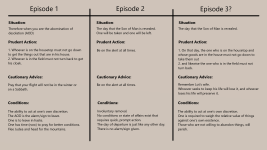
The following chart might help. I developed this chart while studying Luke 17. I concluded that Jesus addressed three distinct episodes. I labeled them Episodes 1-3. To help me sort out the difference between these three episodes, I asked four fundamental questions. 1. What is the situation? 2. What does Jesus recommend we do about it? 3. What is his cautionary advice? What are the logical conditions that accompany the situation?

For instance: the First Episode is "When you see the Abomination of Desolation," What action does Jesus recommend? Whoever is on the housetop must not go down to get the things out that are in his house. Whoever is in the field must not turn back to get his cloak. What is Jesus' cautionary advice? "Pray that your flight will not be in the winter or on a Sabbath." Logical conditions: The ability to act at one's own discretion. The AOD is the alarm/sign to leave. One is to leave in haste. One has time (now) to pray for better conditions. Flee Judea and head for the mountains.
Olivet Discourse Flight Episodes.png
Look at the chart to see that not all the episodes are the same.
 
The answer to the question, "
The church.
the nation of Israel
Biblical nation of Israel

How do these all fit in the last days is a question that is one of the most abused in modern theology.

One critical passage that speaks to this question is Malachi 4. That passage describes an event that will affect two distinct groups differently. Malachi speaks about two groups: those who fear the Lord, and those who are arrogantly evil. For those who are evil, the Day of the Lord will be fire and burning; but for those who fear the Lord, it will be like a sunrise of healing.

So, the question distinguishes between "The nation of Israel" and the "Biblical Nation of Israel." Malachi 4 is one data point that helps define the distinction. Another data point is the prophet Joel. They describe a time in Israel's future when the Nation of Israel will be divided and sorted out. It will exist as "The Nation of Israel" for a while, but when the time comes, God will bring fire on the nation.

The nation of Israel will hear the call to meet in Jerusalem to pray for the nation. Some will make the trip, while others won't. Those who make the trip will survive the fires; those who don't make the trip will be incinerated. Those who call on the name of the Lord will be saved.
Your entire construction collapses because you’re treating “the nation of Israel,” “the biblical nation of Israel,” and “the Church” as three eschatological actors with separate destinies, but Scripture does not divide them the way you’re describing;
Malachi 4 does not teach a future moment where modern Israelis must physically travel to Jerusalem to avoid being incinerated, nor does Joel teach a sorting of Jews based on whether they make a pilgrimage.
Malachi 4 speaks of two moral categories—the wicked and those who fear the Lord—not two political Israels, and Joel 2–3 speaks of the Day of the Lord coming upon all nations, with salvation promised to “everyone who calls on the name of the LORD,” not a subset of Jews who make a trip to Jerusalem.
The “biblical nation of Israel” is the Old Covenant people under Torah; the “nation of Israel” today is a secular state; and the “Church” is the New Covenant people (Jew + Gentile).
In the last days, Scripture teaches a future turning of ethnic Israel to Christ (Rom 11:25–27), not a survival‑by‑pilgrimage sorting event.
The prophets never say “those who don’t travel to Jerusalem will be incinerated”; they say the wicked perish, and the righteous—Jew or Gentile—are saved by calling on the Lord. Your scenario is not exegesis; it’s a system imposed on texts that never say what you’re claiming.
 
Your entire construction collapses because you’re treating “the nation of Israel,” “the biblical nation of Israel,” and “the Church” as three eschatological actors with separate destinies, but Scripture does not divide them the way you’re describing;
Malachi 4 does not teach a future moment where modern Israelis must physically travel to Jerusalem to avoid being incinerated, nor does Joel teach a sorting of Jews based on whether they make a pilgrimage.
Malachi 4 speaks of two moral categories—the wicked and those who fear the Lord—not two political Israels, and Joel 2–3 speaks of the Day of the Lord coming upon all nations, with salvation promised to “everyone who calls on the name of the LORD,” not a subset of Jews who make a trip to Jerusalem.
The “biblical nation of Israel” is the Old Covenant people under Torah; the “nation of Israel” today is a secular state; and the “Church” is the New Covenant people (Jew + Gentile).
In the last days, Scripture teaches a future turning of ethnic Israel to Christ (Rom 11:25–27), not a survival‑by‑pilgrimage sorting event.
The prophets never say “those who don’t travel to Jerusalem will be incinerated”; they say the wicked perish, and the righteous—Jew or Gentile—are saved by calling on the Lord. Your scenario is not exegesis; it’s a system imposed on texts that never say what you’re claiming.

The "ekklesia" is found in the OT and the NT. There has always been one covenant people, by faith.
 
The "ekklesia" is found in the OT and the NT. There has always been one covenant people, by faith.
Yes, the ekklesia appears in the OT (LXX) and NT, and yes, there has always been one people of God by faith, but that truth does not support your system — because the OT ekklesia was the assembly of Old‑Covenant Israel under Torah, while the NT ekklesia is the New‑Covenant Church (Jew + Gentile) in Christ, and Scripture explicitly distinguishes these two covenant communities rather than merging them: the OT assembly was a national, ethnic, covenant‑bound people (Exod 19; Deut 4), while the NT assembly is a transnational, Spirit‑born people (Eph 2:14–16; Gal 3:28), and the NT repeatedly says the Old Covenant is obsolete and vanished (Heb 8:13), the law‑nation is no longer the covenant people (Rom 10:4), and the Church is the new humanity created in Christ (Eph 2:15). So yes, there is one people of God by faith — but that one people is not “the modern nation of Israel,” and it is not “the biblical nation of Israel continued,” it is the New‑Covenant ekklesia formed by Christ, into which ethnic Israel will be grafted again by faith (Rom 11:23–27), not by pilgrimage, geography, or national sorting. Your claim that Malachi and Joel describe two Israels being sorted by a Jerusalem prayer‑call collapses because the prophets speak of the wicked vs. the righteous, not “modern Israel vs. biblical Israel,” and the NT defines the one people of God as those in Christ, not those in a political state
 
Your entire construction collapses because you’re treating “the nation of Israel,” “the biblical nation of Israel,” and “the Church” as three eschatological actors with separate destinies,
I treat them separately because the Bible treats them separately. The classic and obvious passage that supports my contention is Revelation 7, where it speaks about the 144,000 people from the 12 Tribes of Israel, and those from every tongue, nation, family line, etc. who have come out of the Great Tribulation.

We know these are two distinct groups because God seals the 144K to protect them from what is to come. They are on earth. The saints who came out of the GT are waiting in Heaven.

but Scripture does not divide them the way you’re describing;
Malachi 4 does not teach a future moment where modern Israelis must physically travel to Jerusalem to avoid being incinerated
Malachi 4 speaks about two distinct segments of Jewish culture: those who fear the Lord and those who are arrogantly evil. This prophecy is not about Gentile peoples or those outside of Israel. The prophecy addresses those who have returned to the land and settled there. It says that on the Great and Terrible Day of the Lord, something wiil happen that causes the arrogant and evil doers to be incinerated. Malachi depicts God treading down the wicked, causing them to be ashes under the soles of the feet of the survivors. (Verse 3)

Joel chapter one adds more detail. According to Joel chapter one, God will bring a locust famine on Israel so causing mankind and animal kind alike to starve. Joel says that the famine will be so great, Joel recommends that they: Consecrate a fast, Proclaim a solemn assembly; Gather the elders And all the inhabitants of the land To the house of the Lord your God, And cry out to the Lord. (Verse 2:15}

Then, according to chapter 2, God will bring on them armies of fire that will attack the entire nation from north to south, but they will stop before they get to Jerusalem. All those who heard the call and came to Jerusalem will be saved. (verse 2:32)

Joel says that there will be survivors on Mount Zion. Amos (Amos 7) talks about the fires and Isaiah talks about the fires and the survivors. Isaiah 37:32


In the last days, Scripture teaches a future turning of ethnic Israel to Christ (Rom 11:25–27), not a survival‑by‑pilgrimage sorting event.
Both are true. Ethnic Israel turns to Christ after their land is burned up and the survivors are located in Israel. At that time, Jesus will meet with them outside the city where they crucified him. They will look on him whom they pierced. Refer to Zechariah 14.
 
I treat them separately because the Bible treats them separately. The classic and obvious passage that supports my contention is Revelation 7, where it speaks about the 144,000 people from the 12 Tribes of Israel, and those from every tongue, nation, family line, etc. who have come out of the Great Tribulation.

We know these are two distinct groups because God seals the 144K to protect them from what is to come. They are on earth. The saints who came out of the GT are waiting in Heaven.
Revelation 7 does not present two covenant peoples with two destinies; it presents two vantage points of the one redeemed people — the sealed remnant of Israel (symbolic of God’s faithfulness to His promises to Abraham) and the innumerable multitude (the global harvest of the Lamb), and John deliberately shows them back‑to‑back to make the point that the same Lamb saves both. The 144,000 are sealed on earth because their role is missionary protection, not covenant distinction, and the great multitude is seen in heaven because John is viewing the same redeemed community from the eschatological end‑state. Nothing in the text says “the biblical nation of Israel continues as a covenant people,” nothing says “the modern nation of Israel is a separate eschatological actor,” and nothing says “these two groups have different salvific destinies.” The sealing of the 144,000 is functional, not covenantal — just as God sealed Ezekiel’s remnant in exile — and the great multitude is explicitly described as those “who have come out of the great tribulation,” which includes Jews and Gentiles alike. Revelation 7 does not teach three eschatological peoples; it teaches one redeemed people viewed in two scenes: the remnant preserved and the harvest completed. Your reading imposes a system the text never states, while John’s structure shows the unity of the redeemed, not the perpetuation of three separate covenant actors.
Malachi 4 speaks about two distinct segments of Jewish culture: those who fear the Lord and those who are arrogantly evil. This prophecy is not about Gentile peoples or those outside of Israel. The prophecy addresses those who have returned to the land and settled there. It says that on the Great and Terrible Day of the Lord, something wiil happen that causes the arrogant and evil doers to be incinerated. Malachi depicts God treading down the wicked, causing them to be ashes under the soles of the feet of the survivors. (Verse 3)

Joel chapter one adds more detail. According to Joel chapter one, God will bring a locust famine on Israel so causing mankind and animal kind alike to starve. Joel says that the famine will be so great, Joel recommends that they: Consecrate a fast, Proclaim a solemn assembly; Gather the elders And all the inhabitants of the land To the house of the Lord your God, And cry out to the Lord. (Verse 2:15}

Then, according to chapter 2, God will bring on them armies of fire that will attack the entire nation from north to south, but they will stop before they get to Jerusalem. All those who heard the call and came to Jerusalem will be saved. (verse 2:32)

Joel says that there will be survivors on Mount Zion. Amos (Amos 7) talks about the fires and Isaiah talks about the fires and the survivors. Isaiah 37:32
Brother, your entire reading collapses because you treat Malachi 4 and Joel 1–2 as if they are describing a future, geographic sorting of ethnic Jews based on whether they physically travel to Jerusalem, but neither prophet ever says that;
Malachi speaks of the wicked vs. those who fear the Lord, not “those who stayed home vs. those who made the trip,” and Joel’s call to “gather the elders and all the inhabitants of the land” is a national call to repentance, not a prophecy that only those who obey the call will survive a literal fire‑army that stops at Jerusalem.
Joel 2:32 explicitly universalizes the category: “everyone who calls on the name of the LORD shall be saved,” and the survivors on Mount Zion are the remnant of faith, not a geographic subset who happened to be standing in the right city at the right time.
Amos 7’s fire vision is symbolic judgment,
Isaiah 37:32 refers to the remnant of faith preserved from Assyria, and none of these texts describe your scenario of “modern Israelis sorted by pilgrimage.”
You’re merging apocalyptic imagery, national calls to repentance, and remnant theology into a single literal event the prophets never describe.
The OT remnant is always defined by faith, never by location, and the NT confirms the same pattern: the saved remnant is “those who call on the Lord,” not “those who traveled to Jerusalem.” Your system requires geography to determine salvation; the prophets require repentance and faith. That is why your construction cannot stand.
Both are true. Ethnic Israel turns to Christ after their land is burned up and the survivors are located in Israel. At that time, Jesus will meet with them outside the city where they crucified him. They will look on him whom they pierced. Refer to Zechariah 14.
Zechariah 14 does not teach that ethnic Israel will first be burned, then the survivors will gather in Jerusalem, and then they will turn to Christ; it teaches that the Day of the Lord brings cosmic upheaval, nations gathered against Jerusalem, Yahweh’s intervention, and the Lord becoming king over all the earth, but it never says “Israel’s land is burned up,” never says “survivors are located in Israel,” and never says “Jesus meets them outside the city after the fires.”
You are stitching together Malachi’s moral division (the wicked vs. those who fear the Lord),
Joel’s apocalyptic imagery (locusts, fire‑army, cosmic signs),
Amos’s symbolic fire, and
Zechariah’s eschatological deliverance, and turning them into a single literal event the prophets never describe.
The text that does describe Israel’s turning is Romans 11:25–27, and Paul roots that turning in repentance and faith, not in geography, survival, or pilgrimage.
Zechariah 12:10 — “they will look on Me whom they pierced” — is a repentance oracle, not a “post‑fire survivor meeting,” and it is fulfilled when the Spirit of grace and supplication is poured out, not when a remnant happens to be standing in the right location. Your system requires location‑based salvation; the prophets require Spirit‑wrought repentance. Scripture teaches a future turning of ethnic Israel to Christ, not a sorting of Israelis by who survived a firestorm and walked to Jerusalem.

 
Revelation 7 does not present two covenant peoples with two destinies; it presents two vantage points of the one redeemed people — the sealed remnant of Israel (symbolic of God’s faithfulness to His promises to Abraham) and the innumerable multitude (the global harvest of the Lamb), and John deliberately shows them back‑to‑back to make the point that the same Lamb saves both. The 144,000 are sealed on earth because their role is missionary protection, not covenant distinction, and the great multitude is seen in heaven because John is viewing the same redeemed community from the eschatological end‑state.
You are forcing the text to say what you want to hear and avoiding the contextual clues. You need to suspend your suppositions and your paradigm in order to listen to what John wants to teach you.

Your response came too quickly, which suggests you didn't take the time to examine what I said.

Revelation 7:3 Do not harm the earth or the sea or the trees until we have sealed the bond-servants of our God on their foreheads.”

What information can we glean from that verse? The place where the protection event takes place is ON THE EARTH. Angels will be sent out to harm the earth, the sea, and the trees. The 114k are sealed so that no harm will come to them.

Revelation 7:9 After these things I looked, and behold, a great multitude which no one could count, from every nation and all tribes and peoples and tongues, standing before the throne and before the Lamb, clothed in white robes, and palm branches were in their hands;

Notice that the location has changed from the earth, where the wind is blowing, to the throne, which, according to Chapter 4, is in heaven. Verse 3 talks about the tribes of Israel; verse 9 talks about people from every nation. They are wearing white robes, which symbolize their purification. They wave palm branches, celebrating the arrival of the One who brings salvation.

The first group is on the earth; they have not yet been delivered; they are the tribes of Israel. The second group is standing before the throne, already saved, and celebrating the one who saved them.
 
  • Like
Reactions: Psalm1
You are forcing the text to say what you want to hear and avoiding the contextual clues. You need to suspend your suppositions and your paradigm in order to listen to what John wants to teach you.

Your response came too quickly, which suggests you didn't take the time to examine what I said.

Revelation 7:3 Do not harm the earth or the sea or the trees until we have sealed the bond-servants of our God on their foreheads.”

What information can we glean from that verse? The place where the protection event takes place is ON THE EARTH. Angels will be sent out to harm the earth, the sea, and the trees. The 114k are sealed so that no harm will come to them.

Revelation 7:9 After these things I looked, and behold, a great multitude which no one could count, from every nation and all tribes and peoples and tongues, standing before the throne and before the Lamb, clothed in white robes, and palm branches were in their hands;

Notice that the location has changed from the earth, where the wind is blowing, to the throne, which, according to Chapter 4, is in heaven. Verse 3 talks about the tribes of Israel; verse 9 talks about people from every nation. They are wearing white robes, which symbolize their purification. They wave palm branches, celebrating the arrival of the One who brings salvation.

The first group is on the earth; they have not yet been delivered; they are the tribes of Israel. The second group is standing before the throne, already saved, and celebrating the one who saved them.
Brother — the problem isn’t that I “responded too quickly,” it’s that you’re treating location as the controlling category when John is using vision‑sequence as the controlling category, and once you let the text speak in its own categories, your reading collapses.

Revelation 7:3 absolutely places the sealing event on earth, but nothing in the verse says the sealed group is a different covenant people from the multitude; it says they are “bond‑servants of our God,” the same term John uses for all believers (Rev 1:1; 2:20; 19:5).

Revelation 7:9 absolutely places the multitude before the throne, but that shift is not a covenant distinction — it is the standard apocalyptic movement from the earthly scene to the heavenly scene, the same pattern John uses in Revelation 5 (earthly crisis → heavenly worship) and Revelation 14 (earthly danger → heavenly Mount Zion).

You’re treating “earth vs. heaven” as if John were giving you two peoples, but he’s giving you two vantage points: the sealed remnant (God’s protection of His people on earth) and the completed multitude (the eschatological end‑state of the same redeemed community).
Your argument that “the first group is Israel on earth, the second is Gentiles in heaven” collapses because the multitude is explicitly said to be “those who came out of the great tribulation,” which includes Jews and Gentiles alike, and the 144,000 are called servants of God, not “the covenant people distinct from the church.”
John’s structure is deliberate: earthly sealing → heavenly completion, not Israel → church.
You’re imposing a geography‑based distinction the text never makes, while John is showing the unity of the redeemed from two angles — the remnant preserved and the harvest completed.
 
Brother — the problem isn’t that I “responded too quickly,” it’s that you’re treating location as the controlling category when John is using vision‑sequence as the controlling category, and once you let the text speak in its own categories, your reading collapses.

Revelation 7:3 absolutely places the sealing event on earth, but nothing in the verse says the sealed group is a different covenant people from the multitude; it says they are “bond‑servants of our God,” the same term John uses for all believers (Rev 1:1; 2:20; 19:5).

Revelation 7:9 absolutely places the multitude before the throne, but that shift is not a covenant distinction — it is the standard apocalyptic movement from the earthly scene to the heavenly scene, the same pattern John uses in Revelation 5 (earthly crisis → heavenly worship) and Revelation 14 (earthly danger → heavenly Mount Zion).

You’re treating “earth vs. heaven” as if John were giving you two peoples, but he’s giving you two vantage points: the sealed remnant (God’s protection of His people on earth) and the completed multitude (the eschatological end‑state of the same redeemed community).
Your argument that “the first group is Israel on earth, the second is Gentiles in heaven” collapses because the multitude is explicitly said to be “those who came out of the great tribulation,” which includes Jews and Gentiles alike, and the 144,000 are called servants of God, not “the covenant people distinct from the church.”
John’s structure is deliberate: earthly sealing → heavenly completion, not Israel → church.
You’re imposing a geography‑based distinction the text never makes, while John is showing the unity of the redeemed from two angles — the remnant preserved and the harvest completed.

Isn't labeling the 144,000 as simple "bond servants" a little deceiving?

Revelation 7 tells us who the 144,000 are:

4 And I heard the number of them which were sealed: and there were sealed an hundred and forty and four thousand of all the tribes of the children of Israel.

5 Of the tribe of Juda were sealed twelve thousand. Of the tribe of Reuben were sealed twelve thousand. Of the tribe of Gad were sealed twelve thousand.

6 Of the tribe of Aser were sealed twelve thousand. Of the tribe of Nephthalim were sealed twelve thousand. Of the tribe of Manasses were sealed twelve thousand.

7 Of the tribe of Simeon were sealed twelve thousand. Of the tribe of Levi were sealed twelve thousand. Of the tribe of Issachar were sealed twelve thousand.

8 Of the tribe of Zabulon were sealed twelve thousand. Of the tribe of Joseph were sealed twelve thousand. Of the tribe of Benjamin were sealed twelve thousand.

The multitude appearing in verse 9 and verse 14 says that it is a number of people that no man could number and that they ALL came out of the Great Tribulation. So, they obviously weren't sealed before the Great Tribulation started and gave up their lives for Christ.
 
Isn't labeling the 144,000 as simple "bond servants" a little deceiving?

Revelation 7 tells us who the 144,000 are:

4 And I heard the number of them which were sealed: and there were sealed an hundred and forty and four thousand of all the tribes of the children of Israel.

5 Of the tribe of Juda were sealed twelve thousand. Of the tribe of Reuben were sealed twelve thousand. Of the tribe of Gad were sealed twelve thousand.

6 Of the tribe of Aser were sealed twelve thousand. Of the tribe of Nephthalim were sealed twelve thousand. Of the tribe of Manasses were sealed twelve thousand.

7 Of the tribe of Simeon were sealed twelve thousand. Of the tribe of Levi were sealed twelve thousand. Of the tribe of Issachar were sealed twelve thousand.

8 Of the tribe of Zabulon were sealed twelve thousand. Of the tribe of Joseph were sealed twelve thousand. Of the tribe of Benjamin were sealed twelve thousand.

The multitude appearing in verse 9 and verse 14 says that it is a number of people that no man could number and that they ALL came out of the Great Tribulation. So, they obviously weren't sealed before the Great Tribulation started and gave up their lives for Christ.
Calling the 144,000 “bond‑servants” isn’t misleading — it’s John’s own term, used for all believers (Rev 1:1; 2:20; 19:5), so the tribal list points to their role, not a separate covenant group.
Yes, the sealing happens on earth and the multitude appears in heaven, but that’s just the usual apocalyptic shift from earthly to heavenly scenes, not proof they’re different peoples with different destinies.
The text never claims the multitude “obviously weren’t sealed”; it says they “came out of the great tribulation,” including both Jews and Gentiles.
Revelation 7 doesn’t present the seal as a “pre‑tribulation exemption” — it’s protection from divine judgment, not from suffering, just like Ezekiel’s marked remnant.
The idea that “earth = Israel” and “heaven = Gentiles” isn’t in John’s vision; he shows the same redeemed people from two angles: the sealed remnant (God’s people preserved through judgment) and the completed multitude (the final state of those same people). The tribal list reflects God’s faithfulness to His promises to Abraham, the multitude is the global harvest of the Lamb, and the difference is location in the vision, not covenant identity. Geography isn’t theology here — John’s showing one unified redeemed people, preserved and completed, not two groups with separate destinies.
 
Calling the 144,000 “bond‑servants” isn’t misleading — it’s John’s own term, used for all believers (Rev 1:1; 2:20; 19:5), so the tribal list points to their role, not a separate covenant group.
Yes, the sealing happens on earth and the multitude appears in heaven, but that’s just the usual apocalyptic shift from earthly to heavenly scenes, not proof they’re different peoples with different destinies.
The text never claims the multitude “obviously weren’t sealed”; it says they “came out of the great tribulation,” including both Jews and Gentiles.
Revelation 7 doesn’t present the seal as a “pre‑tribulation exemption” — it’s protection from divine judgment, not from suffering, just like Ezekiel’s marked remnant.
The idea that “earth = Israel” and “heaven = Gentiles” isn’t in John’s vision; he shows the same redeemed people from two angles: the sealed remnant (God’s people preserved through judgment) and the completed multitude (the final state of those same people). The tribal list reflects God’s faithfulness to His promises to Abraham, the multitude is the global harvest of the Lamb, and the difference is location in the vision, not covenant identity. Geography isn’t theology here — John’s showing one unified redeemed people, preserved and completed, not two groups with separate destinies.

I disagree with you on the purpose of the sealing of the 144,000...

"The sealing of the 144,000 in Revelation 7 specifically exempts them from the direct effects of God’s wrath and divine judgments during the tribulation. An angel commands four angels to hold back the destructive "winds" of judgment upon the earth, sea, and trees until these 12,000 individuals from each of the twelve tribes of Israel are sealed on their foreheads.

This divine mark serves as a guarantee of protection and ownership, shielding the sealed servants from the harmful plagues and judgments that befall the rest of humanity. While they are preserved from God's wrath, interpretations vary on whether this protection is purely spiritual or physical; however, the text explicitly states that this sealing prevents them from being harmed by the specific divine punishments released during this period."
 
  • Like
Reactions: Psalm1
I disagree with you on the purpose of the sealing of the 144,000...

"The sealing of the 144,000 in Revelation 7 specifically exempts them from the direct effects of God’s wrath and divine judgments during the tribulation. An angel commands four angels to hold back the destructive "winds" of judgment upon the earth, sea, and trees until these 12,000 individuals from each of the twelve tribes of Israel are sealed on their foreheads.

This divine mark serves as a guarantee of protection and ownership, shielding the sealed servants from the harmful plagues and judgments that befall the rest of humanity. While they are preserved from God's wrath, interpretations vary on whether this protection is purely spiritual or physical; however, the text explicitly states that this sealing prevents them from being harmed by the specific divine punishments released during this period."
The sealing of the 144,000 is absolutely protection, but you’re assuming the wrong kind of protection — you’re treating it as exemption from physical harm during the tribulation, when John treats it as identification and preservation from God’s wrath, exactly like the marked remnant in Ezekiel 9, where the seal protects from divine judgment, not from Babylon’s swords.
Revelation 7 never says the 144,000 are spared from martyrdom, never says they avoid suffering, never says they survive physically, and never says the seal is a “pre‑tribulation exemption,” it says only that the destructive winds are held back until the servants of God are sealed, meaning the seal marks them as belonging to the Lamb so that God’s wrath does not fall on them, not that human persecution cannot touch them.
Your interpretation requires the seal to function like a force field, but John uses it as a covenantal marker — the same category as the Spirit’s seal in Ephesians 1:13–14 — and the multitude “coming out of the great tribulation” does not mean “they obviously weren’t sealed,” it means they endured suffering and emerged in victory, which is precisely the pattern Revelation applies to all believers (Rev 12:11). The tribal list identifies role, not a separate destiny; the seal identifies ownership, not physical invulnerability; and the contrast between earth and heaven is vision‑sequence, not covenant distinction. You’re treating the seal as protection from tribulation, but John treats it as protection from God’s wrath,
 
The sealing of the 144,000 is absolutely protection, but you’re assuming the wrong kind of protection — you’re treating it as exemption from physical harm during the tribulation, when John treats it as identification and preservation from God’s wrath, exactly like the marked remnant in Ezekiel 9, where the seal protects from divine judgment, not from Babylon’s swords.
Revelation 7 never says the 144,000 are spared from martyrdom, never says they avoid suffering, never says they survive physically, and never says the seal is a “pre‑tribulation exemption,” it says only that the destructive winds are held back until the servants of God are sealed, meaning the seal marks them as belonging to the Lamb so that God’s wrath does not fall on them, not that human persecution cannot touch them.
Your interpretation requires the seal to function like a force field, but John uses it as a covenantal marker — the same category as the Spirit’s seal in Ephesians 1:13–14 — and the multitude “coming out of the great tribulation” does not mean “they obviously weren’t sealed,” it means they endured suffering and emerged in victory, which is precisely the pattern Revelation applies to all believers (Rev 12:11). The tribal list identifies role, not a separate destiny; the seal identifies ownership, not physical invulnerability; and the contrast between earth and heaven is vision‑sequence, not covenant distinction. You’re treating the seal as protection from tribulation, but John treats it as protection from God’s wrath,

You say that the list showing 12,000 each from the 12 tribes of Israel that make up the SEALED 144.000 just identifies a role. What role exactly would that be?
 
You say that the list showing 12,000 each from the 12 tribes of Israel that make up the SEALED 144.000 just identifies a role. What role exactly would that be?
The “role” of the 144,000 is militant witness, because John frames them as the Lamb’s army, not a demographic subset of ethnic Israel. The tribal list is not about ethnicity; it is about formation, allegiance, and vocation. Judah is placed first because the army is organized around the Lion-Lamb. Dan is removed because idolatry has no place in the Lamb’s forces. Ephraim is replaced by Joseph for the same reason. The symmetrical numbering (12,000 each) is apocalyptic military math — the same symbolic structure used in Numbers when Israel is mustered for war. Revelation 14 confirms the identity: the 144,000 stand with the Lamb on Mount Zion as His firstfruits, His army, His loyal remnant who “follow the Lamb wherever He goes.” Their role is not “protected spectators”; their role is sealed servants who carry the gospel into a world under judgment, marked so that God’s wrath does not fall on them even as human persecution does. The great multitude is the same group after the battle — the church triumphant. The 144,000 is the church before the conflict, numbered, sealed, commissioned. The multitude is the church after the conflict, delivered, vindicated, glorified. One people, two vantage points, one vocation: the Lamb’s army bearing witness unto death and into victory.