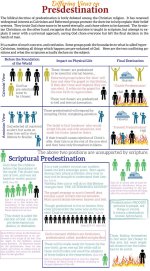
Are you a monergist or a synergist?

  • Christian Chat is a moderated online Christian community allowing Christians around the world to fellowship with each other in real time chat via webcam, voice, and text, with the Christian Chat app. You can also start or participate in a Bible-based discussion here in the Christian Chat Forums, where members can also share with each other their own videos, pictures, or favorite Christian music.

    If you are a Christian and need encouragement and fellowship, we're here for you! If you are not a Christian but interested in knowing more about Jesus our Lord, you're also welcome! Want to know what the Bible says, and how you can apply it to your life? Join us!

    To make new Christian friends now around the world, click here to join Christian Chat.

Which are you? Please vote only once and simply add 1 to the current total for what you choose.

  • Monergist Total = 0 Synergist Total = 0

    Votes: 0 0.0%

  • Total voters
    2
  • Poll closed .
Please expound on what a synergist position is.
The synergist position holds that God initiates the work of salvation and man, by accepting and believing, cooperates with God. It is generally held in opposition to the monergist position, which holds that salvation is entirely the work of God without any cooperation from man and, often, without any ability of man to affect the outcome. "TULIP" Calvinism is typical of the Monergist position.
 
Both teach we are born corrupted. I did not mention born dead. Surely, "partially dead" is corrupted. And dead is also corrupted. The Bible teaches we are conceived and born innocent, and go astray from the innocence we were in the womb and at birth.
No, both don't teach that we are born corrupted. Arminianism teaches that, Calvinism teaches that we are born dead in our sin, meaning we're not only corrupt but completely dead or "totally depraved". Not partially depraved.
The Bible does not teach that we are conceived and born innocent, that's another false Arminian teaching. The Bible teaches that we inherit our sin nature at the point of conception, - Psalm 51:5-9 Behold, I was brought forth in iniquity, And in sin my mother conceived me.
Arminianism teaches that we are "saved by grace + works" Calvinism teaches that we are "saved by grace".

2 Timothy 1:9
who has saved us and called us with a holy calling, not according to our works, but according to His own purpose and grace which was granted us in Christ Jesus from all eternity.

As we can see, Calvinism holds to the Biblical gospel, which is monergistic.
 
My understanding from scripture is that God does not know with 100% certainty what will happen in the future except a select category of things He predetermines and foretells in order to prove His omnipotence. He tests us to see what we will do. So, He does not know what we will do. So, I don't hold to any form of exhaustive divine foreknowledge. Both Calvinism and Arminianism do. This is therefore a third way. If you cannot understand how it is a third way, the problem is purely your own.
Reformed Theology or Calvinism teaches that God knows and ordains everything that happens, including creation, history, and individual salvation.

God works all things according to the counsel of His will, meaning nothing happens outside His ultimate control or plan. God does not look into the future to see what humans will do and then base His choices on that. Instead, He foreknows events because He has decreed them to happen.

God chooses whom to save based entirely on His mercy and grace, not on any foreseen faith or good works by the individual. Humans make genuine choices, but these choices operate within the boundaries of God's sovereign orchestration.

Ephesians 1:11: Believers are predestined according to the purpose of Him who works all things after the counsel of His will.

Romans 8:29–30: Those whom God "foreknew" (understood relationally as fore-loved) he also predestined to be conformed to the image of His Son.

Proverbs 16:9: Humans plan their ways, but the Lord establishes their steps.
 
Where do you see the equivalent to "all eternity" mentioned in the Greek and Hebrew text of the Christian scriptures, friend ? Using fallible translations of God’s word to justify your hatred of fellow human beings is not wise.
In Matthew 25:46 The Lord Jesus uses the exact same Greek word (aionios) for both "eternal life" and "eternal punishment," implying that both states last for the same unending duration.

Passages like Mark 9:48 ("where their worm does not die and the fire is not quenched") and Revelation 14:11 ("the smoke of their torment goes up forever and ever") are descriptions of ongoing, conscious anguish rather than instant annihilation.

Because God is infinitely holy, any offense against Him carries an infinite weight, making eternal retribution a requirement of His perfect justice.

I don't hate anyone, because I was no better than any other sinner before I was saved. Only God's hatred of sinners is justified, if a sinner hates another sinner he is a hypocrite.
 
Why would He love you? You aren't a dirty rotten sinner? Rom 11:32 says that God consigned all to disobedience (Strong's Greek says 'willful unbelief') so that He may have mercy on them all. Everyone is bound in the imprisoned in disobedience. And Titus 2:11 says that the grace of God has appeared, bringing salvation to everyone.

It's not Jesus' hate that consigns anyone to the lake of fire. It is their portion, the share which they've claimed for themselves to hold dear, the right to love the lie and hate Him whom, in truth, is their true love, and their one and only life.
Romans 11:32 ("For God has consigned all to disobedience, that he may have mercy on all") is a capstone to Paul's argument on God's absolute sovereignty in salvation, affirming that "all" means all classes of people (Jew and Gentile) without distinction, rather than every single human being without exception (rejecting universalism).

Titus 2:11 ("For the grace of God has appeared, bringing salvation for all people") does not mean that every single individual will be saved. Again, it means "all people" qualitatively rather than quantitatively—meaning all classes, types, and kinds of people without distinction, rather than every single human being without exception.

It's true, the sinners will be cast into the lake of fire because they loved their sin instead of God.
 
ok ... we can take each verse separately ... but that does not change what God said before Esau was born or what was written after Esau was long dead and gone:

Romans 9:12 It was said unto her, The elder shall serve the younger.

where was it "said" unto Rebecca "The elder shall serve the younger"?


Romans 9:13 As it is written, Jacob have I loved, but Esau have I hated.

where is it "written" ... "Jacob have I loved, but Esau have I hated"?

Answer to Romans 9:12 ... Genesis 25 ... when Jacob and Esau were still in utero (before Esau was born "the elder shall serve the younger").

Answer to Romans 9:13 ... Malachi 1 ...

How many years between Genesis 25 and Malachi 1?

bottom line ... God never said He hated Esau before Esau was born.

do you believe that the Holy Bible is God's Word or not?

If you believe that the Holy Bible is God's Word, then you must accept the fact that God did not say He hated Esau before Esau was born.


.
Paul's argument in Romans 9:11 that the twins had done "nothing either good or bad" when the choice was declared ("the older will serve the younger"). This establishes that God's choice was based entirely on His sovereign grace, not human works or foreseen merit.
The meaning of "hate" (when applied eternally) is God's sovereign decision of reprobation—His eternal decree to pass over an individual, leaving them in their inherited sin to face His rightful justice, while setting His unmerited love (election) upon Jacob.

God's "hatred" or passing over of Esau before birth signifies His eternal decree regarding Esau's ultimate spiritual status outside of saving grace.
 
Please expound on what a synergist position is.


That would be silly. That is like having to choose "on or off", "moving or still", "God does it all or God doesn't do it all" concerning your salvation, "God gets all the glory because he changes the person, God doesn't get all the glory because God offers His saving grace to all, but a person can refuse because of free will. Personally, I think it is silly to imagine an all knowing and powerful God offering His saving grace to someone and being turned down. It's like when He grants repentance. You can't refuse it because when He grants it, you have it. Salvation is a state of being where you recognize that you are a sinner, repent and turn to God for forgiveness, put your trust in His plan for forgiveness of sins through His Son, and lastly, getting sealed and perfected when Christ baptizes you with the Holy Spirit. The Holy Spirit acts as a portal through which both Father and Son enter the being indwelled and change the person's motivation for living from love of self first to love of God first and love of everyone else as one loves himself. It is through the Holy Spirit that we become part of the body of Christ and in the Family of the Father. It is through the Holy Spirit that God communicates and directs our thoughts and actions (all motivated by love). I will admit that I give all the glory for my salvation to God Almighty, the Father who through His Son made it possible. My intent is not to deceive or change the definition of a synergist, but to be truthful. If I'm in error, please correct me in defining a synergist.

But yet there is an answer....
And mine is just like Jesus's.....

None of the above choices.
 
Not sure why you think that, it is all to god's ultimate glory, the deterministic god of your soteriology left them in their sin because he hates them anyway.
Gods ways are infinitely higher than ours, they are past finding out. So attempting to understand His mysterious ways is futile. And I do agree with you, everything God does is absolutely good and perfectly just. So we can be sure that God is glorified when He casts sinners into the lake of fire.
 
Romans 11:32 ("For God has consigned all to disobedience, that he may have mercy on all") is a capstone to Paul's argument on God's absolute sovereignty in salvation, affirming that "all" means all classes of people (Jew and Gentile) without distinction, rather than every single human being without exception (rejecting universalism).

Titus 2:11 ("For the grace of God has appeared, bringing salvation for all people") does not mean that every single individual will be saved. Again, it means "all people" qualitatively rather than quantitatively—meaning all classes, types, and kinds of people without distinction, rather than every single human being without exception.

It's true, the sinners will be cast into the lake of fire because they loved their sin instead of God.
Paul's argument in Romans 9:11 that the twins had done "nothing either good or bad" when the choice was declared ("the older will serve the younger"). This establishes that God's choice was based entirely on His sovereign grace, not human works or foreseen merit.
The meaning of "hate" (when applied eternally) is God's sovereign decision of reprobation—His eternal decree to pass over an individual, leaving them in their inherited sin to face His rightful justice, while setting His unmerited love (election) upon Jacob.

God's "hatred" or passing over of Esau before birth signifies His eternal decree regarding Esau's ultimate spiritual status outside of saving grace.
So sometimes he is speaking of peoples and other times he's speaking of specific individuals, whichever is most convenient or not so much. Whether to this certain theology or that, is left to each individual to decide, except that it's not.
 
Paul's argument in Romans 9:11 that the twins had done "nothing either good or bad" when the choice was declared ("the older will serve the younger"). This establishes that God's choice was based entirely on His sovereign grace, not human works or foreseen merit.
The meaning of "hate" (when applied eternally) is God's sovereign decision of reprobation—His eternal decree to pass over an individual, leaving them in their inherited sin to face His rightful justice, while setting His unmerited love (election) upon Jacob.
I understand what you are saying.

However, that does not change the fact that God never said He hated Esau before Esau was born.

Romans 9:10-12

10 And not only this; but when Rebecca also had conceived by one, even by our father Isaac;

11 (For the children being not yet born, neither having done any good or evil, that the purpose of God according to election might stand, not of works, but of him that calleth; )


12 It was said unto her, The elder shall serve the younger.

Paul quoted from Genesis 25:

Genesis 25:23 And the LORD said unto her, Two nations are in thy womb, and two manner of people shall be separated from thy bowels; and the one people shall be stronger than the other people; and
the elder shall serve the younger.


God's "hatred" or passing over of Esau before birth signifies His eternal decree regarding Esau's ultimate spiritual status outside of saving grace.
your argument is with the Author of Scripture Who could just as easily said what you want Scripture to say ... but He did not ... and Scripture is very clear what God said before Esau was born ... "the elder shall serve the younger" ... period.


remember your words ...


do you believe that the Holy Bible is Gods Word or not.
I suggest you pray about the Holy Bible being God's Word.


.
 
Besides believing the Bible does not teach exhaustive divine foreknowledge, I also do not believe the Bible teaches original sin, i.e. that children are born corrupted with a sin nature, which both Calvinism and Arminianism teach. So, how do I fit into either calvinism Arminianism?
You fit in the category of one who has never read the physical Bible cover to cover.

Online reading topical search and scripture picks,is not the same thing by a long shot.

Prophecy is,divine foreknowledge. The Old Testament is filled with it.
Even,as we know,the future coming of Immanuel.

And the Book of Revelation,if the Book name doesn't suffice,is nothing but foreknowledge. God's plans for this world. "Revelations",regarding those plans.

The Bible and all those facts pre-existed Arminianism,and Calvinism.
 
  • Haha
Reactions: PaulThomson
A monergist is a person who believes that God alone effects a person's salvation. They believe that the Holy Spirit is the only active agent in a person's spiritual rebirth, that the human will is considered spiritually dead and incapable of choosing God on its own until God first steps in to change the person's heart. They believe that saving faith is a gift from God to all whom the Father chooses to become part of the body of Christ. The gift is the Holy Spirit which acts as a portal through which the invisible God the Father enters the being of God the Son, and through which they both enter our beings to change our motivation for living and fill us with love, wisdom, and truth. They believe that all (100%) of the glory for their salvation goes to the Father and to the Son because in 1 Cor 1: 29, no flesh should glory in His presence. That means that no one in heaven can say "I did it!", or "I made the right decision!", or "I did the right things and believed the right things!".
A synergist is a person who believes that salvation involves a cooperative effort between divine grace and human freedom. They believe that God initiates salvation through grace, but the individual must freely choose to accept, respond to, or cooperate with that grace. They emphasize that human beings possess the free will to either assent to or resist God's salvific grace.
I suppose an accurate enough summary.

They believe that they should get some of the glory for their salvation if they accept God's grace.
Until here, or course, where monergy assumes itself glorious over synergy.

Obviously, this is not an objective analysis, but a monergist attack, with a little knowledge of synergism.
 
You fit in the category of one who has never read the physical Bible cover to cover.

Online reading topical search and scripture picks,is not the same thing by a long shot.

Prophecy is,divine foreknowledge. The Old Testament is filled with it.
Even,as we know,the future coming of Immanuel.

And the Book of Revelation,if the Book name doesn't suffice,is nothing but foreknowledge. God's plans for this world. "Revelations",regarding those plans.

The Bible and all those facts pre-existed Arminianism,and Calvinism.
So, at least you recognise neither Calvinist not Arminian. However, you are mistaken in assuming that I have never read the physical Bible form cover to cover.

Most prophecy is not divine foreknowledge. It is mostly contingent warnings and encouragement and promises. If you carry on the way you are going, then you will reap X, but if you turn from your present course, then you may reap Y instead. Occasionally, God does make a settled prediction and forces it come to pass through His omnipotence (e.g. the incarnation of Messiah, and His death on a cross), to inspire confidence that He is able to and will keep His promises.

The book of Revelation does not evidence exhaustive divine foreknowledge. It evidences divine predetermination of certain data points, as described above. It is not proof of divine foreknowledge or predetermination of every detail of history.
 
  • Haha
Reactions: Bible_Locket
However, that does not change the fact that God never said He hated Esau before Esau was born.
Correct. Not until the prophet much later confirmed God hated Esau, and love Jacob:

Mal 1:2
I have loved you, saith the LORD. Yet ye say, Wherein hast thou loved us? Was not Esau Jacob's brother? saith the LORD: yet I loved Jacob, And I hated Esau, and laid his mountains and his heritage waste for the dragons of the wilderness.

And that was only when God judged Esau in life, to destroy his heritage.

Rom 9:12
It was said unto her, The elder shall serve the younger. As it is written, Jacob have I loved, but Esau have I hated.

Paul's quote of Malachi was only to confirm God's choice of ruler from the womb, later proved correct by Jacob's good rule vs Esau's evil rule.

The first prophecy is from the womb, the second is at the end of life.

your argument is with the Author of Scripture Who could just as easily said what you want Scripture to say ... but He did not ... and Scripture is very clear what God said before Esau was born ... "the elder shall serve the younger" ... period.
Correct. While they would both found nations, the age-honored privilege of the first born, would not apply in life.

And, Esau himself never served Jacob, but only his nation was defeated and subjected to David king of Israel.

God's sure foreknowledge of all things, does not make God the predeterminer of all things.

If God predetermines what everyone will do, then God is the Author of a great amount of evil doing.

The only author of evil doing is the god of this world, who himself cannot predetermine what we do.

 
No, both don't teach that we are born corrupted. Arminianism teaches that, Calvinism teaches that we are born dead in our sin, meaning we're not only corrupt but completely dead or "totally depraved". Not partially depraved.
The Bible does not teach that we are conceived and born innocent, that's another false Arminian teaching. The Bible teaches that we inherit our sin nature at the point of conception, - Psalm 51:5-9 Behold, I was brought forth in iniquity, And in sin my mother conceived me.
Arminianism teaches that we are "saved by grace + works" Calvinism teaches that we are "saved by grace".

2 Timothy 1:9
who has saved us and called us with a holy calling, not according to our works, but according to His own purpose and grace which was granted us in Christ Jesus from all eternity.

As we can see, Calvinism holds to the Biblical gospel, which is monergistic.
The biblical Gospel is to love the Lord your God with all your heart, soul, mind and strength; and to love your neighbour as yourself. Does your Calvinism hold to that gospel, which is to express God’s love for all people?
 
I agree that people do not necessarily need to have a precise vocabulary to understand concepts. However, the "underlying concept of divine determinism" vs human "free will" was well known in the First Century by Jewish sects such as the Pharisees, Sadducees and Essenes who had differing views on the matter as well as by the Pagan philosophies and religions that existed at that time.

The Stoics believed every event in the universe was pre-determined and fated by the gods. In Augustine's first work, On Providence (De ordine, 386 CE) teaches this Stoic philosophy when asserting that the falling of a leaf to an exact location is predetermined by a meticulous micromanaging. Augustine himself singled out (Stoic) Providence as the one belief he never doubted throughout his diverse philosophical-religious journeys (Conf.6.5,7; cf. Ord.2.12). To account for human choices, intellectual Stoics like Augustine taught that humans were captives to bad choices because their innate choosing ability was faulty. Excuse me, but this sounds suspiciously like what Augustine later called total inability.

The final influence on Augustine was the nine years he spent as a member of the Persian Gnostic cult of Manichaeism which held that everything that happened in the universe and within the mind of humans was predetermined by one of two universal powers.


There was nothing ambiguous about the language of the early writers. I know having read them myself for many years. The fact that you say this shows that you have not read or studies their writings but and have surrendered your judgment to others who interpret the word for you.
Although I believe Augustine was a true convert to the faith. The system of theology he introduced into Christianity where God micromanages every physical event as well as every movement and choice of the individual makes a mockery out of the gospel of salvation which invites all men to obtain life through repentance and faith. It makes salvation into something like a lottery which does not require any conditions since man's will has been rendered INOPERABLE by God Himself.

What you are calling the word how you interpret the word. The Patristic writers plainly and simply opposed the idea of total divine unilateral determinism of individual destinies and supported the view that humans can make choices. That this WAS what they had been teaching since the times of the Apostles anyone can ascertain by simply reading what they wrote. What they opposed was not Biblical exegesis since they could still read in the original Koine Greek language. What they opposed was the kind of false teaching of the philosopher turned theologian Augustine of Hippo

By assuming your own premise you conclude that any Christian who does not believe Reformed Doctrine has not having experienced the new birth. Tell me, do you think the Reformers Martin Luther, Zwingli and John Calvin exhibited the fruit of Christ in their lives? Christ said we would know them by their fruits
I haven't invested much time in reading about the views of the early Church Fathers, because the early Church was plagued with Gnosticism and Paganism. But we did learn from their mistakes, and now we enjoy the benefit of hindsight so we don't need to make the same mistakes.

Studying the early Church Fathers is like studying superseded or obsolete technologies such as analogue, while we have digital. I don't follow Augustine, or Luther, or Calvin or any man for that matter. I only follow the God Man, so I'm only interested in what He teaches and your theology contradicts His teaching.

God sovereignly determines the eternal destiny of individuals. Passages like Ephesians 1:4-5 and Romans 8:29-30 asserts that God chooses who will be saved before the creation of the world. This choice does not depend on human merit or foreseen faith.

God picks specific individuals for salvation purely by His own grace and will, not because of anything good in them. Spiritual rebirth and faith are gifts created and given directly by God to the elect. For those not chosen, God leaves them in their sin and justly withholds saving grace, holding them responsible for their own sin.
Reformed theology does not teach that God creates people without a will or like robots. It teaches that God is in full control of all things, but humans still have a real will. People make real choices, and they are fully responsible for what they do.
People choose what they want. They act on their own desires. God holds people guilty for their sin. They do not blame God for their bad choices. God guides all things safely to His goal. At the same time, humans act freely without being forced like machines.
The apostles did not preach that man has a "free will" regarding salvation. Instead, the apostolic writings (especially Paul’s) show humans are fallen, morally bound by sin, and utterly dependent on sovereign divine grace to choose God, meaning the unregenerate will is not free to choose spiritual good.
I don't expect you to accept Reformed Theology, as it's obvious you hold to Arminian Theology.

Election and Reprobation are foundational biblical doctrines that form "double predestination." This reveals that God sovereignly chooses some people for salvation and passes over others, leaving them to the just consequences of their sin. So it's not a matter of believing in Reformed Theology, it's actually a matter of believing Gods Word over mans word.

 
So sometimes he is speaking of peoples and other times he's speaking of specific individuals, whichever is most convenient or not so much. Whether to this certain theology or that, is left to each individual to decide, except that it's not.
This is why it's never wise to pluck verses out of their intended context and misapply them to suit your unbiblical doctrine of universalism. The golden rule is to consider the surrounding context, so you don't end up in the kind of confusion that you're in now.
 
I understand what you are saying.

However, that does not change the fact that God never said He hated Esau before Esau was born.

Romans 9:10-12

10 And not only this; but when Rebecca also had conceived by one, even by our father Isaac;

11 (For the children being not yet born, neither having done any good or evil, that the purpose of God according to election might stand, not of works, but of him that calleth; )


12 It was said unto her, The elder shall serve the younger.

Paul quoted from Genesis 25:

Genesis 25:23 And the LORD said unto her, Two nations are in thy womb, and two manner of people shall be separated from thy bowels; and the one people shall be stronger than the other people; and
the elder shall serve the younger.


your argument is with the Author of Scripture Who could just as easily said what you want Scripture to say ... but He did not ... and Scripture is very clear what God said before Esau was born ... "the elder shall serve the younger" ... period.


remember your words ...


I suggest you pray about the Holy Bible being God's Word.


.
Why are you skipping over verse 13 and pretending it's not there. I appreciate, it doesn't fit into your theology. But ignoring it won't make it go away. "Jacob I have loved but Esau I have hated", the preceding verses reveal that God said this before the twins were born.

I would suggest you accept Gods Word as it is written, instead of twisting it and forcing it to fit into your theology.
 
The biblical Gospel is to love the Lord your God with all your heart, soul, mind and strength; and to love your neighbour as yourself. Does your Calvinism hold to that gospel, which is to express God’s love for all people?
I don't have a "Calvinism", and I reject your private version of the gospel because it's not Biblical. It's based on your own wisdom and understanding, which is fundamentally flawed.

The gospel does not consist of those two commandments. The message of the cross is the gospel.