Finneyists among us

  • Christian Chat is a moderated online Christian community allowing Christians around the world to fellowship with each other in real time chat via webcam, voice, and text, with the Christian Chat app. You can also start or participate in a Bible-based discussion here in the Christian Chat Forums, where members can also share with each other their own videos, pictures, or favorite Christian music.

    If you are a Christian and need encouragement and fellowship, we're here for you! If you are not a Christian but interested in knowing more about Jesus our Lord, you're also welcome! Want to know what the Bible says, and how you can apply it to your life? Join us!

    To make new Christian friends now around the world, click here to join Christian Chat.

HeRoseFromTheDead

Senior Member
Sep 4, 2012
14,424
692
113
I'm starting this thread so that the ungodly teachings of Charles Finney, which have permeated and subverted the church, can be exposed. Jerry Falwell and Billy Graham are among those who have regarded him highly. Also, my motivation is to get a discussion going in order to learn more about them; I'm just not that motivated to study them on my own.

As an example of the pernicious influence Finney's ideas have had on the church, roots of sinless perfectionism are found in Finney's teachings. I'm sure that many here will recognize aspects of Finney's doctrine found in CC posts about sinless perfection.

"Whenever [a Christian] sins, he must, for the time being, cease to be holy. This is self-evident. Whenever he sins, he must be condemned; he must incur the penalty of the law of God ... If it be said that the precept is still binding upon him, but that with respect to the Christian, the penalty is forever set aside, or abrogated, I reply, that to abrogate the penalty is to repeal the precept, for a precept without penalty is no law. It is only counsel or advice. The Christian, therefore, is justified no longer than he obeys, and must be condemned when he disobeys or Antinomianism is true ... In these respects, then, the sinning Christian and the unconverted sinner are upon precisely the same ground (p. 46)."

Finney was a rank unbeliever who fully rejected the gospel of Christ and created his own philosophical framework of morality that has infiltrated the church to varying degrees. He rejected the idea that Christ's death "was a literal payment of a debt, which we have seen does not consist with the nature of the atonement ... It is true, that the atonement, of itself, does not secure the salvation of any one" (p.217).
finney3.gif

h/t to zone who introduced me to Finney.
 
It is true, that the atonement, of itself, does not secure the salvation of any one" (p.217).
You're starting to catch on to something. Explore this sentence in comparison to what all arminians teach. It is eerily familiar. ;)
 
Finney's influence on American theology from The Disturbing Legacy of Charles Finney - Dr. Michael Horton

Jerry Falwell calls him "one of my heroes and a hero to many evangelicals, including Billy Graham." I recall wandering through the Billy Graham Center some years ago, observing the place of honor given to Charles Finney in the evangelical tradition, reinforced by the first class in theology I had at a Christian college, where Finney’s work was required reading. The New York revivalist was the oft-quoted and celebrated champion of the Christian singer Keith Green and the Youth With A Mission organization. He is particularly esteemed among the leaders of the Christian Right and the Christian Left, by both Jerry Falwell and Jim Wallis (Sojourners’ magazine), and his imprint can be seen in movements that appear to be diverse, but in reality are merely heirs to Finney’s legacy. From the Vineyard movement and the Church Growth Movement to the political and social crusades, televangelism, and the Promise Keepers movement, as a former Wheaton College president rather glowingly cheered, "Finney, lives on!"
It is upon Finney’s naturalistic moralism that the Christian political and social crusades build their faith in humanity and its resources in self-salvation. Sounding not a little like a deist, Finney declared, "There is nothing in religion beyond the ordinary powers of nature. It consists entirely in the right exercise of the powers of nature. It is just that, and nothing else. When mankind becomes truly religious, they are not enabled to put forth exertions which they were unable before to put forth. They only exert powers which they had before, in a different way, and use them for the glory of God." As the new birth is a natural phenomenon for Finney, so too a revival: "A revival is not a miracle, nor dependent on a miracle, in any sense. It is a purely philosophical result of the right use of the constituted means—as much so as any other effect produced by the application of means."

The belief that the new birth and revival depend necessarily on divine activity is pernicious. "No doctrine," he says, "is more dangerous than this to the prosperity of the Church, and nothing more absurd" (Revivals of Religion [Revell], pp.4-5).

When the leaders of the Church Growth Movement claim that theology gets in the way of growth and insist that it does not matter what a particular church believes: growth is a matter of following the proper principles, they are displaying their debt to Finney.
 
Justification by faith - from A Wolf in Sheep's Clothing: How Charles Finney's Theology Ravaged the Evangelical Movement

The clear implication of Finney's view is that justification ultimately hinges on the believer's own obedience, and God will not truly and finally pardon the repentant sinner until after that penitent one completes a lifetime of faithful obedience. Finney himself said as much, employing the undiluted language of perfectionism. He wrote,

By sanctification being a condition of justification, the following things are intended:

(1.) That present, full, and entire consecration of heart and life to God and His service, is an unalterable condition of present pardon of past sin, and of present acceptance with God.

(2.) That the penitent soul remains justified no longer than this full-hearted consecration continues. If he falls from his first love into the spirit of self-pleasing, he falls again into bondage to sin and to the law, is condemned, and must repent and do his "first work," must turn to Christ, and renew his faith and love, as a condition of his salvation. . . .

Perseverance in faith and obedience, or in consecration to God, is also an unalterable condition of justification, or of pardon and acceptance with God. By this language in this connection, you will of course understand me to mean, that perseverance in faith and obedience is a condition, not of present, but of final or ultimate acceptance and salvation [Systematic Theology, 368-69].


Thus Finney insisted that justification ultimately hinges on the believer's own performance, not Christ's. Here Finney once more turns his guns against the doctrine of imputation:

Those who hold that justification by imputed righteousness is a forensic proceeding, take a view of final or ultimate justification, according with their view of the nature of the transaction. With them, faith receives an imputed righteousness, and a judicial justification. The first act of faith, according to them, introduces the sinner into this relation, and obtains for him a perpetual justification. They maintain that after this first act of faith it is impossible for the sinner to come into condemnation; [Systematic Theology, 369].


But isn't that precisely what Scripture teaches? John 3:18: "He that believeth on him is not condemned." John 5:24: "He that heareth my word, and believeth on him that sent me, hath everlasting life, and shall not come into condemnation; but is passed from death unto life." Galatians 3:13: "Christ hath redeemed us from the curse of the law, being made a curse for us." It was immediately following his great discourse on justification by faith that the apostle Paul wrote, "There is therefore now no condemnation to them which are in Christ Jesus" (Rom. 8:1). But Charles Finney was unwilling to let Christians rest in the promise of "no condemnation," and he ridiculed the idea of security in Christ as a notion that would lead to licentious living. He continues, again caricaturing the position he opposes:

that, being once justified, he is always thereafter justified, whatever he may do; indeed that he is never justified by grace, as to sins that are past, upon condition that he ceases to sin; that Christ's righteousness is the ground, and that his own present obedience is not even a condition of his justification, so that, in fact, his own present or future obedience to the law of God is, in no case, and in no sense, a sine qua non of his justification, present or ultimate.

Now this is certainly another gospel from the one I am inculcating. It is not a difference merely upon some speculative or theoretic point. It is a point fundamental to the gospel and to salvation, if any one can be [Systematic Theology, 369.]

As the final paragraph of that excerpt makes clear, Finney himself clearly understood that what he proclaimed was a different gospel from that of historic Protestantism. By denying the forensic nature of justification, Finney was left with no option but to regard justification as a subjective thing grounded not in Christ's redemptive work but in the believer's own obedience—and therefore a matter of works, not faith alone.
 
Charles Finney was simply a Reformer who came to reject Original Sin but still upheld the U and P of the TULIP. Thus his theology is very contradictory for on one hand he taught that men have free will and ability and then on the other he taught that only certain individuals were elected to salvation (apart from any choice they would make) and that it was these who would persevere.

It was also through Charles Finney that the methodology of the altar call was developed. Charles Finney was very focused on methodology in a psychological sense in order to bring about conversions.

Charles Finney is often promoted amongst those who promote Moral Government Theology. There are many street preachers today who promote this view. Basically they teach that the death of Christ served to satisify the justice of God as a counter balance for the forgiveness of sins. It is very similar to the Penal Substitution (the traditional Reformed view) as the focus is upon the death of Christ as being a "substitute" made in the place of the sinner.

Both the Moral Government view and the Penal Substitution view of the atonement are in error because they negate the purging of sin aspect of the blood. While those of both systems will claim to uphold the purging of sin via the blood the focus in both systems is upon a satisfaction being made apart from an inward transformation taking place.

Basically Penal Substition premises justification upon a forensic legal exchange (guilt of sin transferred to Jesus, obedience/righteousness of Jesus transferred to the believer) whereby God in effect views the believer through a Jesus filter and in effect pretends they are righteous when they are still actually filthy.

Moral Government on the other hand teaches that the death of Christ was such an injustice that it counter balanced God forgiving the guilty. Thus the justice of God is upheld as the seriousness of sin is demonstrated via the requirement of a sacrifice.

Neither view was taught until at least the 11th Century when Anselm of Cantebury put forth the Satisfaction View of the atonement. It was lawyers (with their judicial perspective) who took the Satisfaction View and invented both the Moral Government and Penal views.


There is not a single Scripture in the Bible which teaches that Jesus "paid a penalty." The price Jesus paid was a RANSOM price. Human beings had sold themselves into enslavement to sin and could not extricate themselves from such slavery. Firstly guilt cannot be undone once sin has been committed and secondly the act of sinning is highly addictive.

Jesus Christ gave Himself for us to redeem (set us free via payment of ransom) from ALL iniquity. His blood dedicates the New Covenant by which we are enjoined to God when we approach God in the correct manner.

The death of Christ was an example for us to follow. We are to die WITH Christ and in so doing we die to the rudiments of the world and the lusts of the flesh. No longer do we find ourselves in bondage to the service of sin and thus we are raised up WITH Christ to newness of life whereby we be servants of righteousness. This is the redemption that is found IN Christ. It is a living dynamic of being in a present reality of walking in the light. It is not perfection in the sense of never doing wrong or not still being in the corruptible flesh. What it is though is having a CLEAN HEART before God whereby our wills are submitted to God in all truth. Hence we worship God in spirit and in truth and therefore are able to grow in the grace and knowledge of Jesus Christ.

This is what the Bible teaches yet it is rejected by MOST or professing Christianity in this day and age.

Modern theology for the most part (including Finney theology) has disconnected the aspect of heart purity from salvation. The Reformed side of the Church System basically upholds the Penal View and thus teaches that the blood of Christ is a cloak for ongoing iniquity and that justification is via "trusting" in the forensic legal exchange which they believe took place at the cross. Thus their doctrine will always defend "backsliding for a time" yet remaining in a justified state. Thus they have salvation IN sin and all the sermons will preach right conduct as something we "should" do.

Finneyian theology as well as most on the Wesleyian side of the Church will reject the "forensic justification" aspect of the Penal Model on the surface and instead teach a sin/repent/sin/repent/sin/repent message. They will teach that as long as one is on the "repent" side of this cycle that they will enter the kingdom.

Both sides unfortunately do not understand heart purity as it relates to salvation. Pure hearts don't produce corrupt fruit. The whole purpose of the Gospel is to produce heart purity. Anyone who has been truly redeemed from all iniquity and abides in Jesus Christ is inwardly pure. Faith purifies the heart because faith is the working dynamic of abiding in Jesus Christ.

Don't be deceived into thinking that salvation is some abstract package like thing you have. Salvation is a present reality of purity of heart wrought via faithfully abiding in the Word.

Multitudes of professing Christian's are going to be rejected at the judgement. Multitudes who truly through they were saved because they "trusted in Jesus." Yet these people NEVER came to truly know Christ and Christ NEVER came to know them because they never experienced the dynamic transformation which brings about purity of heart.

Jesus emphatically stated that it is the pure in heart who will see God.

When was the last time you heard a sermon on heart purity as a PRESENT REALITY in salvation? Probably never. The subject of heart purity is the equivalent of the elephant in the room in regards to modern theology. If the subject is raised at all it is always in the context of a purity which will exist sometime in the future that we ought to strive for and thus it is completely disconnected from salvation.

God bless.
 
In Orthodoxy there is Ancestral Sin,and how it is interpreted is fundamental difference between Eastern Orthodox Churches and Western Churches!
 
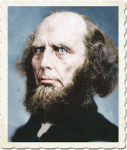
Whose is this man?What he done to be mentioned?Why i don't know him?
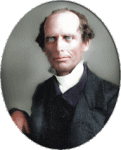
Oh that's just Abraham Lincoln's evil, balding twin from about 16.5 years back. lol, no that's just who he reminds me of. It's Charles Grandison Finney, whom this thread is about.
 
As the final paragraph of that excerpt makes clear, Finney himself clearly understood that what he proclaimed was a different gospel from that of historic Protestantism. By denying the forensic nature of justification, Finney was left with no option but to regard justification as a subjective thing grounded not in Christ's redemptive work but in the believer's own obedience—and therefore a matter of works, not faith alone.

The Bible clearly teaches that God reckons FAITH as righteousness (Rom 4:5). The Bible also defines faith as being the substance of things hoped for and the evidence of things unseen (Heb 11:1) and it also teaches that faith works by love (Gal 5:6). Thus faith is the inward dynamic of an individual by which we produce our fruit. God does not justify us via outward deeds for such deeds can be done for all manner of underlying reasons, instead God reckons faith as righteousness because it is representative of a heart yielded to God.

There is nothing "forensic" about justification. God is looking at the inward reality of the human being He justifies. God does not justify those with filthy hearts.

Historic Protestantism erred in upholding the theology of the Fourth Century Bishop known as Augustine. Augustine was the man who introduced the notion of inability into Christian orthodoxy whereby "sinning" is necessitated via a birth defect often known as being "born depraved." Thus human beings, lacking ability, must be justified in a sinful state. Martin Luther bought hook, line and sinker into that line of thinking and thus developed his view of what he termed the "Blessed Exchange" and thus "forensic justification" was born. The early Church taught the complete opposite of all this stuff.

many of us have erred into very dangerous territory because we view the Bible through the filter of the theology taught by theologians.

Jesus and Paul (among others) warned us about being deceived. Both of them warned about the many deceivers who would come.

This deception basically preaches Satan's old lie that you can sin and not surely die. In doing so they utterly deny heart purity in salvation and treat the blood of Christ as a cloak for a filthy heart.

It is an epic tragedy.
 
In Orthodoxy there is Ancestral Sin,and how it is interpreted is fundamental difference between Eastern Orthodox Churches and Western Churches!

Eastern Orthodox reject the Augustinian notion of Original Sin.

Unfortunately I fear they perceive righteousness is being wrought via OUTWARD IN as opposed to INWARD OUT which is why there is so much focus on rites and rituals in the Orthodox faith.

I have not studied a great deal of Eastern Orthodox writings but I intend to do so when I have completed some of the projects I am currently working on. I find it all very interesting.
 
There is nothing "forensic" about justification. God is looking at the inward reality of the human being He justifies. God does not justify those with filthy hearts.

meanwhile, what's Jesus doing way off in the distance, hanging on a Cross - (having been made a curse) - while God is examining your heart for any speck of impurity before He declares you not guilty...skinski?

...

i didn't see the Holy Spirit mentioned in any of your posts....apologies if i missed it.
what's He doing while God is examining your heart for impurities, skinski?
 
children once called Elisha "thou baldy",,,we know the rest of the story shortly after they died. a person can can do certain things and one then could point out the things they do in error. we in the scriptures find the prophets of old,Christ himself and the apostles pointing out the things that people did by their actions contrary to god,and this from love is something that should be pointed out or else the one doing this thing would not see the error and correct it.

whether a man is bald or ugly or his hair is curly or his eyes are blue. whether he is a Chinese man or a white man or if they are born a woman or a man is determined by god. so in the instance of Elisha who by gods decision was in the day god chose born a man who was in his age created by god a man who then was bald was the very creation god made the choice to create and send into the world. so if his hair fell out,or his eyes were brown or he had a long nose was none of his choice and so then in fact the children were not only disrespecting Elisha(trying to hurt his feelings) but also to god who created Elisha a bald man as if god were half asleep when he created Elisha.

as for Finney,he has no control over how god created him to look. now then on the other hand he does have a choice over the way he decided to teach,believe ect. and it is so that if he stated things in err then as these errors are brought to light then in love they should be pointed out to him when he was alive and also if after he died his teachings still influenced others afterward then also to them that they do not remain in error.

in the letters to the churches in Revelations directed to the 7 churches in Asia the lord says to each one of them one by one the things that he was pleased with them that they were doing correctly and the things that they were not doing correctly. it at the same time stands out that none of the 7 churches were not guilty of of doing something in error as we see from the things he states to them all as he tells them what he wants them to do to correct the things he was pointing out.

in rev. 1;4 he says to these churches "grace be unto you and peace",in rev.1;9 he says "your brother and companion in tribulation",,,the lord then in rev. 2 begins and speaks to all the 7 churches. he at times warns them that if they continue and do not correct certain things that there candlestick might be removed. but he from beginning to end seeing their faults considers them as those whom he loved.

Israel when they erred he still loved,the apostles when they doubted he still loved,and the churches in their errors he still loved,but he corrected them all the whole way the gentiles who were not in the midst of any of these that worshiped every pagan god he saw to bring into salvation and correct because he loved them.

it is not i think a stretch to say even today if we list all of the churches and then Christ wrote them a letter similar to that found in Revelations it would be mostly the same,,, "this thing you do and i am pleased,but this thing i hate,a few of you have remained faithful,but bring these back to their first love",,,,,

he said "he that hath an ear,let him hear what the spirit saith unto the churches",,,the same as then it seems is today we do the same as they did. we should take and help each other,fill each others belly's give water to each other and wash each others feet.

finney is just another man,we are the church. every scripture is from god. we have found that across the years many have come and gone and had many people adhere to certain doctrines, i suppose even more will come. we do know we have the scriptures so if these do come and lead some astray at first some will catch it and begin the path showing the way back,and others will follow and pick up where the other left off,the path will always lead back to the scriptures and what the lord said,,,,,,,,
 
When was the last time you heard a sermon on heart purity as a PRESENT REALITY in salvation? Probably never.

well let's see...here are excerpts from a sermon:

Acts 2
36“Therefore let all Israel be assured of this: God has made this Jesus, whom you crucified, both Lord and Messiah.”

37When the people heard this, they were cut to the heart and said to Peter and the other apostles, “Brothers, what shall we do?”

38Peter replied, “Repent and be baptized, every one of you, in the name of Jesus Christ for the forgiveness of your sins. And you will receive the gift of the Holy Spirit. 39The promise is for you and your children and for all who are far off—for all whom the Lord our God will call.”

40With many other words he warned them; and he pleaded with them, “Save yourselves from this corrupt generation.” 41Those who accepted his message were baptized, and about three thousand were added to their number that day.


were these people saved, skinski?

the very same day they were called out for taking part in the murder of Jesus?

were they pristine in heart (sinless - we've been here before skinski) just before they took part in Christ's murder, but had a stumble?

then the very same day they heard the sermon (somewhere between hearing the message and being baptized, they purified their hearts again)...then God said okay not guilty?

is that what happened? anything like that?

or were they not actually saved.
are you saved?
 
Finney is known as the father of modern revivalism - from Founders Ministries | Charles Finney's Assault Upon Biblical Preaching

The rationale for all that Finney did during revival services was the gaining of converts. The numerical success of his methods was his vindication. As he stated in his Memoirs, "Show me the fruits of your ministry and if they so far exceed mine as to give me evidence that you have found a more excellent way, I will adopt your views." This reasoning prompted Perry Miller to write, "Finney perfected, in his Memoirs, the all-powerful answer to such objections...the results justify my methods."

This factor helped lead later generations of evangelists to adopt Finney's success theme as the barometer of God's blessing. Billy Sunday stated, "theory has got to go into the scrap heap when it comes to experience." In effect, this statement meant that the historic doctrines of grace could be ignored if not altogether rejected by the evangelist. Indeed, D.L. Moody picked up on this reasoning when he said, "It makes no difference how you get a man to God, provided you get him there."​

Finney's lasting legacy - from A Wolf in Sheep's Clothing: How Charles Finney's Theology Ravaged the Evangelical Movement

Predictably, most of Finney's spiritual heirs lapsed into apostasy, Socinianism, mere moralism, cultlike perfectionism, and other related errors. In short, Finney's chief legacy was confusion and doctrinal compromise. Evangelical Christianity virtually disappeared from western New York in Finney's own lifetime. Despite Finney's accounts of glorious "revivals," most of the vast region of New England where he held his revival campaigns fell into a permanent spiritual coldness during Finney's lifetime and more than a hundred years later still has not emerged from that malaise. This is directly owing to the influence of Finney and others who were simultaneously promoting similar ideas.

The Western half of New York became known as "the burnt-over district," because of the negative effects of the revivalist movement that culminated in Finney's work there. These facts are often obscured in the popular lore about Finney. But even Finney himself spoke of "a burnt district" [Memoirs, 78], and he lamented the absence of any lasting fruit from his evangelistic efforts. He wrote,

I was often instrumental in bringing Christians under great conviction, and into a state of temporary repentance and faith . . . . [But] falling short of urging them up to a point, where they would become so acquainted with Christ as to abide in Him, they would of course soon relapse into their former state [cited in B. B. Warfield, Studies in Perfectionism, 2 vols. (New York: Oxford, 1932), 2:24].

...

B. B. Warfield cited the testimony of Asa Mahan, one of Finney's close associates,

. . . who tells us—to put it briefly—that everyone who was concerned in these revivals suffered a sad subsequent lapse: the people were left like a dead coal which could not be reignited; the pastors were shorn of all their spiritual power; and the evangelists—"among them all," he says, "and I was personally acquainted with nearly every one of them—I cannot recall a single man, brother Finney and father Nash excepted, who did not after a few years lose his unction, and become equally disqualified for the office of evangelist and that of pastor."

Thus the great "Western Revivals" ran out into disaster. . . . Over and over again, when he proposed to revisit one of the churches, delegations were sent him or other means used, to prevent what was thought of as an affliction. . . . Even after a generation had passed by, these burnt children had no liking for the fire [Warfield, 2:26-28].

Finney grew discouraged with the revival campaigns and tried his hand at pastoring in New York City before accepting the presidency of Oberlin College. During those post-revivalist years, he turned his attention to devising a doctrine of Christian perfectionism. Perfectionist ideas, in vogue at the time, were a whole new playground for serious heresy on the fringes of evangelicalism—and Finney became one of the best-known advocates of perfectionism. The evil legacy of the perfectionism touted by Finney and friends in the mid-nineteenth century has been thoroughly critiqued by B. B. Warfield in his important work Studies in Perfectionism. Perfectionism was the logical consequence of Finney's Pelagianism, and its predictable result was spiritual disaster.​
 
Eastern Orthodox reject the Augustinian notion of Original Sin.

Unfortunately I fear they perceive righteousness is being wrought via OUTWARD IN as opposed to INWARD OUT which is why there is so much focus on rites and rituals in the Orthodox faith.

I have not studied a great deal of Eastern Orthodox writings but I intend to do so when I have completed some of the projects I am currently working on. I find it all very interesting.

Only what i can tell u is that u will find one new world unknown to the West.I don't know will u understand it and accept,but how much i could read fron western peoples who took Orthodoxy,they entered into new unknown world,many were scared,many didn't understood it at beginning,but they found Early Church.
 
Wow now we condemn someone because we do not approve of how he looks in an old photograph? Seems his position on purity and holiness has struck a nerve with some around here.
Jesus told us that with what measure we measure others we will be measured.

For the cause of Christ
Roger
 
Wow now we condemn someone because we do not approve of how he looks in an old photograph? Seems his position on purity and holiness has struck a nerve with some around here.
Jesus told us that with what measure we measure others we will be measured.

Based on all of Finney's bad fruit and doctrine, it sounds like exposing such has struck a nerve with someone here. Excellent.
 
Finneyism is neo-Pelagianism. Pelagianism has been one of the most, if not the most, condemned heresies in church history. Councils that have condemned it include:

  • Councils of Carthage (412, 416 and 418)
  • Council of Ephesus (431)
  • The Council of Orange (529)
  • Council of Trent (1546) Roman Catholic
  • 2nd Helvetic (1561/66) 8-9. (Swiss-German Reformed)
  • Augsburg Confession (1530) Art. 9, 18 (Lutheran)
  • Gallican Confession (1559) Art. 10 (French Reformed)
  • Belgic Confession (1561) Art. 15 (Lowlands, French/Dutch/German Reformed)
  • The Anglican Articles (1571), 9. (English)
  • Canons of Dort (1618-9), 3/4.2 (Dutch/German/French Reformed).

from The Pelagian Captivity of the Church, by R.C. Sproul

In the nineteenth century, there was a preacher who became very popular in America, who wrote a book on theology, coming out of his own training in law, in which he made no bones about his Pelagianism. He rejected not only Augustinianism, but he also rejected semi-Pelagianism and stood clearly on the subject of unvarnished Pelagianism, saying in no uncertain terms, without any ambiguity, that there was no Fall and that there is no such thing as original sin. This man went on to attack viciously the doctrine of the substitutionary atonement of Christ, and in addition to that, to repudiate as clearly and as loudly as he could the doctrine of justification by faith alone by the imputation of the righteousness of Christ. This man’s basic thesis was, we don’t need the imputation of the righteousness of Christ because we have the capacity in and of ourselves to become righteous. His name: Charles Finney, one of America’s most revered evangelists. Now, if Luther was correct in saying that sola fide is the article upon which the Church stands or falls, if what the reformers were saying is that justification by faith alone is an essential truth of Christianity, who also argued that the substitutionary atonement is an essential truth of Christianity; if they’re correct in their assessment that those doctrines are essential truths of Christianity, the only conclusion we can come to is that Charles Finney was not a Christian. I read his writings and I say, “I don’t see how any Christian person could write this.” And yet, he is in the Hall of Fame of Evangelical Christianity in America. He is the patron saint of twentieth-century Evangelicalism. And he is not semi-Pelagian; he is unvarnished in his Pelagianism.​