Finneyists among us

  • Christian Chat is a moderated online Christian community allowing Christians around the world to fellowship with each other in real time chat via webcam, voice, and text, with the Christian Chat app. You can also start or participate in a Bible-based discussion here in the Christian Chat Forums, where members can also share with each other their own videos, pictures, or favorite Christian music.

    If you are a Christian and need encouragement and fellowship, we're here for you! If you are not a Christian but interested in knowing more about Jesus our Lord, you're also welcome! Want to know what the Bible says, and how you can apply it to your life? Join us!

    To make new Christian friends now around the world, click here to join Christian Chat.
We all sin in many ways. Undoubtably there were some errors in Finney's theology and errors in his practice. But I don't think it can be denied that he was used by God to alert many to turn from their sins to God. He bore fruit. He was a revivalist and an evangelist, in general, evangelists are not theologians, they are communicators. The fact is that God uses human means and spiritual means to accomplish His purposes.
 
We all sin in many ways. Undoubtably there were some errors in Finney's theology and errors in his practice. But I don't think it can be denied that he was used by God to alert many to turn from their sins to God. He bore fruit. He was a revivalist and an evangelist, in general, evangelists are not theologians, they are communicators. The fact is that God uses human means and spiritual means to accomplish His purposes.

Some errors? Virtually everything he taught was error. Fruit? Did you not read earlier in this thread what Finney himself said about his fruit, "I was often instrumental in bringing Christians under great conviction, and into a state of temporary repentance and faith . . . . [But] falling short of urging them up to a point, where they would become so acquainted with Christ as to abide in Him, they would of course soon relapse into their former state [cited in B. B. Warfield, Studies in Perfectionism, 2 vols. (New York: Oxford, 1932), 2:24]. "

Temporary repentance and faith? In terms of the things of GOD, he was an utter failure.
 
Reading about the burned over district of central/western New York that Finney held revivals in. Fascinating connection between the completion of the Erie Canal and the subsequent in-rush of market capitalism and competing, non-traditional religious ideas into this area that was basically a frontier. From this same area that saw the birth of Finney's new measures came Joseph Smith (founder of Mormonism); Millerism, from which the 7th Day Adventists and Jehovah's Witnesses (to some degree) evolved; the Fox sisters (table-rapping seances that inspired spiritualism); and numerous communistic-type, communal religious groups trying to turn back the rushing tide of market capitalism.

That was an important post for setting the stage of a movement. Realize also that Finney was a Freemason and had a large ministry to the Freemason Community, teaching as it were to their level of [mis]understanding. You are right in noting Joe Smith, and note that he founded Mormonism in the same geographic area, and was inculcated in the Masonic Lodge in Palmyra, NY near Rochester, the lodge still remaining today and Palmyra being a pilgrimage site for Mormonism.
Add The Campbellite Movement (now The Church of Christ, with headquarters in the same geographic area) and John Humphrey Noyes The founder of the Oneida Community.

Realize this geographic area is also home to the Native American Iroquois Nation - The COSMO
Cayuga, Onondaga, Seneca, Mohawk, Oneida Tribes (later Tuscarora) -

Now add the coming civil war, the assassination of Lincoln and all that changed a nation by freemasonry since - not a small thing to lay one's life aside to teach the masons a better gospel than that of Albert Pike. Note that William Seward, the United States Secretary of State under Abraham Lincoln and Andrew Johnson and the engineer of the Alaska Purchase was also from the same geographic locale. I find it interesting as an aside that Finney was raised in Oneida County, New York. After a couple years teaching in New Jersey, he returned to New York to help his mother, who had become seriously ill. Meanwhile, he began studying law and became an apprentice to a judge in Adams, NY. Charles Finney later became President of Oberlin College near Cleveland, Ohio.

Charles Finney | Christian History
 
I was somewhat disappointed with Dr. Horton's Essay on Finney in the sense of a comprehensive review of his theology from a scholarly standpoint. It seems perhaps that everyone with a Doctorate has to attack someone. John MacArthur in his otherwise excellent book "Ashamed of the Gospel" has an appendix with an attack by Benjamin Warfield which was a fairly scathing attack on Finney. That has since been rebuked and refuted as posted online here in another thread (easy search, or reference on request). I would prefer to see someone lay out the doctrinal particulars, say up to ten, and then go through them point by point.

I am not here to make a defense of Finney's doctrines, although I do believe it is worthy of discussion for anyone who wants to do a little bit of the legwork.

In Dr. Horton's essay there seems to be a jumble of snippets that are even sometimes blended together and from a scholarly point of view may not represent the real doctrines presented by Finney.

I have to agree that in terms of perfectionism one needs to look deeper. Perhaps also a bit lightweight from my own keyboard I simply see it as the affirmation of a need for continual sanctification.

I do believe Finney wrongly mixes 'justification' with sanctification.

I would like to continue an expanded discussion on atonement for those who have a particular interest in Finney or refuting his doctrine.

Good thread topic anyway you look at it ...
 
I was somewhat disappointed with Dr. Horton's Essay on Finney in the sense of a comprehensive review of his theology from a scholarly standpoint.

I was appalled and disappointed by the Christianity Today article that you linked to in your previous post. What a whitewash. It's a testament to the degenerate state of evangelical Christianity today that they laud him as a hero of the faith, and make no mention of his manifold heresies.
 
I was appalled and disappointed by the Christianity Today article that you linked to in your previous post. What a whitewash. It's a testament to the degenerate state of evangelical Christianity today that they laud him as a hero of the faith, and make no mention of his manifold heresies.

Thus the invitation to go a bit further than Dr. Hor ton and review the doctrinal positions and to state the biblical doctrinal positions for each ...
 
There will always be minds who disagree with God and by default, those minds will also disagree with anyone agreeing with God.

Finney is well known among Calvinist circles and fundamental Christians.

Finney is well known among Calvinist circles for being a shining example of bad theology and a false Gospel of works that denies righteousness from God. Mention the name in a room of sleeping Presbyterians, continental reformed, or reformed baptists and you'll see everyone wake up rather quickly.
 
Some religions and people fall into the concept of cheap or greasy grace, easy believism, name-it, claim-it, he-did-it-all-for-me-rock-on, sunday-go-to-church salvation, and other such concepts that deny that to be 'justified' in our beliefs we need to understand the life and teachings of Jesus and thus accept him as Lord, Master, Teacher, Leader and follow those teachings. To some such as these, they label it Pelagianism or semi-Pelagianism to say that an enlightened or even a convicted person who has heard the gospel must now make a choice as to the path of their walk. There are I believe several threads that discuss this concept of Pelagianism.

Likewise, there are threads that discuss perfectionism - an issue for many of Finney's critics. From a strict theological standpoint, I do believe that Finney mixed Justification with Sanctification.

How to Survive in A Jungle:
* Realize you are lost in the Jungle - it is as dangerous as it is intriguing
* Find out about a leader who knows the path of The Way - listen to others who have walked that Way
* Accept the leader as one who has walked that path and knows the laws of the jungle (as it were) and paid the price to tell of the Path of The Way
* Read the field guide he has written, follow the map he has drawn
* Stay on the path
* When you stray from the path, confess it to others, as much as a warning testimony to others as a admission and reminder to self
* Get back on the path, re-dedicate to the leader, the field guide, the map ...
* stay the course, reviewing and sharing with others the field guide and map to create a fellowship ..
 
Finney is well known among Calvinist circles for being a shining example of bad theology and a false Gospel of works that denies righteousness from God.
What's missing is context within historic events. I'll be brief.

Finney was among the VERY FEW BRAVE Christian men to expose other Christians men who were slave owners during a time in the United States were slavery was the most cruel business to be in. Enslaved Irish women were FORCE to mate with enslaved Black men to produce Mulato offspring, which were sold for higher profit than the malnourished white stock the Irish DNA alone could yield.

Finney would preach to those slave owners about the righteousness of God not being upon them because the Christians faith should mimic our actions. From those years of constant preaching to slave owners, Finney was hated for the same reasons President Lincoln was hated enough to be murdered, and since then, all kinds of "hear-say" wikipedia distortion has "evolved" regarding Finney's faith and Abraham Lincoln's faith, for that matter. :)

By the grace of God, I'm 4th generation of conservative Reformed Baptists. That means, my great-grandparents were contemporary to Finney's generation, contemporary to the overall abolition struggles and the "fundamental Christian" mentality of the time, which lingers in my family. For over 45 years, I have heard preaching over preaching and example after examples of a multitude of saints and sinners gone before us. That's just the stuff Christians would talk about once upon a time... :)

 
Last edited:
Rather than Semi-Pelagianism, how about Biblicism? In terms of initial salvation, God predestined many according to His foreknowledge (1 Peter 1:2) We weren't predestined based on His foreknowledge of our faith(contra Arminianism) nor were we predestined independent of His foreknowledge (contra Calvinism). We were predestined according to His foreknowledge. God chose those who freely chose Him. Could we choose God without being regenerated? No. Could God save those who don't believe? No. Is God sovereign? Yes. Is man responsible? Yes.
 
Quote from another thread by Herosefromthedead

This belief is Finneyist (and ultimately Pelagian) in nature. He believed and taught that only fully sanctified persons were justified, and they are only holy to the extent that they keep the law. In other words, only those who are completely obedient to the law (no sin) are sanctified, and only those who are fully sanctified will be justified. Finney's Pelagianism later devolved into sinless perfectionism, which we are witnessing manifest itself here.

Doesn't this look similar to Reformed theology? Some Reformed theologians say that if one doesn't evidence their faith by faithfulness, they were never saved to begin with. Finney = Reformed theology?
 
Doesn't this look similar to Reformed theology? Some Reformed theologians say that if one doesn't evidence their faith by faithfulness, they were never saved to begin with. Finney = Reformed theology?

Quite the opposite. Reformed theology teaches that a believer receives full justification from which sanctification proceeds. Finney taught that a believer is not justified until he has fully consecrated/sanctified himself.

The former is positional justification through the death of Christ; the latter is justification based on works of (moral) law.

The former is accomplished solely through faith in Christ's work; the latter is accomplished through faith in the will and determination of man.

The former is Abel; the latter is Cain.
 
Rather than Semi-Pelagianism, how about Biblicism? In terms of initial salvation, God predestined many according to His foreknowledge (1 Peter 1:2) We weren't predestined based on His foreknowledge of our faith(contra Arminianism) nor were we predestined independent of His foreknowledge (contra Calvinism). We were predestined according to His foreknowledge. God chose those who freely chose Him. Could we choose God without being regenerated? No. Could God save those who don't believe? No. Is God sovereign? Yes. Is man responsible? Yes.

Finney wasn't semi-Pelagian; he was fully Pelagian. His view was that man saves (justifies) himself with the help of moral influence from the holy spirit.

As I understand it, semi-Pelagianism holds that GOD saves (justifies) a man, but man is responsible for sanctifying himself through works of law (moral or otherwise). It falls somewhere between Pelagianisn and Calvinism, but for good reason is not called semi-Calvinism.

Some, I think, define semi-Pelagianism as being non-monergism. Monergism is the concept that man is incapable of doing anything in regards to GOD until he is regenerated by the spirit (new birth).

I personally believe that a person can respond to GOD before regeneration (new birth). He is incapable of fully pleasing GOD (righteousness) in that condition, but he can learn and respond to the teachings of the father. Jesus said as much:

It is written in the prophets, ‘And they will all be taught of God.’ Everyone, then, who is hearing and learning from the father is coming toward me. John 6:45​

The spirit leads, but man must follow. This happens before and after regeneration (new birth).
 
I would like to continue an expanded discussion on atonement for those who have a particular interest in Finney or refuting his doctrine.

well DA, i've had the misfortune of wading through much/many of Finney's treatises.
you can't get through a single page without something that makes ya go...HUH?
 
What's missing is context within historic events. I'll be brief.

Finney was among the VERY FEW BRAVE Christian men to expose other Christians men who were slave owners during a time in the United States were slavery was the most cruel business to be in. Enslaved Irish women were FORCE to mate with enslaved Black men to produce Mulato offspring, which were sold for higher profit than the malnourished white stock the Irish DNA alone could yield.


By the grace of God, I'm 4th generation of conservative Reformed Baptists. That means, my great-grandparents were contemporary to Finney's generation, contemporary to the overall abolition struggles and the "fundamental Christian" mentality of the time, which lingers in my family. For over 45 years, I have heard preaching over preaching and example after examples of a multitude of saints and sinners gone before us. That's just the stuff Christians would talk about once upon a time... :)

You said in a thread awhile back you weren't a Calvinist, so if you don't have TULIP you can't meaningfully call yourself reformed. Baptist maybe, but not reformed.

That being said, I really don't care what your "Street creds" are. The fact is, finney started this sinner's prayer, getting saved at the altar every week, re-saved ten times this month garbage that runs amock in the Southern Baptist convention and most evangelical churches in this country. He denied the righteousness of God. It sounds to me you have more of a personal attachment to him, than a brotherly attachment.


Finney would preach to those slave owners about the righteousness of God not being upon them because the Christians faith should mimic our actions. From those years of constant preaching to slave owners, Finney was hated for the same reasons President Lincoln was hated enough to be murdered, and since then, all kinds of "hear-say" wikipedia distortion has "evolved" regarding Finney's faith and Abraham Lincoln's faith, for that matter. :)
This is certainly a good thing, when you preach the Gospel. Being that Finney denied the righteousness of God, his preaching might as well have been Islam, or Catholicism. Pelagianism is a heresy.
 
Who is Dr.Mike, Mr. Hor ton?
Michael's teaching clearly reflect his education and PH.D. work at Oxford and Yale. Because of this, he enjoys the praise of the main stream media and the theologians of Oxford and Yale.

The Rev. Dr. Michael S. Horton is the J. Graham Machen professor of systematic theology and apologetics at Westminster Seminary California.

Michael S. Horton does not fit the traditional mole of Calvinism. He is more of evolving open mined neo-Presbyterians that is moving Calvinist away from the strict interpretation of the Westminster Conversion of Faith. Horton is almost the exact opposite of J. Graham Machen who led the culture wars against liberalism at Princeton. The theology of Michael Horton is very mainstream in the thinking of the liberal Presbyterian USA Church. He provides theology to explain away the importance of keeping the moral laws and downplays the Calvinist perspective of obeying the Ten Commandments. Keeping of the moral law and encouraging others to do so, is not consistent with the defined religion of Michael S. Horton.

His approach is little different than the KGB controlling the Orthodox Church in Russia. His book "Beyond Culture Wars" rebukes Christian Cultural / Social Activism (something Finney surely was addressing in his approach to teaching). What has Calvin said about this (not to say I am a Calvinist):
"Yet this distinction does not lead us to consider the whole system of civil government as a polluted thing which has nothing to do with Christian men. Some fanatics, who are pleased with nothing but liberty, or rather licentiousness without any restraint, do indeed boast and shout, "Since we are dead with Christ to the elements of this world, and, being translated into the kingdom of God, sit among the celestials, it is a degradation to us, and far beneath our dignity, to be occupied with those secular and impure cares which relate to things altogether uninteresting to a Christian man."

but this civil government is designed, as long as we live in this world, to cherish and support the external worship of God, to preserve the pure doctrine of religion, to defend the constitution of the Church, to regulate our lives in a manner requisite for the society of men, to form our manners to civil justice, to promote our concord with each other, and to establish general peace and tranquillity; all which I confess to be superfluous, if the kingdom of God, as it now exists in us, extinguishes the present strife. But if it is the will of God, that while we are aspiring towards our true country, that we be pilgrims on the earth, and if such aids are necessary to our pilgrimage, they who take them from man deprive him of his human nature.

For since the insolence of the wicked is so great, and their iniquity so obstinate that it can scarcely be restrained by all the severity of the laws, what may we expect they would do, if they found themselves at liberty to perpetrate crimes with impunity, whose outrages even the arm of secular power cannot altogether prevent?

John Calvin, Institutes of the Christian Religion, Book IV.xx.1

I am surprised but not shocked that Monergism gives much credence to Mr. Doctor Mike.

 
Quite the opposite. Reformed theology teaches that a believer receives full justification from which sanctification proceeds. Finney taught that a believer is not justified until he has fully consecrated/sanctified himself.

The former is positional justification through the death of Christ; the latter is justification based on works of (moral) law.

The former is accomplished solely through faith in Christ's work; the latter is accomplished through faith in the will and determination of man.

The former is Abel; the latter is Cain.

I don't disagree there is a blending in Finney's doctrine of Justification and Sanctification which can seem confusing. Justification in choosing the path of Jesus (and therefore his teachings) is true and proper. Sanctification is about walking that path. When a person CLAIMS justification in Jesus, but walks a different path (not speaking here of perfectionism, occasional stumbles or drifting off the path which results in recognition of same, confession, repentance and a re-commitment to that same path we are justified in walking), a person is no longer justified as a "saved sinner", which for many religions is the essence of the name-it, claim-it, Act, moment or event of a dunking experience.

A faith in the teaching and works of Jesus also calls us to take up our cross and following Him. Jesus is no scapegoat for our sins, but rather, willingly paid the price of his own life to teach us the doctrines to follow. Following Jesus is not a work of the law, but rather a commitment to self control, self denial, moderation or temperance as a fruit of the spirit - by which followers will be known. Faith and Belief are ACTIVE and require a walk, not a work.
 
Finney wasn't semi-Pelagian; he was fully Pelagian. His view was that man saves (justifies) himself with the help of moral influence from the holy spirit.

As I understand it, semi-Pelagianism holds that GOD saves (justifies) a man, but man is responsible for sanctifying himself through works of law (moral or otherwise). It falls somewhere between Pelagianisn and Calvinism, but for good reason is not called semi-Calvinism.

Some, I think, define semi-Pelagianism as being non-monergism. Monergism is the concept that man is incapable of doing anything in regards to GOD until he is regenerated by the spirit (new birth).

I personally believe that a person can respond to GOD before regeneration (new birth). He is incapable of fully pleasing GOD (righteousness) in that condition, but he can learn and respond to the teachings of the father. Jesus said as much:
It is written in the prophets, ‘And they will all be taught of God.’ Everyone, then, who is hearing and learning from the father is coming toward me. John 6:45


The spirit leads, but man must follow. This happens before and after regeneration (new birth).


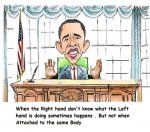
Moral law sees the motive, intent or sometimes simply the base, primal reaction of the sociopath in society. Example - Paul indicated it was no sin to eat meat -- BUT -- if eating meat lead to sin, he would never eat meat again. I walk into a McDonald's (I do not eat meat or dairy), a few days later, a dozen Mormons from the local factory walk into McDonalds, pay their obeisance to the great clown god and the 'golden arches' and lay claim to the big M as their turf and hang-out joint (it even has wireless - the power of the air). None of that makes eating meat a sin, the sin is worshiping the clown and the golden arches and making McDonalds a temple to the C-attle. A sign - the left hand knew not what the right hand was doing, and also - much C-attle.

color-obama-desk-bp-web.jpg
cattle-feed-lot.jpg
 
Justification in choosing the path of Jesus (and therefore his teachings) is true and proper.

Justification is not about choosing anything. That is a modern evangelical corruption introduced by Finney, et al. Justification is through faith, i.e. belief in GOD's witness.

Sanctification is about walking that path. When a person CLAIMS justification in Jesus, but walks a different path (not speaking here of perfectionism, occasional stumbles or drifting off the path which results in recognition of same, confession, repentance and a re-commitment to that same path we are justified in walking), a person is no longer justified as a "saved sinner", which for many religions is the essence of the name-it, claim-it, Act, moment or event of a dunking experience.

You are exhibiting Finneyist roots in your beliefs, unless you are referring to open denial of the lord. The lord said he will remain faithful even when we are not. That is why I started this thread: to reveal how many people have these kinds of errors in their beliefs by using Finney's false doctrines as a benchmark.

A faith in the teaching and works of Jesus also calls us to take up our cross and following Him. Jesus is no scapegoat for our sins, but rather, willingly paid the price of his own life to teach us the doctrines to follow. Following Jesus is not a work of the law, but rather a commitment to self control, self denial, moderation or temperance as a fruit of the spirit - by which followers will be known. Faith and Belief are ACTIVE and require a walk, not a work.

This is Finneyist doctrine at work. Finney taught the holy spirit acted as a moral influence to encourage man, rather than being the power of GOD to transform a sinful being into a new creature. Commitment is just a euphemism for the will of man trying to find justification in works of (moral) law.

I suspected by your initial approach that you are an apologist for Finney. Now I am convinced because in three points made in three paragraphs you have demonstrated that your beliefs conform exactly with what he taught.