Is Knowledge of the Original Languages Necessary for KJV Believers?

  • Christian Chat is a moderated online Christian community allowing Christians around the world to fellowship with each other in real time chat via webcam, voice, and text, with the Christian Chat app. You can also start or participate in a Bible-based discussion here in the Christian Chat Forums, where members can also share with each other their own videos, pictures, or favorite Christian music.

    If you are a Christian and need encouragement and fellowship, we're here for you! If you are not a Christian but interested in knowing more about Jesus our Lord, you're also welcome! Want to know what the Bible says, and how you can apply it to your life? Join us!

    To make new Christian friends now around the world, click here to join Christian Chat.

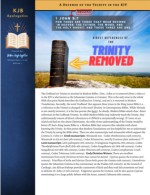
A Defense of the Trinity in the KJV 01.png

Not enough info in my PDF?
Check out: https://textus-receptus.com/wiki/1_John_5:7

There is also going to be a 1 John 5:7 conference that will take place online with various speakers on September 11-12 on Revolution Debates - Nick Sayer's Channel.


And look up how many omissions and alterations are made in the TR to Revelation, the book that strictly warns not to add or remove to its words, from the Byzantine MT.
The charge sounds damaging on the surface, but it needs some unpacking. First, the "six whole verses back-translated from Latin" framing that often accompanies this talking point originated not from Erasmus himself but from Bengel, and was later amplified by Delitzsch in 1861, right in the middle of the German Rationalist era. Erasmus himself described amending only a few words from the Latin, which is a significantly different claim. His own words to Edward Lee were that "in the end of the Book of Revelation I added a small number of words in a Greek codex from our Latin copies," and he was clearly indignant at being accused of something more sweeping than that. On top of that, his later editions do not carry this annotation at all, suggesting that Greek manuscript support was found for those readings.

More importantly, when you get to Stephanus and Beza, that annotation is not carried forward in their TR editions either. That is not a small detail. It means the later TR tradition was not treating those readings as known Latin supplements in need of a disclaimer. Stephanus had access to at least two additional manuscripts specifically for the Revelation section, drawn from the royal and private collections, because his original pool of manuscripts ran out before reaching Revelation. Working with those resources, he examined the ending of Revelation and retained those readings, not as acknowledged Latin patches, but as part of a refined Greek text. Beza then affirmed and carried forward the work of Stephanus, putting his own scholarly seal of approval on it. God was using that process to preserve and settle his word through the TR tradition.

It is also worth noting that Herman Hoskier, the single greatest collator of Revelation manuscripts in history, was not even convinced Erasmus back-translated in the way critics claim. Hoskier suggested Erasmus may have been following Greek manuscript 2049 for the Revelation 22:19 reading rather than constructing it from Latin. That is not a fringe opinion. That is the most qualified manuscript scholar of Revelation in the modern era expressing serious doubt about the standard critical narrative. Edward F. Hills also noted Hoskier's hesitation on this point, which means it has been recognized and taken seriously within the broader TR-friendly scholarly tradition as well.

Second, the Majority Text position is often used as though it were a stable, authoritative standard against which to measure the TR. But what exactly is the Majority Text in practice? It is a modern scholarly reconstruction, formalized by Hodges and Farstad in 1982. Any printed Majority Text edition today rests on collation work covering somewhere between 300 and 600 manuscripts out of the 5,800 plus Greek manuscripts that actually exist, making it a minority of the majority. The name implies broad representation but the reality behind it does not hold up to scrutiny. It has never been the living text of any continuous church tradition. Despite its name, it has produced a remarkably thin shelf of English translations, with the World English Bible being the most notable example. That is a pretty thin footprint for a textual position that gets invoked so frequently as a measuring stick against the TR. The name sounds authoritative but the actual presence in church life is nearly invisible. So the person invoking it is asking us to measure a text that shaped the Reformation, three great revivals, and the English-speaking world against a text that has never stepped off the scholar's shelf and into the life of the church.

Third, and this is worth stating plainly: if we are going to examine the two most influential Bible lines today, the TR tradition and the Critical Text, it is the Critical Text that stands guilty under the warning of Revelation 22:18-19, not the TR. And one does not need an advanced degree in textual criticism to see this. When you take into account the company the Critical Text keeps, unitarians, theological liberals, Catholics, and even a Mormon involved in the BHQ project, it does not require a great deal of spiritual discernment for a Protestant conservative Christian to figure out which text tradition is suspect and which one is true. The TR tradition was built and refined by men who believed the Scriptures, preached the gospel, and gave their lives to the Reformation. The Critical Text was shaped in large part by men who denied the Trinity, undermined the faith, or held to traditions that Protestants have historically stood against. The longer ending of Mark is questioned or placed in brackets, casting doubt on twelve verses of Scripture. The Johannine Comma is removed. The story of the woman caught in adultery is bracketed or questioned as though it does not belong. These are not minor punctuation disputes. These are whole stories and substantial swaths of Scripture being flagged, bracketed, or cut entirely. The Modern Critical Text removes and destabilizes so much that the cumulative effect resembles someone methodically setting a house on fire, one room at a time. The sheer volume of changes and deletions is deeply troubling, and no honest accounting of textual history can wave that away.

The charge that the TR introduced readings into Revelation with no manuscript backing and simply left them there unchallenged is not an accurate picture of what actually happened. Stephanus did not passively reprint Erasmus. He worked with fresh manuscript resources in the Revelation section specifically, examined what was there, and passed on a refined text. Beza did the same. The TR tradition was not spinning its wheels in perpetual revision with no end in sight. It reached its culmination with the Beza 1598 Greek text, which has the greatest agreement with the King James Bible of any TR edition, differing in only around 25 translatable places. That is a tradition that did its work and arrived somewhere.

Where it arrived matters enormously. The King James Bible, built on that foundation, shaped England, America, and countless other nations in ways that frankly cannot be fully calculated. It underlies three of the greatest revivals in human history. It produced a level of unity and Scripture memorization across Protestant denominations that no other Bible translation has ever come close to matching. It reached its settled form in the Pure Cambridge Edition, and that stability is itself a kind of testimony. That kind of fruit does not grow from a corrupted or careless textual tradition. It grows from a text that God was guiding and preserving across generations of careful, faithful scholarship.

Finally, KJV believers do themselves a real favor by staying familiar with the underlying Hebrew and Greek printed texts. The KJV is God's word in English and is without error. A person can come to saving faith through it, grow in holiness by it, and need nothing added to it for life and godliness. It is complete and sufficient on its own. That said, there is a layer of meaning in certain words of the original Hebrew and Greek that the English rendering, while accurate, does not always fully surface. A good example is the word translated "hasteneth not" in Job 40:23 regarding the Behemoth. The underlying Hebrew carries a genuine sense of fear, conveying that the Behemoth is not merely unhurried but is utterly unafraid, which adds a striking dimension to the portrait of that creature that the English alone does not fully bring out. That kind of depth is not a correction of the KJV. It is an additional layer sitting underneath the English, waiting to be discovered by those willing to go looking. The original languages do not undermine the KJV. They enrich it, and for those who explore them, they only deepen the sense of wonder at what God has preserved for us in the English text.


....
 
It's a conspiracy theory that took off in 1993 with the publication of Gail Riplinger's book New Age Bible Versions. It may have been around before that, but her book is what really fueled the fire. It claims there's a vast network of people trying to replace the KJV with modern translations that are Satanic and New Age. I agree there are those who are trying to move people away from the KJV; but it's not because they're Satanic, it's because the KJV is archaic and needs to be replaced. So KJV only isn't so much a preference as a crusade against Satan.
Gail Riplinger is a part of the fringe group of craziness in the KJV believing community. True objective scholarly work has been done in the Textus Receptus / King James Bible community that does not include these individuals for obvious reasons. Just because Riplinger has espoused a lot of falsehoods does not mean that the Textus Receptus / King James Bible community as a whole agrees with her. She is a part of a fringe crazy group of English only KJV believers. Nick Sayers, and many other notable names in the TR community thinks she nuts and she does not represent correctly the true history of the TR/KJV and the Modern Bible Movement. Sure, she may get some things correct, but she also gets many other things wrong, as well. WayofLife.org has an article on Gail Ripler, Peter Ruckman, and Steven Anderson. They are of a fringe weirdo camp of KJV. So appealing to them as if they are our cult leaders or authority is not representing the true reality of the broader TR/KJV believers who do not regard these odd individuals who are of radical fringe branch who believe in the KJV.

If you were to take a time machine back to the 1700s or 1800s, you would see that most conservative Christians regarded the King James Bible as the standard. It was not until 1881 until things started to change slightly in the academic world in England. It is not a conspiracy that George Vance Smith who was a unitarian worked on the Revised Version. Vance wrote about how theological doctrines were changed (which made him happy because they supported his Unitarianism). In fact, by 1831, the Bible societies had become infected by Unitarians so badly that they had to start the Trinitarian Bible Socieity. Westcott and Hort on the revised version committee had communion with George Vance Smith. There were other Unitarians that had influence in the Critical Text Modern Bible Movement. All this is verifiable with reputable sources. Modern Critical Text advocates just do not like to talk about it. Others make excuses for such heretics in that the person does not have anything to do with the text, which is just a dumb argument because a person who has false beliefs can influence the text by their false beliefs. Meaning, unitarians love the newer Critical Text and its translations because there are about 21 places that I have found that water down the deity of Christ in Modern English translations. Some of these are on a textual level in Vaticanus and Sinaiticus, as well. Then there are the 25 Catholic ideas I have catalogued that have grown since the Westcott and Hort 1881 Revised Version. The ideas have grown. This is not whacko conspiracy stuff. You can check these facts for yourself. Then there are new age ideas in Modern Bibles. These are not the new age ideas that Riplinger refers to with the title of her book. She is off the wall. I remember trying to read her book and could not bring myself to do it because it was so bad. Anyway, I have catalogued actual true new age ideas in Modern Bibles in my free PDF that refers to the 77 changed doctrines in Modern Bibles. I do believe you can find it in the Table of Contents section of my PDF. Check it out at www.affectionsabove.com. Granted, keep in mind that I do need to do an overhaul on my writeup to align it more closely to the original languages that underlie the KJV.


....
 
Come on man, it's either inspired by God, or it's not.
There are good english translations that aren't the KJV. If the message it gives creates believers and causes them to bear good fruit to God, then there's no sense in condemning it.
I have two views of inspiration, although I do lean more towards the view that inspiration happened once with the originals and that inspiration was carried through to the printed copies and manuscripts of Hebrew and Greek that underlies the KJV. The KJV is without error as an English translation of these Hebrew and Greek copies. The KJV is a translation that I believe had the hand of God upon it. Is it inspired like the originals? I cannot answer that without knowing the mind of God on the matter. Nevertheless, I believe the KJV is God's word in English. But I strongly believe KJV believers need to also look to the original languages that underlie the KJV. Critical Text advocates need not apply because they go with their Modernist lexicons that offer expanded definitions that redefine original language words beyond their historic usage. They also are for Modern English Bibles that all say different things, which is confusion, and God is not the author of confusion. So who is the author of confusion? That is a question you need to ask yourself.

Anyway, I see that you did not really bother to give a proper reply to what I stated here.
This is because you are currently not an unbiased investigator to follow the truth or facts wherever it may lead (Note: I hope this changes). In any event, like many in the Modern Bible Movement, one is merely defending their team rather than letting the facts speak for themselves. I say this not to wound you dear sir. I say this so that you can try to do your own independent investigation without some critical text advocate or scholar whispering falsehoods in your ear. Don't believe me? Just do your own unbiased investigation on the matter with God in prayer and you will see that I am 100% right. Then again, if you are liberal and you prefer a shape shifter text or a text that you can chop up like a piece of meat at the butcher shop, then my words here will be completely foreign to you. You will have zero idea or understanding of what I speak of here.


....
 
The problem with Riplinger is not that she's crazy, it's that she's a deceiver who peddles falsehoods and misinformation; as do most KJV onlyists.
 
This is poor logic. What people happen to do with ideas is not the fault of the people who generate those ideas.
No, it shows a pattern of influence and way of thinking that they borrowed from. There are some connections between the two. Even if you removed German Rationalism from the equation in having any influence upon the "Westcott & Hort / Nestle and Aland" Modern Bible Movement today, you still have the influence of Unitarians, Catholics, and liberals, for your text, along with a Mormon for your BHQ future Hebrew critical text. The critical text was used to shape the JW Bible, and the spiritualist bible. Even spirits told a spiritualist (Greber) to not use the Textus Receptus. I don't think he was talking to good spirits. Even men who were into the occult wanted to replace the KJV one day. There is just too much evidence to just dismiss all of this. But of course you can ignore all of this.


....

....
 
The problem with Riplinger is not that she's crazy, it's that she's a deceiver who peddles falsehoods and misinformation; as do most KJV onlyists.
In my experience, most people are not really good deep researchers to begin with. They also like placing things into neat little boxes and keeping things really simple when life does not always work that way. They prefer to just listen to some guru then do any kind of heavy lifting to find the truth for themselves. I used to lean a little more on the English KJV-only belief for a brief time, but by the grace of God I always had tools like BlueLetterBible even then. In this past year, my investigation into the original languages that underlie the KJV was like seeing the Bible in full color for the first time. I now see what so many TR/KJV believers are talking about now.

I do argue a little with some of my fellow KJV brethren who are for the English only approach to the KJV. One fellow brother holds to the view that I have competing authorities because I believe that we must look to not only the KJV but to the original languages, as well. This is not to undermine the KJV in any way. I believe the KJV is without error and is God's word in English. But we need to also be good Bereans or detectives and look the original languages, too. After all, the KJV was translated from the Hebrew and Greek.


....
 
The kjv is perfect to God will . There are flaws in language translation gaps and the italicize words that you don't know are Not supposed to be italicized. yet most important to have The Live word of God it must be read by The Holy Spirit. mans carnal mind can't understand it period
Personal Note:
Actually the errors etc Help
me to seek further truth and at same time confusion to non followers
 
The problem with Riplinger is not that she's crazy, it's that she's a deceiver who peddles falsehoods and misinformation; as do most KJV onlyists.
From my perspective, this is also true of the Critical Text Modern Bible Movement believer, as well. They simply will repeat falsehoods sometimes by Modern scholars without always checking if what they said was true or not.

She said that her book (New Age Bible Versions) was inspired. That sounds pretty crazy to me. She believed her work on New Age Bible Versions involved divine guidance or inspiration of some kind, though she did not claim inspiration in the same sense as Scripture itself. Still, even to say that her book was even remotely close to inspiration is heretical in my view.


.....
 
The problem with Riplinger is not that she's crazy, it's that she's a deceiver who peddles falsehoods and misinformation; as do most KJV onlyists.
Hypothetically, I could point to the Passion Translation as a major point against the Critical Text but I would not do that because it is just one fringe crazy guy who created that translation that even other critical text advocates have also condemned. Keep in mind there are many who are for the Passion Translation. Charismatics, etc. The real truth to this topic is knowing your Bible history. What are the two most influential Bible lines for Protestant Christians today and what do each of their histories look like? What does the fruit say in each of these two Bible lines? I think if a person is honest and unbiased to the truth, and they do their own investigation, they will trust the TR/KJV.

Also, I was not influenced by Ruckman, Riplinger, Anderson, etc. There many others just like me.
Should we be erased? Should we just look at only the low hanging fruit?


....
 
The King James onlys have a major problem in the Preface from the translators in the 1611 edition.

They had critics who were asking why a new translation was necessary. These critics were basically saying if a new translation is necessary, how do we know if that which went before was perfect or not. Have we been consuming bread with grit in it? Their answer was, nothing was wrong with what went before but they would build on their work and make something better.

They also shunned the notion that there could ever be one final perfect translation. People have an ongoing need for God's word in a language they can understand. Simply put, they weren't KJV onlyists by any means.

Some of it's pretty hard to understand but with Google and a good dictionary it's not insurmountable. Well worth a look.
 
The King James onlys have a major problem in the Preface from the translators in the 1611 edition.

They had critics who were asking why a new translation was necessary. These critics were basically saying if a new translation is necessary, how do we know if that which went before was perfect or not. Have we been consuming bread with grit in it? Their answer was, nothing was wrong with what went before but they would build on their work and make something better.

They also shunned the notion that there could ever be one final perfect translation. People have an ongoing need for God's word in a language they can understand. Simply put, they weren't KJV onlyists by any means.

Some of it's pretty hard to understand but with Google and a good dictionary it's not insurmountable. Well worth a look.
I have never encountered a KJV-onlyist who seriously considers the Preface. The usual response is, “It isn’t Scripture.”
 
  • Like
Reactions: DavidLamb
I have never encountered a KJV-onlyist who seriously considers the Preface. The usual response is, “It isn’t Scripture.”
And of course, the preface isn't Scripture. However, the preface does include statements from the translators to the effect that they did not consider their translation perfect.
 
  • Like
Reactions: Dino246
It claims there's a vast network of people trying to replace the KJV with modern translations that are Satanic and New Age.
There's undoubtedly a few stragglers out there like the 'queen james bible' and 'the passion translation'; but God exalts His true word enough for them to not be an issue.
 
There's undoubtedly a few stragglers out there like the 'queen james bible' and 'the passion translation'; but God exalts His true word enough for them to not be an issue.
I agree. Oddly though, you never hear the KJV onlyists warning about those "Bibles." They seem to be mostly concerned with the NIV, NASB, and even the NKJV. All those that they think are a genuine threat to the KJV.
 
  • Like
Reactions: Dino246
I agree. Oddly though, you never hear the KJV onlyists warning about those "Bibles." They seem to be mostly concerned with the NIV, NASB, and even the NKJV. All those that they think are a genuine threat to the KJV.
And yet they will often cite the ridiculous examples to demonstrate that all other translations are inferior.
 
The King James onlys have a major problem in the Preface from the translators in the 1611 edition.

They had critics who were asking why a new translation was necessary. These critics were basically saying if a new translation is necessary, how do we know if that which went before was perfect or not. Have we been consuming bread with grit in it? Their answer was, nothing was wrong with what went before but they would build on their work and make something better.

They also shunned the notion that there could ever be one final perfect translation. People have an ongoing need for God's word in a language they can understand. Simply put, they weren't KJV onlyists by any means.

Some of it's pretty hard to understand but with Google and a good dictionary it's not insurmountable. Well worth a look.
I have to do more of a deeper study on this one. I do realize that the KJV translators understood shades of meaning and said that they were not tied to a uniformity of phrasing. I gave these quotes in my Powerpoint slide of my debate, which is now in PDF format on my site www.affectionsabove.com. Nevertheless, it does not matter what they believed on this point. God can use people for His purposes despite what they may think or believe. Granted, they were not extreme heretics like many in the Modern Bible Movement who helped shaped the critical text.

Granted, I am no fan of Calvinism, but this pales in comparison to Unitarianism, and liberalism.


....
 
There's undoubtedly a few stragglers out there like the 'queen james bible' and 'the passion translation'; but God exalts His true word enough for them to not be an issue.
Which one? Which NIV edition? Which NASB edition? Which ESV edition? They differ among themselves even among their own editions in radical ways and this was not due to the printing technology not being perfected yet. So one has a Bible buffet mentality. Don't like that reading? Ah, just switch to that Bible over there instead. That's what dumb about the Modern Bible Movement. It's just so obviously fake. You wouldn't test fly a plane that was built on conflicting schematics. Then why do it with a book that deals with your very soul? It's madness.

Side Note:

Even your Greek critical text is not stable. What will the Nestle and Aland Greek look like 100 years from now if the Lord has not returned yet? So you have a shape-shifter text that is never settled. You are all still trying to figure out what God said when us TR/KJV believers have already figure it out. We have God's words.


...
 
  • Like
Reactions: dkontner
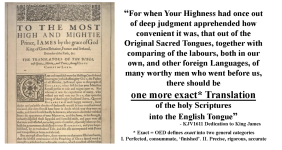
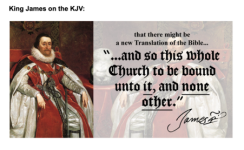
This is what I do have so far on King James & the KJV translators on the KJV:

The preface to the King James Bible was written by a single translator, Miles Smith. At the Hampton Court Conference, when the KJV was first proposed, the expectations and desires for a new English translation were clearly stated. In response, Richard Bancroft remarked that “if every man’s humor was to be followed there would be no end of translating.” Bancroft has been described as “the supervisor and overseer of the KJB translation project and its chief director.” While we are thankful that his objection was not followed, his statement reveals that he did not hold a theological position that anticipated the Bible would need to be continually retranslated to suit individual preferences.

Roman Catholics had long criticized Protestants for producing ever changing English translations. This criticism appears in the 1609 preface to the Latin Vulgate Old Testament printed at Douay, which reproached the Anglican Church for lacking a single, authoritative standard text. In a section with the marginal note titled, “None yet in England allowed fot [sic] sufficient,” the preface states: “What then do our countriemen, that refuse this Latin, but deprive themselves of the best, and yet all this while, have set forth none, that is allowed by all Protestants, for good or sufficient” (The Holie Bible, 1609).

Miles Smith directly answered this charge in the KJV preface when he wrote, “but to make a good one better, or out of many good ones one principal good one, not justly to be excepted against.” In other words, Rome accused the Anglicans of lacking a standard Bible, and the Anglicans replied by producing one.

This original intention also appears to have endured among the KJV translators themselves. Daniel Featly repeatedly expressed this conviction in the 1640s, stating his desire that the Book of Common Prayer be “correctly Printed, with all the Psalmes, Chapters, and allegations out of the old and new Testament, according to the last translation,” and elsewhere writing, “for my owne part, I wish (as I have elsewhere expressed my self) that all the Psalmes, Lessons, Chapters, Verses, and allegations of the Scripture in the book of Common-Prayer should in the next edition be printed agreeable to the last and best Translation.

Note: The following section is a reworded presentation of material originally written by Christopher Yetzer. The original write-up can be found in the thread discussion of this Facebook post here at the following source.

Screenshot 2026-05-26 at 1.18.41 PM.png
King James - Screenshot_2026-05-26_at_1.18.54_PM_33.png


....
 
The NKJV is easier to understand as it has today’s proper American vernacular. Personally, I don’t like to read the old English; it’s even outdated in the UK.

I’ve read where many other versions have added/ deleted verses. The more slang versions are the least correct.
 
"Hebrew is primarily considered a concrete, sensory-based language, particularly in its ancient and biblical forms, rather than an abstract one. It describes the world through actions and physical functions that can be seen, touched, or heard, as opposed to abstract, philosophical, or passive descriptions often found in Western languages"

the above is the point I was attempting to make.
personally I find it difficult to understand when abstract word are used.
My mind need a clear mental picture.

The abstract words used in the New Testament are the cause of much of the division among Christians.
I do not think this is a mistake, nothing Done, is done against the will of God.
If God had wanted the Word to be easy to understand -- it would have been so.

my sister has a huge problem with the Old T God, she says God is love and what God did in those times was not love.
But, she can not define the word "love"????
Jesus was in the beginning, too. God the Father created all things through Jesus. So the same God of the NT was in the OT.

The Jews in the OT were many times disobedient, wandered off course, bowing to other gods; God is a jealous God who demands respect, and obedience. Many times God destroyed many wicked nations, but showed unconditional love and patience to His people.