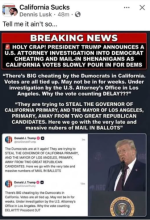
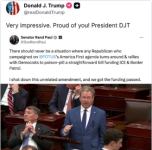
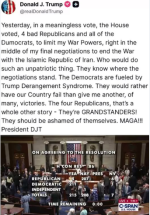
Unfortunately Trump is the one who set the expectation that problems with other countries be resolved without prolonged military conflict. He is the one that exposed the neocon blshtrs for what they are, and having absorbed so many of them into his administration, people don't trust him like they did before and they are actively pushing congress to claw back its war powers to ensure this conflict doesn't continue in perpetuity. As we've discussed before, nobody actually expects the conflict to be resolved through good-faith negotiation in the first place; so the idea that congress somehow undermined his bargaining power will easily be dismissed.
Well, at least the HYPOCRISY is historically consistent and persistent... The GOOD NEWS is that GOD WINS and the LIGHT of TRUTH is SHINING for all to begin to SEE the BIGGER Picture and Greater TRUTH....
There are differences with a distinction...
- One this is the most EPIC BIBLICAL WAR against the DS Globalists in the current history of our World...
- Meaning that the Strategic Implications are for the Greater Good of Humanity against the EVIL Powers that REIN the rampant corruption in the US and around the World...
- Technically - this confrontation in Iran and the Straits is deemed a "Conflict" and was a 38 Day Military Operation ...
Operation Epic Fury (U.S. code name for joint U.S.-Israel military operations against Iran) began on
February 28, 2026, and lasted approximately
38 days of major combat operations.
- All the military engagements since "Ceasefire" commenced have TECHNICALLY been deemed "SELF DEFENSE" Operations against the RADICAL TERRORIST IRGC REGIME...
- FOR ALL those who are Strategically NAIVE or have a BLIND SPOT for the clear and present and imminent THREAT that the Iranian Radical Regime has posed in THEIR ONGOING WAR with WESTERN CIVILIZATION over the past 47 years - it is because they have drank the DS FAKE NEWS NARRATIVE - because it is in the DS's best interests to get the NAIVE along with those complicit Operatives in these TREASONOUS obstacles that are being thrown into GEARS designed to finally DEFEAT The REIN of EVIL and Satan's Elite Globalist Cabal...
Key Timeline Details
- Start: February 28, 2026 (U.S. Central Command forces commenced strikes at the direction of the President, with initial actions in the early morning hours).
- Major combat phase: Roughly 38 days, during which U.S. and partner forces conducted extensive airstrikes, targeting Iranian missile/drone capabilities, navy, defense infrastructure, and related sites. This aligns with pre-operation statements expecting a 4-to-6-week campaign.
- Conclusion/Ceasefire: Major operations effectively wound down by early April 2026, with a ceasefire taking hold around that time (some sources note activities concluding near May 5, 2026, possibly including residual or negotiated phases).
Official statements emphasized that core military objectives were achieved within the 38-day window of intensive operations.
This fits into broader discussions of War Powers Resolution compliance, as the administration filed notifications to Congress consistent with the WPR shortly after commencement. For the most precise ongoing details, refer to official CENTCOM or White House releases.
The War Powers Resolution (WPR) of 1973, passed over President Richard Nixon’s veto, requires presidents to consult Congress “in every possible instance” before introducing U.S. forces into hostilities or imminent hostilities, report to Congress within 48 hours of such commitments (without a prior declaration of war or statutory authorization), and generally limit engagements to 60 days (plus 30 for withdrawal) unless Congress authorizes continuation.
Every president since its enactment has submitted reports to Congress “consistent with” the WPR (over 100–168 total, depending on the source and timeframe), but compliance has been limited and contentious. Presidents across parties have typically:
- Avoided citing the specific provision (Section 4(a)(1)) that triggers the 60-day clock.
- Argued the WPR is unconstitutional (or at least that certain limits infringe on Article II commander-in-chief powers).
- Interpreted “hostilities” narrowly (e.g., limited airstrikes or support roles may not count).
- Relied on existing authorizations (like post-9/11 AUMFs), UN/NATO actions, or claimed inherent executive authority for defensive or short actions.
Key Precedents by Administration
Gerald Ford (1974–1977): Submitted the first reports, including the
Mayaguez incident (1975), the only known report explicitly citing Section 4(a)(1). Quick action to rescue a seized ship; forces disengaged rapidly.
Jimmy Carter (1977–1981): Minimal use; one report on the failed Iran hostage rescue attempt (1980).
Ronald Reagan (1981–1989): Multiple actions with limited congressional buy-in. Examples include the 1983 invasion of Grenada (no prior authorization), deployments to Lebanon (peacekeeping that turned hostile; Congress later passed a resolution), and actions in the Persian Gulf and against Libya. Reports were filed, but “hostilities” definitions were contested.
George H.W. Bush (1989–1993): Invasion of Panama (1989) — reported after the fact; swift operation. For the 1990–1991 Gulf War buildup and Operation Desert Storm, he sought and obtained congressional authorization (though he argued it wasn’t strictly required) and reported deployments.
Bill Clinton (1993–2001): Frequent reports (highest volume in some terms). Actions in Haiti, Bosnia, Iraq (strikes), and especially Kosovo (1999 NATO bombing campaign, which exceeded 60 days). The administration claimed funding appropriations constituted implicit authorization; a lawsuit (
Campbell v. Clinton) was dismissed as a political question.
George W. Bush (2001–2009): Post-9/11, obtained the 2001 AUMF (broad authority against those responsible for the attacks and associated forces) and 2002 Iraq AUMF. These have been cited by later administrations for ongoing operations. Major wars had congressional approval, but expansions relied on executive interpretations.
Barack Obama (2009–2017): Libya intervention (2011) — extensive airstrikes as part of NATO; argued they did not constitute “hostilities” under the WPR due to limited scope/duration (no ground troops). Congress rebuked this but took no binding action. Continued use of 2001/2002 AUMFs for counterterrorism; high report volume.
Donald Trump (2017–2021): Airstrikes in Syria, the 2020 Soleimani strike in Iraq (reported under WPR, citing AUMF and self-defense), and other counter-ISIS/Iran actions. Emphasized executive authority while filing required reports.
Joe Biden (2021–2025): Strikes against Iran-backed groups (e.g., in Iraq, Syria, Yemen) citing 2002 AUMF and Article II powers. Continued patterns of reporting without new broad authorizations.
Overall Patterns and Criticisms
- Reports are routine, but substantive congressional checks (via the 60-day limit or forced votes) are rare and often ineffective. Congress has occasionally used expedited procedures or appropriations to influence (e.g., Lebanon 1983, Yemen debates), but courts treat many disputes as non-justiciable political questions.
- Bipartisan precedent for executive flexibility: No administration has fully treated the WPR as binding in a way that halted major operations. Short, limited, or “defensive” actions are common workarounds.
- Critics (from both sides, depending on the president) argue this erodes Congress’s constitutional war-declaring power. Supporters of strong executive authority cite the need for rapid response in modern threats.
- Reforms have been proposed periodically (e.g., repealing or strengthening the WPR, sunsetting old AUMFs), but major changes have not stuck.
In practice, the WPR has prompted more transparency via reports but has not fundamentally curtailed presidential initiative in military engagements. Precedents show continuity across Democratic and Republican administrations, with disputes often resolved politically rather than through strict legal enforcement. For the most current or specific case details, congressional research service reports or official White House notifications provide primary sources.