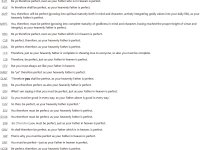
First: It's reply:in Matthew 5:48 the word translated “perfect” is τέλειος (teleios), not τέλος (telos), though teleios is directly derived from telos. Jesus is using a word built on the idea of goal, end, completion, maturity — not flawlessness.
I disagree with the AI because either complete or perfect is a good translation. But we are not limited to the lexicon in order to understand what Jesus means. As I demonstrated in my previous post, perfect love, which is possible for anyone to do, is enemy love. We can obey Jesus' command to love our enemies whenever we want. The only question is, "What do you want?"
First, τέλειος being related to τέλος does not mean “not flawlessness.” That's an etymological argument, not how lexical meaning works. τέλειος can describe something perfect or without deficiency relative to its standard, as well as something complete or mature. The context determines which sense is functioning.
Second, Matthew 5:48 is the conclusion of more than one isolated command. Throughout Matthew 5 Jesus repeatedly takes righteousness to its full standard: anger as well as murder, lust as well as adultery, complete truthfulness, righteous responses to mistreatment, and finally love even toward enemies. Then He says, “Therefore, you are to be perfect, as your heavenly Father is perfect.”
Now for my response:
The lexicon shows translation options, and you choose which word applies via context as to the meaning. Like the example I gave earlier, the difference between the right to bear arms vs oh there's a bear! Context chooses the right meaning for the word and if you take an english word from the lexicon and try and fit it there, it creates issues for meaning that the rest of the chapter is not saying.
Again, the context behind "complete" gives the impression that something is progressing. You literally said it yourself, "He is talking about full‑grown love — love that mirrors God’s own character." Hence the bolded words you used.
Definition of the word Complete: The word complete means having all necessary parts, finished, or total. It works as an adjective (whole, absolute) or a verb (to finish, or to make whole). Meaning, you don't start out complete, you are brought through growth to eventually become complete.
So I ask you: Do you believe the Father had to grow in love? Because if you do, then the english word "complete" is the right translation choice. Since we are to be as the Father is, and do what the Father does. If you do not, then you have to concede that your word choice is in error. It's why you will NEVER see a single translation that translates the word τέλειος as "complete".