Is Knowledge of the Original Languages Necessary for KJV Believers?

  • Christian Chat is a moderated online Christian community allowing Christians around the world to fellowship with each other in real time chat via webcam, voice, and text, with the Christian Chat app. You can also start or participate in a Bible-based discussion here in the Christian Chat Forums, where members can also share with each other their own videos, pictures, or favorite Christian music.

    If you are a Christian and need encouragement and fellowship, we're here for you! If you are not a Christian but interested in knowing more about Jesus our Lord, you're also welcome! Want to know what the Bible says, and how you can apply it to your life? Join us!

    To make new Christian friends now around the world, click here to join Christian Chat.
It is an ongoing action that is contingent if we are holding fast. The present state does not negate the ongoing action.

There are only 14 occurrences in the NT with verbs parsed the same way that I can see.

I do not have time presently to go through them thoroughly. But scratching the surface I do not see where we can ignore the process of the present action happening. Here are the verses:
Matthew 23:28
2 Corinthians 6:12
Ephesians 2:22
Philippians 2:15
Colossians 2:20
1 Corinthians 6:7
1 Corinthians 15:2
Galatians 5:4
Galatians 5:18
1 Peter 2:5
1 Peter 4:14
Mark 5:39
Mark 12:24
Mark 12:27


There are older ones also, YLT for one.

1Cor 15:2 through which also ye are being saved, in what words I proclaimed good news to you, if ye hold fast, except ye did believe in vain,


Thanks for the thoughtful reply. As I said I am pressed for time. However I intend to give your post the attention it deserves when I am a bit more freed up.

May the Lord our God continue to bless us in all His Way, Jesus Christ.
That's a good observation, and I think it strengthens your argument that this isn't just a "modern translation" issue.
Even Young's Literal Translation renders it: "through which also ye are being saved ... if ye hold fast..."
So let me ask the question this way: If Paul wanted to emphasize a completed, unconditional event here, why use a present-passive form and then immediately attach an "if you hold fast" condition?
That doesn't sound like Paul is merely looking back to a past profession of faith.
It sounds like he's describing an ongoing reality connected to perseverance in the gospel
 
So, if all Bibles have errors, then who becomes the authority to decide what is an error and what is not an error in God's word? Is that not placing the authority in the hands of man or the individual instead of God? (Proverbs 30:5-6; Romans 3:4, KJV).

You do realize that we believe in the existence of a perfect, singular word of God because of Scripture, right? (Psalm 12:6-7; Psalm 119:89, 160; Isaiah 34:16; Matthew 5:18; Matthew 24:35; John 10:35, KJV).

So, where does Scripture teach that we each have the authority to pick and choose which readings belong in God's word and which ones do not? Are there any verses that support the idea that you can simply chop up the Bible however you like in your own mind, deciding, "This reading belongs in the Bible, but that reading does not"? (Deuteronomy 4:2; Proverbs 30:5-6; Revelation 22:18-19, KJV).

What authority in Scripture do you have for claiming that it is idolatry to believe God has preserved His words and that His word is perfect? And if we find corrupted forms of His word, where does Scripture teach that it is wrong to rebuke such things?

And if every Bible contains errors, then by what perfect standard are you determining those errors in the first place?


.....
And please understand that this is not about the authoritativeness of the bible, but the imperfection of KJV. One simple example, in KJV the Holy Spirit is translated as the Holy "Ghost", how could the third person of the Godhead, the life-giving spirit be a "ghost"? Ghost is the disembodied soul of a dead person, typically being punished to wander around the world of the living until their unfinished business is settled. It could also mean hallucination. When Jesus was walking on water, the disciples thought they were seeing a "ghost"; when Jesus walked into the disciple's dwelling place after his resurrection, Thomas thought he was seeing a "ghost". Don't you think this is quite a big misconception that would directly affect your understanding of the godhead? Jesus taught that God is the God of the LIVING, not the dead, but how could that be, when the third person of the godhead is a "ghost"?
 
In 1611 I guess people understood what was meant by "ghost," but it's another example of how language that made sense back then is completely inappropriate now.
 
  • Like
Reactions: Dino246
And please understand that this is not about the authoritativeness of the bible, but the imperfection of KJV. One simple example, in KJV the Holy Spirit is translated as the Holy "Ghost", how could the third person of the Godhead, the life-giving spirit be a "ghost"? Ghost is the disembodied soul of a dead person, typically being punished to wander around the world of the living until their unfinished business is settled.
The KJV is Jacobean English. It's English of the early 1600s. So you cannot impose your modern understanding of English upon it.

The Middle English Dictionary that covers the periods of 1100s to the 1500s defines "ghost" as "spirit." So in that time period that obviously influenced the 1600s, "ghost" was simply a synonym for "spirit" in general. So that means the Holy Ghost is just another way of saying "Holy Spirit." Today, that meaning has changed obviously and most are ignorant of the history of English. But KJV believers have never really needed any dictionary to know that this simply means "spirit." But if you need to see the proof that this word "ghost" (gōst or goost) was spoken to mean "spirit" (as general word for "spirit") then here is the screenshot and link to the Middle English Dictionary for the entry:

Screenshot 2026-10-17 at 9.56.50 AM.png

Source:

Historical English Evidence for “Ghost” Meaning “Spirit”​

LIST ONE: MIDDLE ENGLISH PERIOD (1100–1500)​

5 Historical Quotations

#1. Orm — c. 1175

Source:
The Ormulum, Dedication, lines 285–288.

Original Middle English:

"All swa þe Laferrd Jesu Crist, All þurrh his aȝhenn mahhte, Wiþþ Faderr & wiþþ Haliȝ Gast An Godd & all an kinde,"

Literal Modern English:

"Just as the Lord Jesus Christ, through his own power, with the Father and with the Holy Ghost, [is] one God and entirely one nature."

Significance: One of the earliest Middle English witnesses. Orm uses "Haliȝ Gast" (Holy Ghost) in a statement concerning the divine nature of the Father, Son, and Holy Ghost.

Source: University of Glasgow, Helsinki Corpus.

https://helsinkicorpus.arts.gla.ac.uk/browse.py?text=orm&format=xml&toc=title


#2. Anonymous — c. 1230

Source:
Ancrene Wisse (Guide for Anchoresses), opening invocation.

Original Middle English:

"I þe feaderes ⁊ i þe sunes ⁊ i þe hali gastes nome"

Literal Modern English:

"In the Father's and in the Son's and in the Holy Ghost's name."

Significance: The expression "hali gastes" represents an early Middle English form of "Holy Ghost." The passage explicitly identifies the Holy Ghost alongside the Father and Son.

Source: Selections from Early Middle English, edited by Joseph Hall, with reference to Corpus Christi College, Cambridge, MS 402.

https://www.gutenberg.org/files/43555/43555-h/43555-h.htm


#3. Geoffrey Chaucer — Late 1300s

Source:
The Canterbury Tales — The Second Nun's Tale, lines 328–329.

Original Middle English:

"The Goost, that fro the Fader gan procede, Hath sowled hem, withouten any drede."

Literal Modern English:

"The Ghost, who from the Father began to proceed, has ensouled them, without any doubt."

Significance: Chaucer's word "Goost" literally corresponds to the English word "Ghost." The surrounding passage discusses the Trinity, explaining how three persons exist in one divine being (lines 333–341).

The context establishes that "Goost" refers to the Holy Spirit rather than the ghost of a deceased person.

Source: Harvard University's Geoffrey Chaucer Website.

https://chaucer.fas.harvard.edu/pages/second-nuns-prologue-and-tale


#4. Geoffrey Chaucer — Late 1300s

Source:
The Canterbury Tales — The Parson's Tale, approximately line 250.

Original Middle English:

"For soothly, the grace of the Hooly Goost fareth lyk fyr, that may nat been ydel;"

Literal Modern English:

"For truly, the grace of the Holy Ghost behaves like fire, which cannot be idle."

Significance: Chaucer explicitly employs "Hooly Goost," establishing the religious meaning of the term in his own writing. Together with quotation 3, this shows that Chaucer could refer to the same divine Person as both "Goost" and "Hooly Goost."

Source: The Parson's Tale, Internet Sacred Text Archive.

https://sacred-texts.com/neu/eng/mect/mect47.htm


#5. Margery Kempe — c. 1430s

Source:
The Book of Margery Kempe, Book I.

Original Middle English:

"The Holy Gost mevyth nevyr a thing ageyn charité, and, yf he dede, he wer contraryows to hys owyn self, for he is al charité."

Literal Modern English:

"The Holy Ghost never moves anything against charity, and if he did, he would be contrary to his own self, for he is all charity."

Significance: This fifteenth-century religious text explicitly uses "Holy Gost" for the divine Person. Its surrounding discussion also contrasts the Holy Ghost with evil spirits, demonstrating the distinction through context.

Source: Medieval Institute Publications, Middle English Texts Series.

https://metseditions.org/read/3L34BgNubNPUyz9TMz9ZcV6Y24X0l8


​

[ Continued in my next post ]


....
 

LIST TWO: EARLY MODERN ENGLISH PERIOD (1500–1600)​

10 Historical Quotations

#1. William Tyndale — 1526

Source:
English New Testament — Acts 2:4.

Original English:

"and they were all filled with the holy goost and beganne to speake with other tonges even as the sprete gave them vtteraunce."

Modern English:

"And they were all filled with the Holy Ghost and began to speak with other tongues, even as the Spirit gave them utterance."

Significance: Tyndale uses "holy goost" and "sprete" (Spirit) in the same verse, both referring to the same divine Person. This is particularly strong sixteenth-century evidence connecting "Ghost" with "Spirit."

Source: Tyndale Bible of 1526.

https://biblehub.com/tyndale/acts/2.htm


#2. Miles Coverdale — 1535

Source:
Coverdale Bible — Acts 2:4.

Original English:

"and they were all fylled with the holy goost. And they beganne to preach with other tunges, euen as the sprete gaue them vtteraunce."

Modern English:

"And they were all filled with the Holy Ghost. And they began to preach with other tongues, even as the Spirit gave them utterance."

Significance: Coverdale independently supplies another published Bible witness using "holy goost" and "sprete" in the same verse. This reinforces the continuity of the English expressions following Tyndale.

Source: Coverdale Bible of 1535.

https://biblehub.com/coverdale/acts/2.htm


#3. Thomas Cranmer's Book of Common Prayer — 1549

Source:
The Book of Common Prayer — Holy Communion, Nicene Creed.

Original English:

"And I beleve in the holy ghost, the Lorde and gever of life, who procedeth from the father and the sonne"

Modern English:

"And I believe in the Holy Ghost, the Lord and giver of life, who proceeds from the Father and the Son."

Significance: The Book of Common Prayer identifies the Holy Ghost as divine and as the giver of life. It demonstrates that "Holy Ghost" was firmly established in the official English religious language of the mid-sixteenth century.

Source: The 1549 Book of Common Prayer, Society of Archbishop Justus.

https://justus.anglican.org/resources/bcp/1549/Communion_1549.htm


#4. Geneva Bible — 1560

Source:
Acts 2:4.

Original English:

"And they were all filled with the holy Ghost, and began to speake with other tongues, as the Spirit gaue them vtterance."

Modern English:

"And they were all filled with the Holy Ghost, and began to speak with other tongues, as the Spirit gave them utterance."

Significance: The Geneva Bible preserves the same distinction of wording found in Tyndale and Coverdale: "Holy Ghost" in the first clause, followed by "Spirit" in the second. Both identify the same divine Person.

Source: Geneva Bible (1560).

https://bibelvers.no/en/geneva/acts/2/4


#5. John Jewel — 1564

Source:
An Apology of the Church of England, English translation by Anne Bacon.

English Translation (spelling modernized in the consulted edition):

"We believe that the Holy Ghost, who is the third person in the Holy Trinity, is very God: not made, not created, not begotten, but proceeding from both the Father and the Son"

Significance: Jewel's theological defense explicitly identifies the Holy Ghost as the third Person of the Trinity. His work was originally published in Latin in 1562 and translated into English in 1564, making it another important sixteenth-century witness outside Bible translation.

Source: An Apology of the Church of England, New Whitchurch Press, reproducing Anne Bacon's English translation with editorial modernization.

https://newwhitchurch.press/jewel/apology


#6. John Foxe — 1570

Source:
Acts and Monuments (Book of Martyrs), 1570 edition, p. 2026, examination of John Philpot.

Original English:

"the holy ghost is CHRISTES Vicar in earth."

And in the same exchange:

"that the spirit is CHRISTES Vicar on earth"

Modern English:

"The Holy Ghost is Christ's vicar on earth."

"That the Spirit is Christ's vicar on earth."

Significance: This is one of the strongest non-Bible-translation witnesses in the collection. Foxe's account renders the substance of Philpot's Latin statement using both "Holy Ghost" and "Spirit." The wording provides direct evidence that these English terms could identify the same Person.

Source: University of Sheffield, Acts and Monuments Online, 1570 edition, p. 2026.

https://www.dhi.ac.uk/foxe/index.php?book=11&gototype=&realm=more&type=citation


#7. Thirty-Nine Articles of Religion — 1571

Source:
Article V — Of the Holy Ghost.

English Text (later standardized presentation):

"The Holy Ghost, proceeding from the Father and the Son, is of one substance, majesty, and glory, with the Father and the Son, very and eternal God."

Significance: This official English doctrinal statement identifies the Holy Ghost as possessing the same divine substance, majesty, and glory as the Father and Son. It establishes the continued use of "Holy Ghost" in formal English theology.

Source: Fordham University, Internet Modern History Sourcebook.

https://sourcebooks.web.fordham.edu/mod/1571-39articles.asp


#8. English Translation of John Calvin's Commentaries — 1580

Source:
Commentaries upon the First Epistle of Saint John and the Epistle of Jude, translated into English by W. H.

Original English (from the published title):

"accordyng to the truthe of the woordes of the holie Ghost"

The same title also refers to:

"sanctification by the Spirit of Christ"

Modern English:

"According to the truth of the words of the Holy Ghost."

"Sanctification by the Spirit of Christ."

Significance: The English translator's published title employs both "holie Ghost" and "Spirit of Christ." This demonstrates the simultaneous use of these expressions in sixteenth-century theological publishing.

These are words from the English edition's title, not a claim that Calvin personally composed the English wording.

Source: University of Jyväskylä bibliographical record, 1580 English edition.

https://jyu.finna.fi/Record/nelli09.1000000000629844


#9. Rheims New Testament — 1582

Source:
Acts 2:4.

Original English:

"and they were al replenished with the Holy Ghost, and they began to speake with diuerse tongues according as the Holy Ghost gaue them to speake."

Modern English:

"And they were all filled with the Holy Ghost, and they began to speak with diverse tongues, according as the Holy Ghost gave them to speak."

Significance: The Roman Catholic Rheims New Testament also retained "Holy Ghost." Its use confirms that the expression was not peculiar to Protestant Bible translations, but was established across different English Christian traditions.

Source: Original Rheims New Testament (1582).

https://originaldouayrheims.com/acts2


#10. Richard Hooker — 1593

Source:
Of the Laws of Ecclesiastical Polity — Preface, III.10.

English Text (later editorial spelling):

"it is the special illumination of the Holy Ghost, whereby they discern those things in the word, which others reading yet discern them not."

Hooker continues:

"There are but two ways whereby the Spirit leadeth men into all truth"

Significance: Hooker employs "Holy Ghost" and "Spirit" in the same surrounding discussion of divine illumination and understanding Scripture. His wording provides another late-sixteenth-century example from theological prose rather than Bible translation.

Source: Richard Hooker, Of the Laws of Ecclesiastical Polity, Preface.

https://merecatholicity.com/hooker-a-preface-to-them-that-seek-as-they-term-it-the.html


CONCLUSION​

So what do these fifteen historical quotations demonstrate?

Well, for one thing, the English word "Ghost" was being used to refer to the Holy Spirit centuries before the King James Bible of 1611. In fact, you can see this in the Middle English period with expressions such as "Haliȝ Gast," "Goost," "Hooly Goost," and "Holy Gost." These are historical forms of the same English expression that we know today as "Holy Ghost." The historical evidence demonstrates that "Ghost" was an established English word for "Spirit," and that "Holy Ghost" was a recognized expression for the Holy Spirit long before the KJV translators ever began their work. So why should we judge the language of the KJV according to a restricted modern understanding of the word "ghost" when the historical evidence demonstrates that the word had a broader meaning?

Should we not first seek to understand what these English words actually meant to the people who used them?

I hope this info helps, and may the Lord Jesus Christ bless you.

....

 
The KJV is Jacobean English. It's English of the early 1600s. So you cannot impose your modern understanding of English upon it.

The Middle English Dictionary that covers the periods of 1100s to the 1500s defines "ghost" as "spirit." So in that time period that obviously influenced the 1600s, "ghost" was simply a synonym for "spirit" in general. So that means the Holy Ghost is just another way of saying "Holy Spirit." Today, that meaning has changed obviously and most are ignorant of the history of English. But KJV believers have never really needed any dictionary to know that this simply means "spirit." But if you need to see the proof that this word "ghost" (gōst or goost) was spoken to mean "spirit" (as general word for "spirit") then here is the screenshot and link to the Middle English Dictionary for the entry:

View attachment 297795

Source:

Historical English Evidence for “Ghost” Meaning “Spirit”​

LIST ONE: MIDDLE ENGLISH PERIOD (1100–1500)​

5 Historical Quotations

#1. Orm — c. 1175

Source:
The Ormulum, Dedication, lines 285–288.

Original Middle English:

"All swa þe Laferrd Jesu Crist, All þurrh his aȝhenn mahhte, Wiþþ Faderr & wiþþ Haliȝ Gast An Godd & all an kinde,"

Literal Modern English:

"Just as the Lord Jesus Christ, through his own power, with the Father and with the Holy Ghost, [is] one God and entirely one nature."

Significance: One of the earliest Middle English witnesses. Orm uses "Haliȝ Gast" (Holy Ghost) in a statement concerning the divine nature of the Father, Son, and Holy Ghost.

Source: University of Glasgow, Helsinki Corpus.

https://helsinkicorpus.arts.gla.ac.uk/browse.py?text=orm&format=xml&toc=title


#2. Anonymous — c. 1230

Source:
Ancrene Wisse (Guide for Anchoresses), opening invocation.

Original Middle English:

"I þe feaderes ⁊ i þe sunes ⁊ i þe hali gastes nome"

Literal Modern English:

"In the Father's and in the Son's and in the Holy Ghost's name."

Significance: The expression "hali gastes" represents an early Middle English form of "Holy Ghost." The passage explicitly identifies the Holy Ghost alongside the Father and Son.

Source: Selections from Early Middle English, edited by Joseph Hall, with reference to Corpus Christi College, Cambridge, MS 402.

https://www.gutenberg.org/files/43555/43555-h/43555-h.htm


#3. Geoffrey Chaucer — Late 1300s

Source:
The Canterbury Tales — The Second Nun's Tale, lines 328–329.

Original Middle English:

"The Goost, that fro the Fader gan procede, Hath sowled hem, withouten any drede."

Literal Modern English:

"The Ghost, who from the Father began to proceed, has ensouled them, without any doubt."

Significance: Chaucer's word "Goost" literally corresponds to the English word "Ghost." The surrounding passage discusses the Trinity, explaining how three persons exist in one divine being (lines 333–341).

The context establishes that "Goost" refers to the Holy Spirit rather than the ghost of a deceased person.

Source: Harvard University's Geoffrey Chaucer Website.

https://chaucer.fas.harvard.edu/pages/second-nuns-prologue-and-tale


#4. Geoffrey Chaucer — Late 1300s

Source:
The Canterbury Tales — The Parson's Tale, approximately line 250.

Original Middle English:

"For soothly, the grace of the Hooly Goost fareth lyk fyr, that may nat been ydel;"

Literal Modern English:

"For truly, the grace of the Holy Ghost behaves like fire, which cannot be idle."

Significance: Chaucer explicitly employs "Hooly Goost," establishing the religious meaning of the term in his own writing. Together with quotation 3, this shows that Chaucer could refer to the same divine Person as both "Goost" and "Hooly Goost."

Source: The Parson's Tale, Internet Sacred Text Archive.

https://sacred-texts.com/neu/eng/mect/mect47.htm


#5. Margery Kempe — c. 1430s

Source:
The Book of Margery Kempe, Book I.

Original Middle English:

"The Holy Gost mevyth nevyr a thing ageyn charité, and, yf he dede, he wer contraryows to hys owyn self, for he is al charité."

Literal Modern English:

"The Holy Ghost never moves anything against charity, and if he did, he would be contrary to his own self, for he is all charity."

Significance: This fifteenth-century religious text explicitly uses "Holy Gost" for the divine Person. Its surrounding discussion also contrasts the Holy Ghost with evil spirits, demonstrating the distinction through context.

Source: Medieval Institute Publications, Middle English Texts Series.

https://metseditions.org/read/3L34BgNubNPUyz9TMz9ZcV6Y24X0l8


​

[ Continued in my next post ]


....
How is this vague, generic definition remotely helpful, when it could be angel, devil or "any wicked-looking creature?" Hamlet was roughly written in the same period, the prince was seeing his father's "ghost", is there anything holy about it?

And once again, please understand that this is not about the authoritativeness of the bible, but the imperfection of KJV. This is the difference between life and death. Ghost is the dead, Holy Spirit is the living.

Granted, there're plenty of evil spirits, but "spirit" itself is neutral, "ghost" on the other hand has a, inherently negative connotation.
 
I agree an interlinear has limits.
It shows you the words, but it doesn't automatically teach you how Greek or Hebrew grammar works.
At the same time, Williams and Wuest are making interpretive decisions too.
The interlinear lets you see what the text actually says, while expanded translations help explain how the translators think the grammar functions.
Both can be useful, but neither should replace examining the text itself.
Part of the gift's function is for the one teaching to utilize his interpretive ability to impart to the body of Christ what the Lord has to flow through them. For that is how digested nutrients move through a body to keep the whole body benefiting from what the last part received to pass on.

We are to be like a biologically functioning body, but done with the spiritual life we have been given in Christ.
 
In 1611 I guess people understood what was meant by "ghost," but it's another example of how language that made sense back then is completely inappropriate now.

And how is it that two different scholarly schools ended up giving us "ghost" and "spirit" translated from the exact same Greek words?
And, the advocates will claim that their preferred translation is without error.
 
Granted, there're plenty of evil spirits, but "spirit" itself is neutral, "ghost" on the other hand has a, inherently negative connotation.
You are imposing your modern understanding of "ghost" on a 400-year-old text and pretending it is an airtight argument
 

LIST TWO: EARLY MODERN ENGLISH PERIOD (1500–1600)​

10 Historical Quotations

#1. William Tyndale — 1526

Source:
English New Testament — Acts 2:4.

Original English:

"and they were all filled with the holy goost and beganne to speake with other tonges even as the sprete gave them vtteraunce."

Modern English:

"And they were all filled with the Holy Ghost and began to speak with other tongues, even as the Spirit gave them utterance."

Significance: Tyndale uses "holy goost" and "sprete" (Spirit) in the same verse, both referring to the same divine Person. This is particularly strong sixteenth-century evidence connecting "Ghost" with "Spirit."

Source: Tyndale Bible of 1526.

https://biblehub.com/tyndale/acts/2.htm


#2. Miles Coverdale — 1535

Source:
Coverdale Bible — Acts 2:4.

Original English:

"and they were all fylled with the holy goost. And they beganne to preach with other tunges, euen as the sprete gaue them vtteraunce."

Modern English:

"And they were all filled with the Holy Ghost. And they began to preach with other tongues, even as the Spirit gave them utterance."

Significance: Coverdale independently supplies another published Bible witness using "holy goost" and "sprete" in the same verse. This reinforces the continuity of the English expressions following Tyndale.

Source: Coverdale Bible of 1535.

https://biblehub.com/coverdale/acts/2.htm


#3. Thomas Cranmer's Book of Common Prayer — 1549

Source:
The Book of Common Prayer — Holy Communion, Nicene Creed.

Original English:

"And I beleve in the holy ghost, the Lorde and gever of life, who procedeth from the father and the sonne"

Modern English:

"And I believe in the Holy Ghost, the Lord and giver of life, who proceeds from the Father and the Son."

Significance: The Book of Common Prayer identifies the Holy Ghost as divine and as the giver of life. It demonstrates that "Holy Ghost" was firmly established in the official English religious language of the mid-sixteenth century.

Source: The 1549 Book of Common Prayer, Society of Archbishop Justus.

https://justus.anglican.org/resources/bcp/1549/Communion_1549.htm


#4. Geneva Bible — 1560

Source:
Acts 2:4.

Original English:

"And they were all filled with the holy Ghost, and began to speake with other tongues, as the Spirit gaue them vtterance."

Modern English:

"And they were all filled with the Holy Ghost, and began to speak with other tongues, as the Spirit gave them utterance."

Significance: The Geneva Bible preserves the same distinction of wording found in Tyndale and Coverdale: "Holy Ghost" in the first clause, followed by "Spirit" in the second. Both identify the same divine Person.

Source: Geneva Bible (1560).

https://bibelvers.no/en/geneva/acts/2/4


#5. John Jewel — 1564

Source:
An Apology of the Church of England, English translation by Anne Bacon.

English Translation (spelling modernized in the consulted edition):

"We believe that the Holy Ghost, who is the third person in the Holy Trinity, is very God: not made, not created, not begotten, but proceeding from both the Father and the Son"

Significance: Jewel's theological defense explicitly identifies the Holy Ghost as the third Person of the Trinity. His work was originally published in Latin in 1562 and translated into English in 1564, making it another important sixteenth-century witness outside Bible translation.

Source: An Apology of the Church of England, New Whitchurch Press, reproducing Anne Bacon's English translation with editorial modernization.

https://newwhitchurch.press/jewel/apology


#6. John Foxe — 1570

Source:
Acts and Monuments (Book of Martyrs), 1570 edition, p. 2026, examination of John Philpot.

Original English:

"the holy ghost is CHRISTES Vicar in earth."

And in the same exchange:

"that the spirit is CHRISTES Vicar on earth"

Modern English:

"The Holy Ghost is Christ's vicar on earth."

"That the Spirit is Christ's vicar on earth."

Significance: This is one of the strongest non-Bible-translation witnesses in the collection. Foxe's account renders the substance of Philpot's Latin statement using both "Holy Ghost" and "Spirit." The wording provides direct evidence that these English terms could identify the same Person.

Source: University of Sheffield, Acts and Monuments Online, 1570 edition, p. 2026.

https://www.dhi.ac.uk/foxe/index.php?book=11&gototype=&realm=more&type=citation


#7. Thirty-Nine Articles of Religion — 1571

Source:
Article V — Of the Holy Ghost.

English Text (later standardized presentation):

"The Holy Ghost, proceeding from the Father and the Son, is of one substance, majesty, and glory, with the Father and the Son, very and eternal God."

Significance: This official English doctrinal statement identifies the Holy Ghost as possessing the same divine substance, majesty, and glory as the Father and Son. It establishes the continued use of "Holy Ghost" in formal English theology.

Source: Fordham University, Internet Modern History Sourcebook.

https://sourcebooks.web.fordham.edu/mod/1571-39articles.asp


#8. English Translation of John Calvin's Commentaries — 1580

Source:
Commentaries upon the First Epistle of Saint John and the Epistle of Jude, translated into English by W. H.

Original English (from the published title):

"accordyng to the truthe of the woordes of the holie Ghost"

The same title also refers to:

"sanctification by the Spirit of Christ"

Modern English:

"According to the truth of the words of the Holy Ghost."

"Sanctification by the Spirit of Christ."

Significance: The English translator's published title employs both "holie Ghost" and "Spirit of Christ." This demonstrates the simultaneous use of these expressions in sixteenth-century theological publishing.

These are words from the English edition's title, not a claim that Calvin personally composed the English wording.

Source: University of Jyväskylä bibliographical record, 1580 English edition.

https://jyu.finna.fi/Record/nelli09.1000000000629844


#9. Rheims New Testament — 1582

Source:
Acts 2:4.

Original English:

"and they were al replenished with the Holy Ghost, and they began to speake with diuerse tongues according as the Holy Ghost gaue them to speake."

Modern English:

"And they were all filled with the Holy Ghost, and they began to speak with diverse tongues, according as the Holy Ghost gave them to speak."

Significance: The Roman Catholic Rheims New Testament also retained "Holy Ghost." Its use confirms that the expression was not peculiar to Protestant Bible translations, but was established across different English Christian traditions.

Source: Original Rheims New Testament (1582).

https://originaldouayrheims.com/acts2


#10. Richard Hooker — 1593

Source:
Of the Laws of Ecclesiastical Polity — Preface, III.10.

English Text (later editorial spelling):

"it is the special illumination of the Holy Ghost, whereby they discern those things in the word, which others reading yet discern them not."

Hooker continues:

"There are but two ways whereby the Spirit leadeth men into all truth"

Significance: Hooker employs "Holy Ghost" and "Spirit" in the same surrounding discussion of divine illumination and understanding Scripture. His wording provides another late-sixteenth-century example from theological prose rather than Bible translation.

Source: Richard Hooker, Of the Laws of Ecclesiastical Polity, Preface.

https://merecatholicity.com/hooker-a-preface-to-them-that-seek-as-they-term-it-the.html


CONCLUSION​

So what do these fifteen historical quotations demonstrate?

Well, for one thing, the English word "Ghost" was being used to refer to the Holy Spirit centuries before the King James Bible of 1611. In fact, you can see this in the Middle English period with expressions such as "Haliȝ Gast," "Goost," "Hooly Goost," and "Holy Gost." These are historical forms of the same English expression that we know today as "Holy Ghost." The historical evidence demonstrates that "Ghost" was an established English word for "Spirit," and that "Holy Ghost" was a recognized expression for the Holy Spirit long before the KJV translators ever began their work. So why should we judge the language of the KJV according to a restricted modern understanding of the word "ghost" when the historical evidence demonstrates that the word had a broader meaning?

Should we not first seek to understand what these English words actually meant to the people who used them?

I hope this info helps, and may the Lord Jesus Christ bless you.

....
While your evidence supports your argument, you fail by insisting that 16th-century common understanding should be imposed on a 21st-century audience. The meaning of "ghost" has changed just as the meaning of "suffer" has changed.

Deal with it.
 
And please understand that this is not about the authoritativeness of the bible, but the imperfection of KJV. One simple example, in KJV the Holy Spirit is translated as the Holy "Ghost", how could the third person of the Godhead, the life-giving spirit be a "ghost"? Ghost is the disembodied soul of a dead person, typically being punished to wander around the world of the living until their unfinished business is settled. It could also mean hallucination. When Jesus was walking on water, the disciples thought they were seeing a "ghost"; when Jesus walked into the disciple's dwelling place after his resurrection, Thomas thought he was seeing a "ghost". Don't you think this is quite a big misconception that would directly affect your understanding of the godhead? Jesus taught that God is the God of the LIVING, not the dead, but how could that be, when the third person of the godhead is a "ghost"?
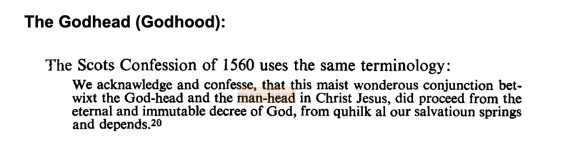
Furthermore, most people today do not understand the original meaning of the word "Godhead." The meaning of this word has wrongfully shifted in the minds of many people to mean "Trinity."

Here is a snippet of proof:

Godhead means Godhood.png

Source:

https://paperzz.com/doc/8001561/what-do-we-mean-by--godhead-?

Obviously, nobody is saying that the word "manhead" in the historical example above is referring to some kind of trinity of man! It simply means "manhood" (i.e., the state or nature of being a man).

Yes, you can find modern dictionaries that define "Godhead" as "Trinity," but these dictionaries are simply recording how people have come to use the word. That does not necessarily mean the newer definition reflects the original meaning of the word. In fact, I would argue that this shift in meaning arose because people misunderstood the older sense of the word and its inherent meaning.

Now, I accept that the meanings of words can change over time, and that such changes can be both natural and acceptable. However, this is one of those cases where the newer meaning developed from a misunderstanding of what the word originally meant. Simply because people begin using a word incorrectly does not automatically mean that their understanding of the word was historically or etymologically justified.

The older suffix "-head" is equivalent in meaning to "-hood," as in "childhood" or "manhood" (i.e., the state or condition of being a child or a man). In the same way, "Godhead" means "Godhood," referring to the nature or state of being God.

Note: Granted, today, the word "childhood" is commonly understood as referring to the period of a person's life when they are a child. Nevertheless, the original meaning of the suffix "-hood" refers to a state or condition of being.

The Greek Behind "Godhead" in the KJV

Interestingly, the KJV uses the word "Godhead" three times, translating three closely related Greek expressions:

  1. Acts 17:29 — τὸ θεῖον (to theion): Referring to the Divinity or Divine Being. LSJ recognizes the substantival use of θεῖον as referring to the Divinity.

    Source (LSJ): https://atlas.perseus.tufts.edu/dic...te2:scaife-viewer:dictionaries.v1:lsj-n48051/
  2. Romans 1:20 — θειότης (theiotēs): Divine nature, divinity. LSJ explicitly defines this Greek word as "divine nature, divinity."

    Source (LSJ): https://atlas.perseus.tufts.edu/dic...te2:scaife-viewer:dictionaries.v1:lsj-n48054/
  3. Colossians 2:9 — θεότης (theotēs): Divinity, divine nature. Again, LSJ expressly recognizes this meaning.

    Source (LSJ): https://atlas.perseus.tufts.edu/dic...te2:scaife-viewer:dictionaries.v1:lsj-n48321/
Even a Modern Greek Dictionary Confirms This Meaning!

The Dictionary of Standard Modern Greek (Triantafyllidis) defines the modern Greek word θεότητα (theótita), which derives from the ancient Greek θεότης, as follows:

Definition 1: "The divine nature, the sum of the attributes of God."

Definition 2: "God," including an individual god or deity.

Source (Centre for the Greek Language):

https://www.greek-language.gr/greekLang/modern_greek/tools/lexica/search.html?lq=θεότητα

Notice that the first definition is not restricted to the Trinity. It refers to the divine nature and the sum of God's attributes!

Think about that for a moment.

God is omniscient (all-knowing), omnipotent (all-powerful), omnipresent (present everywhere), eternal, holy, and so on. All these things concern the divine nature of God.

Likewise, the fact that God is triune is one aspect of what Scripture reveals concerning His divine nature. But the triune nature of God is not the entire meaning of "Godhead." It is only one aspect of what we understand concerning God's divine nature.

In other words, while people have wrongfully appropriated the word "Godhead" to mean "Trinity" today, historically the Trinity is not the definition of the word "Godhead." The word refers more broadly to the divine nature of God, which includes far more than the fact that God is Father, Son, and Holy Ghost.

Likewise, the word "Godhead" means "Godhood." The word itself is not inherently a reference to the Trinity, but rather to the divine nature or what it means to be God, including all His divine attributes.


....
 
When you begin to make blatant statement that only the KJV is true, anything else is susceptible to modern corruption, then disparage all these modern versions, furthermore, denigrate all who don't read and quote KJV, whoever reads another translation is deceived, only you as the KJV only stalwart has access to the real word of God. This kind of attitude is idolatry.

The bottom line is, what the bible states, regardless of version, is one thing; what you read into it and glean from it is quite another. As a matter of fact, God has two revelations, one is his special revelation through his words, the other is his GENERAL revelation through all his creations. You can't truly understand one without the other. Case in point, if you don't know anything about the sacking of Jerusalem in 70AD, you'll be totally clueless about the Olivet Discourse.
I will forgive your lack of knowledge on this topic and give you time to do more research into the matter. If you took even a cursory look at the doctrinal changes between the KJV and Modern Bibles, you would see that Modern Bibles are corrupt on a doctrinal level. That alone is reason enough not to trust or use them. Then there are the liberals and heretics who helped shape the Critical Text and its contradictory Modern English translations.

Here are 67 Changed Doctrines in Modern Bibles:

67 Changed Doctrines in Modern Bibles.


Side Note:

The NKJV adopts bad Critical Text English Bible readings. Why? Because none of them were for the Received Text. While the NKJV is based primarily on the Received Text, it does not always follow the same Received Text as the KJV. For example, the word "God" in 1 John 3:16 is removed in the NKJV and yet it is in the Beza 1598 Greek and the KJV. This change by removing the word "God" waters down the deity of Jesus Christ. Another problem with the NKJV is that when the New Testament version came out, they told you that they were not going to expose you to the Westcott and Hort text. Then, when the full version of the NKJV came out they turned around and told you that you can now delete or add from the Bible based on the revisers (i.e., Westcott and Hort). It's why it has NU in the footnotes now (i.e., the Nestle and Aland and UBS Critical Texts). In other words, I don't like it when people lie to me. The cover of the NKJV is lying to you in the fact that it is not really the same KJV that we follow. It cannot rightfully be called a KJV in any sense if it does not follow the KJV. It should have been called something else, but of course they knew it would not have sold as well if they did that.


.....
 
Here is something else to help you. Which brings out another error in the KJV in respect to the present tense of σῴζεσθε.

1Cor 15:2 δι' By
οὗ Which
καὶ Also
σῴζεσθε You all Are Being Saved, (being saved not saved. the verb is in the present tense, so it is ongoing action not a state of being.)
τίνι What
λόγῳ Word
εὐηγγελισάμην I Announced
ὑμῖν To You
εἰ If
κατέχετε ἐκτὸς You all Hold Fast, ( It says we are to hold fast that which was announced to us is the common understanding, not keep in memory. To hold fast to something is so much more than just keeping it in memory. However I would argue that the holding fast is to the standing in the Gospel that verse one speaks of. Because if we do not then our believing is in vain. )
εἰ μὴ Unless
εἰκῇ In Vain
ἐπιστεύσατε You all Believed.
Your not helping. You are just denying the lexical information.
Not interested in having a convo with you.
Sorry, you are not qualified.
Just ask AI and it will show you and give you even more links to verify the truth of what I said to disprove your oddball interpretations.


....
 
How is this vague, generic definition remotely helpful, when it could be angel, devil or "any wicked-looking creature?" Hamlet was roughly written in the same period, the prince was seeing his father's "ghost", is there anything holy about it?

And once again, please understand that this is not about the authoritativeness of the bible, but the imperfection of KJV. This is the difference between life and death. Ghost is the dead, Holy Spirit is the living.

Granted, there're plenty of evil spirits, but "spirit" itself is neutral, "ghost" on the other hand has a, inherently negative connotation.
I cannot even believe that you are even arguing this kind of point. Its absurd. You are claiming that the KJV is deficient because of its archaic or uncommon English wording. Would you argue that is the case for the Hebrew and Greek, too?

In other words, just because something is older, does not make it any less truthful or accurate if it is a written document that correctly conveys truth. Perhaps you have been watching too much Mark Ward or others like him. Nobody attacks the works of Shakespeare or other older works unless they are a bunch of uneducated modern day barbarians. Oh, but because its the KJV, you must attack it. Why? Because its an authority. It really has nothing to do with the fact that is written in 1600s English and you need to study to shew yourself approved unto God. I mean, if you knew there was a book written in 1600s English that could help you to retire early and spend time with your family and serve God, would you be attacking that book like you are doing with the KJV? Of course not.


....
 
In 1611 I guess people understood what was meant by "ghost," but it's another example of how language that made sense back then is completely inappropriate now.
You do realize that you are reveling in anti-knowledge or anti-intellectualism. You might as well join the jocks down the street who drink Coors light and smash these cans into their foreheads and scream like barbarians. Most KJV believers do not have a problem with understanding that Holy Ghost is just saying Holy Spirit without even a dictionary telling them that. So this Mark Ward tactic is just silly. Unless one likes to glory in anti-education and not to learn anything, then your point really has no merit. Your whole point of supposed merit here is the laziness of people and that they should stay in a state of not reading anything or educating themselves. I mean, you do realize that we are told to study to shew ourselves approved unto God.

Oh wait a minute. Your Bible does not say that.


....
 
While your evidence supports your argument, you fail by insisting that 16th-century common understanding should be imposed on a 21st-century audience. The meaning of "ghost" has changed just as the meaning of "suffer" has changed.

Deal with it.
God has chosen foolish things of this world to confound the wise.

Deal with it.


....