
State of the Dead. what happens when you die. ???

  • Christian Chat is a moderated online Christian community allowing Christians around the world to fellowship with each other in real time chat via webcam, voice, and text, with the Christian Chat app. You can also start or participate in a Bible-based discussion here in the Christian Chat Forums, where members can also share with each other their own videos, pictures, or favorite Christian music.

    If you are a Christian and need encouragement and fellowship, we're here for you! If you are not a Christian but interested in knowing more about Jesus our Lord, you're also welcome! Want to know what the Bible says, and how you can apply it to your life? Join us!

    To make new Christian friends now around the world, click here to join Christian Chat.
Hello TMS,

If you go to heaven when you die do you see what is happening on earth?


What I have on this, if it is relative, is when Paul is talking about the hero's of faith of old in Hebrews and says:

"
Therefore, since we are surrounded by such a great cloud of witnesses, let us throw off everything that hinders and the sin that so easily entangles. And let us run with perseverance the race marked out for us,[/quote]

If you go to heaven in the year 100 ad and watch until Jesus come again do you have a body?


That would be a no, for the resurrection has not yet taken place, which means that they would still be in their spiritual state. It is not until the resurrection that they will be reunited with their bodies.

Was eternal life given to all the saved at the cross


According to scripture, all of the saved, their names were written in the book of life before the world began, as can be seen from the following:

"
The beast, which you saw, once was, now is not, and yet will come up out of the Abyss and go to its destruction. The inhabitants of the earth whose names have not been written in the book of life from the creation of the world will be astonished when they see the beast, because it once was, now is not, and yet will come.

"And all who dwell on the earth will worship the beast--all whose names have not been written from the foundation of the world in the book of life of the Lamb who was slain.

Based on these two scriptures above, by saying that names were not written in the book of life before the world began, it would also infer that the names of the saved were also written in the book of life before the world began.

and will the unsaved go to hell at the cross?

The unsaved will go to Hades when they die without Christ. While they are still alive, they still have the opportunity to be saved.


 
None of this is true according to the New Testament. As already mentioned, those who focus on the afterlife as described in the Old Testament simply go into error, and that is obvious in your statements.

Let's take this erroneous statement and examine it in the light of New Testament truth: The former things will not be remembered or ever comes to mind.

When we turn to Revelation 20:12 this is what we read: And I saw the dead, small and great, stand before God; and the books were opened: and another book was opened, which is the book of life: and the dead were judged out of those things which were written in the books, according to their works.

So were the former things brought to mind? Very definitely. And were they judged according to the former things? Very definitely. As you can see you simply neglected to study what the New Testament has to say about the afterlife (and beyond) and simply resorted to the OT. And that is why we have this false doctrine of Soul Sleep being promoted in this thread.
Isa 65:17 For, behold, I create new heavens and a new earth: and the former shall not be remembered, nor come into mind.

The new heaven and the new earth is after the 1000 years, after the judgement. The 1000 years is after the 1st resurrection.

Rev 20:5 But the rest of the dead lived not again until the thousand years were finished. This is the first resurrection.
Rev 20:6 Blessed and holy is he that hath part in the first resurrection: on such the second death hath no power, but they shall be priests of God and of Christ, and shall reign with him a thousand years.
Rev 20:7 And when the thousand years are expired, Satan shall be loosed out of his prison,
Rev 20:8 And shall go out to deceive the nations which are in the four quarters of the earth, Gog and Magog, to gather them together to battle: the number of whom is as the sand of the sea.
Rev 20:9 And they went up on the breadth of the earth, and compassed the camp of the saints about, and the beloved city: and fire came down from God out of heaven, and devoured them.


Rev 21:1 And I saw a new heaven and a new earth: for the first heaven and the first earth were passed away; and there was no more sea.
Rev 21:2 And I John saw the holy city, new Jerusalem, coming down from God out of heaven, prepared as a bride adorned for her husband.
Rev 21:5 And he that sat upon the throne said, Behold, I make all things new. And he said unto me, Write: for these words are true and faithful.
Rev 21:6 And he said unto me, It is done. I am Alpha and Omega, the beginning and the end. I will give unto him that is athirst of the fountain of the water of life freely.
Rev 21:7 He that overcometh shall inherit all things; and I will be his God, and he shall be my son.
Rev 21:8 But the fearful, and unbelieving, and the abominable, and murderers, and whoremongers, and sorcerers, and idolaters, and all liars, shall have their part in the lake which burneth with fire and brimstone: which is the second death.

Put in together, and remember that the style of righting is not in order like modern English it was a Chiastic structure, Look it up. (A,B,B,A).

So i'm saying that the end isn't until after the 1000 years is finished and the saints will be with Jesus as priests judging the wicked.
 
No. that is NOT what I am saying. The bodies of the OT saints were in their graves -- giving the appearance of sleep -- but their souls and spirits were in Sheol/Hades separate from the unsaved dead. And they were silent in Sheol since they were awaiting the resurrection of Christ. The full revelation of the afterlife was given by Christ, who also took the souls and spirits of all the OT saints with Him to Heaven, where they were perfected ( presumably by receiving the gift of the Holy Spirit). Thus they are now "the spirits of just [justified] men made perfect".

At the same time the unsaved dead also went (and continue to go) to Sheol/Hades, to a separate region, and we know that they are in torment, awaiting their final judgment at the Great White Throne.

The afterlife is not fully revealed in the OT, and that is why we need to study both Testaments to get the complete picture. We know that after the resurrection of Christ, the souls and spirits of the saints go directly to Heaven, and the best example is the martyrdom and death of Stephen (Acts 7 & 8). He spoke directly to Christ and said "Lord Jesus receive my spirit" and that is what happened. All of this is confirmed in Hebrews 12:22-24.
Why did Moses go to heaven and Elijah go without seeing death, if the promised Christ had not done the work of salvation?

Mat 17:3 And, behold, there appeared unto them Moses and Elias talking with him.
 
"having a desire to depart, and to be with Christ; which is far better:" Is it instantly with Jesus? To go to sleep and be unconscious weather it is 1 hour or 1000 years would be the same for Paul. The next thing he would know after death would be Jesus when he is risen.

so please prove this means that Paul instantly goes to heaven.

God has provided some clear sign-posts on the topic, however he has not revealed every detail. We are invited to search the Bible for answers, but not be dissatisfied when the complete picture is hidden from us. There are two key "lines in the sand".

First, the Christian dead are asleep to the world, but are alive to God. Because "for to [God] all are alive." (Luke 20:38). This is confirmed by the words of Jesus on the cross, when he said to the repentant criminal next to him"today you will be with me in paradise" (Luke 23:43). The Apostle Paul expresses this view as a desire to "depart and be with Christ" (Philippians 1:23). The presentation of the Bible is that Christians are with God after their death.

Second, the Christian dead are in a state of conscious, enriched fellowship with Christ. This is an expansion of the previous point, and it highlights that there is not a period of "soul sleep" or purgatory. Paul expresses this view as he would "prefer to be away from the body and at home with the Lord" (2 Corinthians 5:8).

So, the Bible reveals that at death, the believer is with Christ, and in fellowship with him, as they await their final resurrection and the consummation of all things. However, this is not the emphasis of the Christian message. The emphasis is on the final resurrection, when God will restore all things and make them new. Ultimately, what happens between death and resurrection is secondary because the final state is what will matter. And only those who turn to Christ will experience the resurrection that he experienced three days after his physical death. A resurrection to life, joy, peace and an eternity with God in heaven.

Bring it on!!
 
I've explained ways to interpret the texts you have put forward so that they line up with the soul sleep principle, but you keep saying it must mean the spirit goes straight to Heaven even when you haven't shown any way to disprove the verses i put forward.

1. According to the Creation account, humanity received the gift of life from God:And the LORD God formed man of the dust of the ground, and breathed into his nostrils the breath of life; and man became a living soul (Genesis 2:7).
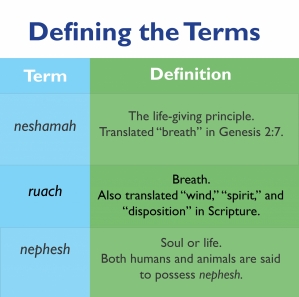
The Hebrew word for "breath" in Genesis 2:7 is neshamah: the life-giving principle. The breath is equivalent to life itself (Isaiah 2:22). Another Hebrew word which is translated 28 times as "breath" in the King James Version is ruach, which can also mean "wind," "disposition," or "spirit." It is translated 237 times as "spirit" in the KJV. In Genesis 2:7, God's breath makes the inanimate material come to life, and transforms it into a living soul.
5073-defining-the-termsx300.jpg


Job correlates the usage of breath and the spirit, saying, "All the while my breath is in me, and the spirit of God is in my nostrils" (Job 27:3).
Moses reported that the breath of life was in Adam's nostrils, whereas Job referred to both terms, saying that the spirit of the Lord was in his nostrils. Hence, the Hebrew terms neshamah and ruach are used here in a similar context—namely life itself. According to the Scriptures, all living creatures received life in the same way from God, and are subject to the same fate (Genesis 2:19; 7:15).
Both human and beast "have all one breath; so that a man hath no preeminence above a beast" (Ecclesiastes 3:19). And since humans and beasts have one breath, they also die the same way. "For that which befalleth the sons of men befalleth beasts...as the one dieth, so dieth the other (Ecclesiastes 3:19)." Both humans and animals were created from dust. When they die they return again to dust; the reverse of Creation (Genesis 3:19).
The Hebrew for "soul" is nephesh, and both the terms ruachand nephesh have frequently been misapplied to suit unBiblical positions about death.
the text of Genesis 2:7 clearly states that God breathed into the formed man the "breath of life" and the man became a living soul. He did not receive a living soul; he became one. The New King James Bible states, "man became a living being."

2. Of the Bible's 1700 references to the soul and the spirit, neither the soul or spirit is ever declared to be immortal or eternal. In fact, 1 Timothy tells us that only God is immortal. The doctrine of the immortality of the soul is full of false hope and negates the message of death. If humans continue to live—albeit in an altered state—then there is no need for the atoning death of Christ. Christ died to restore life to those who had forfeited it through sin.

3. It was the serpent who lied to Eve, saying, "You will not die." The idea that our soul is immortal is a lie that originated in Eden to convince us that we are immortal like God.

We are not immortal, but it's true that we were never meant to die. Death entered the world as a consequence of sin (Romans 6:23). Only when Adam and Eve chose to ignore God's good plan and choose death did it become a reality.
When someone dies, their spirit, or breath of life, returns to God (Ecclesiastes 12:7). God takes back the life (ruach, spirit, breath) that He granted on condition of obedience, and the person ceases to live. When God said that humans would surely die if we transgressed His requirements (Genesis 2:17), He meant that we would cease to live, and would return to dust.

4. Martin Luther puts it this way:

We should learn to view our death in the right light, so that we need not become alarmed on account of it, as unbelief does; because in Christ it is indeed not death, but a fine, sweet and brief sleep, which brings us release from this vale of tears, from sin and from the fear and extremity of real death and from all the misfortunes of this life, and we shall be secure and without care, rest sweetly and gently for a brief moment, as on a sofa, until the time when He shall awaken us together with all His dear children to His eternal glory and joy...For since we call it a sleep, we know that we shall not remain in it, but be again awakened and live, and that the time during which we sleep, shall seem no longer than if we had just fallen asleep... Hence we shall censure ourselves that we were surprised or alarmed at such a sleep in the hour of death, and suddenly come alive out of the grave and from decomposition, and entirely well, fresh, with a pure, clear, glorified life, meet our Lord and savior Jesus Christ in the clouds...Scripture everywhere affords such consolation, which speaks of the death of the saints, as if they fell asleep and were gathered to their fathers, that is had overcome death through this faith and comfort in Christ, and awaited the resurrection, together with the saints who preceeded them in death.
5. Far from being a conscious state, death is the ultimate state of non-being or unconsciousness, and is described as such in the Scriptures:
His breath goeth forth, he returneth to his earth; in that very day his thoughts perish (Psalm 146:4).
For the living know that they shall die: but the dead know not any thing, neither have they any more a reward; for the memory of them is forgotten. Also their love, and their hatred, and their envy, is now perished; neither have they any more a portion for ever in any thing that is done under the sun (Ecclesiastes 9:5-6).
For in death there is no remembrance of You (Psalm 6:5 NKJV).
The dead praise not the LORD, neither any that go down into silence (Psalm 115:17).
So man lieth down, and riseth not: till the heavens be no more, they shall not awake, nor be raised out of their sleep (Job 14:12).
Humans lie in the sleep of death until the resurrection at the end of time. Then, and only then, will we awake and be raised out of what David called the "sleep of death" (Psalm 13:3).

6. The Bible teaches that humans sleep in death until they are resurrected at the end of time. The resurrection of Lazarus illustrates this Biblical truth. Read the full story in John 11

While speaking to His disciples about Lazarus, Jesus said, "Our friend Lazarus sleepeth; but I go, that I may awake him out of sleep." His disciples replied, "Lord, if he sleep he shall do well." The disciples were confused and thought Christ meant natural sleep, but He meant the sleep of death. "Howbeit Jesus spake of his death; but they thought that he had spoken of taking of rest in sleep. Then said Jesus unto them plainly, Lazarus is dead" (John 11:11-14).
"On His arrival, Jesus found that Lazarus had already been in the tomb for four days" (John 11:17 NIV). Jesus said to Lazarus' sister Martha, "Thy brother shall rise again."
Martha responded, "I know that he shall rise again in the resurrection at the last day" (John 11:23-24). Martha knew the truth about death. She expected that, like everyone, Lazarus would remain in the sleep of death until the resurrection at the last day.
When Jesus called Lazarus from the tomb, "he cried with a loud voice, Lazarus, come forth" (John 11:43). That voice raised dead Lazarus to life, and Jesus said, "Loose him, and let him go" (John 11:44). If Lazarus had indeed been somewhere in the afterlife during those four days, wouldn't he have said something?
Others might have asked him about the afterlife. Or, if Lazarus had been to heaven, then he would have likely been upset that he was back on Earth, surrounded by pain and brokenness again. But in reality, Lazarus gives us no account whatsoever of heaven or anywhere else.
The fact, of course, is that there was nothing to report about what happened after he died, or about the realm of the dead, simply because he had experienced the sleep of death which is a state of absolute silence and oblivion.

7. Marvel not at this: for the hour is coming, in which all that are in the graves shall hear his voice, And shall come forth; they that have done good, unto the resurrection of life; and they that have done evil, unto the resurrection of damnation (John 5:28-29).
For the Lord Himself will descend from heaven with a shout, with the voice of an archangel, and with the trumpet of God. And the dead in Christ shall rise first (1 Thessalonians 4:16 NKJV).
But the rest of the dead did not live again until the thousand years were finished. This is the first resurrection. Blessed and holy is he who has part in the first resurrection (Revelation 20:5-6 NKJV).

The same voice that raised Lazarus from the grave will be heard on that last day, calling forth those who have slept in the graves of the earth. Christ will recreate the righteous dead, or "dead in Christ." He will breathe eternal life into them, and they shall enter heaven. The rebellious dead remain as dust, to be raised after the millennium in the resurrection of those who have rejected God.
8. God denounced the consulting of mediums or communication with the dead (Exodus 22:18; Leviticus 19:31; 20:6, 27; Deuteronomy 18:9-14; 2 Kings 21:6; 23:24; Jeremiah 27:9-10).
God has clearly defined the means of communication with Him. He communicates through His inspired Word, the Scriptures (2 Timothy 3:16; Psalm 119:89, 100-101), and through His prophets (Revelation 19:10).
If the spirits that are called up by mediums or channels are not the spirits of the dead, then they must be spirits of demons who try to deceive us and rob us of salvation (Revelation 16:14).
There are numerous examples in the Bible of both angels and demons working on Earth.
-------------------

i know we have been over these points already but the points that will change my view have not been challenged at all.

Prove clearly from the word that the spirit can live separate from the body.

And prove that the soul is immortal and will not die.


  • Like
Reactions: Waggles
So, the Bible reveals that at death, the believer is with Christ, and in fellowship with him, as they await their final resurrection and the consummation of all things. However, this is not the emphasis of the Christian message. The emphasis is on the final resurrection, when God will restore all things and make them new. Ultimately, what happens between death and resurrection is secondary because the final state is what will matter. And only those who turn to Christ will experience the resurrection that he experienced three days after his physical death. A resurrection to life, joy, peace and an eternity with God in heaven.

Bring it on!!
I disagree but you are right about the fact that it will not matter as long as you are saved. If you sleep in Christ or are next to Christ until the resurrection matters little once you die. but i want to highlight what is dangerous - it is the new age and problem of communication with the dead.
If the dead know nothing and are unconscious than you will be wise when a demon comes with a message and it is your mother. But if you believe your mother is alive then you may (likely) be deceived by the demon.
 
Many not all..
Mat 27:52 And the graves were opened; and many bodies of the saints which slept arose,
Mat 27:53 And came out of the graves after his resurrection, and went into the holy city, and appeared unto many.


Act_7:59 And they stoned Stephen, calling upon God, and saying, Lord Jesus, receive my spirit.
Mat 27:50 Jesus, when he had cried again with a loud voice, yielded up the ghost.
Luk 23:46 And when Jesus had cried with a loud voice, he said, Father, into thy hands I commend my spirit: and having said thus, he gave up the ghost.


Ghost and Spirit, are the same word
G4151
pneuma
pnyoo'-mah
From G4154; a current of air, that is, breath (blast) or a breeze; by analogy or figuratively a spirit.


We know that Jesus did not go to heaven when He died so the verse about Stephen does not prove anything.
 
We know that Jesus did not go to heaven when He died so the verse about Stephen does not prove anything.


On the contrary, it proves that when Stephen died his spirit departed and went to be in Christ's presence. If you'll notice, Jesus was "standing" at the right hand of God to receive Stephen's spirit.

When Jesus said, "Into your hands I commend my spirit" it doesn't necessarily refer to his spirit going to be in the presence of the Father, but that he entrusted his spirit to him for safe keeping after He departed from his body and went down into Hades and to be resurrected. This pretty much goes right along with the Psalm regarding Christ which says, "You will not abandon me to Sheol, nor will You allow your Holy One to see decay."
 
Last edited:
Job 34:14 If he set his heart upon man, if he gather unto himself his spirit and his breath;
Job 34:15 All flesh shall perish together, and man shall turn again unto dust.
Job 34:16 If now thou hast understanding, hear this: hearken to the voice of my words.


On the contrary, it proves that when Stephen died his spirit departed and went to be in Christ's presence. If you'll notice, Jesus was "standing" at the right hand of God to receive Stephen's spirit.

When Jesus said, "Into your hands I commend my spirit" it doesn't necessarily refer to his spirit going to be in the presence of the Father, but that he entrusted his spirit to him for safe keeping after He departed from his body and went down into Hades and to be resurrected. This pretty much goes right along with the Psalm regarding Christ which says, "You will not abandon me to Sheol, nor will You allow your Holy One to see decay."

where is your proof? its presumption what you stated.
"Into your hands I commend my spirit" it doesn't necessarily refer to his (Stephen) spirit going to be in the presence of the Father, but that he entrusted his spirit to him for safe keeping after He departed from his body and went down into Hades and to be resurrected."
Jesus is our example, and He did not go straight to Heaven until after the resurrection.
 
When a Christian dies their soul sleeps in a place referred to as Hades (Greek) or Sheol (Hebrew).
Hell is the grave where our bodies do their thing in the ground.
Confusion arises because of the inconsistencies in Bible translations, such as the KJV.
Also Hades and Hell are not of eternal condemnation and the fire that is never quenched
(Isaiah 66:24)

The scriptures that refer to death describe death as a "sleep" wherein there is no consciousness, no praise and no remembrance. The dead simply sleep awaiting resurrection to judgment.

5 Free among the dead, like the slain that lie in the grave, whom thou rememberest no more: and they are cut off from thy hand.
12 Shall thy wonders be known in the dark? and thy righteousness in the land of forgetfulness?
Psalm 88: is representative of many scriptures referring to death and the grave as the land of darkness for everybody.

The dead do not worry, not are they subject to tribulation or temptation any more - they are at rest; hence the euphemism to sleep.

It is not physical death that one should fear - for all die - but rather spiritual death and not entering the eternities with God.

My Brother why do you not place the verses in their context? Psalm 88 is the prayer of a believer who is looking at life from his human prospective, so lets look at the context. 88:1-2 “O Lord, God of my salvation, I cry out day and night before you.2 Let my prayer come before you; incline your ear to my cry!”

We know they are a believer because the Lord is the God of his salvation. Satrting in verse 3 he begins to pray about his self seen troubles. “3 For my soul is full of troubles, and my life draws near to Sheol.4 I am counted among those who go down to the pit; I am a man who has no strength,5 like one set loose among the dead, like the slain that lie in the grave, like those whom you remember no more, for they are cut off from your hand.6 You have put me in the depths of the pit, in the regions dark and deep.7 Your wrath lies heavy upon me, and you overwhelm me with all your waves.
Selah

He is feeling so sorry for himself that he is comparing his life to someone that is lost and in waiting for eternal
judgement, in his reference to those who He remembers no more, they are cut off from the Lord's hand, with which He placed them in the pits, deepest and darkest parts with His strength, represented by the waves as in Psalm 93:4
“Mightier than the thunders of many waters, mightier than the waves of the sea, the Lord on high is mighty!”

Now he is going to start complaining about how the Lord has interfered in his life and come between him and his friends, how many times have our friends said why do you always talk about Jesus, when you have not even mentioned Him that day. So he complains in his prayer, but he is like those sinners that the Lord does not help, this Psalm is simular to Psalm 73. But even in his complaining he tells the Lord as if He did not know that His attributes are known in the pit/grave.

8 You have caused my companions to shun me; you have made me a horror to them. I am shut in so that I cannot escape;9my eye grows dim through sorrow. Every day I call upon you, O Lord; I spread out my hands to you.10 Do you work wonders for the dead? Do the departed rise up to praise you? Selah

11 Is your steadfast love declared in the grave, or your faithfulness in Abaddon?12 Are your wonders known in the darkness, or your righteousness in the land of forgetfulness?”

Then he has his aha moment, just like the writer of Psalm 73 in verses 16-17.

13 But I, O Lord, cry to you; in the morning my prayer comes before you.14 O Lord, why do you cast my soul away? Why do you hide your face from me?15 Afflicted and close to death from my youth up, I suffer your terrors; I am helpless.16 Your wrath has swept over me; your dreadful assaults destroy me.17 They surround me like a flood all day long; they close in on me together.18 You have caused my beloved and my friend to shun me; my companions have become darkness.”

Verses 16-17 “But when I thought how to understand this, it seemed to me a wearisome task,17 until I went into the sanctuary of God; then I discerned their end.”

That writer has this after starting out his pray this way. 1-3 “Truly God is good to Israel, to those who are pure in heart.2 But as for me, my feet had almost stumbled, my steps had nearly slipped.3 For I was envious of the arrogant when I saw the prosperity of the wicked.”


The Psalm is not about what death is, but it is a believer having a not so faith filled day and it is coming out in his prayer. All of his references to death are about those that are not believers the first verse you used from the Psalm is making that statement. This is why it is so very important that we use the Scriptures in there context, not cherry pick verses that seem to support our doctrine. Even verse 12 has more meaning when you read it with verse 11 because those is the grave and the place of destruction, they never spoke of His steadfast love or His faithfulness because they never expirenced it for themselves. So how could His wonders and righteousness be proclaimed in the darkness of the land of forgetfulness, if they never expirenced them in the land of the living.

My guess is you go to a Church that teaches this way, they pick out verses that seem to support whatever they are teaching, but 9 times out of 10 they are being used out of context. It is called teaching from the Bible, not teaching the Bible. Many people do not see the difference between the two, but it is like taking an instruction manual and taking step 3, 5, 6, 9, 13 and 19 arranging them in the order that suits the person doing the instructing. They assemble something, but it is not what the instruction would of assembled if they were followed. Here is the problem when men use this method to teach the Bible, new believers do not know what the Bible is about as far as how it should be read. Because it is a spiritual book so people naturally assume that it needs to be read in some different way than a regular book because it is about a person that we do not know that much about and a life style that we only have ideas of what it should be like because of all the different ideas we have heard and have picked up as a young person that may have attended a Church that was more about tradition than about what the Bible taught.

So this man begins to tell you what he thinks the Bibles says and it is what the person he learned from thoughts on the Bible or it is what the denomination they belong to, teaches. When the Bible needs to be read like other books, in it's context according to the storyline or in this case it's historical setting. Other parts are about wisdom, some parts are prophecy, genealogies, science, marriage, personal conduct to name a few and all of these need to be taught with the overall context of the Bible. The Bible needs to be taught in it's immediate context and it's overall context.
 
The Safe keeping of Jesus's body for 3 day's is the same as the safe keeping of Stephens body for 2000 years,
 
For the believer to be absent from the body is to be present with the Lord.

For the cause of Christ
Roger

yes

this topic should be framed in God's definition of "
dead" not man's. in God's definition of "people" not man's, as well -- God doesn't calls a human their body. He speaks of the soul, heart, spirit and mind of men, and none of these things are physical.
 
I've explained ways to interpret the texts you have put forward so that they line up with the soul sleep principle, but you keep saying it must mean the spirit goes straight to Heaven even when you haven't shown any way to disprove the verses i put forward.

1. According to the Creation account, humanity received the gift of life from God:And the LORD God formed man of the dust of the ground, and breathed into his nostrils the breath of life; and man became a living soul (Genesis 2:7).

The Hebrew word for "breath" in Genesis 2:7 is neshamah: the life-giving principle. The breath is equivalent to life itself (Isaiah 2:22). Another Hebrew word which is translated 28 times as "breath" in the King James Version is ruach, which can also mean "wind," "disposition," or "spirit." It is translated 237 times as "spirit" in the KJV. In Genesis 2:7, God's breath makes the inanimate material come to life, and transforms it into a living soul.

5073-defining-the-termsx300.jpg


Job correlates the usage of breath and the spirit, saying, "All the while my breath is in me, and the spirit of God is in my nostrils" (Job 27:3).

Moses reported that the breath of life was in Adam's nostrils, whereas Job referred to both terms, saying that the spirit of the Lord was in his nostrils. Hence, the Hebrew terms neshamah and ruach are used here in a similar context—namely life itself. According to the Scriptures, all living creatures received life in the same way from God, and are subject to the same fate (Genesis 2:19; 7:15).

Both human and beast "have all one breath; so that a man hath no preeminence above a beast" (Ecclesiastes 3:19). And since humans and beasts have one breath, they also die the same way. "For that which befalleth the sons of men befalleth beasts...as the one dieth, so dieth the other (Ecclesiastes 3:19)." Both humans and animals were created from dust. When they die they return again to dust; the reverse of Creation (Genesis 3:19).

The Hebrew for "soul" is nephesh, and both the terms ruachand nephesh have frequently been misapplied to suit unBiblical positions about death.

the text of Genesis 2:7 clearly states that God breathed into the formed man the "breath of life" and the man became a living soul. He did not receive a living soul; he became one. The New King James Bible states, "man became a living being."

2. Of the Bible's 1700 references to the soul and the spirit, neither the soul or spirit is ever declared to be immortal or eternal. In fact, 1 Timothy tells us that only God is immortal. The doctrine of the immortality of the soul is full of false hope and negates the message of death. If humans continue to live—albeit in an altered state—then there is no need for the atoning death of Christ. Christ died to restore life to those who had forfeited it through sin.

3. It was the serpent who lied to Eve, saying, "You will not die." The idea that our soul is immortal is a lie that originated in Eden to convince us that we are immortal like God.

We are not immortal, but it's true that we were never meant to die. Death entered the world as a consequence of sin (Romans 6:23). Only when Adam and Eve chose to ignore God's good plan and choose death did it become a reality.

When someone dies, their spirit, or breath of life, returns to God (Ecclesiastes 12:7). God takes back the life (ruach, spirit, breath) that He granted on condition of obedience, and the person ceases to live. When God said that humans would surely die if we transgressed His requirements (Genesis 2:17), He meant that we would cease to live, and would return to dust.

4. Martin Luther puts it this way:

We should learn to view our death in the right light, so that we need not become alarmed on account of it, as unbelief does; because in Christ it is indeed not death, but a fine, sweet and brief sleep, which brings us release from this vale of tears, from sin and from the fear and extremity of real death and from all the misfortunes of this life, and we shall be secure and without care, rest sweetly and gently for a brief moment, as on a sofa, until the time when He shall awaken us together with all His dear children to His eternal glory and joy...For since we call it a sleep, we know that we shall not remain in it, but be again awakened and live, and that the time during which we sleep, shall seem no longer than if we had just fallen asleep... Hence we shall censure ourselves that we were surprised or alarmed at such a sleep in the hour of death, and suddenly come alive out of the grave and from decomposition, and entirely well, fresh, with a pure, clear, glorified life, meet our Lord and savior Jesus Christ in the clouds...Scripture everywhere affords such consolation, which speaks of the death of the saints, as if they fell asleep and were gathered to their fathers, that is had overcome death through this faith and comfort in Christ, and awaited the resurrection, together with the saints who preceeded them in death.

5. Far from being a conscious state, death is the ultimate state of non-being or unconsciousness, and is described as such in the Scriptures:

His breath goeth forth, he returneth to his earth; in that very day his thoughts perish (Psalm 146:4).
For the living know that they shall die: but the dead know not any thing, neither have they any more a reward; for the memory of them is forgotten. Also their love, and their hatred, and their envy, is now perished; neither have they any more a portion for ever in any thing that is done under the sun (Ecclesiastes 9:5-6).

For in death there is no remembrance of You (Psalm 6:5 NKJV).

The dead praise not the LORD, neither any that go down into silence (Psalm 115:17).


So man lieth down, and riseth not: till the heavens be no more, they shall not awake, nor be raised out of their sleep (Job 14:12).


Humans lie in the sleep of death until the resurrection at the end of time. Then, and only then, will we awake and be raised out of what David called the "sleep of death" (Psalm 13:3).

6. The Bible teaches that humans sleep in death until they are resurrected at the end of time. The resurrection of Lazarus illustrates this Biblical truth. Read the full story in John 11

While speaking to His disciples about Lazarus, Jesus said, "Our friend Lazarus sleepeth; but I go, that I may awake him out of sleep." His disciples replied, "Lord, if he sleep he shall do well." The disciples were confused and thought Christ meant natural sleep, but He meant the sleep of death. "Howbeit Jesus spake of his death; but they thought that he had spoken of taking of rest in sleep. Then said Jesus unto them plainly, Lazarus is dead" (John 11:11-14).

"On His arrival, Jesus found that Lazarus had already been in the tomb for four days" (John 11:17 NIV). Jesus said to Lazarus' sister Martha, "Thy brother shall rise again."

Martha responded, "I know that he shall rise again in the resurrection at the last day" (John 11:23-24). Martha knew the truth about death. She expected that, like everyone, Lazarus would remain in the sleep of death until the resurrection at the last day.

When Jesus called Lazarus from the tomb, "he cried with a loud voice, Lazarus, come forth" (John 11:43). That voice raised dead Lazarus to life, and Jesus said, "Loose him, and let him go" (John 11:44). If Lazarus had indeed been somewhere in the afterlife during those four days, wouldn't he have said something?

Others might have asked him about the afterlife. Or, if Lazarus had been to heaven, then he would have likely been upset that he was back on Earth, surrounded by pain and brokenness again. But in reality, Lazarus gives us no account whatsoever of heaven or anywhere else.

The fact, of course, is that there was nothing to report about what happened after he died, or about the realm of the dead, simply because he had experienced the sleep of death which is a state of absolute silence and oblivion.

7. Marvel not at this: for the hour is coming, in which all that are in the graves shall hear his voice, And shall come forth; they that have done good, unto the resurrection of life; and they that have done evil, unto the resurrection of damnation (John 5:28-29).

For the Lord Himself will descend from heaven with a shout, with the voice of an archangel, and with the trumpet of God. And the dead in Christ shall rise first (1 Thessalonians 4:16 NKJV).

But the rest of the dead did not live again until the thousand years were finished. This is the first resurrection. Blessed and holy is he who has part in the first resurrection (Revelation 20:5-6 NKJV).

The same voice that raised Lazarus from the grave will be heard on that last day, calling forth those who have slept in the graves of the earth. Christ will recreate the righteous dead, or "dead in Christ." He will breathe eternal life into them, and they shall enter heaven. The rebellious dead remain as dust, to be raised after the millennium in the resurrection of those who have rejected God.

8. God denounced the consulting of mediums or communication with the dead (Exodus 22:18; Leviticus 19:31; 20:6, 27; Deuteronomy 18:9-14; 2 Kings 21:6; 23:24; Jeremiah 27:9-10).

God has clearly defined the means of communication with Him. He communicates through His inspired Word, the Scriptures (2 Timothy 3:16; Psalm 119:89, 100-101), and through His prophets (Revelation 19:10).

If the spirits that are called up by mediums or channels are not the spirits of the dead, then they must be spirits of demons who try to deceive us and rob us of salvation (Revelation 16:14).

There are numerous examples in the Bible of both angels and demons working on Earth.
-------------------

I know we have been over these points already but the points that will change my view have not been challenged at all.

Prove clearly from the word that the spirit can live separate from the body.

And prove that the soul is immortal and will not die.
Excellent post, TMS :)
 
yes

this topic should be framed in God's definition of "
dead" not man's. in God's definition of "people" not man's, as well -- God doesn't calls a human their body. He speaks of the soul, heart, spirit and mind of men, and none of these things are physical.
Man became a living soul when God breathed life into the physical body/elements of man.
 
My guess is you go to a Church that teaches this way, they pick out verses that seem to support whatever they are teaching, but 9 times out of 10 they are being used out of context. It is called teaching from the Bible, not teaching the Bible.
I have re-read Psalm 88 this morning and I stand by my assertion that this psalm, like other psalms, and many other scriptures is representative of the Biblical truth that all the dead do down into the grave and that their souls sleep in a state of forgetfulness in a place of darkness.

As TMS has demonstrated in his excellent post #65 above the scriptures are consistent in this teaching in both the OT and the NT.
And yet we all differ in our interpretations and understanding of the very same scriptures. That is not a problem as CC is a chat site and an exchange of points of view and doctrines.

It is one thing to present your understanding of what scripture says to a topic, but you trespass and offend me by your attack on my church with your depreciative remarks about what sort of church I go to. You are of course strongly implying that your church preaches the full truth and nothing but the truth as opposed to my church.

I do not go to a church that cherry picks the verses but to a Pentecostal church wherein men filled with the indwelling Holy Spirit are taught and led by the Spirit of truth in teaching Biblical truth.
For in the gifts from the Holy Spirit are knowledge and wisdom and prophecy.
And again Jesus himself gives to the Spirit-filled church some to be pastors and teachers ... for the edifying of the body of Christ.

My experience here on CC is that everybody approaches the scriptures through the lens of their doctrines. Thus the same verses are interpreted differently by CC members.
But I do not need to condemn other members' churches in order to validate or prove my viewpoint.
 
Last edited: